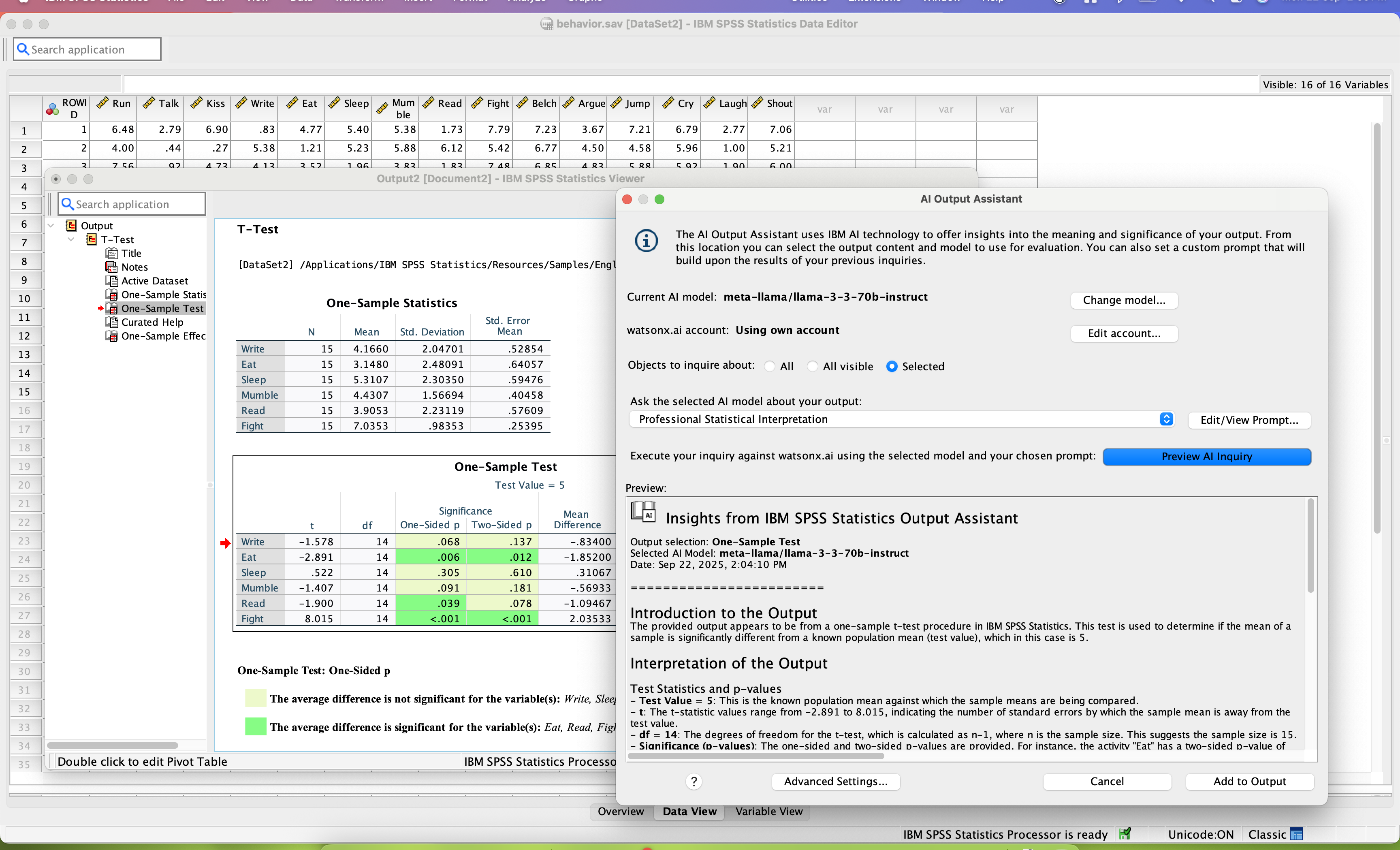
SPSS Statistics is a software package used for statistical analysis. It is now officially named "IBM SPSS Statistics". Companion products in the same family are used for survey authoring and deployment (IBM SPSS Data Collection), data mining (IBM SPSS Modeler), text analytics, and collaboration and deployment (batch and automated scoring services).
$99
per month per user
Microsoft Access
Score 7.6 out of 10
N/A
Microsoft Access is a database management system from Microsoft that combines the relational Microsoft Jet Database Engine with a graphical user interface and software-development tools.
$139.99
per PC
Pricing
IBM SPSS Statistics
Microsoft Access
Editions & Modules
Base
USD 3,830
one-time fee per user
Standard
USD 8,440
one-time fee per user
Professional
USD 16,900
one-time fee per user
Premium
USD 25,200
one-time fee per user
Monthly subscription
USD 99
per month per user
Annual subscription
USD 1,188.00
per year per user
Microsoft Access
$139.99
per PC
Offerings
Pricing Offerings
IBM SPSS Statistics
Microsoft Access
Free Trial
Yes
No
Free/Freemium Version
No
No
Premium Consulting/Integration Services
No
No
Entry-level Setup Fee
No setup fee
No setup fee
Additional Details
—
—
More Pricing Information
Community Pulse
IBM SPSS Statistics
Microsoft Access
Considered Both Products
IBM SPSS Statistics
Verified User
Anonymous
Chose IBM SPSS Statistics
Advanced statistical analysis is possible which is not possible in powerbi. It is very much easy to prepare basic charts. I dept statistical tests like regression analysis can be done. It is user -friendly and even layman can understand basic data easily through IBM SPSS's …
Data Scientist ,Pre-Sales,Consultor/Instrutor em Estatística e Mineração de dados em Big Data
Chose IBM SPSS Statistics
I also point out that the two softwares are complementary, then IBM SPSS Statistics works very well with statistical tests, creation and visualization of detailed tables and creation of statistical project models and project models. The IBM SPSS Modeler helps you quickly view …
Occupational Safety, Health, and Environment Technician
Chose IBM SPSS Statistics
I have also used other statistical software such as the SAP Predictive Analytics software, SAP possesses most of the decode options as SPS, but it is not as graphical and easier to use as SPS. Thus, IBM SPSS Statistics was chosen as a primary and powerful statistical tool that …
We had not ever used anything as diverse as IBM SPSS Statistics before, so don't have much to compare it to but would highly recommend it based on all the previous comments before here. The platform is easy to use and again gives you a quick snapshot of company health based on …
If you have made it this far, you should have a very good idea of how SPSS stacks up the competition (data processing and analytics tools). Even the free ones, such as r Studio or Stata, are leaps and bounds ahead of SPSS. IBM is resting on a reputation developed nearly 30 …
We used IBM SPSS Statistics as it works well with the other IBM tools that we use. It may not work as well for smaller organizations with limited budget/resources. We have a mix of technical and devops people and this tool is easily used by everyone on the team globally.
I have on many occasions launched new versions of a big Python application in production, only to immediately drown in errors, caused by exceptions that were in turn caused by Python code where a single glance confirmed that it could never ever work and consequently had never …
IBM SPSS Statistics is much easier to use, even in classes with students, compared to other similar data analytic software that I have used previously. I selected it because of this reason and I plan to continue using it in the future. The interface is user friendly and the …
I, along with my supervised research student, used IBM SPSS Statistics compared to other software because of its simplicity and user-friendliness. A timeframe is a fundamental part of research work. Time is precious for both of us in terms of research work and using IBM SPSS …
The price of IBM SPSS and its quality-price ratio was one of the triggers for choosing the software over the competition. The ease of obtaining a demo of the product and the continuous training it presents was another of the key points in the decision making we made in the …
Its better for quick tasks, Psychology, Sociology, may lack in complex models, AI, or business-decision-making models. It's better for things that you want to compare, correlate or detect influence of one on the other. It's worse that R for complex models, custom models, big …
I also use or have used Tableau, Excel, and R (wasn’t able to list R above). Tableau is better for visualizations, Excel works for generalized/more basic statistical analysis but lacks more complex features, and R has been difficult for me to master and lacks the UI and ease of …
Compared to stata, python and MPlus, SPSS is more user friendly especially for beginners. It displays data and output in easily readable formats and makes statistics fun and easy. However, stata, python and MPlus are more ideal for complex statistical methods like structural …
IBM SPSS Statistics Logistic Regression's user-friendly interface is among its most important benefits. Without the need for sophisticated technical knowledge, users can navigate and analyze their data with ease. As a faculty member of a university, I used it using its numerous …
For my own statistical analyses, I personally use R and MPlus. However, these tools have a steep learning curve and require dedicated time and a course on their own. In m yopinion, they are not useful for trying to quickly acclimate undergrads to the new world of stats and …
We tend to shy away from open source where possible. with SPSS from our feeder university system for our co-op interns, this is a great transition and a low barrier to getting them working quickly.
IBM SPSS Statistics beats the pants off of Minitab in every area except cost. Minitab has far cheaper entry-level costs, but the software is much more limited. With the versions of Minitab I have used, importing mapping data is a non-starter. With IBM SPSS Statistics, once the …
I described this in a previous question. R is free and full of features, but time consuming to learn, especially since you have to download different libraries for whatever you're doing. I know IBM SPSS Statistics fairly well, and it has been worth the cost, but maybe not for …
Microsoft Access is a superb software in database management system. I have been using it for many years without any hesitations. The software is making it different from other software with its awesome features. The software is cost effective for the organisation. It also …
Excel is a fantastic - robust application that can do so much so easily. Its easy to train and understand. However - excel does not provide a reporting function and that is typically where we will suggest a move to [Microsoft] Access. [Microsoft] Access requires a little more …
With [Microsoft] Access I am able to quickly create simple database driven solutions with built in UI and reporting in one tool. Advanced coding is not necessary and the tool guides you through building out. Opponents for a robust, end-to/end product.
Having used Snowflake, I can definitely say that both of these tools are very easy to use and value for money. Although for me, the aspects where Microsoft Access stacks up are its low cost and usability. Snowflake is good with its cloud-based system but for startups where the …
I haven't really used another database product other than Microsoft Access since the mid-90s. I don't even remember which program I did use, but needless to say, it did not have as much functionality nor was it as user friendly as databases today. So I really can't say how …
Crystal is easier for report writing, but isn't a database solution. Salesforce is lovely, but much more expensive than an old copy of Microsoft Office. For a small budget, [Microsoft] Access was really the only viable option. I only wish it was easier to write complex reports.
[Selected Microsoft Access for] employee learning simplicity, attractive graphical environment and features of Microsoft 365 with responsive Microsoft support.
Visual FoxPro is a discontinued software, and no longer has support. Also, very few people still use it, or ever know how to use it. Excel is very popular, but [Microsoft] Access can do things like data joins much easier and faster
Although SQL is a full-blown platform for heavy database management, Microsoft Access serves the purpose perfectly for small and mid-scale enterprises. It is also perfect for people just getting started with database management. The graphical user interface is a major plus …
Microsoft Access is better for large files and backlogs than Excel because it can handle the workload. Excel is great as well, but filtering and searching is limited, and it can crash rather easily. You don't see those problems with Access.
We've actually started to use both of these programs. There are pros and cons to both. Microsoft Access is best for linking two sets of data that already have a common shared field (i.e. both sets of data include a student ID number, social security number, etc) Airtable is best …
SharePoint is good for simple data structures, use of workflow, integration with AD, etc. But SharePoint does not support fully relational data or complex reporting, whereas Access absolutely does.
Being a similar "Windows application" it's easier to start to use as part of Office. Also, the GUI capabilities are much more advanced than other high-performance databases.
Tableau is not even a 'switch-out' tool, it's for visualization so it's not a fair comparison. Against other databasing tools, MySQL is still my favorite may be simply due to being a creature of comfort because that's where I first learned to manage DB. However, Microsoft …
MS SQL is a more powerful tool but I love the reporting feature in MS Access. MS Excel is useful for complex calculations but to me, MS Access helps me organize that data. InfoPath is similar to MS Access in that you can create forms for data entry, but it does not include …
Microsoft Access is a bit dated compared to other database tools. It is slower, not able to handle quantities of data that are as large as the other tools, and a bit more finicky. However, it is sometimes the preferred tool for some clients. It also has a lower barrier to entry …
Filemaker Pro focuses more on data collection in a single, flat file while Access allows for relationships to be drawn between data tables the reduces duplication. I have not worked with FileMaker Pro for several years but found it to be very unwieldy for my needs which were …
We tried Salesforce, which was expensive and not as customizable as Access. QuickBase also was pricey compared to already having an MS license with the existing package, and QuickBase was not very intuitive. The other option was an open source version which was less intuitive …
Microsoft Access is much easier to understand and use than SAP. There are a lot of menus in SAP which can be very difficult to navigate. If you are familiar with Microsoft Word/Excel it is very similar and should be easy to learn. Also maintaining databases in Access is much …
Microsoft Access databases are more suitable for us because we are a smaller team. It's easy for us to export the reporting. It's also easy for people to create their own databases as well! Microsoft Access is honestly a one-stop-shop for us, and we figured we were not at a …
SPSS is well-suited for the following: 1) User Behavior Analysis: SPSS handles large datasets to analyze user behavior data. 2) Customer Satisfaction / Foundational Surveys: SPSS facilitates analysis of quant data from satisfaction surveys, keeping us informed about customer needs and preferences. 3) A/B test analysis: SPSS statistical tools for A/B test analysis, which helps optimize user experience of our products. Scenarios where SPSS are less appropriate: 1) Qualitative Data Analysis: I do not use SPSS for open-ended survey responses/qual data. 2) Live/in-vivo data analysis: SPSS is not ideal for real-time data processing. 3) Complex Data Integration: SPSS isn’t the best fit for complex data integration tasks
Having worked at startups, I can say Microsoft Access is most suited for their needs. Some of the reasons for that can be the ease and ability to create tables, design an entity-relationship diagram, define the relationship between different tables, feeding data into the tables, and retrieving data. All of this can be curated very easily into a process for small to medium-size enterprises. But a serious limitation can be observed where Access does not provide better features for large-scale companies. Another limitation is for companies where Mac is used as work computers.
SPSS has been around for quite a while and has amassed a large suite of functionality. One of its longest-running features is the ability to automate SPSS via scripting, AKA "syntax." There is a very large community of practice on the internet who can help newbies to quickly scale up their automation abilities with SPSS. And SPSS allows users to save syntax scripting directly from GUI wizards and configuration windows, which can be a real life-saver if one is not an experienced coder.
Many statistics package users are doing scientific research with an eye to publish reproducible results. SPSS allows you to save datasets and syntax scripting in a common format, facilitating attempts by peer reviewers and other researchers to quickly and easily attempt to reproduce your results. It's very portable!
SPSS has both legacy and modern visualization suites baked into the base software, giving users an easily mountable learning curve when it comes to outputting charts and graphs. It's very easy to start with a canned look and feel of an exported chart, and then you can tweak a saved copy to change just about everything, from colors, legends, and axis scaling, to orientation, labels, and grid lines. And when you've got a chart or graph set up the way you like, you can export it as an image file, or create a template syntax to apply to new visualizations going forward.
SPSS makes it easy for even beginner-level users to create statistical coding fields to support multidimensional analysis, ensuring that you never need to destructively modify your dataset.
In closing, SPSS's long and successful tenure ensures that just about any question a new user may have about it can be answered with a modicum of Google-fu. There are even several fully-fledged tutorial websites out there for newbie perusal.
One good aspect of Microsoft Access is how the software can be customized for different applications. This is very useful because we are able to use this software for multiple applications, which makes it cost-friendly.
Another strong point of Microsoft Access is the skill required to customize, the amount of programming required is less than most other database programs. This is good for a beginner looking to get into database management.
Microsoft Access is one of the more cost-friendly database applications, and most of the time it comes with Microsoft Office. Other database programs can be expensive and not as easy to use.
It's super easy to use for newbies and super powerful for power users! It does EVERYTHING you are usually asked to do analytically. Their Help Desk is PHENOMENAL. And I find the upgrade and renewal price to be a good deal.
I and the rest of my team will renew our Microsoft Access in the future because we use and maintain many different applications and databases created using Microsoft Access so we will need to maintain them in the future. Additionally, it is a standard at our place of work so it is at $0 cost to us to use. Another reason for renewing Microsoft Access is that we just don' t have the resources needed to extend into a network of users so we need to remain a single-desktop application at this time.
SPSS is beginner friendly and user-friendly for beginner analysts and simple statistical tests. It's "click and go" interface does take some learning, but overall this is much easier than other programs I have used and seen. Compared to SAS software, SPSS takes a great deal less familiarizing and it not a matter of learning a coding language like SAS and RStudio.
Microsoft Access is easy to use. It is compatible with spreadsheets. It is a very good data management tool. There is scope to save a large amount of data in one place. For using this database, one does not need much training, can be shared among multiple users. This database has to sort and filtering features which seem to be very useful.
I have not contacted IBM SPSS for support myself. However, our IT staff has for trying to get SPSS Text Analytics Module to work. The issue was never resolved, but I'm not sure if it was on the IT's end or on SPSS's end
While I have never contacted Microsoft directly for product support, for some reason there's a real prejudice against MS Access among most IT support professionals. They are usually discouraging when it comes to using MS Access. Most of this is due to their lack of understanding of MS Access and how it can improve one's productivity. If Microsoft invested more resources towards enhancing and promoting the use of MS Access then maybe things would be different.
Have a plan for managing the yearly upgrade cycle. Most users work in the desktop version, so there needs to be a mechanism for either pushing out new versions of the software or a key manager to deal with updated licensing keys. If you have a lot of users this needs to be planned for in advance.
If you have made it this far, you should have a very good idea of how SPSS stacks up the competition (data processing and analytics tools). Even the free ones, such as r Studio or Stata, are leaps and bounds ahead of SPSS. IBM is resting on a reputation developed nearly 30 years ago and has shown no desire to improve.
Excel is a fantastic - robust application that can do so much so easily. Its easy to train and understand. However - excel does not provide a reporting function and that is typically where we will suggest a move to [Microsoft] Access. [Microsoft] Access requires a little more knowledge of data manipulation.
I found SPSS easier to use than SAS as it's more intuitive to me.
The learning curve to use SPSS is less compared to SAS.
I used SAS, to a much lesser extent than SPSS. However, it seems that SAS may be more suitable for users who understand programming. With SPSS, users can perform many statistical tests without the need to know programming.
Microsoft Access has had a mostly positive impact on our business objectives in that most of our work is funded by grants and those grants need reports with data about our projects. Microsoft Access makes getting and organizing that data very easy.
Another positive is that since it is built on an Excel backbone, Excel files can be easily imported into Microsoft Access and also it is easy to export Microsoft Access reports, data sheets, etc. into Excel and some other programs as well. That might help more people who already use Excel learn how to work in a database.
I can't really think of a negative impact other than not many people at my workplace have ever used or understand how to use a database. Most people tend to use Excel rather than a database, like Microsoft Access.