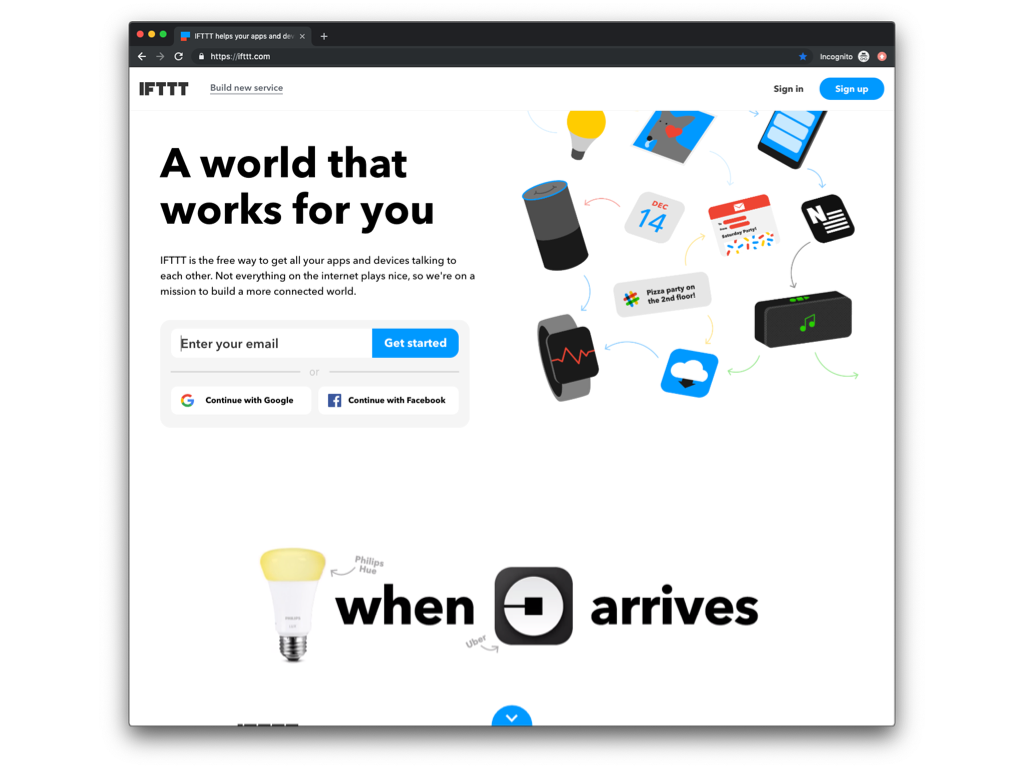
IFTTT is a marketing automation software solution offered by IFTTT. It is scaled for non-technical
users and less complex, generally two-step connectors and API’s.
N/A
Oracle Integration (OIC)
Score 5.0 out of 10
N/A
The Oracle Integration Cloud Service is an iPaaS providing prebuilt integration flows between applications, including other Oracle products. The Integration Cloud Service is scaled for enterprises, with prebuilt codeless adapters for on-premises and SaaS systems and low-code automation capabilities.
N/A
Pricing
IFTTT
Oracle Integration (OIC)
Editions & Modules
No answers on this topic
No answers on this topic
Offerings
Pricing Offerings
IFTTT
Oracle Integration (OIC)
Free Trial
Yes
Yes
Free/Freemium Version
Yes
No
Premium Consulting/Integration Services
No
No
Entry-level Setup Fee
No setup fee
Optional
Additional Details
—
—
More Pricing Information
Community Pulse
IFTTT
Oracle Integration (OIC)
Considered Both Products
IFTTT
Verified User
Anonymous
Chose IFTTT
Less programmatic capabilities, somewhat simpler design interface. More sophisticated events supported per task.
Ultimately, the kinds of tasks that need automation are simple, and a simple/easily maintainable user interface ensures no more time than is needed is spent on this …
Zapier is always trying to feed me information I don't want, whereas IFTTT has a clean, easy to use website. Microsoft Flow is time-consuming to set up, IFTTT isn't. In my line of work, time is very important. I need to do the work and get it done. Automate doesn't offer the …
I initially was using Zapier for some of my simple integrations but started using IFTTT for some of our project work as it allowed me to do logical connections between applications. While it's great in some areas, it can be improved upon to allow for more deep configurations.
We have used Microsoft Flow, Stringify and IFTTT for various solutions. Stringify is no longer an option as it was shut down. We have found that IFTTT and Flow both have their place and in some places working together for the same task. We have found there is no one …
IFTTT is free and easy to use, where Zapier has a freemium business model. We actually use both platforms for different things. I prefer Zapier for more complicated connections, where IFTTT allows us to have more connections without the added fee. Additionally, IFTTT allows us …
As IFTTT, Zapier also helps users to connect apps and services, but it seems more directed to the corporative world. While IFTTT provides support for home devices (as lighting and security systems) and voice assistants (Alexa, Cortana, Google Assistant, and Siri), Zapier …
IFTTT has worked better for us than Hootsuite because we utilize it spur of the moment and only have to post to one platform. Once that post is done IFTTT does the rest and we're good to go. Using the native social media apps and software has allowed us to schedule posts in a …
I am using both but for different uses. DLVR.IT seems to be opimized for social media sharing only, whereas that is only a small part of what IFTTT does.
Compared to Buffer, IFTTT has a far greater reach and scope, across numerous Social and off-site platforms. If you work in SEO, Content, or marketing in general, marrying IFTTT with Buffer will provide functionality you otherwise pay for.
Office 365 has a program called Flow that functions similar to IFTTT, however, IFTTT has more integrations with 3rd parties and Flow has problems with getting triggers to go off properly. Unless there were some corporate requirement to utilize Flow only or limit integrations, I …
I haven't used Zapier extensively, but it seems that IFTTT is much simpler to set up. However, Zapier appears to be a much deeper integration where you can sync a variety of fields of data and customize the sync more than you can with IFTTT. Zapier may be more valuable for …
In my mind, the only real competitor to IFTTT is Zapier. Zapier is great because of the amount of SaaS tools that it has, but Zapier fails in the ease of use category. Zapier's website is slow, and the integrations can be confusing to set up. IFTTT is simple, easy to use.
In the past, I have run scripting on a Linux server to provide some level of integration of some of the smart devices in the workspace. This had always been cludgy and at times unreliable as it oftentimes fell victim to idiosyncrasies in the devices being controlled.
IFTTT …
Zapier is a more in-depth if-then statement builder with way more detailed integrations to hundreds of applications as well as different tasks that can get implemented within your if then, then that statements. Way cooler and there are certification options that help you get to …
While other paid services might give your a little extra features and possibly a connectivity with enterprise application, it's nearly impossible to beat IFTTT with the cost factor, ease of use, hundreds of channels and a great community of users.
IFTTT has the most integrations, the least bug recipes and it is the cheapest alternative. IFTTT has also been in the game for years. Automation for the people! You cannot get the kind if ideas from any other integration site, and many are missing key apps like Instagram or …
Truthfully I use both of these products. IFTTT is a very robust app but it does not get any where near as robust as Zapier. But although Zapier is more robust, for simpler tasks IFTTT is not only easier to set up, but gets the job done just as well. And now that IFTTT is …
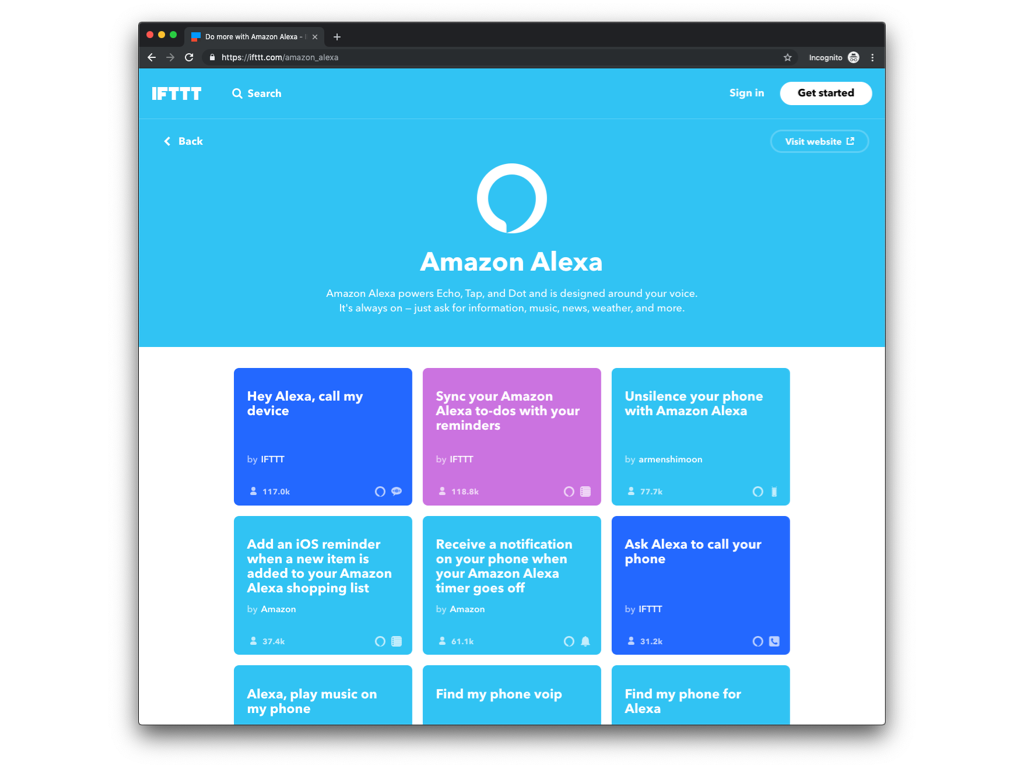
IFTTT is great for personal, home-life use, as it targets social media, personal email preferences, and home-automation devices. Zapier is much more business-oriented and does not provide integrations with Amazon Alexa or WeMo home devices.
The nearest thing I have used to OIC is UiPath, as it is often used as a tool to integrate software together. However, it is much more suited to legacy software which have little to no API endpoints. If the infrastructure already exists I understand why people use RPA for …
Oracle Integration (OIC) Cloud is a new iPaaS that makes it very easy to connect ERP applications with Salesforce.com. They have pre-built connectors that eliminate errors by not having to worry about all the connection details needed to make sure the data mapping is accurate. …
Oracle has more SAS offerings than any other vendor and a higher number of clients are going towards Oracle SAS offering. In order to integrate SAS with other systems, OIC comes up with pre-built cloud adapters which make the turn around time faster than any other tool.
Oracle Mobile HUb is good to support the integration between Oracle ERP and Cloud systems. Integration Cloud is way broader in supporting the integration between both Oracle and non oracle third party systems. Wherever the transactions are real time and huge, Integration Cloud …
I haven't used any products like Oracle Process Cloud in the past, but our organization is planning to test out UIPath RPA and see how it compares with Oracle Process Cloud in the near future.
Oracle Integration Cloud product focuses more on integration compared to other Oracle products that we are using. We selected the OIC product to solve our integration needs, which are growing day by day, and the core applications are becoming more of the backbone of these …
This is my first PaaS product I've used, so I cannot compare it to others, but I can attest to the ease of development vs coding integrations from scratch. It is a huge time saver from a development standpoint.
Boomi has more stable integration and connectivity to SFDC, email and a few other adapters, but with OIC the user-friendly UI makes it simpler to build and support various integrations.
OIC has allowed us to decommission our Tibco environment and migrate from outsourced integration development to in house where costs are lower and time to development has increased in some cases from months to days or weeks.
It can integrate with any software or hardware and is easy to deploy between Enterprise Resource Planning, Supply Chain functions like procurement, inventory, ordering, on-premise applications, and human resources, marketing, sales and services. The connectors for databases …
Oracle's solutions play well with their own software and other systems. Their cloud products are familiar if you have used one and the UI is easy to use. Uptime and reliability are also always a factor.
SOA Suite Leverages JDeveloper and is much more robust than the standard tool. It incorporates so much more and has easy to use GUI features making it truely no comparison.
In my opinion there are other products that can implement SOA but the Oracle SOA Suite is the most comprehensive product available. I have not encountered many clients that disagree. While they may sometime moan and groan about the complexity they know that Oracle provides some …
IFTTT is a great tool for people wishing to integrate different productivity tools, but who lack the resources and/or knowledge about programming these connections themselves. Anyone who uses at least email, calendar and social networks on a regular basis can benefit from IFTTT. However, it probably won't be appropriate and/or relevant to casual users, or users inexperienced with the many possible links between smartphones and online apps.
Oracle Process Cloud is suited for medium-sized companies and up who want to create applications that can automate tasks without the need of recruiting more software developers. With a couple hours of training, any member of the organization's business team will be well-equipped with all of the knowledge that is needed to use Oracle Process Cloud effectively. If your IT team is large and able to take upon the task of making the given application, then something like Oracle BPM is a better solution.
Their UX and UI for creating recipes is brilliant. So easy to use and very well thought out.
I love that you can search for recipes other users have created and implement those if you choose to do so. It saved me so much time vs. having to figure certain recipes on my own.
Their notification and syncing options are spot on. I love how much I can customize what I want to see. Their variety of apps is also phenomenal and I love that they're adding new integrations/apps every week.
Auto-association of Oracle applications prepopulates the application connector select box and preconfigures Oracle Integration (OIC) using secure credential access for faster integration.
Various other system connectors are available to use readily.
User-intuitive experience--Connectors, integrators, and dashboard can be seen on one page.
Currently, it is not retaining the logs for more than 3 days, which it needs to address.
We also need some functionality inside the interface to re-push the same transaction again so that it will be helpful while testing and fixing the issue.
Also, some log errors are not giving the correct details. Oracle needs to rectify those.
There is no better alternative and although Integromat is new and the GUI is slick, they make you pay per push and IFTTT does not. The rest of the competition make you pay per integration or are just not as seamless in usage or have the depth of catalogue. If you use Zapier for instance, it is because they have an integration you have to use, not because Zapier does a better job.
For the most part, IFTTT is great but it does have its limitations. You may only do one thing at a time. If you want branching logic it can be cumbersome and clunky. This it where something like Microsoft Flow does better. For simplicity, nothing can beat IFTTT for how easy it is to set up and use right out of the box
I have had a few issues with apps over the years. Compared to other services, ITFFF is the best choice but no service is perfect unless you build it yourself for yourself. ITFFF needs more tutorials on how to create a custom platform, but overall I will recommend it as an easy to use, time-saving service.
IFTTT is free and easy to use, where Zapier has a freemium business model. We actually use both platforms for different things. I prefer Zapier for more complicated connections, where IFTTT allows us to have more connections without the added fee. Additionally, IFTTT allows us to do more unique and one-off automations.
The nearest thing I have used to OIC is UiPath, as it is often used as a tool to integrate software together. However, it is much more suited to legacy software which have little to no API endpoints. If the infrastructure already exists I understand why people use RPA for integration, however for when API's are easily accessible and you're using Oracle tools, OIC is better.
IFTTT was a free program for us and has worked wonders.
The time that it saves us when it posts across platforms is great because we only have to post one picture and caption and it goes out to all of our social media accounts.
IFTTT has definitely helped us to communicate more and in better ways.
We run big integration practices and that practice is pretty successful. We have seen the customer getting quick ROI as the initial investment is not much. The customer can also get a free 1-month trial instance of OICS to try out. All of our customers are happy with this investment so far.