inFlow Inventory is an inventory management software offering from Archon Systems.
$186
per month 2 team members
Odoo
Score 6.9 out of 10
Mid-Size Companies (51-1,000 employees)
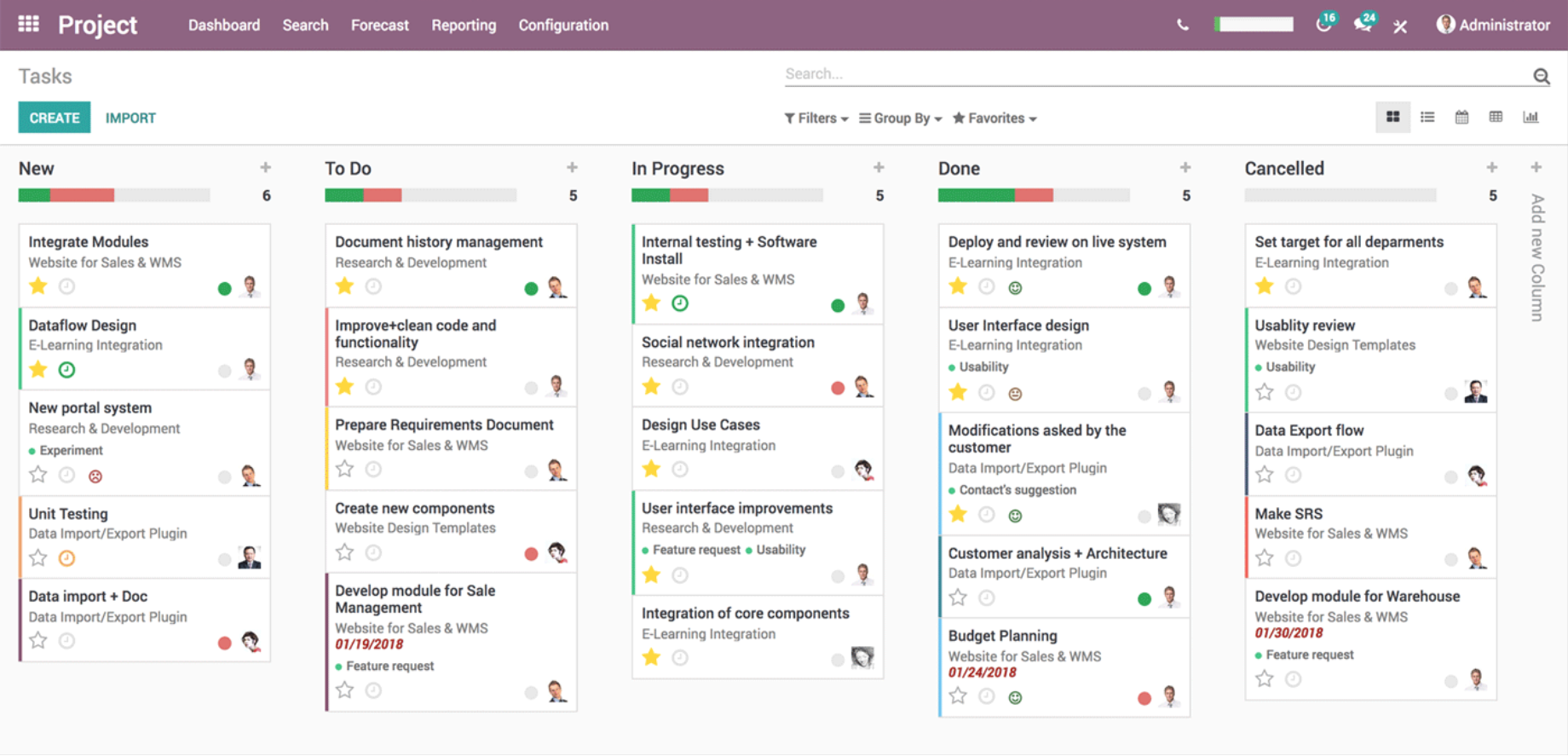
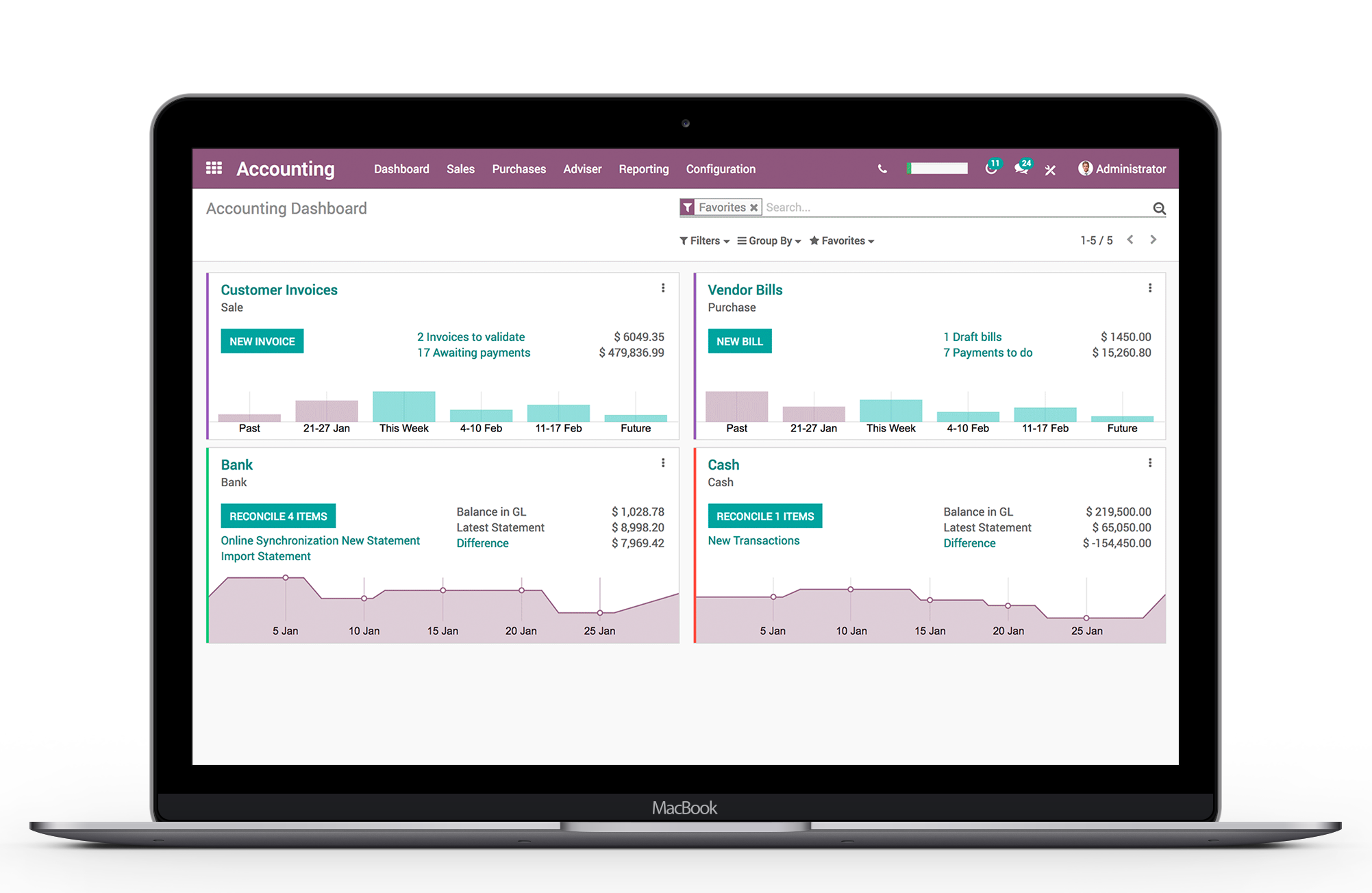
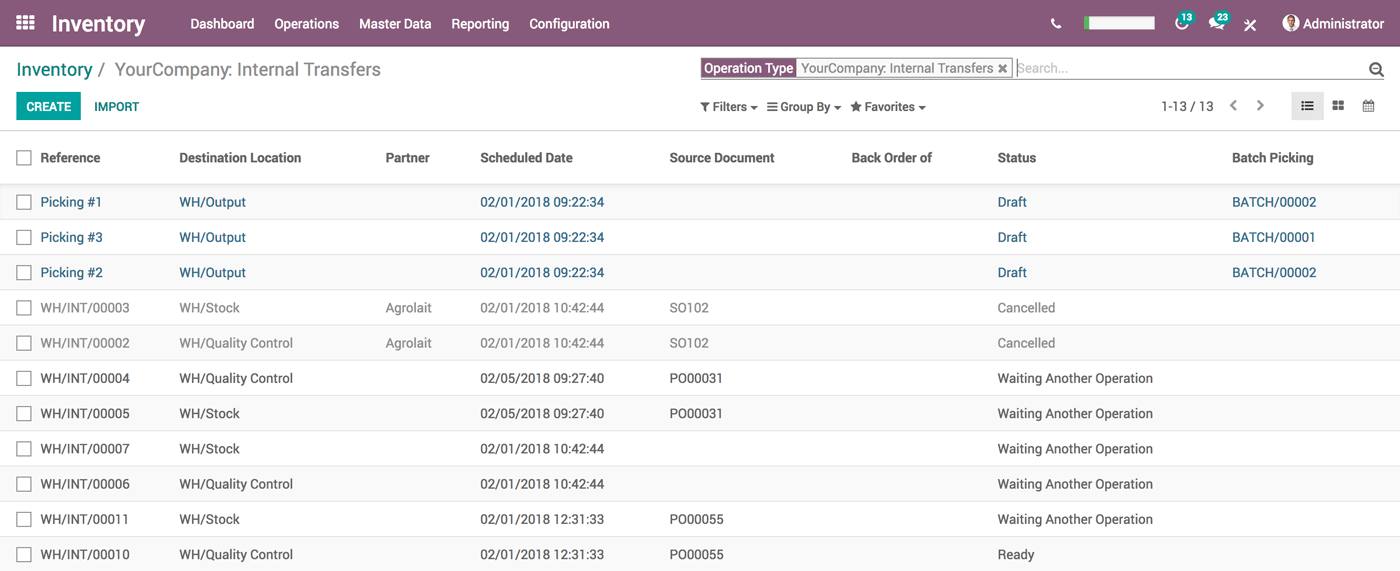
Odoo, from the Belgium-headquartered multinational company of the same name, is a suite of business applications for managing the sales pipeline. It also comprises a PoS and inventory management modules, scaling to a warehouse or retail management solution.
$31.10
per month per user
Pricing
inFlow Inventory
Odoo
Editions & Modules
inFlow Inventory - Entrepreneur
$186
per month 2 team members
inFlow Inventory - Small Business
$436
per month 5 team members
inFlow Inventory - Mid-Size
$999
per month 10 team members
Standard
$31.10
per month per user
Custom
$46.70
per month per user
Offerings
Pricing Offerings
inFlow Inventory
Odoo
Free Trial
Yes
Yes
Free/Freemium Version
No
Yes
Premium Consulting/Integration Services
No
No
Entry-level Setup Fee
$499 one-time fee
-$49,321,250 per app/ per user/ per month
Additional Details
inFlow helps solve inventory issues through two offerings: inFlow Inventory and inFlow Manufacturing.
inFlow Inventory is used to track stock or manage orders.
inFlow Manufacturing is for companies that assemble products or sell kits.
Both products offer:
- all the required features to manage inventory and orders
- reorder points to help restock ahead of time
- Built-in B2B Showroom to simplify sales
- Built-in document, label, and email designers
- Great mobile apps for getting work done on the go
And all inFlow plans include:
- technical support
- a dedicated customer success manager
There's a 20% discount available for annual pricing.
A discount is offered for new users for the first 12 months of use for the initial users purchased. ($24.90 instead of $31.10 for Standard)
InFlow stacks up quite better wrt to their competitors. 1. Better reach in industries and depth of features - esp custom reporting. 2. Free trial that is very extensive and helps orgs make quick decisions.
I haven’t used any other inventory management system before using inFlow Inventory, I feel very lucky to have found a software that does what I need it to do without the need to try any other software prior. It meets my eCommerce small business needs and I’m very satisfied with …
We used inFlow to manage our retail outlet. We must say it handled it pretty well. Our employees were very happy using it, and they learned it pretty quickly.
It is simple to use and the features in Odoo are more advanced compared to zoho. The cost of Odoo is also very less comparatively with other competitors that are available in market. Accessing the in depth reports is very easy with Odoo and a person with low executive level can …
Odoo is much easier to use than SAP and is much more adaptable and cost effective. Odoo is much more of a complete system than Quickbooks and more thorough in its approach. If you have a very basic business to run, Quickbooks could work, but if you have any customizations that …
We decided to go with Odoo over Netsuite due to a few factors. Price was a big reason why, Netsuite is the most expensive ERP we vetted. I also did not have a great experience with Netsuite at my last job. I was on the roll out team and it did not work as promised for POS, …
Odoo talks with our other software (shipping, website, etc.) while our old software did not. It is also a web-based product so it is easily accessible from home, mobile, etc. Before, if I needed to work from home for some reason, I had to project my office computer screen to my …
we CAME from NetSuite (and should have stayed there!!) - but we thought Odoo would be better. Brightpearl was too expensive and too slow to implement - and we needed a system that could do the Spanish Legally mandatory Accounting reports...... and even here Odoo fails as no …
They don't even compare. Odoo is so bad with its UI it took me months to learn, and still be confused by it. Within less than a month using HubSpot I've surpassed my limitations and set up far more complex systems.
I selected Odoo because it is all in the cloud online and it is very easy to conect from everywhere, but then it did nos suit what we wanted in other fields and the service was poor,so we deceided to cancel the contract, but never get our money back since november 2020.
Odoo offers great ease of use and time to market. You can build on modules and integration, not an issue since the system will say "before" setup what modules relate to what you want. And in some instances will even install needed modules without your having to guess.
Odoo firmly holds a strong position among its competitors. It is extremely easy to use and getting started is a few clicks away provided that you are using their online services. The good thing about Odoo is they have a good support which gives them slight edges on their …
While comparing Direkto with the Odoo, I'd say, only consideration of the UI is enough to see the vital advantage of the latter. Moreover, the specific functions are way [more] easily searchable through the Odoo than in Direkto.
Well, since I started my current job we use Odoo as ERP for everything, in my previous jobs I used other systems but they have nothing to do with this system, but personally, it is a very friendly and easy to use system, they trained me for a couple of days and it was quite …
Compared to Zoho, I think Odoo lacks some clear ease of use that Zoho provides out of the box. Mainly the easy importation of leads and conversion / tracking. Additionally Zoho analytics is easier to customize the dashboard from the menus. After some tinkering I think you can …
We have been using the standalone version of inFlow for many years. It is quite easy to use, with great support staff via their live chat on the inFlow website while the maintenance plan is active. Though sadly technical support over the phone isn't offered.
Implementation was a terrible experience for us. Because it required a third party, we ended up way over budget and schedule. While Odoo advertises that it works with many systems, these third-party integrations often don't work out of the box and require extensive coding to set up. Furthermore, these "apps" can frequently break or lose integration.
Very pricey, you have to pay for the mobile version.
The integration to make labels is very complicated for my fellow colleagues. Sometimes it doesn't log in easily, and we've had to purchase quite a few licenses when we first started up with inFlow because it cannot be used on more than one PC at a time. Now that years have passed and we don't need so many concurrent users, we are sadly stuck with all these extra users that we paid extra for, for no reason.
We also are looking for reasons to switch to another company, as inFlow does not offer much support after the maintenance period has ended and we've had to constantly pay extra to renew a maintenance plan to receive support.
Once you complete the training with Odoo, you have a great grasp of how the system works, and most every feature is intuitive- There is rarely a task within Odoo that I get frustrated trying to figure out- I can typically look through the system and find what I need to do, and if I ever do need support, the Odoo Support team is excellent
Easy - there is NO SUPPORT (like in ABSOLUTELY NOTHING!!!!!!!). Even for legally mandatory requirements where the system MUST work, they will gladly take a month to get back to you with a NON-answer. We couldn't even get our bank statements correctly into Odoo for 2 months - leading to no reconciliation and the company accounts were a mess (still are!!) as a result - Completely irresponsible. Have not EVEN had an apology from Odoo - they couldn't care less !!
I haven’t used any other inventory management system before using inFlow Inventory, I feel very lucky to have found a software that does what I need it to do without the need to try any other software prior. It meets my eCommerce small business needs and I’m very satisfied with the customer service I receive from this app.
Compared to Zoho, I think Odoo lacks some clear ease of use that Zoho provides out of the box. Mainly the easy importation of leads and conversion / tracking. Additionally Zoho analytics is easier to customize the dashboard from the menus. After some tinkering I think you can get the same thing with Odoo, it's language and logic just take some geting used to. Airtable provides similarly easy to customize dashboards that are aesthetically appealing. but lacks the ability to track the customer journey as effectively as Odoo or Zoho systems.
It has helped us improve our purchasing and sales flow, now it is more organized, we can see which product was purchased from which supplier and which price is more convenient, very good
It helps to manage payments efficiently, and in less time than when it was managed manually, so it is a positive point that we can rescue in our organization.
In my case, managing inventory helps me more easily locate the most specific products that I require. Currently, we do not have details of mismatches with the products, so my inventory and my stock are kept perfectly updated.