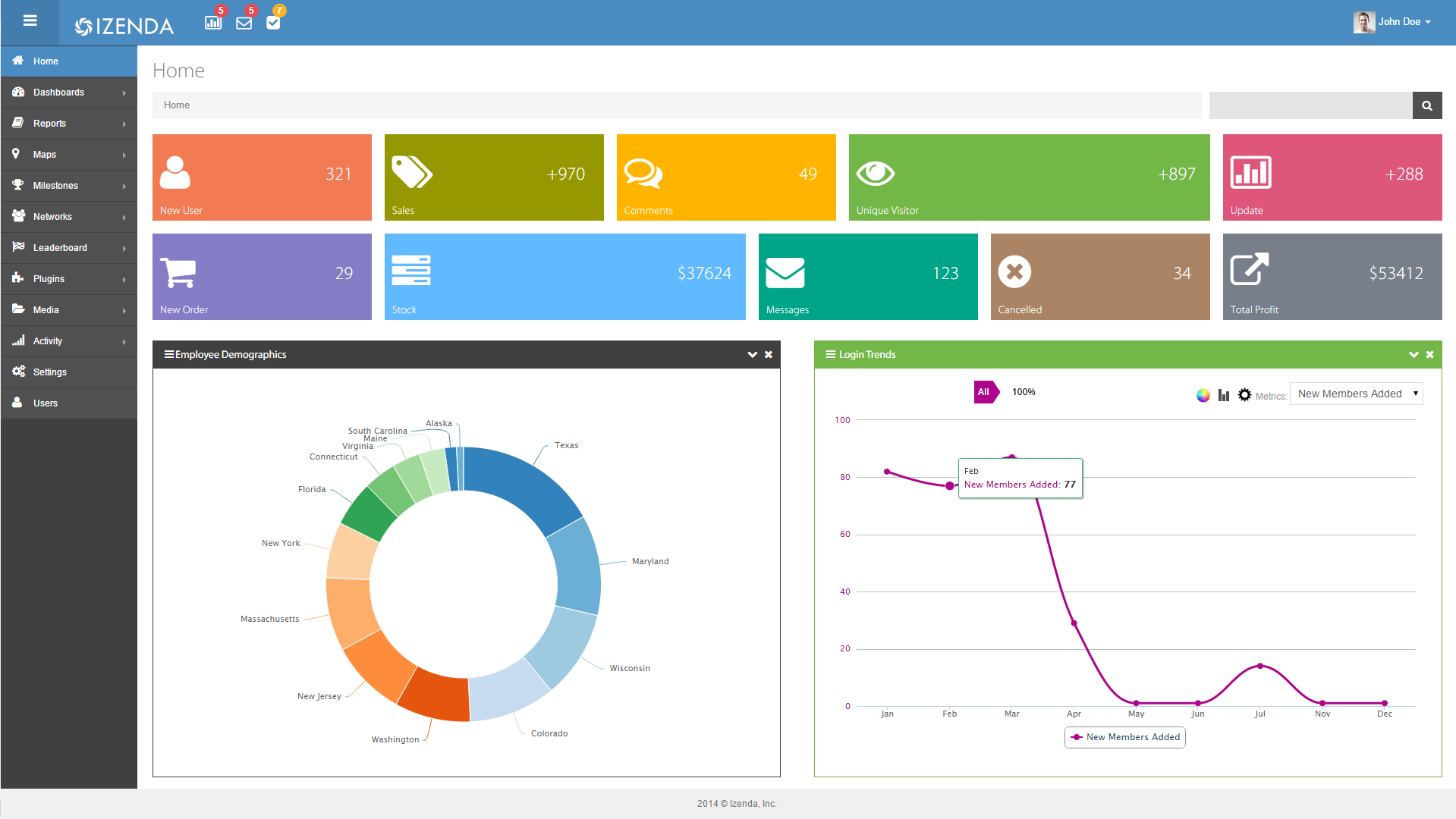
Izenda is a business intelligence software offering from Izenda.
N/A
Looker
Score 8.7 out of 10
N/A
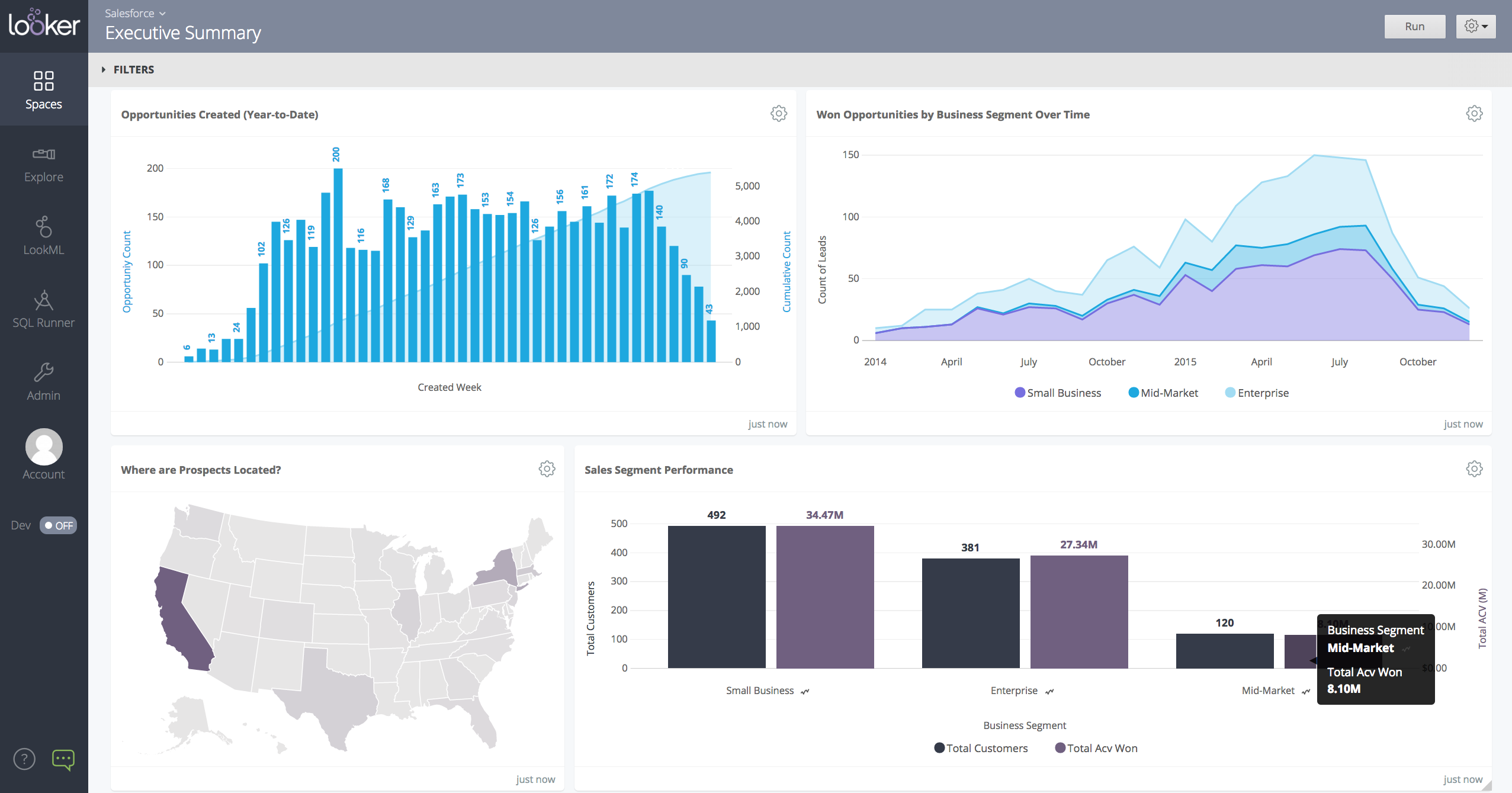
Looker is a BI application with an analytics-oriented application server that sits on top of relational data stores. It includes an end-user interface for exploring data, a reusable development paradigm for data discovery, and an API for supporting data in other systems.
N/A
Pricing
Izenda
Looker
Editions & Modules
No answers on this topic
No answers on this topic
Offerings
Pricing Offerings
Izenda
Looker
Free Trial
Yes
Yes
Free/Freemium Version
No
No
Premium Consulting/Integration Services
No
No
Entry-level Setup Fee
No setup fee
Required
Additional Details
No per user or core fees, unlimited use licensing for production and non-production instances.
Must contact sales team for pricing.
More Pricing Information
Community Pulse
Izenda
Looker
Considered Both Products
Izenda
Verified User
Anonymous
Chose Izenda
We compared to other end user tools like Qlik, Tableau and Power BI. These tools are very refined but not positioned for OEM/Embedded use cases. The closest we came was logi and Birst and the price and business model of Izenda was much more appealing.
Better in terms of data configuration with slight harder learning curve, available help material is not that much and we usually have to connect with Looker Help with chat for our data and analysis questions. While Looker offers a wide range of visualization options, there were …
It takes forever sometimes to have data ready in tableau dashboard, and also it takes effort to maintain each dashboards. We do not have so many efforts to maintain all. Also, we need to be able to see data faster and therefore take actions and work faster. With Looker we might …
Looker Studio is not as robust as Tableau or Microsoft BI. So it does not provide quite as much insight or depth and it has more limitations overall then the other major reporting products. However, it is also free and connects perfectly with other Google products. Plus, all of …
Technically, Power BI is much more complete and powerful, but it's like an ocean liner. I didn't need all that equipment. In my case, I needed to move more quickly, like on a speedboat, to build a page with several data sources in a single source of truth that could be easily …
Looker is a free tool to use on the basic level, which can't really compare apples to apples since all of the other services are paid services. Looker already has a leg up because of that. The other platforms definitely have more features and capabilities off the bat because it …
The learning curve for Tableau Cloud was too steep for our team. After watching a couple of YouTube videos, anyone can begin connecting data sources and creating reports with Looker. Looker is also free with Google Workspace, making the decision between Looker and Tableau a …
Tableau did not have the customization that we were told it had, and it was expensive. Domo looks promising, but is also expensive so we haven't purchased it (we may in the future). Google Sheets was very basic and did fine for what it was, but we needed something a bit more …
Looker seems to be all inclusive in data analysis and reporting. Along with the ability to forecast and add specific metrics to data sets. The automatic reporting sending them on scheduled days is great as well. The only concern is the ease of use as it requires high level …
I have not used any other products like Looker before and the company has been using Looker since I've joined. We've talked about replacing other software vendors in the past but never discussed replacing Looker because of how vital it is to our organization.
Looker is a great fit for our company because we have collaborative analytics workflows and complicated data ecosystems and because of its strengths in data modeling, integration, and collaboration. Brand name and peer recommendations also helps us to select Looker against …
Our organization is going all in on Google products so switching out of the Microsoft suite of tools is a no brainer. All the Google tools work incredibly well together and once you transition it’s incredibly hard to be half in half out between Google and Microsoft. If you’re a …
Looker is more mailable; it allows more dynamic visualisations, filters, drilldowns etc. It's sharing capabilities are also more streamlined than AWS Quicksight. However in contrast to this AWS Quicksight can leverage AWS IAM roles and policies which can be quite scalable. …
Looker is free, so it's certainly better bang for your buck. It's a good platform for someone who just needs a quick way to look at the data they have. It doesn't have some of the advanced functionality that Tableau has, but it integrates well with the Google ecosystem, so it's …
In terms of reporting specifically Looker Studio allows to integrate way more sources into a single report. If needed sources can be blended and parameters can be created with calculations etc
We haven't had a proper benchmarking done. We might consider looking at other options, but this thing is deeply integrated into our platform, so not anytime soon.
I choose Looker when I need quick charts. It is easier to start and configure, browser-based, and easy to connect with Google Sheets. This gives it a good competitive advantage when comparing pricing—other similar tools have expensive licenses. In a corporate Google …
Looker and Tableau are similar products with benefits and drawbacks according to which software you choose to employ. Looker is a Google product whereas Tableau is a Salesforce product. Depending on your existing tech stack it is recommended to leverage the integrated, native …
Looker is web based app and much easier to use.¨ON the othe hand Power BI offers robust integration with Microsoft products (like Azure, SQL Server, and Excel) and a wide range of other data sources. Power BI's ability to seamlessly connect and import data from these sources is …
We use both Looker and Tableau. It depends on the specific team. However, there is a clear correlation that we use Tableau more often when there are more data sources, including financial data.
With Izenda, we can offer our trusted users dashboards, generated custom reports, and ad-hoc reporting, right within our own operation. Integrating the Izenda tool directly into our usage meant that we were suitable to use a small corridor of Izenda as core functionality while reserving the more advanced sections of Izenda for guests willing to pay redundancy for the licensing.
When you need to create a centralised dashboard for multiple stakeholders that blends cross-channel reporting. As an SEO agency reporting for clients - Looker is a great solution. It's less appropriate depending on the intended users. For instance, in my experience Looker reports have been under-utilised because they're not accessed regularly, provide too much noise or often simple PDF reports are preferred
User and tenant management is excellent. It is very simple to implement and easy to manage.
The configurability and customizability are excellent. We have access to all aspects of the system and have rebranded and configured single sign on. The users really like it.
Reports and visualizations work. There's lots of flexibility and users enjoy creating reports themselves.
We are very haooy with Looker, it provides us with all the funciomalities we need for both the day to day oerformance tracking and longer periods reporting. It is easy to use for account managers, configurable and customizable for soecialists and what is most imoortant, our clinets generally really love it
With the help of Izenda, we are able to build a mature foundation that users can quickly customize to their needs. Once permissions are layered in, we can simply use the same report and only show fields a specific user has access to.
Looker is relatively easy to use, even as it is set up. The customers for the front-end only have issues with the initial setup for looker ml creations. Other "looks" are relatively easy to set up, depending on the ETL and the data which is coming into Looker on a regular basis.
Somehow resources heavy, both on server and client. I recommned at least 50Mbs data rate and high performance desktop comouter to be abke to run comolex tasks and configure larger amount of data. On the other hand, the client does not need to worry when viewing, the performance is usually ok
Never had to work with support for issues. Any questions we had, they would respond promptly and clearly. The one-time setup was easy, by reading documentation. If the feature is not supported, they will add a feature request. In this case, LDAP support was requested over OKTA. They are looking into it.
We compared to other end user tools like Qlik, Tableau and Power BI. These tools are very refined but not positioned for OEM/Embedded use cases. The closest we came was logi and Birst and the price and business model of Izenda was much more appealing
In my opinion, Looker is no Power BI. It is good, but I think Power BI is amazing. That said, in my experience, Power BI is nowhere near as easy to setup and report on Google services as Looker is. We plan to continue using Power BI for c-suite and corporate reporting, especially for internal databases, but will gladly use Looker for our marketing information for AdWords, Analytics, Search Console, and YouTube.
Other than some people not liking the numbers, I don't see any negative impacts; we haven't experienced that.
The reports help us unravel the story of our users and how they are sifting through our pages.
Our clients enjoy seeing the numbers to understand better what stands out on their sites.
The reports have helped us see what campaigns are working and where we need to tweak things.
The reports have enabled us to have better conversations with stakeholders about how their web pages should be modified, edited, etc., to reflect the data.