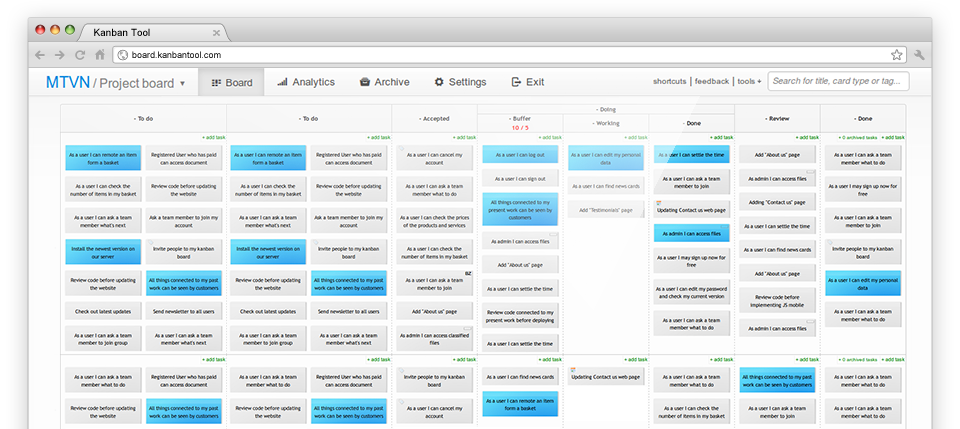
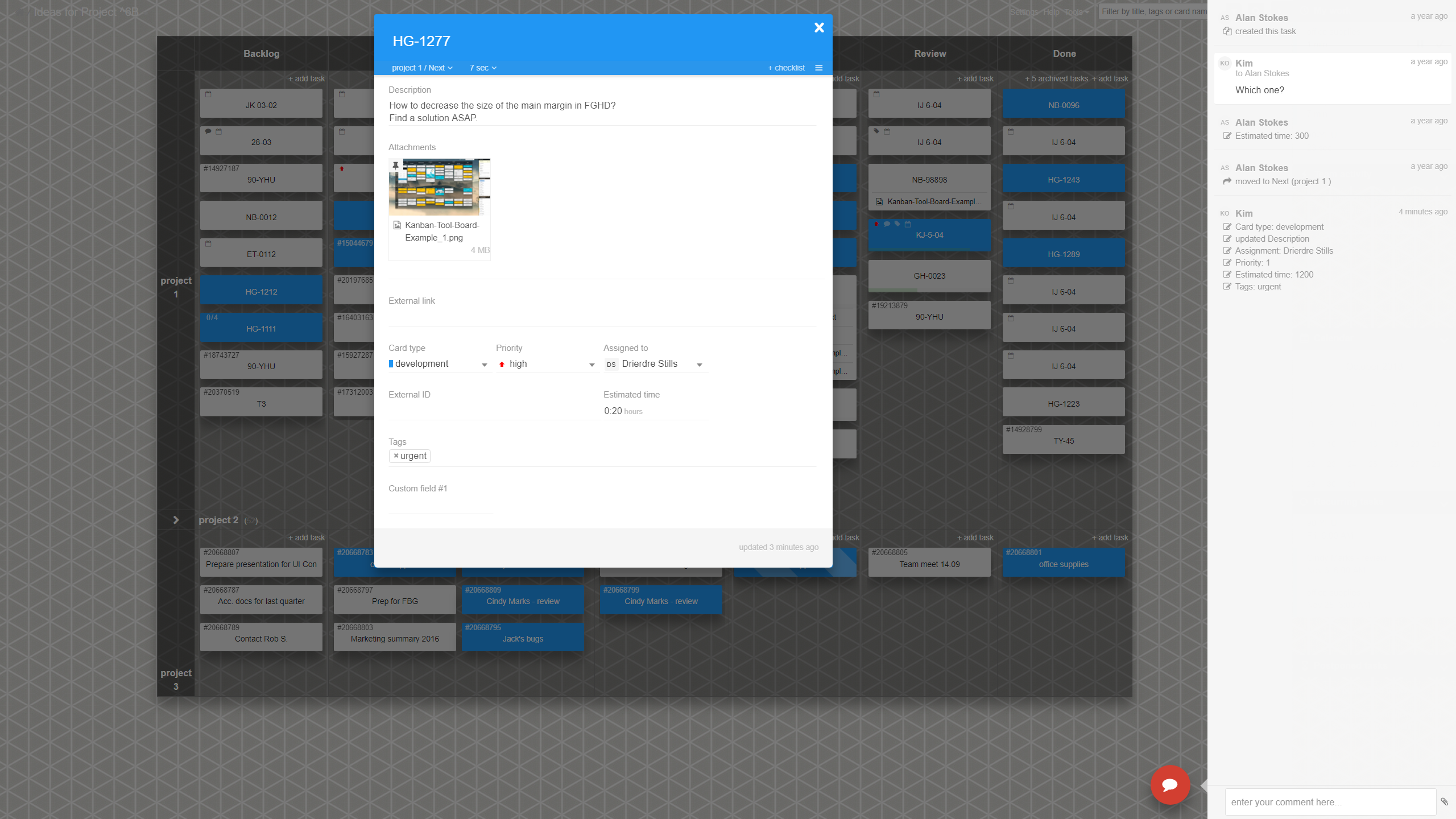
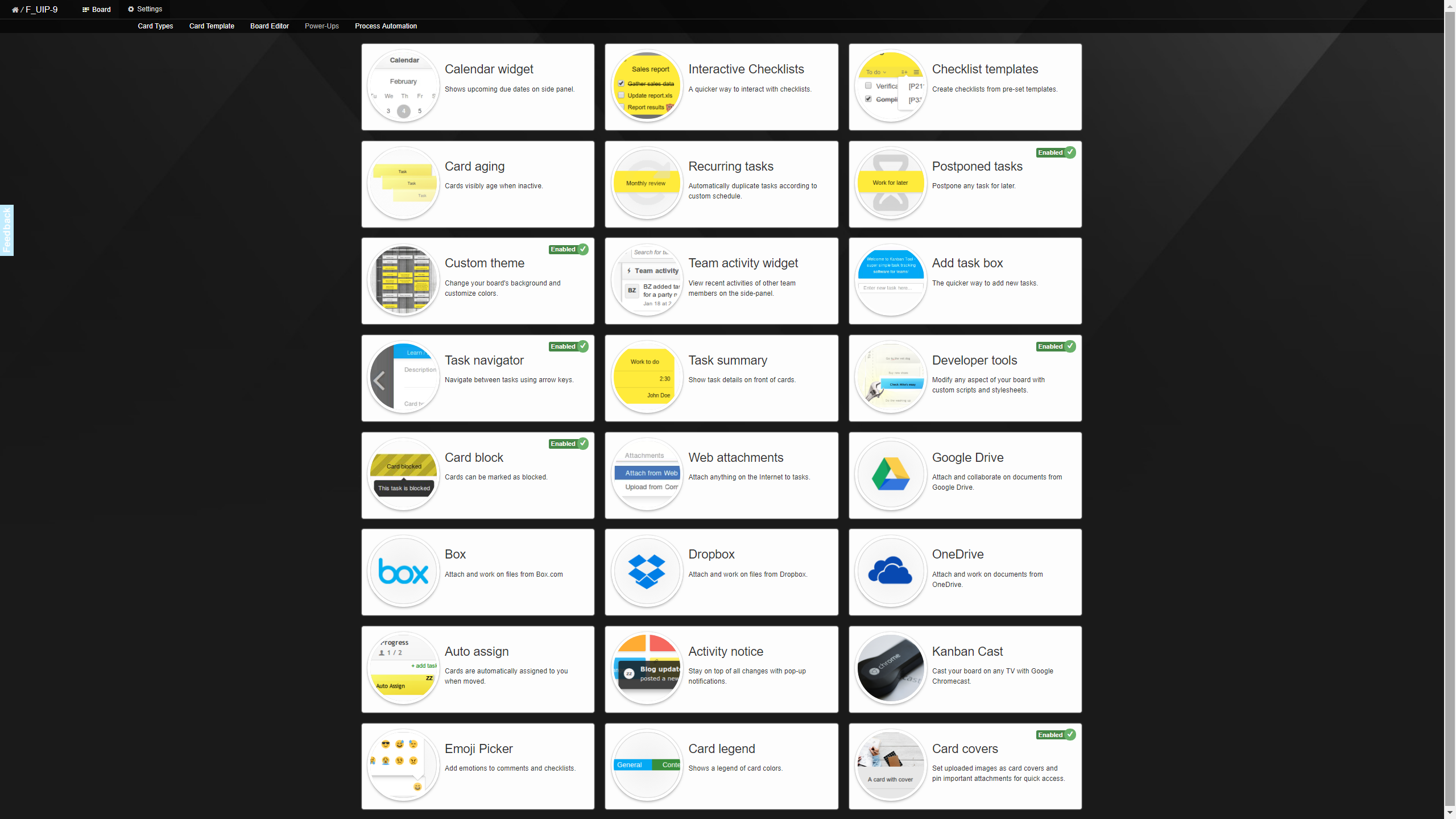
Kanban Tool is a visual project management application based on Kanban that helps companies visualize workflow, track project progress, analyze and improve business processes. Some key features include: time tracking and time reports, real-time collaboration and Kaban analytics.
$6
per month per user
Notion
Score 8.7 out of 10
N/A
Notion aims to present users with an all-in-one workspace — for notes, tasks, wikis, and databases, from Notion Labs in San Francisco.
More straight forward and easier to setup and use. Ideal for teams that need a quick and simple solution. More specialized features and customized options. more flexible and adaptable to various workflows.
Probably my personal preference but I just didn't like Trello. I found Kanban Tool much more in line with what I wanted in a project management solution.
Jira is more robust and more connected. Kanban Tool is a good basic tool to do basic tasks. At an enterprise level, Jira has more to offer a mixed discipline team that has hardware and software builds (model-based design). For small teams doing just software development in an …
Kanban is superior to Scrum and AGILE because it can visually organize all your projects and data into one board. Kanban integrates with JIRA which digs deeper into the project data when it is needed. By integrating Kanban with JIRA, you don't need any other tool for project …
We've only tried JIRA Agile and KanbanFlow before. Kanban Tool was the one that our team actually liked and enjoyed working with. Also - it's been much easier to get started with and to understand than some of the other two (JIRA in particular). Although JIRA has many more …
Notion is far superior to OneNote. OneNote is unnecessarily complex and quite constrained by 'old ways' of doing things. Notion is a more simplistic interface and just 'works'.
Needed something outside of Microsoft Office for overall deal and project tracking and collating our collective knowledge and learnings from different deals. We have not evaluated against anything else.
I listed only the other tools we use. These are not necessarily competitors to Notion, nor we use them for the same things. For organising tasks and collaborative work we only use Notion. Slack is good for communication, Figma for design and development, while Miro for …
I like Notion more than Trello and Google Sheets because it has the best parts of both. Trello is good for making lists of tasks, but it can’t do much else. Google Sheets is great for organizing data, but it can get messy. I chose Notion because I can make lists, tables, and …
The first major difference is the ability to create formulas using other columns and even using other formulas. This increases the possibility of customization to another level. I couldn't do the same things using these other tools. The second is the infinite number of things …
I think Miro also has it's downsides but in general there is more options to illustrate one's creative ideas and workflows etc. Notion is slightly more limiting in that sense. And due to two facor authentification I also tend to work more in google sheets and google docs and …
Notion pretty much combines all the capabilities each one of these platforms have and just takes the most important ideas and concentrates on making them stand out. I can create a "Trello" type of timeline, and use a more traditional "Jira" or "Asana" type of waterfall view. …
Notion goes beyond file storage, which are what the two selected above primarily offer. Also I have used Notion for personal use cases and projects and have found it to have a really amazing user experience and UI. Microsoft products tend to fail at having a good UX. Also, …
The company uses both Notion and Trello within the company. Notion is more for North America employees while Trello is used between Operation team overseas and in North America. Sometimes it's a preference of how the tools look like for project management. I would say both …
Jira is a great tool, that is probably more robust than Notion and more scalable. But for a small company (under 50 people) the investment is hard to swallow without a significant revenue stream justifying it. Notion is a perfect low cost option that meets 80% of the …
We found Notion to be a lot easier to use than ClickUp. They offer a similar feature set, but ClickUp was a lot less user-friendly in my opinion. We also tried Trello and Todoist, but found they were just lacking the features we needed. We still use Trello for some internal …
Notion's flexibility and extensive customization options make it the perfect tool for my personal organization. I appreciate not being confined to a single format, and I find that the process of personalizing my workspace sparks creativity, which is a great asset for managing …
Notion is the most in depth of all of the above applications. You can make a simple to-do list and share it with other people, or dive deep into formulas and page linking. I appreciate that it does not take a large time to set up like Monday.com, but it still offers a huge …
Notion has a powerful feature, and it is their templates within databases. They allow our operation to flow seamlessly and create new tasks with defined subtasks in seconds.
not nearly as useful, it is just a file organiser tool but Notion has the functionality of creating many thing in one page, allowing to include more pages and link with other spaces. such as Miro, google drive, calendar, etc Integration is part of what makes Notion the best …
I think that Notion adds a better user experience which is more customisable. Some of these apps are really rigid and dont give youthe flexability that Notion does.
I found that Notion offered the most versatility. In particular it allowed me to super easily format and reformat information depending on how I was using it. This has proven incredibly useful. And has allowed me to store various types of information all in the same place.
Notion is less complicated than ClickUp and more user friendly, especially for those who prefer simplicity. I am aware that ClickUp does offer simple template and let us scale it but Notion is one step ahead because of the UI design is easier to use. I like Confluence at work …
I've used Evernote in the past and currently use Asana alongside Notion, so I can compare them based on my experience.
Notion is much more flexible than Evernote. While Evernote is great for basic note-taking, Notion allows me to structure my notes with nested pages, databases, …
We were using Nation for the whole company and it's amazing, however, for the CS team with the tech/ops we are using Trello. As a CS & Operation manager, the reminders/alarms/notifications are the most important for handling time and minimizing the SLAs, so I created automation …
Most users looking at Kanban Tool will ultimately have a process that they work through. This is a great tool and very flexible for any business. Take your time to really review your process and the stages of the process. Kanban Tool will make it clear visually so you can see bottlenecks and areas to improve. I think this tool can be adapted to any company or process.
At the company I work for, we use Notion as an organizational base for all sectors and projects. For example, we use it for the marketing team, customer support team, among others. And for each one, we can create pipelines, tasks, due dates, execution time, tags with different colors. It's something very versatile that helps with everything around here. We've even created a sales funnel in Notion.
Kanban does not show the task or story clearly. You have to open the project separately to view the details of the project.
Kanban gives a higher level project management view but it lacks customization and personal settings features.
I would like to see Kanban provide mobile access to their tool, data, and board. This would be very useful for all companies and provide an increase in efficiency and productivity.
I use Notion on my personal tablet, and unlike on the computer, I have a lot of difficulty editing backgrounds, GIFs, and page dividers. It's not as user-friendly, and often the elements end up cut off or misaligned, which is frustrating.
While the current calendar feature is helpful, I'd love to see more customization options. The Google Calendar style isn't always ideal, especially for tasks without specific times or for ongoing projects that require daily maintenance.
It would be fantastic to have more flexibility in customizing Notion pages. For example, I'd love to create planners with the freedom to add illustration boxes, stickers, or GIFs without being restricted to a fixed layout.
The integration with Teams is well suited. This works wonderful for my company. Our team can easily prioritize tasks based on their importance. It help our team identify and reduce inefficiencies in workflow. With great visibility in data our team can make informed decisions. Ensuring clear accountability and responsibility of team members
Notion addresses most of our needs and help teams to organize their tasks, track their progresses and then archive for future reference. The company uses Notion to share announcement, holiday schedules, employee contact information and organizational structures. Everyone finds it useful and helpful. The notifications are instant. Reminders are on time.
Kanban is superior to Scrum and AGILE because it can visually organize all your projects and data into one board. Kanban integrates with JIRA which digs deeper into the project data when it is needed. By integrating Kanban with JIRA, you don't need any other tool for project management that is effective for both the business and the development teams. Kanban is recommended for any user groups who wish to increase their efficiency to deliver products, transparency for all users and on-time productivity.
Notion is much more robust than Google Tasks, which I find very limited. Notion is far more customizable and affordable than Asana, which is more of a turnkey solution for teams that want to work within a pre-defined structure. Notion and ClickUp are comparable, in my opinion, in terms of task management and affordability, however Notion is the more customizable and expansive option whereas ClickUp is mostly just for task management.