Kaspersky Hybrid Cloud Security provides cloud-native protection for hybrid environments.
N/A
Microsoft Defender for Cloud
Score 8.5 out of 10
N/A
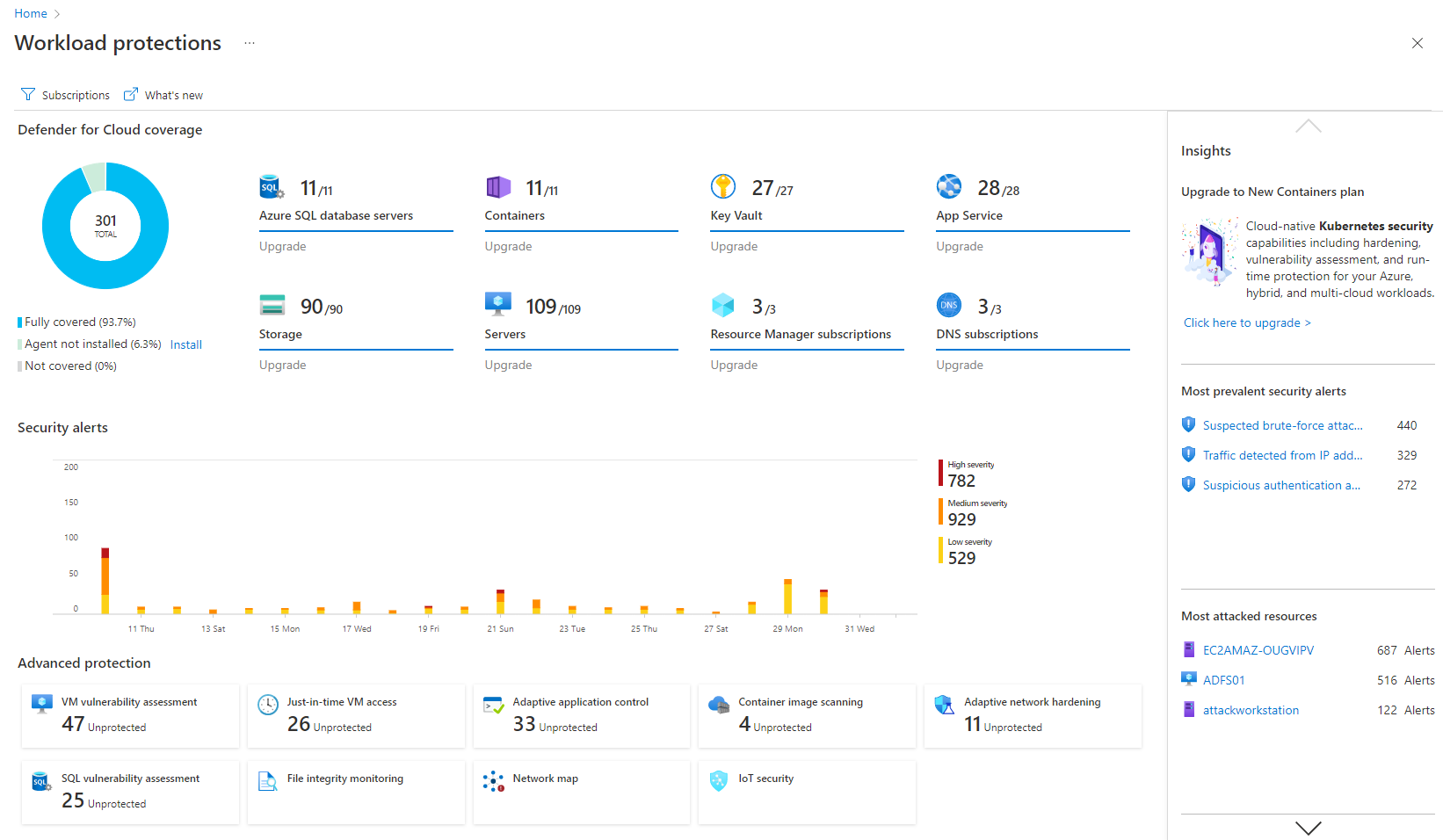
Microsoft Defender for Cloud is a Cloud Security Posture Management (CSPM) and Cloud Workload Protection Platform (CWPP) for Azure, on-premises, and multicloud (Amazon AWS and Google GCP) resources.
Kaspersky Hybrid Cloud Security is better on scanning and removing malware. It got automated removal and got a feature called advanced disinfection. If we can’t remove trying to restart the device the remove it also we can control everything on devices like apps, devices and …
We looked into competitors like Trend Micro and Sophos throughout our research into cloud security solutions. Kaspersky Hybrid Cloud Security stands out as the best option because of its superior threat detection capabilities, its ability to easily integrate with widespread …
It is easy to use and deploying it on our local system is also easy. No irrelevant notification or pop-ups which make us feels frustrate always. It is cheaper than McAfee. Also Kaspersky is being recommended by many persons and specialist. Its ranking is also nice world wide in …
In terms of target market, Qualys Cloud Platform is more focused on organizations that are looking to improve their security posture in the cloud, whereas Kaspersky Hybrid Cloud Security is more focused on organizations that want to secure their data and applications in a …
We have selected Kaspersky Hybrid Cloud Security against all other peers because of their competitive pricing. They have given huge discount with extended product support. Also, by decreasing some negative points, we have enjoyed our deployment phase with some fantastic product …
We were one of the first ones to deploy when Microsoft released it, so it's hard to compare, but what we hear from competitors, the fact that Microsoft can see the full ecosystem using this product makes it a lot better as compared to using a third party tool. So it's the ease …
Evaluated between cost. I just think it integrates better with the Microsoft stack and I mean, I think just cost from just that perspective and being the one pane of glass, I think that's enough.
I believe Microsoft Defender for Cloud stacks up well against the other tools we looked at. It is native to the Azure platform and provides the same insights as the other tools. We selected Microsoft Defender for Cloud because it integrates well with the Azure resources and …
Microsoft Defender for Cloud offered a more integrated and comprehensive solution for our multi-cloud environment, integrating well with our security and compliance needs
Microsoft Defender for Cloud is definitely the choice with the latest market trend and attacks that are currently happening. Microsoft has been able to safe guard a lot after the recent serious attacks happening globally in the digital world. There is a trust in this software …
There is the several ways to protect the applications and lot more tools available in the market. Most commonly we used Crowd strike Falcon for endpoint detection and response capabilities. McAfee endpoint protection also provide broad range of security features. Best …
We used to use Symantec and McAfee. It's been mostly defenders since, gosh, the last eight to 10 years. So we're a small organization. We don't have a lot of folks, so single-painted glass is really important to be able to see the whole environment in a single place. And the …
When we purchase this data fund, we check with not competition and we decided to purchase these tools because it's strong and we have a good relationship with Microsoft.
It is very good in comparison to other products that we have used. Its price is very effective and attractive, and it also provides good security policies. threat intelligence is also good and user protection is also very much better, and it also serves new updates as and when …
Microsoft Defender for Cloud supports the hybrid resource assessment which includes Non-Azure Resources, Aws resources, gcp resources. So it is flexible to asses different cloud platforms. Also its pricing is comparatively affordable then Other cloud security tools available in …
Defender for Cloud (previously known as Azure Security Center) is a more comprehensive and extensive security solution. Currently, threat analytics make up only a small portion of the whole picture. It encourages a comprehensive picture of the cloud environment across all of …
Defender for Cloud is definitely less complex a solution and more turn-key. We found that it was easier to grab the information we needed, faster than the Palo solution. In addition, accounting loved the fact that it was less expensive. At the time of implementation, Palo's …
We installed Kaspersky Hybrid Cloud Security on prem because it will affect bandwidth on cloud but you can control it to determine how much you want. But overall I prefer on prem. It's better and faster when you try to install endpoint on devices. It got all the features you want & you can control everything but the interface needs improvement.
If you need to proceed with pay as you go service then go ahead with Microsoft Defender for Cloud. This could be expensive in the long run but if the organization usage is slightly less than then this would suite the purpose. Also, it has the latest threat updates, so you're future proof in terms of potential treats.
Automation is crucial to managing sprawl and the additional complexity that comes with it. SOC management workbooks and process automation give significant flexibility.
The Security posture score and Security Alerts are neatly centralized and offer me crucial information quickly.
Defender for Cloud avoids the common compromise of simplicity for completeness (former Azure Security Center). The security warnings and advice go into great detail while remaining current and useful.
UI/UX. It can get a little messy when navigating around with all the flyouts in the Azure portal which can be frustrating, particularly when under time pressure.
The query languages for the queries and workbooks are another language that needs to be learned - it would be nice to have kept it closer to T-SQL or something like that to minimize the need to learn new syntax.
Adding cost estimations to the security recommendations would really improve the experience.
It is a great product that integrates nicely when running an Azure platform and even multi-cloud environment. Not looking for point-solutions but a suite that answers most requirements. It is very comfortable being able to use KQL, workbooks and automation that is native to the azure platform
Protection against advanced threats, as the solution includes advanced threat prevention technologies, such as sandboxing and detection of abnormal behavior in daily accesses. Centralized management, allows you to manage the security of several devices from a single management console.
We looked into competitors like Trend Micro and Sophos throughout our research into cloud security solutions. Kaspersky Hybrid Cloud Security stands out as the best option because of its superior threat detection capabilities, its ability to easily integrate with widespread cloud services, and its ability to adapt to our unique infrastructure requirements through a hybrid strategy.
I believe Microsoft Defender for Cloud stacks up well against the other tools we looked at. It is native to the Azure platform and provides the same insights as the other tools. We selected Microsoft Defender for Cloud because it integrates well with the Azure resources and gives the needed insight, security alerts and recommendations.
Increased security posture by providing advanced threat protection and data loss prevention capabilities.
Business continuity by providing a robust security solution that ensures the protection of the organization's data and applications in the case of a security incident.
Increased productivity by providing a unified security management console that allows us to manage security for all of our environments from a single location.