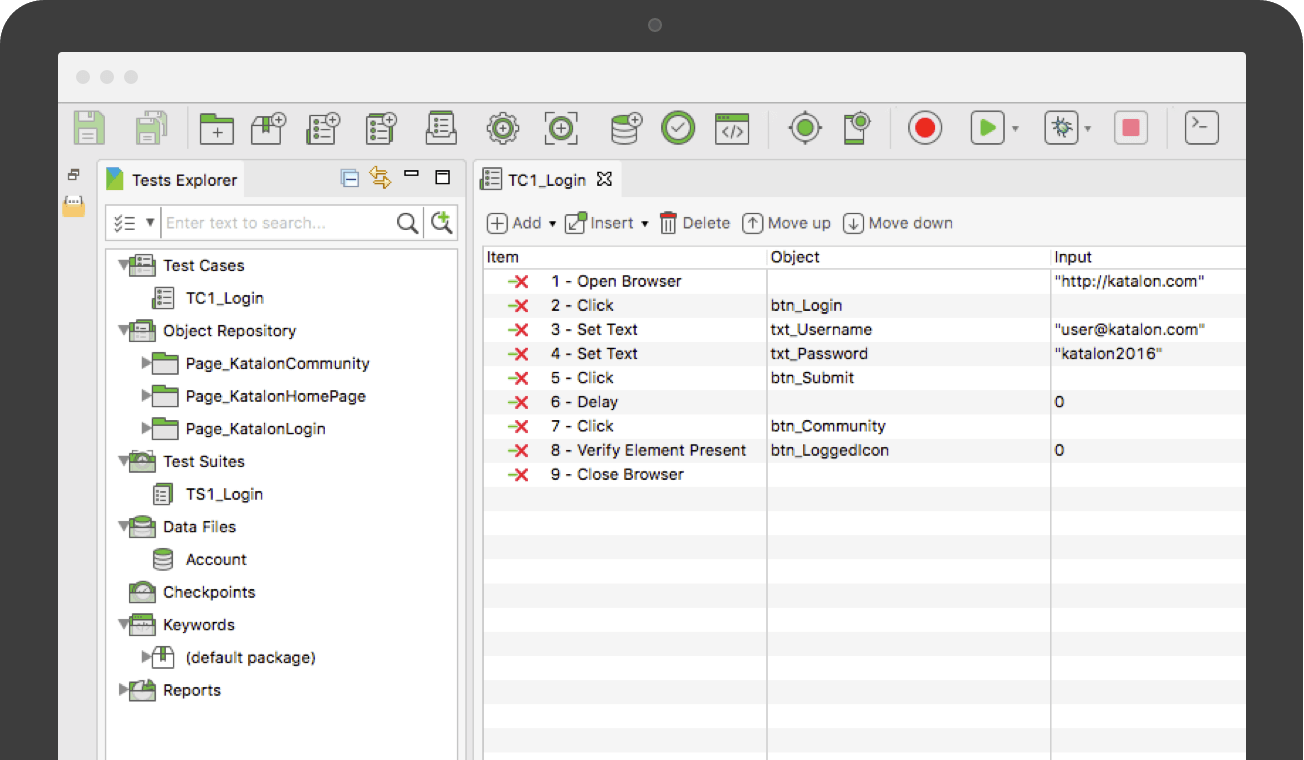
Katalon Studio is provided by the vendor as a free and robust automation solution for API, Web and Mobile testing. It is designed to eliminate the complexities of building an automation framework by integrating all necessary test components with built-in keywords and project templates. Katalon Studio includes a full feature set for a complete test automation process covering multiple platforms and testing types. New users can get started with test automation using its easy-to-use…
$69
per month
ReadyAPI
Score 7.0 out of 10
N/A
ReadyAPI (formerly SoapUI Pro, LoadUI Pro, and ServiceV Pro) is a REST and SOAP API functional testing tool that enables software developers, QA engineers, and manual testers to work together to create, maintain, and execute complex end-to-end API tests in their CI/CD pipelines without needing to code.
N/A
Pricing
Katalon
ReadyAPI
Editions & Modules
Node Locked License
$69.00
per month
Floating License
$1,529.00
per year
No answers on this topic
Offerings
Pricing Offerings
Katalon
ReadyAPI
Free Trial
Yes
Yes
Free/Freemium Version
Yes
Yes
Premium Consulting/Integration Services
No
No
Entry-level Setup Fee
No setup fee
No setup fee
Additional Details
Katalon Studio was originated from KMS Technology R&D. It has been a successful solution for numerous automation projects ranging from small team to enterprise client.
Katalon Studio is free for use, product development is funded by the testing services provided by KMS Technology. To support future releases, please consider subscribing to our business support services.
—
More Pricing Information
Community Pulse
Katalon
ReadyAPI
Considered Both Products
Katalon
Verified User
Anonymous
Chose Katalon
The decision to use Katalon was made by my organization before i joined it.

Initially, our oragnization had to integrate Katalon tests with the Jenkins to schedule the test runs. The reports were stored in company local database. To identify test flakiness or product issue one had to dig deep into the reports. This issue was all solved by Katalon …
Ready API is one of the most popular and widely used tool for API automation. Data driven testing and reporting are some of the features which makes this tool very useful. but if we compare this tool with Katalon Studio, this is only useful for API automation where as Katalon …
Katalon Studio License cost is reasonable and it suits the budget where as other tools are expensive and its difficult to get right ROI. Capabilities are user friendly while using the Katalon Studio for api, mobile , web and desktop application automation where as expensive …
My company was using selenium until we shifted to Katalon Studio. The transition was pretty easy as this tool is built on top of selenium frameworks. Since the companies application grew from web to mobile, glad to have a single automation tool for all different testings. The …
Katalon has no License fee, a nice user-friendly UI to use, easy setup and quick automation, easy integration with other tools like JIRA, Jenkins, ALM, etc., and Katalon analytics tools.
Katalon Studio is above both the tools is due to its codeless test automation feature and having API, desktop, web, and mobile automation in one place but obviously there is room for improvement when desktop automation is of primary importance in the automation.
Katalon studio doesn't have powerful features like Data-driven testing with different sources such as Excel, GRID, Groovy, etc. Parallel testing is not available. Import API definitions which are one of the important of ReadyAPI are also not there in Katalon studio. Reporting …
Each product has a different specialty. With ReadyAPI, it combines multiple specialties into one product and also allows a combination of other products within the Smartbear suite. With other products integration of multiple test, products are far more difficult and require …
ReadyAPI manages DataSources, Endpoints, and Environments much better than Postman. Postman is a little simpler implementation but has a Team Workspace that is powerful for Development handoffs and manual testing.
Postman is simpler and super less expensive than ReadyAPI. In addition, the product continues to work even after the license has expired in comparison to ReadyAPI which requires you to purchase a new license every time. Is a turnoff.
ReadyAPI is a comprehensive tool that allows for developing, validation, and testing all in one suite. There are advanced features like user simulation and assertion capabilities that set ReadyAPI apart from other tools in the same segment. We also have several legacy solutions …
I have used a couple of products mentioned above. But the best thing about ReadyAPI is, it's a complete [package] for API testing. Not all software offers load testing, assertion, and reporting features. Also, lots of plugins, like Azure API Management, AWS API plugin features …
Postman didn't have the flexibility of detailed assertions that we needed, although it was easy to use. Also their integration points weren't as straightforward.
ReadyAPI beats all other alternatives because of its support of all kinds of API types. Also, users can specify every flow and every step for every second to replicate every test case with ease. It also has GIT support with is a big plus.
The main competitor for ReadyAPI was Postman. It is much more lightweight, but that means you also get fewer features. ReadyAPI also provides an ecosystem in which you can have an entire lifecycle for your API, if that is what you want - and are willing to put in the work to …
I am using ReadyAPI tools for more than two years helped us to evaluate the quality of our API. For all API Automation testing, load testing, and security testing ReadyAPI bring us the best result and quality. It has many useful features in automation that we use to do more …
I didn't have much experience with automation in Postman, but ReadyAPI seems more robust and in my opinion is able to cover many use cases. For me it was also easier to write the tests in SoapUI as many times it is matter of clicking and copying existing things.
I have not used other API testing products but I am completely satisfied with the functionality and performance of ReadyAPI. It covers all required API protocols and database connections that are used in our organization. It also allows extending the functionality by adding …
ReadyAPI provides intuitive GUI capabilities compared to their own open source product.
When compared to Postman, ReadyAPI also supports SOAP based services, which is a saver especially when integrating with legacy or other third party systems.
SoapUI Pro is good because you can start automating functional testing even if you don't have scripting knowledge. However, it doesn't work very well with GraphQL and so we had to use Insomnia is those cases.
ReadyAPI vs Postman: ReadyAPI makes testing WSDL, SOAP, etc. much easier and quicker. Postman would require you to manually construct the SOAP envelopes and metadata XML, which is a lot of work for something that is meant to be a quick test.
We selected SoapUI because it generates tests easily using drag and drop, and point-and-click. It gives powerful data-driven testing with data from files and databases. Scripts can be reused easily. We had an extra option to integrate it directly with our build tool, Jenkins, …
Our team did an extensive analysis of the products that were available to carry out API Testing. There were 3 products that were finalized, SoapUI Pro, Postman, and Katalon Studio, out of these 3 SoapUI was the clear winner. I can't stress enough about the SoapUI's UI …
Free trial version is fine but you don't get the adequate support and VFM for the licensed version. Customer service needs to be improved a lot and any QA's with less technical background or less time to troubleshoot issues in the software on their own would find it difficult to use.
As stated, we do a LOT of API testing, the swaggerhub import makes it easy to add APIs. This is very well-suited, as well as easy management of the steps/cases/suites inside of ReadyAPI. The one thing I do wish ReadyAPI was better suited for is changes to data, we have a lot of test cases in ReadyAPI and if we make a change to how the backend data is structured, one-by-one adjustments need to be made to the steps. Less appropriate, UI testing.
Easy to setup and quick to get started: As Katalon comes with built-in features a new automation tester can automate easily. Script creation time is quick.
Test Analytics: Katalon also provides analytics which tells you the pattern of your automated tests at a different instance of time.
Third Party Integration: Katalon provides amazing integration with 3rd party tools like JIRA, ALM, GIT, JENKINS, etc.
Image-based testing: Katalon also provides inbuilt image based test automation.
SoapUI NG Pro is a prefect tool for setting up complicated test cases with many steps including parameterized Web Service requests, response assertions, data generators, data sources, data sinks (report recorders) and more
You can use Groovy or JavaScript for more complicated automation such as validating the results, extracting data, using external Java libraries or running system processes. Groovy IDE is compatible with Java and you can easily write your code in Java with very few modifications.
SoapUI enables you to run multiple test suites in parallel or in a loop, and provide user friendly reports including all test case results and test case coverage.
SoapUI NG Pro lets you to perform security test against your web services with predefined scenarios such as xml bombing, xml injection, sql injection, buffer overflow tests, monkey testing and so on.
SoapUI NG Pro, offers a simple but practical solution for low to medium load testing scenarios. You can obtain many more Load and Performance testing features by extending your license with purchasing LoadUI Pro.
REST - They have come a long way, but there could still be improvements here. I find the learning curve much higher and not as straight forward using REST vs SOAP.
Composite Projects - I'd really like to see them implement something around saving/refreshing Test Suites when using the Composite project ability in Pro. This is currently an enhancement in feature backlog (see their forum for more details). Functionality around Projects and Test Cases seems pretty sound.
I would definitely renew the ReadyAPI as I was pretty happy while using it. But then I switched my job, and the current workplace is using Postman so we are using it for now. Plus, I don't have any issues with Postman. At the end of the day, it about selecting the tool that gets your work done more efficiently.
SoapUI allows us to combine multiple tests and adhere to the sequence that they need to run in order to complete successfully. It has an excellent GUI design and the reporting mechanism is also very good. It does consume a lot of memory though during concurrent testing
Soap UI has managed to continuously build on it's solid foundation and keep improving by each release. It is by far the most dependable and accurate testing tool out there of its kind. Available via connecting to VM's created as SoapUI test machines give access to it anytime, anywhere practically.
I love the support. They have provided answers and solutions for most of our questions or doubts that could come up. They also have provided basic tutorials on how to get familiarized with the program.
For my purposes, the provided help features have been sufficient. I am sure I would be better off if I were to spend more time studying the app. For now, I load a project, connect, and execute. It just works.
Initially, our oragnization had to integrate Katalon tests with the Jenkins to schedule the test runs. The reports were stored in company local database. To identify test flakiness or product issue one had to dig deep into the reports. This issue was all solved by Katalon TestOps. Katalon TestOps provides report history in one place and also helps in easy triage of the report by pointing out script flakiness
I have not used other API testing products but I am completely satisfied with the functionality and performance of ReadyAPI. It covers all required API protocols and database connections that are used in our organization. It also allows extending the functionality by adding external DB drivers and wiring custom scripts when the native assertion/data manipulation test steps are not sufficient.
It has an excellent GUI design and the reporting mechanism is also very good. It does consume a lot of memory though during concurrent testing. However, I have read that added monitoring tools have been added, which if so the 7 could possibly go to a 8 or 9.
Support can be better: As mentioned before, katlon community is still growing but is currently a small community. If you are stuck, its hard to find help in the community and one has to reach out to the support for help. This takes a while before you can get solution to your problem.
Result upload takes little longer time: It is been observed that uploading tests results takes little longer.
Sometimes it gets hard to integrate: Since this is fairly a new tool, requires lot of learning curve to get the job done effectively.