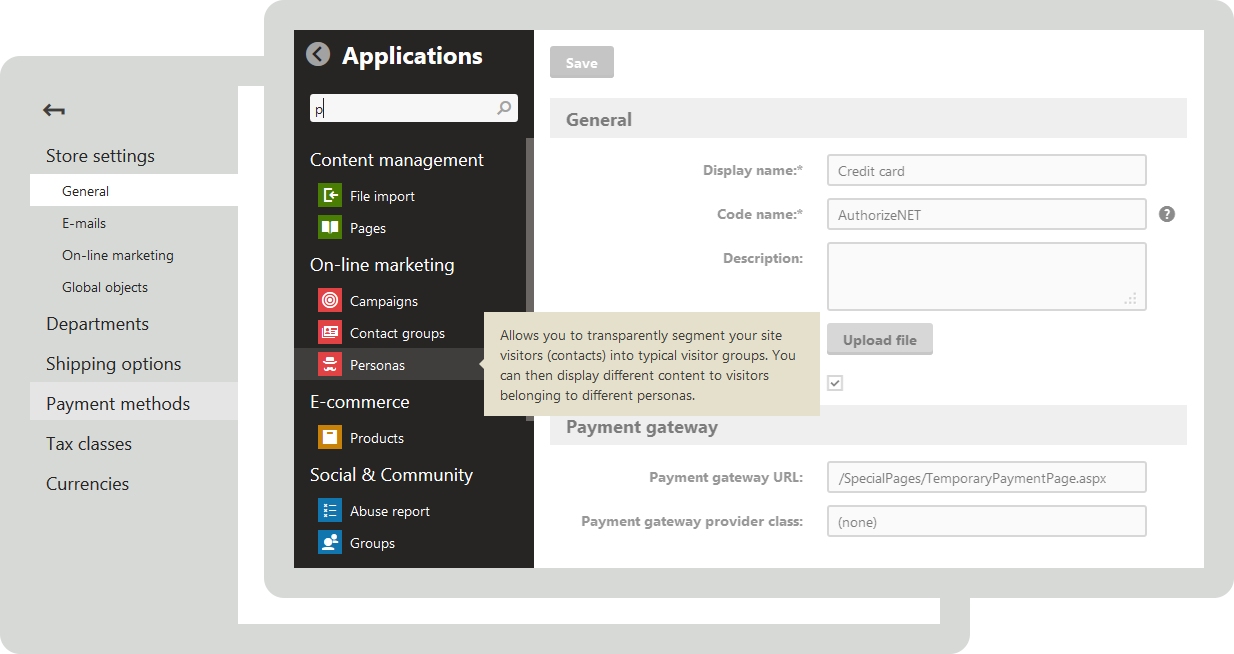
Kentico is a web content management system for building websites, online stores, intranets, and Web 2.0 community sites. Kentico CMS uses ASP.NET and Microsoft SQL Server for development via its Portal Engine, using Visual Studio, or through Microsoft MVC.
$9,999
Subscription license
Magento Open Source
Score 8.5 out of 10
N/A
Magento Open Source is an ecommerce content management solution originally developed by Varien Inc and presently supported by Adobe. The Open Source product is for developers and merchants that is available as a free download, and supported with free upgrades from the Magento Community.
N/A
Pricing
Kentico Xperience
Magento Open Source
Editions & Modules
Kentico Xperience Business
$9,999 / year
Subscription license
Kentico Xperience Business
$14,999
Perpetual license
Kentico Xperience Enterprise
$17,999 / year
Subscription license
Kentico Xperience Enterprise
$29,999
Perpetual license
Kentico Xperience Corporate
Upon request
No answers on this topic
Offerings
Pricing Offerings
Kentico Xperience
Magento Open Source
Free Trial
Yes
No
Free/Freemium Version
Yes
No
Premium Consulting/Integration Services
No
No
Entry-level Setup Fee
Optional
No setup fee
Additional Details
—
Pricing for Magento will vary greatly depending on outsourcing support and maintenance services.
More Pricing Information
Community Pulse
Kentico Xperience
Magento Open Source
Features
Kentico Xperience
Magento Open Source
Security
Comparison of Security features of Product A and Product B
Kentico Xperience
7.1
Ratings
14% below category average
Magento Open Source
-
Ratings
Role-based user permissions
7.10 Ratings
00 Ratings
Platform & Infrastructure
Comparison of Platform & Infrastructure features of Product A and Product B
Kentico Xperience
7.5
Ratings
10% below category average
Magento Open Source
-
Ratings
API
8.00 Ratings
00 Ratings
Internationalization / multi-language
7.00 Ratings
00 Ratings
Web Content Creation
Comparison of Web Content Creation features of Product A and Product B
Kentico Xperience
7.0
Ratings
9% below category average
Magento Open Source
-
Ratings
WYSIWYG editor
8.00 Ratings
00 Ratings
Code quality / cleanliness
7.10 Ratings
00 Ratings
Admin section
7.20 Ratings
00 Ratings
Page templates
7.10 Ratings
00 Ratings
Library of website themes
5.80 Ratings
00 Ratings
Mobile optimization / responsive design
8.00 Ratings
00 Ratings
Publishing workflow
6.20 Ratings
00 Ratings
Form generator
7.00 Ratings
00 Ratings
Web Content Management
Comparison of Web Content Management features of Product A and Product B
Kentico Xperience
6.9
Ratings
4% below category average
Magento Open Source
-
Ratings
Content taxonomy
6.30 Ratings
00 Ratings
SEO support
7.20 Ratings
00 Ratings
Bulk management
5.10 Ratings
00 Ratings
Availability / breadth of extensions
7.90 Ratings
00 Ratings
Community / comment management
7.90 Ratings
00 Ratings
Online Storefront
Comparison of Online Storefront features of Product A and Product B
Kentico Xperience
-
Ratings
Magento Open Source
7.7
Ratings
2% below category average
Product catalog & listings
00 Ratings
8.50 Ratings
Product management
00 Ratings
9.50 Ratings
Bulk product upload
00 Ratings
8.00 Ratings
Branding
00 Ratings
6.50 Ratings
Mobile storefront
00 Ratings
4.00 Ratings
Product variations
00 Ratings
9.50 Ratings
Website integration
00 Ratings
8.00 Ratings
Visual customization
00 Ratings
6.50 Ratings
CMS
00 Ratings
8.50 Ratings
Online Shopping Cart
Comparison of Online Shopping Cart features of Product A and Product B
Kentico Xperience
-
Ratings
Magento Open Source
8.0
Ratings
4% above category average
Abandoned cart recovery
00 Ratings
7.10 Ratings
Checkout user experience
00 Ratings
9.00 Ratings
Online Payment System
Comparison of Online Payment System features of Product A and Product B
Kentico Xperience
-
Ratings
Magento Open Source
6.6
Ratings
23% below category average
eCommerce security
00 Ratings
6.60 Ratings
eCommerce Marketing
Comparison of eCommerce Marketing features of Product A and Product B
Kentico Xperience
-
Ratings
Magento Open Source
4.2
Ratings
59% below category average
Promotions & discounts
00 Ratings
5.60 Ratings
Personalized recommendations
00 Ratings
2.00 Ratings
SEO
00 Ratings
5.10 Ratings
eCommerce Business Management
Comparison of eCommerce Business Management features of Product A and Product B
Kentico Xperience
-
Ratings
Magento Open Source
9.1
Ratings
13% above category average
Multi-site management
00 Ratings
9.50 Ratings
Order processing
00 Ratings
9.50 Ratings
Inventory management
00 Ratings
9.50 Ratings
Shipping
00 Ratings
8.50 Ratings
Custom functionality
00 Ratings
8.50 Ratings
Best Alternatives
Kentico Xperience
Magento Open Source
Small Businesses
Bloomreach - The Agentic Platform for Personalization
Well suited for marketers that do not have in-house web programming or web designing resources available. Less appropriate for people that aren't computer savvy (i.e. don't know how to use basic programs like email, Excel, PowerPoint) or for those who are not detail-oriented because if you skip certain steps when adding/editing content, your webpage won't render correctly and/or create negative impact for search engine optimization without you knowing it.
It's well suited for large eCommerce stores as it requires much effort to set up and the development cost for setting it up is high. It's less appropriate to use Magento where you are looking for quick development and launch of the store. Also, it is required to have a developer or sometimes the entire tech team to manage an e-commerce store, so you may need to hire a few PHP developers.
Ease of use for the developer, content authors, and internet marketers that use it. The user interface in Kentico 8 truly is amazing and easy to pick up with no training.
Strong customization and integration capabilities, including the built in REST service, Integration Bus, and elegant API. I love the fact that if there is anything not in the box we can use the system to extend it or connect it to any CRM, ERP, or other third party service very easily.
Large out of the box functionality. There is an extremely high level of value that the platform provides. Instead of having to build extra modules for things like Event Booking, Forums, Polls, or E-commerce, they are already there for us to use.
Ability to control the HTML output of the site at a very fine level. Creating HTML5 is very easy in Kentico and implementing any design, as responsive, is totally possible in the system.
The ability to get a very high level of insight into the visitors journey through the website and market back to them with the Contact management, Lead Scoring, and Marketing Automation modules is very impressive.
The scalablity of the system is impressive. Running a very highly trafficked web site is totally possible with Kentico and its strong caching and web farm capabilities.
The support that Kentico provides is top notch, 24/7 global support is included with any purchase, 7 day bug fix policy, and excellent documentation
The development community is engaged and ready to help if you are a developer learning Kentico, and the Kentico partner community is very strong as well.
Their slogan - "Right First Time Technology" - I get what they mean, but some things may be lost in translation. This is a sentence fragment in English, and some clients may be turned off by it.
Easier to understand documentation - their official documentation could use an overhaul. All of the information is there, but most of their code examples need to be fleshed out a bit. This aspect of their product can be very hard to navigate for first-time Kentico developers.
Email Queue - this should be in the same section as Email Marketing; currently this is under Configuration
Magento 2 community is full of known and new bugs with long-pending pull requests and the community is on the hook for changes. Submit an very obvious issue to the github repo, and you will likely be met with a "this is open source and you use at your own risk." I counter this poor attitude with the fact that open source community has standards, and we do not label a "release" until those standards are met. Otherwise it's just a alpha, beta or numbered build. We don't release obviously bad software until it's fully working.
Magento is expensive to maintain. You will need a well-paid php developer with apache and hosting knowledge, or you will have to hire an external firm. Either option will turn your website into an additional $100k/yr cost center, so you'd better be ready to ramp up sales. Every feature update or bugfix in the past year has uncovered more bugs, which my devs fix, but at the cost of timelines and billed hours way outside of my budget and target dates.
We are locked into Kentico for the long haul. It provides us with an easy and flexible solution for a very non technical company to create a site and have the features they want, especially with the inclusion of EMS into our license. Now we have a true platform to build and grow our solutions.
It's the dominant force in the SMB open source market. With the continued support of eBay/PayPal, Magento will continue to evolve and should be a market leader for some time.
It seriously is one of the best interfaces I have ever used. I also love the fact that I can use UI personalization to secure any functionality by user or role that I don't want that role to have access to. The best part is the customization of the UI, I can add in any button, tab, or menu item I want through it, no code required.
Magento has a relly step learning curve. This means that you need to find experienced developers who can lead junior ones, otherwise the overall development process can be a disaster. However, once you are comfortable in developing on the platform, the customization capability are basically limitless and you can adapt the platform to any use case you can imagine. Also, there are many alredy developed marketplace modules that can solve, out of the box, many problems you may face.
Their support staff is friendly, knowledgeable, and will work with you until your issue is fixed. This could take a few phone calls back and forth, but they are very diligent in helping you.
Previously we used Microsoft SharePoint as a content management system and it was very limited, required a ton of support, and we encountered bugs on a weekly/monthly basis. All of the negatives that we had associated with SharePoint went away when we switched to Kentico. It was really night and day and Kentico has really helped us move forward and become much more efficient.
Shopify is a closed ecosystem; the moment a client has a complex, custom workflow or needs to integrate with a legacy ERP system, Shopify’s app-based model falls short. WooCommerce just does not scale like Magento, and its architecture is not made for enterprise-scale e-commerce. SAP Commerce Cloud is a very close competitor, but it comes with licensing costs and sometimes can be overkill. It's, however, perfect if the customer already has something SAP in their ecosystem.
Kentico has allowed us to deliver to clients more quickly, more cheaply, and with high quality to our clients. It's an inexpensive licensing model, an easy development platform, and powerful enough we can deliver amazing results to our clients.
Kentico's quick setup and deployment model has allowed me to very quickly ramp up new developers. This saves money and time.
We routinely see extraordinary returns in visits, time on page, and other critical metrics after rolling out Kentico-based systems/applications.
Better Total Cost of Ownership than bespoke e-commerce solutions due to being open source and the wide range of free/commercial extensions available to extend the platform.
Often more extensive to set up and maintain than other open source alternatives, such as WooCommerce.