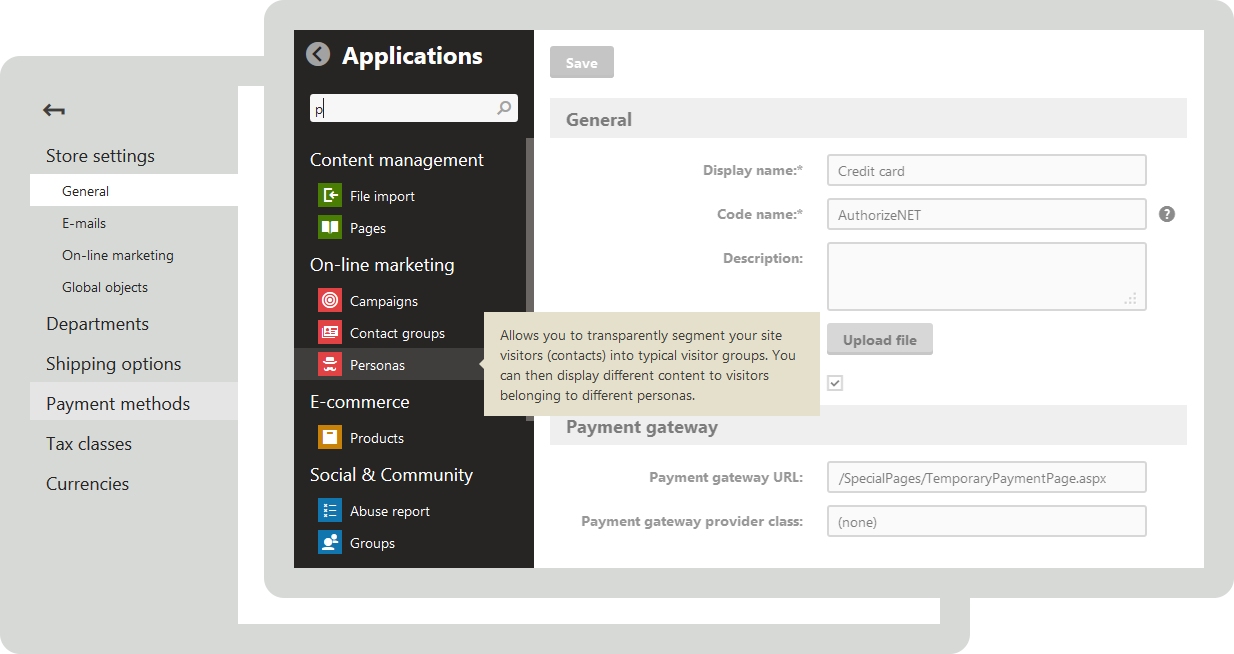
Kentico is a web content management system for building websites, online stores, intranets, and Web 2.0 community sites. Kentico CMS uses ASP.NET and Microsoft SQL Server for development via its Portal Engine, using Visual Studio, or through Microsoft MVC.
$9,999
Subscription license
Miva
Score 7.5 out of 10
Small Businesses (1-50 employees)
Miva Merchant is a point-and-click, online store development and management system that allows merchants to build their online store through a web browser, and lets developers provide aftermarket enhancements for the online store.
N/A
Pricing
Kentico Xperience
Miva
Editions & Modules
Kentico Xperience Business
$9,999 / year
Subscription license
Kentico Xperience Business
$14,999
Perpetual license
Kentico Xperience Enterprise
$17,999 / year
Subscription license
Kentico Xperience Enterprise
$29,999
Perpetual license
Kentico Xperience Corporate
Upon request
No answers on this topic
Offerings
Pricing Offerings
Kentico Xperience
Miva
Free Trial
Yes
No
Free/Freemium Version
Yes
No
Premium Consulting/Integration Services
No
No
Entry-level Setup Fee
Optional
No setup fee
Additional Details
—
Miva employs a revenue-based pricing model. The Miva platform is best suited to growing mid-size and enterprise merchants that have complex business needs and are making (or planning to make) $1 million or more in annual online revenue.
More Pricing Information
Community Pulse
Kentico Xperience
Miva
Considered Both Products
Kentico Xperience
Verified User
Anonymous
Chose Kentico Xperience
Kentico provided us with a far more robust and customizable platform than lower-cost alternatives such as Wix or Squarespace, and was available at a much lower cost of entry than Ektron. It required a lot fewer fiddly uses of extensions than Wordpress, though some custom …
We selected Kentico for our particular project to match up with another site we had and it was more financial wise for us than other solutions we looked into. A big thing for us was that we needed to have language management and Kentico being an international country was a good …
Previously we used Microsoft SharePoint as a content management system and it was very limited, required a ton of support, and we encountered bugs on a weekly/monthly basis.
All of the negatives that we had associated with SharePoint went away when we switched to Kentico. It was …
Marketing email coordinator (part time contract project)
Chose Kentico Xperience
I recently started learning Sitecore which resembles Kentico in some aspects, and I find Kentico to be more user-friendly and intuitive. Sitecore is a more robust system, but in my opinion it gives content administrators too many options, and has a way steeper learning curve. …
Kentico is a lot easier, more fluent and slicker than these products. It is easy to setup, use and teach others, so content can be managed by multiple users without any special training or skills i.e coding. It is definitely a lot more expensive so you are paying for a premium …
Kentico 8 really is a drastic improvement over previous versions of Kentico - the whole system is light years faster, much more intuitive to use and nicer for all users involved.
When discussing Kentico with clients, I find myself uttering the same phrase repeatedly. "Kentico provides 95% of the functionality of high-dollar CMSs at a fifth of the price." This allows clients to use the dollars they would have previously put towards licencing into feature …
I've used SiteCore, Ektron, Joomla!, Wordpress, and SharePoint (if you want to count that as a competitor for CMS). Kentico 8 blows them all out of the water. Nothing is more intuitive in the way that content is created, the way the site is setup, and how efficient rollouts can …
When compared to the above solutions the value that Kentico offers is much higher when compared to the price of these other solutions. Kentico will do 90% of what Sitecore and Ektron and Adobe do, and those other solutions will do 90% of what Kentico does. In my opinion they …
Better than all of the above on almost every level. SiteFinity comes closest from a developer tool perspective and Umbraco from a flexibility perspective.
Out of these CMS systems I've worked in, Kentico is still hands down the easiest to build and manage.
Ingeniux was a failed project, it was too cumbersome to work in (MVC based), it was a nightmare to do any custom dev work in it, couldn't debug, and their own staff couldn't get …
The competitive toolset and streamlined development process that Kentico provides allows for it to be a viable option at a fraction of the cost of other solutions.
It seems to have better organization and better extendability. In comparison to WordPress, the support that is offered by Kentico is incredible. When comparing to Sitecore, the price point makes it much more affordable for smaller to mid-size organizations that need a great CMS …
When deciding on Kentico we compared 2 other products, all vendors provided either provided 1 to 2 demos. Compared to the other vendors, the Kentico product worked as expected when demonstrating compared to the other two vendors that had a range of problems in their product …
WordPress - I do like WordPress, and we propose this CMS as an option to Kentico, but I firmly believe that unless everything happens to work perfectly, WordPress will cost more money to develop in the long run. Aside from that, WordPress has intrusive updates very regularly, …
The greatest thing about Kentico is its API-first development focus. What most people don't realize, but is the most telling item for developers, is that ALL of the Kentico UI is an API client using the publicly available API. If you can see it in Kentico, you can do it, or …
Kentico is to most full featured for large corporate sites needing multiple versions. WordPress may update more frequently, but Kentico has released 2 updates in the 2+ years I've been using it, which is fantastic.
At Bit-Wizards we have used many open source CMS tools like Word Press and Joomla as well as enterprise solutions like SiteCore and Ektron. The open source challenges are stability and security of the platform. Support for correcting those issues depends greatly on the …
Wordpress is much quicker and lighter, but not as robust and is suitable in different situations. Sitecore and Kentico offer similar functionality, but with a different approach to development. Sitecore has a much higher price point and similar functionality, so in my opinion …
BigCommerce, Shopify and Shopware are all superior to Miva. They allow you more power to personalize, power your store, and better B2B options. They have all solved the issues that Miva has with categorizing and subcategorizing products, which Miva doesn't allow that creates …
Miva is so much more customer oriented and willing to work with and for you. There are many modules you can install to get specific functionality to work, but if there's none available, they are more than willing to work with you to accomplish your needs. Miva actually listens …
Each player has positive features and value to add to a business. BigCommerce and Shopify have brand recognition that has lead to them being the more common choice in eCommerce. Overall, they have their place for simple B2C sites, and less complex B2B sites. Miva was the …
Versatility and customer service. There is nothing more frustrating than being in the middle of a task and having to do tech support via a computer-generated chat box. Miva Merchant gives you a live tech support engineer 24/7.
Miva is more costly than its competitors. [In my opinion] it's harder to set up and use and user interface is cumbersome. Requires costly customization for integration to services you get from Big Commerce or Shopify right out of the box. No Google Shopping integration. No …
OS Commerce, PHP Cart, and many other open code systems. We find the native feature set ample and the developer community quite active and easy to identify. Some platforms can be difficult to find good qualified consultants/coders that can make good quality, well performing, …
Miva Merchant can be customized to fit nearly any design, and it has nearly unlimited custom stand-alone, product and category pages for unique and varying layouts. With some other carts, they don't always allow much, if any, design customization outside of the few options or …
Verified User
Anonymous
Chose Miva
Miva Merchant has it's own language which had a high learning curve for me to understand. Customize the template to match a html/css static site was difficult because you needed those Miva Merchant code pieces to be in the correct places. Now that I'm older and wiser, I no …
Miva Merchant for me as a Module Developer I believe scales better than the above. Has better customer support, and as a developer has the most open API.
MIVA Merchant is a good choice for both developers and store owners with small to medium size businesses. The platform is secure, feature-rich, easy to modify and easy to administer. MIVA Merchant is actively being developed and so constantly improving via both the official …
The closest solution I found to Miva is Magento. Magento seems to be gaining popularity at a rapid pace but I think this is only because they have done a better job at marketing their product (it's an eBay Company). When comparing the two I gave the slight edge to Miva because …
Verified User
Anonymous
Chose Miva
Many years ago, Miva was a good eCommerce platform compared to others, typically offered by a hosting company for free or a small charge. However, it's fallen way behind the pack now and the declining interest in their system and ever increasing fees make it exceptionally …
Because I have worked with Miva Merchant longer than any other shopping cart package, I'm comfortable doing anything that needs to be done within the package. I find it easier to develop modules for Miva than to do plug-ins or extensions for other carts, primarily based on my …
I have used others, but don't recall all the names. In the end though - we always go back to Merchant. Its just easier, and we have full access to our data.
Working with Miva directly reduced the need to utilize someone to help us integrate and become accustom to the platform. Magento does have more flexibility with personalized messaging from my experience however.
All of these products are nice in their own way. MIVA's big advantage is their selection of modules, although I have to say WooCommerce is starting to catch up in that area. While MIVA has begun to show its age, it's still a solid way to manage a store that contains a lot of …
Magento - BigCommerce - Shopify. In essence it all depends on the end client needs and project specifications. Miva Merchant seems to be the most flexible in the bunch at the most attractive pricing (SaaS model)
Verified User
Anonymous
Chose Miva
Other software that I have used are: ShopSite, X-Cart and Quick Shopping Cart. They are less flexible and customization is limited.
Well suited for marketers that do not have in-house web programming or web designing resources available. Less appropriate for people that aren't computer savvy (i.e. don't know how to use basic programs like email, Excel, PowerPoint) or for those who are not detail-oriented because if you skip certain steps when adding/editing content, your webpage won't render correctly and/or create negative impact for search engine optimization without you knowing it.
If you are familiar with online retail, you will find it easy to use and love the diverse way of arranging your store and products. If you are brand new to online retail, Miva Merchant has partners that can help you design the perfect present that is easy to maintain.
Ease of use for the developer, content authors, and internet marketers that use it. The user interface in Kentico 8 truly is amazing and easy to pick up with no training.
Strong customization and integration capabilities, including the built in REST service, Integration Bus, and elegant API. I love the fact that if there is anything not in the box we can use the system to extend it or connect it to any CRM, ERP, or other third party service very easily.
Large out of the box functionality. There is an extremely high level of value that the platform provides. Instead of having to build extra modules for things like Event Booking, Forums, Polls, or E-commerce, they are already there for us to use.
Ability to control the HTML output of the site at a very fine level. Creating HTML5 is very easy in Kentico and implementing any design, as responsive, is totally possible in the system.
The ability to get a very high level of insight into the visitors journey through the website and market back to them with the Contact management, Lead Scoring, and Marketing Automation modules is very impressive.
The scalablity of the system is impressive. Running a very highly trafficked web site is totally possible with Kentico and its strong caching and web farm capabilities.
The support that Kentico provides is top notch, 24/7 global support is included with any purchase, 7 day bug fix policy, and excellent documentation
The development community is engaged and ready to help if you are a developer learning Kentico, and the Kentico partner community is very strong as well.
Their slogan - "Right First Time Technology" - I get what they mean, but some things may be lost in translation. This is a sentence fragment in English, and some clients may be turned off by it.
Easier to understand documentation - their official documentation could use an overhaul. All of the information is there, but most of their code examples need to be fleshed out a bit. This aspect of their product can be very hard to navigate for first-time Kentico developers.
Email Queue - this should be in the same section as Email Marketing; currently this is under Configuration
Training and documentation. Miva Merchant is fairly complex, and while they continue to make good progress in providing resources for all levels of expertise (beginner to expert), there are still a number of gaps. To take the step beyond the initial levels of online storefront requires expert assistance for most businesses (unless they have some substantial IT/technical resources available).
Market for add-on and add-in products. (Note: this is significantly biased by our own business experience selling workflow and feature products for Miva Merchant.) The long-term goal for Miva has been stated to essentially involve having integration partners (selling their time) and larger companion product partners (selling products that work with, but usually NOT within Merchant). There is clearly a gap of potential customer needs that they are attempting to build into the core platform. Of course, no one can cover all needs! While Miva Merchant is not hostile to third-party product companies, neither do they have an explicit place in their long term roadmap. It is my opinion that their strategy of minimizing third-party add-on developers may be throwing the baby out with the bathwater, and I shudder to imagine a time when all significant features only come from the developers within Miva. As good as they are (quite good) they suffer from the inevitable myopia that ALL companies have - they are NOT their customers!
We are locked into Kentico for the long haul. It provides us with an easy and flexible solution for a very non technical company to create a site and have the features they want, especially with the inclusion of EMS into our license. Now we have a true platform to build and grow our solutions.
Miva Merchant works! It is a stable platform, it uses many standards and when it does break, typically due to database corruption, if you know a little about SQL or have a Miva support package, repairs are typically minutes away Vs. hours or days.
It seriously is one of the best interfaces I have ever used. I also love the fact that I can use UI personalization to secure any functionality by user or role that I don't want that role to have access to. The best part is the customization of the UI, I can add in any button, tab, or menu item I want through it, no code required.
Miva Merchant allow individual of various skills to create the perfect online store! The wizards inside Miva Merchant that has step by step allow someone with little or no programming skills to a skilled programmer who can customize to his or her heart content.
I work with multiple Miva sites daily, and uptime is fantastic. Outages are rare from my experience, and any issues have generally been short and handled quickly.
Their support staff is friendly, knowledgeable, and will work with you until your issue is fixed. This could take a few phone calls back and forth, but they are very diligent in helping you.
An overwhelming majority of the support technicians are top-notch. One or two key exceptions stand out, but even those are typically fine - just occasionally wrong or unhelpful. Overall I seem to get quick and useful support, whether it's for the software or a web hosting-based need.
Creating the Miva store originally took a reasonable amount of time, 2-3 months, but we were unable to migrate our orders and customer accounts from the old platform. Additional refinements were required over the following 6 months to refine the functionality and features so that they worked properly for our store and fulfillment process.
Previously we used Microsoft SharePoint as a content management system and it was very limited, required a ton of support, and we encountered bugs on a weekly/monthly basis. All of the negatives that we had associated with SharePoint went away when we switched to Kentico. It was really night and day and Kentico has really helped us move forward and become much more efficient.
BigCommerce, Shopify and Shopware are all superior to Miva. They allow you more power to personalize, power your store, and better B2B options. They have all solved the issues that Miva has with categorizing and subcategorizing products, which Miva doesn't allow that creates issues with duplicating subcategories, duplicate keywords and canibalization. Miva isn't mobile first, mobile friendly, the other sites are.
Miva has proven to be a great solution for smaller mom-and-pop stores through large enterprise-class businesses with tens of thousands of products. Performance is just as strong on enterprise-class stores as on considerably smaller stores, and an increasing number of marketing/sales tools are continually being added to the core Miva functionality to keep up with current marketplace demands.
Kentico has allowed us to deliver to clients more quickly, more cheaply, and with high quality to our clients. It's an inexpensive licensing model, an easy development platform, and powerful enough we can deliver amazing results to our clients.
Kentico's quick setup and deployment model has allowed me to very quickly ramp up new developers. This saves money and time.
We routinely see extraordinary returns in visits, time on page, and other critical metrics after rolling out Kentico-based systems/applications.
We have lost some business due to lack of easy MIVA connectivity with popular POS systems.
For the most part, focussing on MIVA as the primary eCommerce platform my company offers has been very positive choice for me and my clients. The choice of MIVA has allowed me to focus on learning a singular platform where I have the ability to modify the look & feel as well as the function of the store. For my clients, MIVA presents an easy to use administrative interface (Magento, by comparison, is a nightmare) with plenty of functionality.