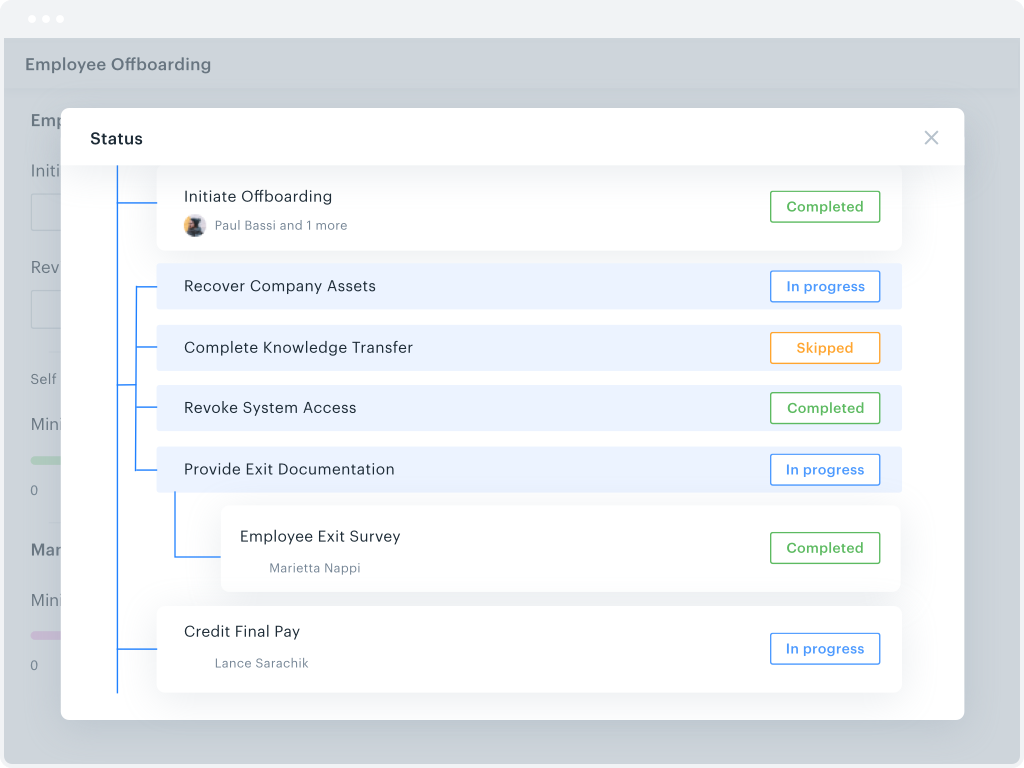
Kissflow is a low-code platform for custom application development tailored to business operations. Kissflow empowers process owners and IT developers to automate and build processes and applications for internal business operations.
$1,500
per month
Power Apps
Score 7.7 out of 10
N/A
PowerApps is a low code / rapid application development product from Microsoft that allows users to quickly build apps.
$20
per month per user
Pricing
Kissflow
Power Apps
Editions & Modules
Small Business
$1500
per month
Power Apps Premium
$20
per month per user
Offerings
Pricing Offerings
Kissflow
Power Apps
Free Trial
Yes
Yes
Free/Freemium Version
No
No
Premium Consulting/Integration Services
No
No
Entry-level Setup Fee
No setup fee
No setup fee
Additional Details
—
—
More Pricing Information
Community Pulse
Kissflow
Power Apps
Features
Kissflow
Power Apps
Low-Code Development
Comparison of Low-Code Development features of Product A and Product B
KiSSFLOW is well suited for any information heavy paperwork that multiple people approve and have access to complete work. It is less suited for processes that require a lot of back and forth with a form initiator. The workflows like to be very linear without much back tracking. It can do that but it prefers to be forward linear.
PowerApps is well suited for "quick-wins" and fast prototypes of business solutions. It also is beneficial for situations where business partners and developers work together - it allows the business folks to provide a "quick-and-dirty" prototype which is then fleshed-out by developers that are trained experts on the platform. The interactive and easy to understand representation of the solution allows business partners to "see" the solution and add, remove, or correct aspects of it themselves. It provides a common view and understanding of the actual solution across business units and tech teams. PowerApps, being a low-code\no-code platform is not well suited for business processes that require many complex computations or large amounts of custom code - such as solutions that are better architected as Web Site or "full-blown" desktop solutions. There are solutions that are just not easy or quick to accomplish in a low-code\no-code platform. Enterprise Architects should know the difference, however business partners often try to create a solution and only when stuck because it becomes too complex do they engage a tech team for assistance - at which point there are sunk-costs involved and hinderences to re-platforming the solution
I appreciate the automatic email notifications when it is your turn to complete a task. This keeps everyone on track.
I appreciate being able to "reassign" a task as well--leaving flexibility for some folks to cover for others when needed.
I appreciate the personal check-ins from our rep, asking how things are going. That makes me feel like someone is paying attention and wants me to be happy with the product.
Power Apps has formats that are pre-built that don't require any coding which makes it easier to achieve your vision. This does become a challenge if your App needs don't fit into that format.
We deal with a ton of data so the fact that you can connect to any data source in addition to their pre-stablished data connections makes the process a breeze.
The online learning resources and tutorials are helpful as well for those who are tech savvy.
Learning. If you are coming from a 100% paper process and have employees who know nothing more, then there is definitely a learning curve. You will need to bring someone in to help you train employees on the core concept of the change (the "Why are we doing this" questions). KiSSFLOW does have support, but this is more getting down to the details in your own work environment.
Visual learners will love it, but not non-visual. If you are an accountant, and your brain works like an accountant, then this program will be difficult to learn. It is very visual, and I have seen more success with visual learners than any others.
Bugs. A few years ago, there were a lot of bugs. There are not that many anymore. This is to be expected with any program, so if you are training an impatient staff who doesn't do well with error messages, you will want to be sure to pad the training sessions. I have not seen error messages in a long time; however, the nature of the beast is that you won't see one until you actually find one...
PowerApps has a great coding option, but there are some pieces of the tool that the requirement to understand code is a barrier to fun if the user doesn't code.
MUCH time can be spent looking for solutions on this young platform and the body of forum/help/lessons learned is not as robust as it will be in a few years.
Like many early-stage Microsoft products, PowerApps is a relatively blank slate that will be improved by the feedback of their users and ongoing feature development. Right now it seems that the product lacks a critical mass of use-case driven templates (there are some, but I haven't yet found one that didn't require more work to customize it to my need that it would take to build my own tool).
The system has room to grow as it's limited by not being able to edit POs after they've been approved. The system is great for registrations and syncing to other systems while including the attachments. The reporting from Kissflow is also easy to setup to link to other platforms such as Looker
PowerApps is a great solution and I have spent the last year familiarizing myself with the platform and building custom applications to complete a whole range of tasks such as asset management, custom invoice generation, and item restriction tracking. We as a company have barely begun to scratch the surface of what can be achieved with PowerApps.
I haven't encountered a need for support with KiSSFLOW. It's not a perfect platform, but it's functional, dependable, and reasonably intuitive. I can't fault a support team just because their product works!
The community forums are extremely responsive to questions asked, there is a good body of online documentation and many community posts to draw from. Although the platform has changed, which means some of the posts are out of date and the solutions provided aren't relevant. Of relevance, I read over 400 articles plus documentation to get this first app built in SharePoint, move it to SQL and make it work exactly the way it should.
KiSSFLOW wants you to be able to increase productivity, make it possible to "manage the chaos" (their own words) and simply make things better. It is exactly what it sounds like. For a visual learner, KiSSFLOW is perfect. It really does make good on its promise to help you manage the chaos, and it makes it easy for your employees to understand how your business works. More specifically, I recommended this program for a small school that had never automated anything. They knew nothing about the process. Bringing in KiSSFLOW allowed them to not only refine their process, but it gave awareness to other employees and ensure that they could work as a team, knowing the intricacies of how each department works (so, the Director would understand the many steps of Admissions before taking over after enrollment -- they would know what each family experienced).
1. PowerApps functionality comes with E1 over E3 License without adding extra costs 2. For Nintex you pay (at the beginning) for each workflow, so my intention would be, to do no workflows to prevent additional costs, but I want a platform with a fair price that allows me to create workflows without thinking about the price for each workflow and we use only some workflow and relative easy workflows and forms as a medium-sized company. 3. PowerApps provides a lot of functionality without needing to invest in premium features directly.
Somewhat expensive compared to other cheap (or free) task management alternatives. ROI depends on your specific needs and the size of your organization.
ROI can be ambiguous since KiSSFLOW is primarily for internal company use. A simple email thread could accomplish many of the same things, but with less efficiency.