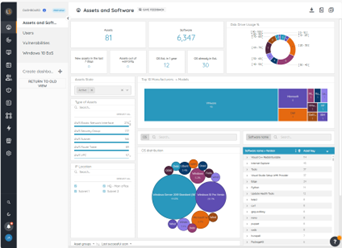
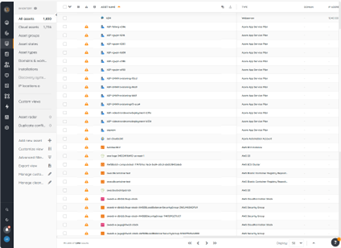
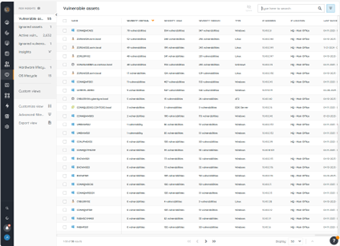
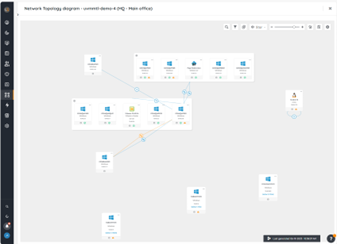
Lansweeper is an IT asset management solution that provides network discovery of all connected users, devices, and software within the IT estate. Lansweeper's device recognition capabilities provide complete visibility across the entire IT estate, in one centralized IT inventory. Lansweeper automatically and continuously discovers IT assets across infrastructure — servers, laptops, desktops, virtual & cloud machines, networks devices and IoT assets— in order to…
$2,868
per year Includes 2,000 assets
OpenNMS Meridian
Score 8.9 out of 10
N/A
OpenNMS Meridian is a scalable open source network management platform with network traffic analysis, network discovery, alerting, and monitoring. It's presented as a solution to monitor enterprise network performance and ensure the availability and performance of critical network services.
$42,000
per year Up to 2 Meridian and cores Up to 25 Minions
Pricing
Lansweeper
OpenNMS Meridian
Editions & Modules
Starter
$2868
per year Includes 2,000 assets
Pro
$5268
per year Includes 2,000 assets
Enterprise
Contact Sales
Starts at 10,000 Assets
Essential
$42,000
per year Up to 2 Meridian and cores Up to 25 Minions
Premier
$56,700
per year Up to 4 Meridian cores and Up to 100 Minions
Microsoft System Center needs to install agents on all IT asset for discovery and sometimes the agents can easily get corrupted. Lansweeper is a SaaS solution and it's easier to deploy to all IT asset that are connected to the network. This save us a lot of deployment time …
Lansweeper is a more mature software. Its ability to scan hardware and software is more to the point and not so full of bad info or junk you don't need. The Helpdesk feature has better options and not locked down to what the creator wants you to see. But the Reporting and …
Though Lansweeper isn't designed as a live network management tool, it's intended as a static Networked Asset Inventory Manager. It does share many functions with other applications, and the reporting tool in Lansweeper is much easier to use and to customize (create your own …
Lansweeper is DRAMATICALLY cheaper than KACE and provides the same level of reporting and inventory of asset data. Where KACE outshines Lansweeper, is Lansweeper has a very minimal software deployment system that requires clients to have direct access to a common file share. …
Lots of solutions were not able to scan platforms outside of Windows and LS was able to at some point. Lansweeper was the most affordable solution at the time when we did our selection. Lots of solutions we're not user-friendly and had way too many menus and configurations and …
For the price Lansweeper easily moved to the top of our list. It is extremely easy to use and manage. The amount of detail it gathers on each asset automatically was amazing. Manually adding an asset is very simple as well. The fact that it will detect peripherals on machines …
The main competitor that are not isted on your TrustRadius is PDQInventory and PDQDeploy, and those two come as a package and they blow Lansweeper out of the water for both software deployment and hardware inventory. That being said, comparing it to the others I see listed: …
Track-It!'s inventory control costs a lot more than LANSweeper. We're happy with the cost and features of LANSweeper compared to Track-It! We do use Track-It! for our ticketing system now. It is robust, full-featured, and blows LANSweeper out of the water. But for …
Two very different products. Snow has agents, Lansweeper is agentless with massively different functionality. Lansweeper will be good for 150 to 200 user businesses, Snow is better for anything larger. Lansweeper has little software recognition beyond Microsoft. Snow has better …
Lansweeper is great for what it does at its price point. However, it has nothing on Labtech. I have been spoiled by the feature rich Labtech and its automation greatness. If you are on a budget and need a robust product that will get the job done. I would recommend Lansweeper.
SolarWinds Web Help Desk is very bare bones and just not a very intuitive interface. The ticketing system was just a pain to work with and setup took ages upon ages to set up. ManageEngine was a nice solution but it also took quite some time to configure properly. It really was …
Although Grafana is in no way an alternative to OpenNMS's full functionality, it can be integrated with other solutions (including OpenNMS itself) to offer the graphing and data visualisation aspects of OpenNMS. In this regard, Grafana is more flexible, and some would say …
With the cost of OpenNMS, it is totally worth it. Additionally, the system works on most platforms which is great. The system can be configured following how to guides and Google searches and is open so it doesn’t require specialized admins. I prefer this system and it’s …
I've setup and administered Zabbix at past jobs and now just use OpenNMS from an end user perspective while working as a Sr. Network Engineer. I think both are great products, both have steep learning curves when it comes to initial setup and installation. From the end user …
OpenNMS's more attractive GUI and its price break were the main reasons our company chose to explore and use this product. However, it never managed to actually replace Nagios which had a much more established hold within the company. Perhaps we were over-monitoring, but our …
Because of its slowdown as we have acquired more equipment, I think LANSweeper may be better suited for smaller environments. We have 3000+ users and over 1500 devices on our WAN. It has shown considerable performance issues as we have grown. Maybe moving it to a full blown SQL instance will make things a bit better. But as it stands, it has gotten tiresome waiting for it to update and refresh.
Large network environments with few types of devices. The system is great but getting all of the MIBs loaded and to try and create unique rules /alarm type. Alarm correlation is doable but it takes too much manual work and XML configuration. I do enjoy the dashboard and surveillance categories.
Lansweeper is grabbing lots of data from the machines without slowing the network and the client machines. We can easily get all the installed software data, hardware and linked hardware and all the user you can grab from the AD (computer and user).
Lansweeper can now scan Windows, Mac and Linux with an agent installed (or not if you want that the server is the one pulling the data).
The web interface is really friendly user and offers lots of possibilities to personalize your dashboard as you see fit.
Reports engine is really powerful and easy to monitor your machines and also your security issues.
When we used OpenNMS you could download the base package for free and configure it fairly easily for your own environment. You can't beat that kind of price break.
OpenNMS had a very nice looking GUI that was easily navigated and fairly straightforward to understand and configure.
There were a wide variety of add-ons available for download and implementation.
Lansweeper offers a variety of customer support options (including KBs for self-serve and get in touch with them via email), and most importantly, it's a matter of dialing within their allotted supporting time frames. However, I always make sure to provide the following information:
- Screenshots of the issue (if available).
- Program Files (x86)/Lansweeper/Service/Errorlog.txt, as present on your Lansweeper server.
- If it exists, the error log present in Program Files (x86)/Lansweeper/Website/App_Data.
Lansweeper is DRAMATICALLY cheaper than KACE and provides the same level of reporting and inventory of asset data. Where KACE outshines Lansweeper, is Lansweeper has a very minimal software deployment system that requires clients to have direct access to a common file share. KACE allows you to upload files directly into it's environment, and assets can download over HTTPS those files for installation anywhere. Spiceworks was a great inventory and helpdesk system for free - but the product I feel has gone stale and not nearly as powerful as it use to be - for that reason Lansweeper appears to have taken up the charge and utilized a lot of Spiceworks was going for
Although Grafana is in no way an alternative to OpenNMS's full functionality, it can be integrated with other solutions (including OpenNMS itself) to offer the graphing and data visualisation aspects of OpenNMS. In this regard, Grafana is more flexible, and some would say prettier, than OpenNMS's graphing. For the best of both worlds, I'd recommend using them both!