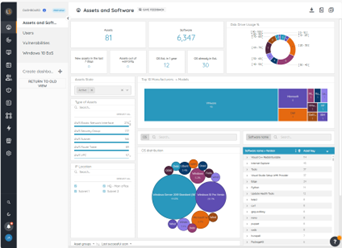
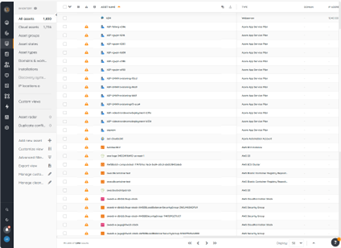
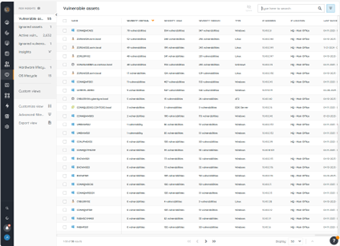
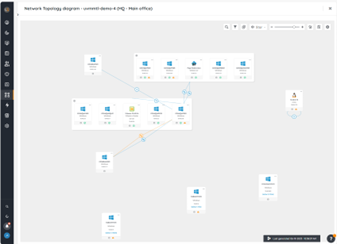
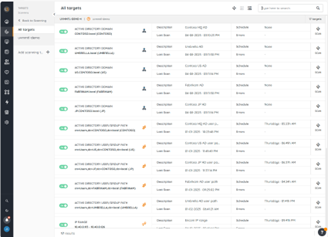
Lansweeper is an IT asset management solution that provides network discovery of all connected users, devices, and software within the IT estate. Lansweeper's device recognition capabilities provide complete visibility across the entire IT estate, in one centralized IT inventory. Lansweeper automatically and continuously discovers IT assets across infrastructure — servers, laptops, desktops, virtual & cloud machines, networks devices and IoT assets— in order to…
$2,868
per year Includes 2,000 assets
OpenText Network Node Manager i (NNMi)
Score 8.4 out of 10
N/A
OpenText Network Node Manager i is a network management platform acquired by Micro Focus from Hewlett-Packard Enterprise, and now supported by OpenText.
Microsoft System Center needs to install agents on all IT asset for discovery and sometimes the agents can easily get corrupted. Lansweeper is a SaaS solution and it's easier to deploy to all IT asset that are connected to the network. This save us a lot of deployment time …
Lansweeper is a more mature software. Its ability to scan hardware and software is more to the point and not so full of bad info or junk you don't need. The Helpdesk feature has better options and not locked down to what the creator wants you to see. But the Reporting and …
Though Lansweeper isn't designed as a live network management tool, it's intended as a static Networked Asset Inventory Manager. It does share many functions with other applications, and the reporting tool in Lansweeper is much easier to use and to customize (create your own …
Lansweeper is DRAMATICALLY cheaper than KACE and provides the same level of reporting and inventory of asset data. Where KACE outshines Lansweeper, is Lansweeper has a very minimal software deployment system that requires clients to have direct access to a common file share. …
Lots of solutions were not able to scan platforms outside of Windows and LS was able to at some point. Lansweeper was the most affordable solution at the time when we did our selection. Lots of solutions we're not user-friendly and had way too many menus and configurations and …
For the price Lansweeper easily moved to the top of our list. It is extremely easy to use and manage. The amount of detail it gathers on each asset automatically was amazing. Manually adding an asset is very simple as well. The fact that it will detect peripherals on machines …
The main competitor that are not isted on your TrustRadius is PDQInventory and PDQDeploy, and those two come as a package and they blow Lansweeper out of the water for both software deployment and hardware inventory. That being said, comparing it to the others I see listed: …
Track-It!'s inventory control costs a lot more than LANSweeper. We're happy with the cost and features of LANSweeper compared to Track-It! We do use Track-It! for our ticketing system now. It is robust, full-featured, and blows LANSweeper out of the water. But for …
Two very different products. Snow has agents, Lansweeper is agentless with massively different functionality. Lansweeper will be good for 150 to 200 user businesses, Snow is better for anything larger. Lansweeper has little software recognition beyond Microsoft. Snow has better …
Lansweeper is great for what it does at its price point. However, it has nothing on Labtech. I have been spoiled by the feature rich Labtech and its automation greatness. If you are on a budget and need a robust product that will get the job done. I would recommend Lansweeper.
SolarWinds Web Help Desk is very bare bones and just not a very intuitive interface. The ticketing system was just a pain to work with and setup took ages upon ages to set up. ManageEngine was a nice solution but it also took quite some time to configure properly. It really was …
Even though there are many products in the market such as from Solarwinds, CA Spectrum (no DX Spectrum), PRTG that offers similar or even with more flexibility the fault and performance monitoring still Micro Focus is a very nice tool when it comes to Scalability and Stability …
Micro Focus comes with in built database for store its raw polled data from network devices and hence it is preferred tool compared to others since other tools requires additional efforts and cost involved as compared to Micro Focus. Also the stability of the product is vey …
NNMi is best suited for enterprise-grade, large to very large infrastructure. You have fewer servers to install the product and manage all your devices through a single server, which also enhances ease of use.
Because of its slowdown as we have acquired more equipment, I think LANSweeper may be better suited for smaller environments. We have 3000+ users and over 1500 devices on our WAN. It has shown considerable performance issues as we have grown. Maybe moving it to a full blown SQL instance will make things a bit better. But as it stands, it has gotten tiresome waiting for it to update and refresh.
[Micro Focus Network Node Manager i (formerly HP Network Node Manager)] is like you implement it, setup monitoring and alerting and forget it forever until any major activity is there and that is possible because of the product's stability. Another reason for product stability is less features as compared to other vendor tools and its own inbuilt database.
Lansweeper is grabbing lots of data from the machines without slowing the network and the client machines. We can easily get all the installed software data, hardware and linked hardware and all the user you can grab from the AD (computer and user).
Lansweeper can now scan Windows, Mac and Linux with an agent installed (or not if you want that the server is the one pulling the data).
The web interface is really friendly user and offers lots of possibilities to personalize your dashboard as you see fit.
Reports engine is really powerful and easy to monitor your machines and also your security issues.
Most customers would like to see NNM get away from using some Java applets.
In environments where we see more than 10 different network device vendors in production, we see issues with L2 mapping. Different vendors use different L2 protocols. This can cause an issue with L2 discovery and mapping.
NNMi's user interface is described as well-designed and intuitive, making it easy for users to navigate and perform tasks quickly, thereby enhancing the overall user experience. The system offers a powerful network discovery mechanism that maps out your network's physical and virtual topology, enabling you to visualize connections between devices and identify potential issues. Fault monitoring is at its best. NNMi provides a unified environment for viewing faults, availability, and performance data, consolidating essential information into a single platform.
Lansweeper offers a variety of customer support options (including KBs for self-serve and get in touch with them via email), and most importantly, it's a matter of dialing within their allotted supporting time frames. However, I always make sure to provide the following information:
- Screenshots of the issue (if available).
- Program Files (x86)/Lansweeper/Service/Errorlog.txt, as present on your Lansweeper server.
- If it exists, the error log present in Program Files (x86)/Lansweeper/Website/App_Data.
Support is long and arduous and often are unable to help resolve the issue. We often have to do escalations or duty manager to get things moved. Even with a technical account manager, we do not see much improvement from a support point of view. This is an area where Micro Focus has a lot of improvement to do.
Lansweeper is DRAMATICALLY cheaper than KACE and provides the same level of reporting and inventory of asset data. Where KACE outshines Lansweeper, is Lansweeper has a very minimal software deployment system that requires clients to have direct access to a common file share. KACE allows you to upload files directly into it's environment, and assets can download over HTTPS those files for installation anywhere. Spiceworks was a great inventory and helpdesk system for free - but the product I feel has gone stale and not nearly as powerful as it use to be - for that reason Lansweeper appears to have taken up the charge and utilized a lot of Spiceworks was going for
NNMi is best suited for enterprise-grade, large to very large infrastructure. You have fewer servers to install the product and manage all your devices through a single server, which also enhances ease of use.