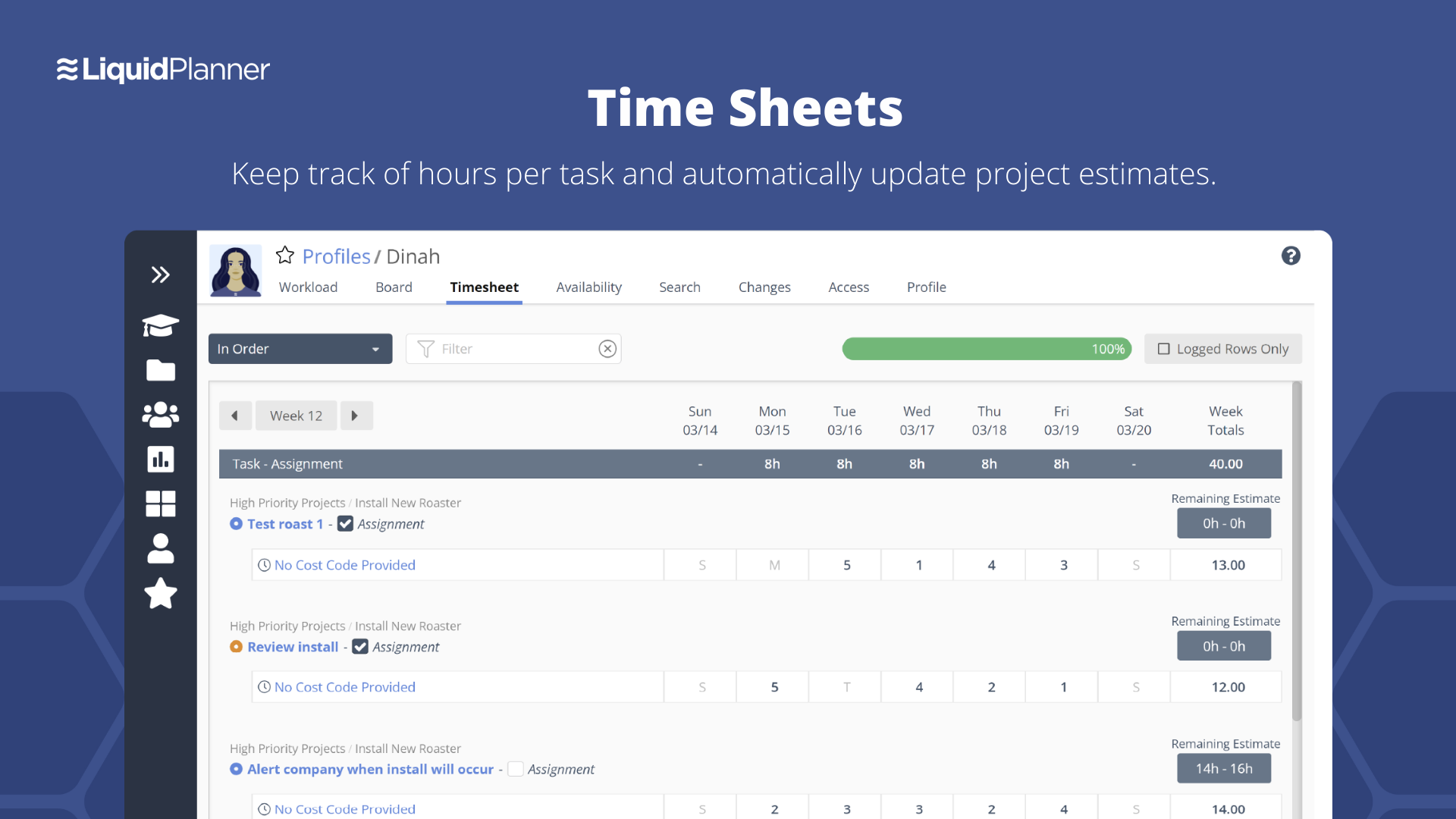
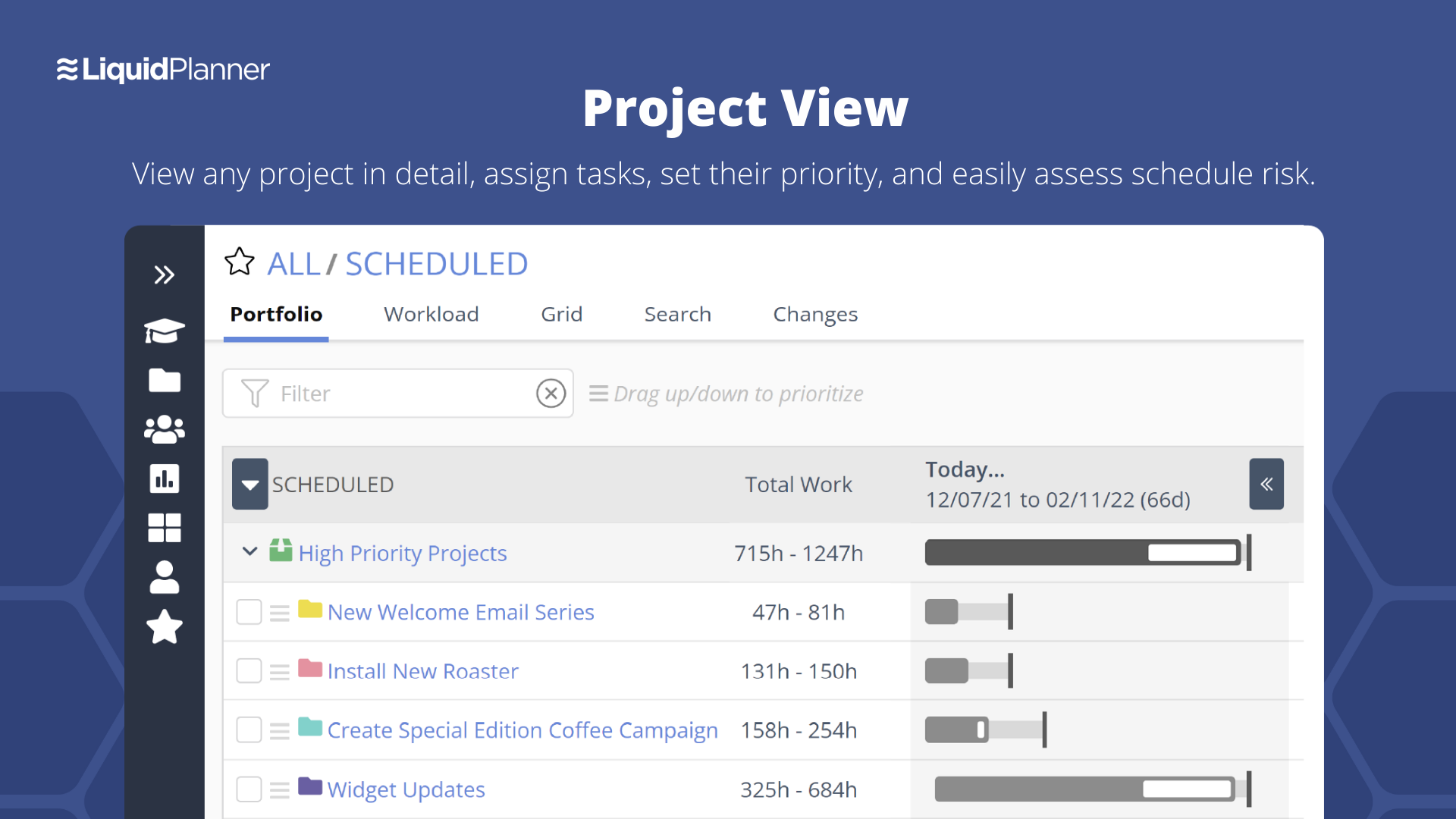
LiquidPlanner is a cloud based predictive project management solution. Some key features include: Dynamic Timeline View, Workload View, and Real-Time Activity Stream.
$0
per month per user
Smartsheet
Score 8.4 out of 10
N/A
Smartsheet is an online project management and collaboration tool. It includes automated alerts, instantaneous updating and sharing across team members, resource management, nested tasks organized in a hierarchy, a Gantt chart view, exportable and automated reports, and integration with email.
Smartsheet offers the best blend of features from its direct and indirect competitors. It is intuitive and collaborative, like Asana. It provides entry-level features from DevOps in regards to Agile, it offers traceability and integrations better than both Teams and Liquid …
I was attempting to do all I've described with Google Sheets & SharePoint. Google Sheets didn't have all the functionality we needed. SharePoint was too difficult to set up and doesn't work well with Mac users. None of the solutions I listed could match Smartsheet's versatility …
Features
LiquidPlanner
Smartsheet
Project Management
Comparison of Project Management features of Product A and Product B
LiquidPlanner
8.1
Ratings
6% above category average
Smartsheet
9.0
Ratings
16% above category average
Task Management
8.70 Ratings
10.00 Ratings
Resource Management
8.60 Ratings
9.00 Ratings
Gantt Charts
8.60 Ratings
9.00 Ratings
Scheduling
8.80 Ratings
10.00 Ratings
Workflow Automation
8.40 Ratings
8.10 Ratings
Team Collaboration
8.90 Ratings
10.00 Ratings
Support for Agile Methodology
7.70 Ratings
7.00 Ratings
Support for Waterfall Methodology
8.40 Ratings
8.90 Ratings
Document Management
9.90 Ratings
8.90 Ratings
Email integration
7.90 Ratings
9.90 Ratings
Mobile Access
4.80 Ratings
8.00 Ratings
Timesheet Tracking
7.20 Ratings
10.00 Ratings
Budget and Expense Management
7.60 Ratings
9.00 Ratings
Change request and Case Management
00 Ratings
9.00 Ratings
Professional Services Automation
Comparison of Professional Services Automation features of Product A and Product B
LiquidPlanner is amazing for any time of project management scenario where you have to manage several teams and details. Running a project through LiquidPlanner is so easy because it lets you break down the project into sections and folders and small tasks that you can assign to specific people. With a small to medium size team-- LiquidPlanner is amazing for organizing and tracking details. If you have a huge team or not a ton of details to track LiquidPlanner might not be right for you because it is a software that requires some good training to learn and has tons of functions that can be utilized so it seems better suited to be used by a smaller group looking to coordinate or for people who have lots of details that can be difficult to track.
The Smartsheet platform is extremely similar to Microsoft Excel, so if you are familiar with Excel, you will pick Smartsheet up quickly. Even if you aren't Smartsheet has a relatively simple user interface, meaning just about anyone can learn it. One thing to note is that the interface is that some may consider the interface so simple that they feel the need to look for more robust platforms. If you have a small to medium project that needs to be manages in a central hub, Smartsheet would be a great fit. If you have a very large project, I might consider looking into more advanced platforms.
Priority based planning. Every other planning software we've used relies on dates and therefore needs constant attention. Priority based planning means that the plan is always up to date.
Ease of use. LiquidPlanner has a very short learning curve. This is critical to getting team members to use it.
Forecasting. LiquidPlanner makes it very easy to run scenarios by simply dragging and dropping projects and reassigning resources.
Awesome Support. I get personal responses very fast. Usually within a couple hours. And, they listen and ask for more information.
LiquidPlanner's mobile app definitely needs some work. It doesn't display properly, having many things on the right hand side cut off. It doesn't update/refresh well. I can't imagine the mobile app will ever have the functionality of the Web version, but it needs to come a lot closer.
LiquidPlanner requires that everyone actively participate in order to maximize its benefit. However, it can be difficult for everyone to be on top of all of their responsibilities all of the time. Not sure on a solution, but it can be a lot to manage.
Smartsheet set up is similar to Excel, yet when you upload an Excel file, things like conditional formatting are lost. Smartsheet has its own conditional formatting, and you have to reinstate the rules. It would be great if those would apply automatically once a file is uploaded
Some Smartsheet management and access rules can take some tweaking to work properly. This may be a case of offering more info to admins so they can apply these better and with more efficiency
We may not renew LiquidPlanner's contract, but only because my company has recently been acquired and we'll be adopting some of the software that they're using to standardize process. LiquidPlanner's development team releases new features pretty often, so it seems like the gaps and inefficiencies are slowly getting smaller/less frequent
Smartsheet has made my work life easier. Reduced my email significantly. Smartsheet and SaneBox have got me leaving the office with 0... Yes 0 emails in my inbox. My inbox would reach 150-250 email per day. Smartsheet brought that number down significantly and SaneBox took it the rest of the way. Do yourself a favor and check out SaneBox, too.
Smartsheet is very easy to learn. However, while I have been able to pick it easily, Microsoft Excel and Project super users that I have trained on Smartsheet get bogged down in the differences and can find it frustrating. Explaining the differences ahead of time and why Smartsheet is being chosen instead of a different software seems to counteract those reactions
They have been great in trying to come up with creative solutions to help us do what we want to do with the platform. I would say their support has been exceptional because we have hit them with some complex requests.
They're a smaller company but they've always given great service when we rarely need to reach out. Pretty good online content but a bigger user base would help to produce more content in a self-sufficient community much as we see with Salesforce. To be fair we haven't needed their direct customer support very often. The sales guys are nice and not too pushy!
Work with the Smartsheet support team to get the best overall. If no one in your organization has used Smartsheet before, the support team will get things started. We had a couple of people who had used this product before and it was a great help in getting our framework together how we wanted to use it.
We had a "homebrew" time track program previously. It did one thing and it did it well--track time spent on an individual tactic or project, and it was deployed across all departments. It did not, however, capture the conversations or the work that could shed light on where problems occurred or issues were encountered.
Smartsheet is a dedicated project management tool that is built on spread sheet principles. When compared to Microsoft's own offering, Smartsheet came out on top in some areas like dedicated project management features vs having to build custom features to Microsoft 365. However when you compare them on price, Microsoft 365 definitely has more value than Smartsheet.
LiquidPlanner has improved everybody's visibility into tasks, decreasing the communication load required and increasing client communication and status updates, effectively increasing client satisfaction and likely helping to generate more business.
LiquidPlanner has improved our estimation and communication about changing estimates. Allowing us to keep a running estimate of the remaining work lets our account managers bill appropriately for overages ahead of time, preventing issues with customers who may not want to pay for work that was done.
LiquidPlanner sometimes takes time to navigate, find the right tasks, etc. and in this way, it may have added time to our day that we are not getting paid for. However, this is fairly negligible.