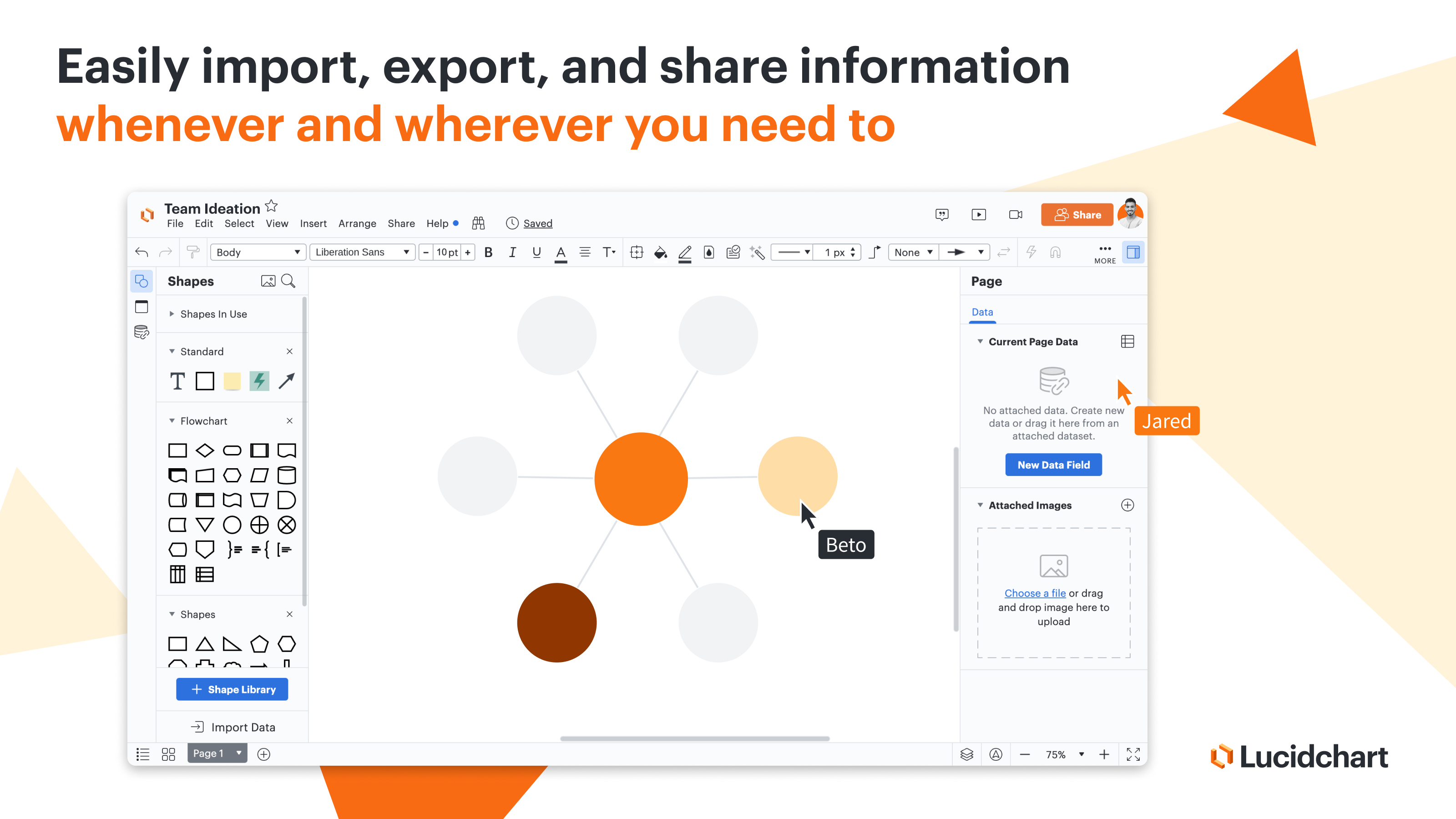
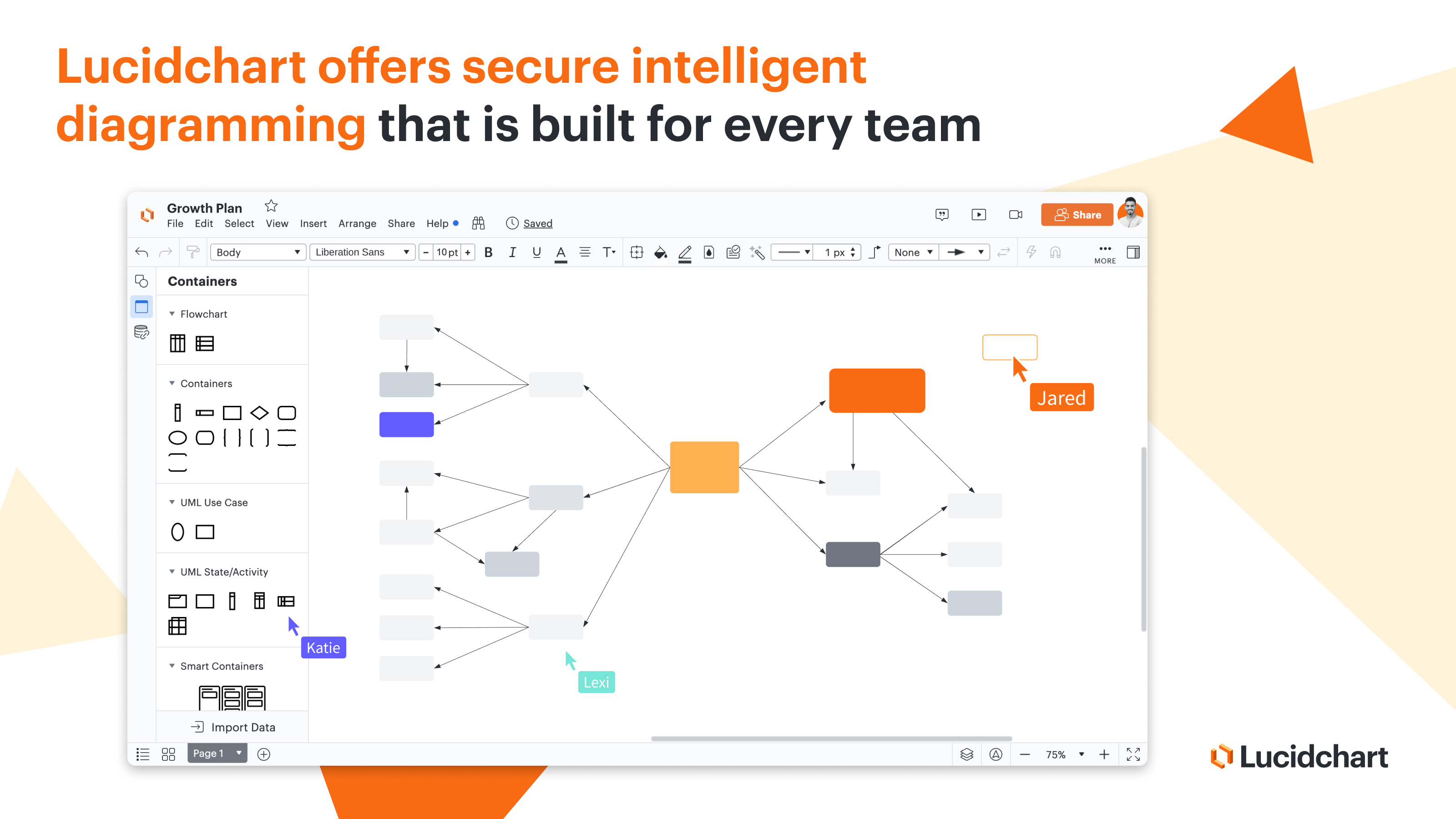
The Lucid Visual Collaboration Suite empowers teams to ideate, plan, design, build, and launch game-changing solutions from a shared infinite canvas.
$0
Microsoft Visio
Score 7.7 out of 10
N/A
Microsoft offers Visio, a diagramming tool for building flowcharts, diagrams (e.g. network diagrams), org charts and floor plans, available online as a subscription and also in enterprise level packages (e.g. Visio Professional).
$5
per month per user
Pricing
Lucid Visual Collaboration Suite
Microsoft Visio
Editions & Modules
Free
$0
Individual
$9
per month per user
Team
$10
per month per user (3 user minimum)
Enterprise
.
per year
Visio Plan 1
$5.00
per month per user
Visio Plan 2
$15.00
per month per user
Visio Standard 2024
$309.99
one-time fee On-premises diagramming solution, licensed for one PC
Visio Professional 2024
$579.99
one-time fee On-premises diagramming solution, licensed for one PC
Offerings
Pricing Offerings
Lucid Visual Collaboration Suite
Microsoft Visio
Free Trial
Yes
No
Free/Freemium Version
Yes
Yes
Premium Consulting/Integration Services
No
No
Entry-level Setup Fee
Optional
No setup fee
Additional Details
—
—
More Pricing Information
Community Pulse
Lucid Visual Collaboration Suite
Microsoft Visio
Considered Both Products
Lucid Visual Collaboration Suite
Verified User
Anonymous
Chose Lucid Visual Collaboration Suite
I've used Visio for block diagramming before, but using Lucid is like having google suite and microsoft 365 in one. We get to make all of our block diagrams as easily as visio, but we get the collaboration and sharing functionality that comes with google suite. It stacks up …
Draw.io is probably the closest but not as slick an experience and less collaborative tools (as of when I last used them).
Miro/Canva/Figma/Powerpoint can all mimic the functionality but are not explicitly designed for flow charting so you're fighting the UI as they want to do …
While all of the other platforms we have evaluated and some we even use, Lucid has it's own unique solution and aesthetic that we find to work well for us for many of our different deliverables. There is no "One-App-Does-All" solution out there, however, when it comes to …
Based on my personal experience, Lucid Visual Collaboration Suite is head and shoulders above any other competitor. Canva is good, but not intuitive at all. Miro is good as well, but not nearly as appealing and still lacks some of the logical functions that LucidSpark has. I’ve …
Lucid Visual Collaboration Suite is the best in class for documenting anything technical. It has all the templates you would need to represent anything from AWS, Microsoft as well as workflows for business processes. Other tools might cover just one of each of these things, but …
I usually use excalidraw for more ad hoc realtime visualizations, but I usually use Lucid Visual Collaboration Suite charts when I need to work on a visualization to present in a document / presentation
Lucid Visual Collaboration Suite has a more professional feel, an easier way of organizing and a simpler look. Miro, while very similar, has more aggressive color schemes and a more toy like UI that does not inspire as much confidence in our stakeholders.
I did not select Lucid Visual Collaboration Suite. That decision was taken by others in the organization. Given a choice, I am not sure I would have selected Lucid Visual Collaboration Suite. Miro was already established and, with a local client, was a better user experience in …
Much better, it doesn't get the steps in lines even a tenth as much as Visio, can use custom shapes as actual shapes rather than images, and aligns much easier. Lucid Visual Collaboration Suite is easily the best and I have tried about 4-5 programs over the last 5 years.
Miro had an advantage with the unlimited canvas until Lucidchart recently added that feature. Lucidchart seems to be better designed for creating drawings, incredibly technical or software architectural diagrams. Miro appears to be more designed for non-technical folks as a …
Draw.io is a free tool which has very limited functionality. Some of the advanced features like AI based generation and templates are not available in other applications. Also, I’ve used bot framework for different purposes. If customer wants to collaborate and they don’t have …
I have used Miro, but we use them for different things. There's not much I can compare as we use them only for what each one of them is strong, but if I had to compare, Miro doesn't have the power to deal with database diagrams like Lucid Visual Collaboration Suite Lucidchart …
I like Lucid Visual Collaboration Suite more than both of those for the ease of use and collaboration. Miro is similar with collaboration but didn't find as easy to use and Visio is similar to use but a bit harder to collaborate with.
Lucidchart is well beyond Microsoft Visio and is constantly improving. Visio is pretty much stagnant and hasn't been improved for several years, Lucid is constantly adding new functionality like AI powered functions and tools. We have no reason to pay for Visio licenses when …
Microsoft Visio defaults to more professional looking diagrams and has a simpler UX/UI, however it lacks hugely on the collaboration and engineering design templates side of things.
Microsoft Visio is easier to use than MindManager from the user experience. Whilst MindManager is lightweight and supports the browser which make it great with sharing diagrams, its display with information is not always intuitive especially when it becomes too nested. For …
Cost benefit is significant with Microsoft Visio vs Miro, as it is included in the MS 365 Suite. While it has less capability overall than Miro, for flowcharts specifically it is great.
Microsoft Visio is a much more improved software. Its technological features are very advanced compared to the ones from other softwares. It makes it easy to create work of quality, to analyze and visualize any process or data and generate ideas of any kind. It is the easiest …
We still use Sketchup for certain things - especially where the library of existing elements and drawings can be more easily grabbed and manipulated for our needs. Vectorworks is used by some of our main clients, and for theatrical lighting it’s the best out there. We also have …
I have personally never used or evaluated other programs similar to Microsoft Visio. I started using it following an indication from a colleague who told me that our University distributes it free of charge to its users. Since I first used it (more or less three years ago), I …
Publisher is more generic and while it is able to do what we need, Microsoft Visio allows us to do the same thing using less time and higher accuracy with features like custom icon sets, ease of linking and maintaining links to denote work flows as well as scaling up without …
I feel like they all can play an important role in your organization's success but for those who are comfortable with the Microsoft suite of tools, I would choose Visio.
Other paid services have rather better aesthetics and template/graphic support compared to Visio. However, Visio is a clear winner being a part of the Microsoft family and the positives it brings along such as collaboration, service, etc.
Visio is easier to use however a smart draw is a wonderful tool with some unique libraries. Visio, however, is a little easier to license, install and manage.
Chose it for the ease of use, the professionalism of the exported visuals, and the quick and easy learning curve. I personally use Adobe Illustrator for some of the more complex graphics needed, as I've been using that platform for years; but training contractors and clients …
We have used Lucid charts in the past, Lucid chart does the job well. Microsoft Visio has more templates and seamless integration with MS word and excel. Both of the software does the diagram and charting pretty well but Visio is costly in comparison to Lucid charts. If you …
Microsoft Visio is very user-friendly and has many options for the created to use in order to get to their final product. The tool helps to get complex ideas into a visual design, therefore making it easier for other team members to understand the message you are trying to …
Even though it’s a more expensive solution, Vizio is built for the enterprise. Therefore, it integrates perfectly with our existing Microsoft stack, and quite frankly, because it’s such a more mature product, it provides exactly the functionality we need and expect.
Well, I have more than 25 years of experience with all MS products since MS Windows was launched; the user interphase has changed to improve and accommodate the new feature requirements as they come along. Overall, MS Office is coming to have a single experience but separating …
Some comparable products I have used to complete similar tasks would be Microsoft PowerPoint and Adobe Illustrator. Although both of these are very great programs in their own right, I would say Microsoft Visio is still the best to use, specifically when wanting to create …
Visio is superior to the Lucid chart. They are similar in functionality, but Visio is much better when combined with other Microsoft applications (e.g., MS word to document policies and procedures or MS power point when presenting to executives). I like the Lucid Chart is a …
I looked ar LibreOffice Draw and Lucidchart. While LibreOffice Draw was free and Lucidchart was less expensive, neither had the Microsoft familiarity that Microsoft Visio has. I found myself spending a great deal more time trying to figure out how to perform the same functions …
Microsoft Visio is more aligned for professional presentation where a process flow is very important to be read and understood. Microsoft Visio is the market leader in this field and has all the great options. Comparing to other tool Microsoft Visio is great for flow charts and …
Microsoft Visio and Miro are both diagramming and visual collaboration tools, but they have some differences in terms of their capabilities and intended uses.One main difference between the two is the range of diagram types that they support. Microsoft Visio is primarily …
Visio has a larger number of templates. More versatile. There are many ready-made elements. More reliable. It is better integrated with other software products, both from the Microsoft ecosystem and with other ecosystems. More convenient to learn. There are much more …
Lucidchart is very simple to use and integrates well with other Microsoft products. Lucidchart is great for simple diagrams but it is not a perfect solution for complex diagrams [compared to] Microsoft Visio which stands out. Microsoft Visio has really advanced diagramming …
We have evaluated Dia, Microsoft Word, Microsoft PowerPoint, and Good Drawings, but Microsoft Visio stands out in terms of flexibility, time, and efforts as well as impressive presentations. Microsoft Visio is very easy to use and produces standard and very complex diagrams in …
It is hard to think of ways in which Lucid Visual Collaboration Suite would not be best suited to provide an effective tool for any organization to find success in its use. Whether it is a visual display to map an organizational structure, a collaboration to find an answer of how to improve workflow, or even to display the upcoming budget needs, working in Lucid can seamlessly provide that!
I believe any company or individual that is looking to get a process map visualized; would be a great tool. The tool is a great way to get complex ideas onto “paper” for all to see. Visio can be harder to use if you have an idea that is going in many different directions. If all ideas can fit on one page, this is the tool to use to visualize it all.
Serverless. You don't need to install another program to create diagrams, you just open a new tab and there you are, ready to go.
Collaboration. You don't need to update your colleague diagram by creating a new file and creating a new file version, you both are in the same diagram and you and all the team are free to update it at any time, at the same time, you are seeing the same thing. That is really helpful and time-saving.
Shapes. It has any shape that you can think of and Lucidchart is always updating them, I can create an Azure solution architecture, an AWS one, an old on-premise solution. Or just put standard shapes to describe a business process. Providing so many specific shapes help the diagram to express specific information, and for specific teams, that's less text and more visual information, you don't need to put a text below a standard database shape (this is an Azure SQL database), you just put the azure shape and done. That....is beautifully helpful.
We use Microsoft Visio to keep our diagrams updated and to that end we will need the subscription to keep using the software. Otherwise we will be left with PDF versions of the diagrams.
The interface is easy to use and understand and most features feel very familiar from the start. There are so many features and functions that users may not know it can be done without some instruction. Lucid's champion network is a great, fun resource to learn more about the product.
I think Microsoft Visio is pretty easy to initially pick up and understand the user interface to dive into make basic models. It would be nice if there were some fit for purpose templates so that not as much time needs to be spent on some types of engineering diagram structure. Trying to work on a single Visio file with multiple team members is also a sticking point.
I would rate the overall support for Lucidchart as a 9. The support provided is generally robust and responsive. Their help center, tutorials, and webinars offer extensive resources for users. The ticket-based support system is effective, providing timely resolutions to most issues. Moreover, they actively gather user feedback, demonstrating a commitment to continuous improvement
Overall, I feel that Microsoft's support is weak. They are now such a behemoth that their model of putting documentation online for their users to sift through is totally outgrown. Given the amount of money you pay for these licenses, Microsoft should provide easy one-on-one support for their products via email or chat. The idea of paying their rates for support incidents is ridiculous. If you have an enormous amount of time on your hands, use their support websites and you will eventually find a solution most of the time.
Based on my personal experience, Lucid Visual Collaboration Suite is head and shoulders above any other competitor. Canva is good, but not intuitive at all. Miro is good as well, but not nearly as appealing and still lacks some of the logical functions that LucidSpark has. I’ve also used Apple FreeForm quite a bit, which is a free software with Apple. Once again you can accomplish the same things in any of these software, but Lucid Visual Collaboration Suite is so much better to the point that it is 3-4 times faster to use Lucid than Free Form or Canva.
I have personally never used or evaluated other programs similar to Microsoft Visio. I started using it following an indication from a colleague who told me that our University distributes it free of charge to its users. Since I first used it (more or less three years ago), I have never left Microsoft Visio. Excellent!
Though I can't necessarily provide hard numbers, I can confidently say that Lucidchart has saved countless hours for myself and my teams as we don't need to try to develop some type of complex diagram using markup or any kind of code.
I have previously been able to build a complete ERD using Lucidchart in a past position, which the company never had before. It ended up being used by countless teams in the company and ultimately in a large-scale data stack migration effort.
Greatly enhanced time to create share and finalize documentation.
Better collaboration between disparate teams, such as marketing opts and sales ops.
Transparency/visibility into standardize, workflows and processes have led to better team, relationships, and better results that translate directly to the bottom line and ROI.