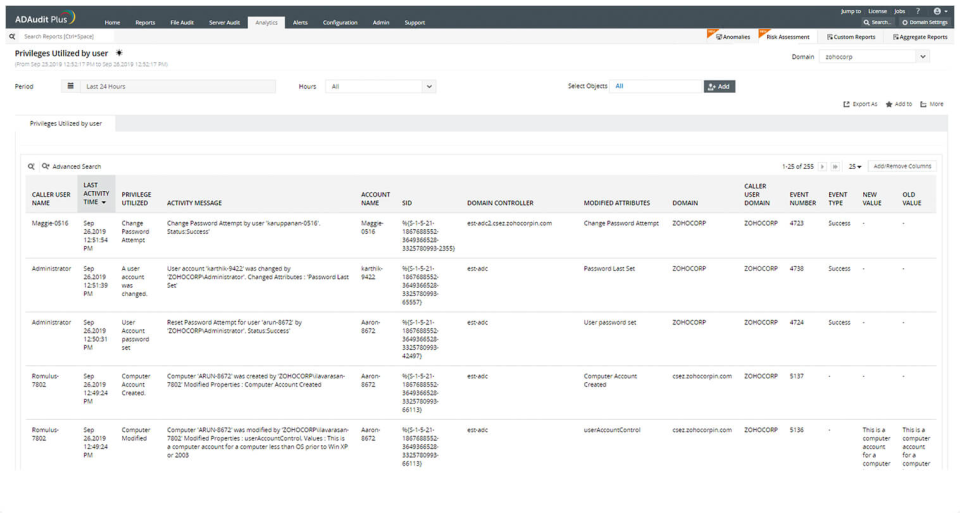
ADAudit Plus offers real-time monitoring,
user and entity behaviour analytics, and change audit reports that helps users keep AD and IT infrastructure secure and compliant. Track all changes to Windows AD objects including users, groups,
computers, GPOs, and OUs. Achieve hybrid AD monitoring with a single, correlated view of all
the activities happening across both on-premises AD and Azure AD. Monitor every user's logon and logoff activity, including…
$595
per year
Nagios Core
Score 8.6 out of 10
N/A
Nagios provides monitoring of all mission-critical infrastructure components. Multiple APIs and community-build add-ons enable integration and monitoring with in-house and third-party applications for optimized scaling.
N/A
Pricing
ManageEngine ADAudit Plus
Nagios Core
Editions & Modules
Standard
$595
per year
Professional
$945
per year
Single License
Free
Single License
Free
Offerings
Pricing Offerings
ManageEngine ADAudit Plus
Nagios Core
Free Trial
Yes
Yes
Free/Freemium Version
No
Yes
Premium Consulting/Integration Services
No
No
Entry-level Setup Fee
No setup fee
No setup fee
Additional Details
Pricing is dependent on the number of domain controllers and starts at $595/year for the Standard edition, and $945/year for the Professional edition.
—
More Pricing Information
Community Pulse
ManageEngine ADAudit Plus
Nagios Core
Features
ManageEngine ADAudit Plus
Nagios Core
Monitoring Tasks
Comparison of Monitoring Tasks features of Product A and Product B
ManageEngine ADAudit Plus
7.0
Ratings
10% below category average
Nagios Core
-
Ratings
Remote monitoring
6.60 Ratings
00 Ratings
Network device monitoring
4.30 Ratings
00 Ratings
Multiple Server Monitoring
8.60 Ratings
00 Ratings
Multi-device monitoring
8.50 Ratings
00 Ratings
Automated alerts and notifications
7.10 Ratings
00 Ratings
Management Tasks
Comparison of Management Tasks features of Product A and Product B
ManageEngine ADAudit Plus
8.3
Ratings
12% above category average
Nagios Core
-
Ratings
Service configuration management
7.00 Ratings
00 Ratings
Software and hardware inventory
10.00 Ratings
00 Ratings
Policy-based automation
7.90 Ratings
00 Ratings
Reporting
Comparison of Reporting features of Product A and Product B
ManageEngine ADAudit Plus
8.1
Ratings
7% above category average
Nagios Core
-
Ratings
Performance data reports
8.00 Ratings
00 Ratings
Customizable reporting
7.50 Ratings
00 Ratings
Data visualization
8.40 Ratings
00 Ratings
Risk analysis
8.40 Ratings
00 Ratings
Security
Comparison of Security features of Product A and Product B
ManageEngine is mostly a "check the box" solution for SIEM systems. We needed something that satisfied our customer and was cost-effective. I would highly rate the system on "worth what paid for". Support is eager to please and prompt. My only issue is that it's mostly based outside the US with helpful, but non-native speakers so it's hard to understand them. I wish they would spring for better help "phone lines" so I'm not dealing with difficult to understand and unclear speakers.
Nagios is simply a very configurable and rock solid monitoring engine. For these reasons I would recommend it to any IT professional in any medium to large organization where creating custom checks and programming ones custom needs into the configuration is practical. I would be more hesitant to recommend it as a first monitoring solution for a small business which is usually accompanied by a less experienced and/or more time constrained admin.
Logons - reports are very clean and concise and accurate
Account Lockouts - very challenging to do without ManageEngine ADAudit Plus. The tool allows us to easily locate the device or, at the very least, point us in the right direction!
AD change management - IT admins should consider this a necessity, and ManageEngine ADAudit Plus facilitates this seamlessly
In earlier releases there were quite a few bugs and performance issues. These have since been resolved.
When integrated with the Log360 Suite, it can be confusing on whether EventLog Analyzer or ADAudit Plus are "managing"/"Ingesting" the data from a given endpoint.
It's built by engineers for engineers so setting it up and configuring it is relatively complicated. It could really use a simplified configuration approach, or a GUI to set it up instead of editing config files.
I'd like to see the option to have service notification settings inherited from the host setting notifications. They have to be set up separately but they are often the same, so it would be nice to have less redundancy.
It works great for everything we need and use. Any issues in the software are pretty easy to resolve with tech support. And they are very responsive to resolving issues. Even ones where a fix/patch are required. At present, the software does everything we need it to for compliance, audit, and account review.
We're currently looking to combine a bunch of our network montioring solutions into a single platform. Running multiple unique solutions for monitoring, data collection, compliance reporting etc has become a lot to manage.
ADAudit with its cloud and on prem install option allows any organization to get in on AD report management. Whether you need to report internally only for for external audit controls its a great tool with flexibility to handle most any user or group report capability. Since this also includes m365 integration it enables IT pros to administer usage, license, cost control and permission access to most anything in Microsoft's portfolio. Its a great tool all around for AD integrated access needs.
The Nagios UI is in need of a complete overhaul. Nice graphics and trendy fonts are easy on the eyes, but the menu system is dated, the lack of built in graphing support is confusing, and the learning curve for a new user is too steep.
The attention to cases or situations with the tool has been exceptional. being able to count on the manufacturer either by mail, call or chat. generate cases directly from the application allows you to have personalized support in order to solve problems that has been able to appear.
I haven't had to use support very often, but when I have, it has been effective in helping to accomplish our goals. Since Nagios has been very popular for a long time, there is also a very large user base from which to learn from and help you get your questions answered.
The remote setup team helped when i needed it and setup weas very straight forward and easy. The advanced setup for an external db and customizations for our latest version AD environment went pretty easy once they found documentation on customization.
In terms of features, ADAudit Plus offers a comprehensive set of features for monitoring and auditing Active Directory, including real-time alerts, detailed reports, and user behavior analytics. The platform also offers support for multiple platforms, including Windows, UNIX, and Linux, as well as integration with other ManageEngine tools.
We have tested several other monitoring products which were able to monitor the basic matrix (Memory, DiskUsage, CPU%, UpTime, Running Service Status, Port 80 Up/Down). Although some offered far better UIs, they lacked the ability to monitor ANYTHING. Zabbix, being the only contender worthy of competing, is a good alternative to Nagios. We also tried Zenoss Core & OpenNMS which were good enough for non-Linux engineers to get started with. OP5 was another service-oriented monitoring solution we evaluated. Apart from Nagios, Consul is heavily used to monitor & register the micro-service systems & end-point URLs. Due to the time invested (9+years) in Nagios, we were able to get more components installed/configured easily than alternatives.
The visibility of changes made in AD are very helpfull. We had an admin that made a change in a GPO that causes some strange behaviour in our environment. Normally that would take days to find, especially because the admin was a few days out of office and couldnt tell us the change he made. But after looking into our alerts we found very fast the specific change that was made to a GPO that pointed us in the right direction to solve the problem within 30 minutes.
No more ghost accounts and password never expires in our AD, the security level is therefore much higher then it was before. And we need less manhour to maintain that.
Before ADAuditplus we had several hundred accounts with password never expires and at least 15 changes on that item every week. Since we have ADaudtiplus we have no accounts with password never expires and we only see modifications on that item sometimes when a new IT employee starts within our group. IT crew learns fast what to do and especially what NOT to do in our environment to keep things secure.
Before ADAuditPlus I wrote PowerShell scripts to create reports for management, since ADAuditplus the reports are build automatically every month and send to management.
With it being a free tool, there is no cost associated with it, so it's very valuable to an organization to get something that is so great and widely used for free.
You can set up as many alerts as you want without incurring any fees.