Matillion vs. Talend Data Integration

Overview
ProductRatingMost Used ByProduct SummaryStarting Price
Matillion
Score 7.9 out of 10
N/A
Matillion is a data pipeline platform used to build and manage pipelines. Matillion empowers data teams with no-code and AI capabilities to be more productive, integrating data wherever it lives and delivering data that’s ready for AI and analytics.
$2.50
Pay as you go per user
Talend Data Integration
Score 10.0 out of 10
N/A
The Talend Integration Suite, from Talend, is a set of tools for data integration.N/A
Pricing
MatillionTalend Data Integration
Editions & Modules
Developer: For Individuals
$2.50/credit
Pay as you go per user
Basic
$1000
per month 500 prepaid credits (additional credits: $2.18/credit)
Advanced
$2000
per month 750 prepaid credits (additional credits: $2.73/credit)
Enterprise
Request a Quote
No answers on this topic
Offerings
Pricing Offerings
MatillionTalend Data Integration
Free Trial
YesNo
Free/Freemium Version
NoNo
Premium Consulting/Integration Services
NoNo
Entry-level Setup FeeNo setup feeNo setup fee
Additional DetailsBilled directly via cloud marketplace on an hourly basis, with annual subscriptions available depending on the customer's cloud data warehouse provider.
More Pricing Information
Community Pulse
MatillionTalend Data Integration
Considered Both Products
Matillion
Chose Matillion
Matillion's price is cheaper than Talend and has similar functionalities Matillion has better functionality than Apache Hop
Chose Matillion
Matillion has more security and better version control features. The support of amazing with new connectors introduced every day.
Chose Matillion
Matillion is cheaper and we really like the customer support of Matillion as well as lerning materials provided by Matillion were far better. They also made connectors for us for free while others were charging us for it.
Chose Matillion
I have not used any other products yet
Chose Matillion
Matillion gives great ability to connect to variety of sources and bring data into cloud data warehouse using connector based approach with which we can build complex transformation jobs which can do automated data fetches from your sources.
Chose Matillion
Matillion is affordable, easy to use with a graphical interface
Chose Matillion
I think Matillion is more cost effective and user friendly as compared to the ones mentioned
Chose Matillion
Matillion has better capabilities and better built-in elements that saves your time and efforts. also the connectivity across multiple data warehousing tool is better in Matillion. even the performance of the pipeline and the time required to create a particular pipeline is …
Chose Matillion
Cheaper and faster and more innovative
Chose Matillion
My manager selected Million based on his previous work experience. He believes it is easy to use and maintain, cheaper than competitors, and suitable for our use case.
Chose Matillion
The only other ETL tool I've used was SSIS. At first I thought Matillion seemed "kiddish" after using the polished Microsoft tool but now I think Matillion is easier and can do much more as it has so many built-in connectors etc. We selected Matillion at our job because of …
Chose Matillion
In my opinion Matillion provides more flexibility then the other tools I mentioned.
Chose Matillion
n/a -- joined the team after they already were established in Matillion. Have had brief looks at other ETL products but found nothing compelling enough to suggest a change.
Chose Matillion
We selected Matillion primarily because of it's ability to connect to numerous data sources and easily create transformation jobs. While FiveTran does a better job managing and examining deltas, it is not easy to use and is very non user friendly. SSIS was not a good fit for …
Chose Matillion
Fivetran offers a managed service and pre-configured schemas/models for data loading, which means much less administrative work for initial setup and ongoing maintenance. But it comes at a much higher price tag. So, knowing where your sweet spot is in the build vs. buy spectrum …
Chose Matillion
We decided to move forward with Matillion because it was the best tool among tools that support both ingesting data from a source system to a target database and running transformation workflows on it afterwards. Fivetran and Airbyte only support data ingestion and we had our …
Chose Matillion
Cost and ease of use were better for our purposes. Matillion distinguishes itself from Fivetran and Snaplogic through its user-friendly design, no-code interface, in-depth transformation capabilities, allowing for complex data manipulations directly within the platform, …
Chose Matillion
The Matillion selection was not my decision. But I think it's a good enough choice. It is especially valuable that the team can learn Matillion easily and that the project can be understood by the entire team with the visual environment instead of complex ETLs.
Chose Matillion
Both the Databricks platform and Dbt Cloud are more powerful from the point of view of the development lifecycle and data use cases covered. They are also more complex and require specialized data engineering skills to be used. Matillion has a lower barrier of entry for small …
Chose Matillion
Removes most of the complexity around setting up and preparing things.
If you could describe with words what needs to be done to move data from A to B, the implementation in Matillion would probably be the most similar in terms of simplicity of understanding what you are doing …
Chose Matillion
Better UI, logging, minimal configurations, easy previews and faster
Chose Matillion
Matillion is a good tool for integrating multiple clouds. Informatica has been a market standard for many years, it provides multiple capabilities for data governance, data quality, etc. However, Informatica is pretty expensive compared to Matillion. Also, Matillion is more …
Chose Matillion
This is my first time using an ETL tool
Talend Data Integration
Chose Talend Data Integration
Talend has many built-in components that reduce the development work. We were able to complete the project sooner than expected. Easy to on-board resources as it is straightforward to use. We can manage all the pipelines in the cloud with simple alerting. No major downtimes. …
Chose Talend Data Integration
In comparison with the other ETLs I used, Talend is more flexible than Data Services (where you cannot create complex commands). It is similar to Datastage speaking about commands and interfaces. It is more user-friendly than ODI, which has a metadata point of view on its own, …
Chose Talend Data Integration
Talend can integrate with any source, whereas Jitterbit is better used for APIs.
Chose Talend Data Integration
Talend Product Intelligence was a easy win because of below reasins
  1. Level of customization that is possible
  2. Ability to create custom queries Richness in feature set
Chose Talend Data Integration
Ease of use
Efficient integration interface
Reliable with large datasets
Chose Talend Data Integration
I wasn't a part of product evaluation for Talend Product Intelligence.
Chose Talend Data Integration
SAP Business Object Data Services is another ETL offering that I have used before Talend. The biggest advantage is that Talend is open source and very user-friendly. SAP BODS needs to improve on the user interface. Also, it works well with relational databases but is not very …
Chose Talend Data Integration
Data Preparation is something which can improved and connectivity with more visualization tools are few factors which can be improved.
As Talend Data Integration becomes more cloud focused, the gap in features / functionality widens between on-premise functionality and the …
Chose Talend Data Integration
You have more control on what happens to your data and it still is a visual tool where you can see whats happening when.
Chose Talend Data Integration
Pros
Custom coding in Java
Easy deployment
Generates a Java code that can then integrate different application
Chose Talend Data Integration
Talend is the best for ETL out of all the other products we looked at. Of course, it is not meant for synchronous services. But, batch jobs that we schedule and run on bulk data are the best fit for Talend Data Integration. Though Talend does not provide a preview of …
Chose Talend Data Integration
Most other tools of similar nature work well for small and medium sized data warehouses, but fail to maintain performance for very large data warehouses. However, Talend works decently well on large data as well. On the other hand, there are software tools like Oracle Data …
Chose Talend Data Integration
Talend is much versatile in assimilating various different business use cases. It covers more functionality and is packed with tons of features to explore. It has the ability to fine tune to each project, and not be a one-fits all solution. Problems with Excel, is that it is …
Chose Talend Data Integration

There are code building and code conversions internally in most of these ETL tools. The repository is an overhead in the ETL process. There may be a need for a full-time administrator to manage deployments and monitor jobs. With Talend, it seems to be transparent with the pure …

Chose Talend Data Integration
Compared to Microsoft SQL Server Integration Services (SSIS) talend gives developers much more tools and flexibility in order to achieve different ETL processes. For instance, SSIS, separates processing from data management, and Talend mixes both stages so that you can perform …
Chose Talend Data Integration
Talend has all the data integration features needed for an enterprise along with big data integration. It stands tall as a data integration suite and has a low cost as compared to some of its commercial counterparts. Talend does not have reporting tools like Pentaho but its …
TrustRadius Insights
MatillionTalend Data Integration
Highlights

TrustRadius
Research Team Insight
Published

Matillion and Talend Data Integration are both data integration tools. Matillion specializes in ETL for cloud-based warehouses. Talend differentiates by offering a free open source version of its data integration platform. Talend is more commonly used at the enterprise level, with a larger focus on big data integration,  while Matillion’s cloud focus is gives it functionality across company sizes. 

Features

Both Matillion and Talend provide a variety of features for data integration. 

Matillion offers a robust Extraction, Transformation, and Loading (ETL) capability. Users highlight its ability to centralize and structure data from a wide range of platforms and cloud environments, particularly AWS applications. Matillion’s focus on cloud-based data warehouses makes it ideal for this use case.

Talend differentiates with its free open source data quality management and integration software, which can be used for simple use cases. At larger scale, Talend also provides a high degree of customizable connectors between different system, including custom-built connectors. 

Limitations 

Talent and Matillion also both have some limitations to their offerings. 

Matillion’s users have struggled to create and utilize the platform’s documentation for updates and project management. This issue is particularly pronounced when implementing or integrating Git. 

Talend’s free version is extremely limited for most users. Many ETL tasks quickly scale beyond the technical functionality of the free version, requiring paid upgrades. Talend also struggles with utilizing Git, particularly in the free version of the software. 

Pricing 

Matillion provides four packages for its ETL capabilities, priced per hour of usage. The “Medium” package, at $1.27/hr, provides 2 users and 6 environments. The “Large” package, at $2.74/hr, supports 5 concurrent users and 15 environments and clustering. The “XLarge” package, at $5.48/hr, supports 12 concurrent users and 35 environments. Enterprise package pricing is available by quote from the vendor. 

Talend offers four products around data integration. Data Quality and Data Integration are available in open source versions. There are also Data Integration Entry Level and a Data Management Platform package. The former includes more advanced integration features, and the Data Management Platform includes advanced data profiling and quality governance. Pricing is available by quote from the vendor. 

Features
MatillionTalend Data Integration
Data Source Connection
Comparison of Data Source Connection features of Product A and Product B
Matillion
8.3
Ratings
1% below category average
Talend Data Integration
9.5
Ratings
12% above category average
Connect to traditional data sources8.70 Ratings10.00 Ratings
Connecto to Big Data and NoSQL7.90 Ratings9.00 Ratings
Data Transformations
Comparison of Data Transformations features of Product A and Product B
Matillion
6.9
Ratings
17% below category average
Talend Data Integration
9.0
Ratings
10% above category average
Simple transformations7.50 Ratings9.00 Ratings
Complex transformations6.40 Ratings9.00 Ratings
Data Modeling
Comparison of Data Modeling features of Product A and Product B
Matillion
8.2
Ratings
3% above category average
Talend Data Integration
9.0
Ratings
12% above category average
Data model creation9.10 Ratings9.00 Ratings
Metadata management9.10 Ratings10.00 Ratings
Business rules and workflow8.30 Ratings8.00 Ratings
Collaboration7.20 Ratings9.00 Ratings
Testing and debugging7.50 Ratings9.00 Ratings
Data Governance
Comparison of Data Governance features of Product A and Product B
Matillion
8.2
Ratings
1% above category average
Talend Data Integration
8.5
Ratings
5% above category average
Integration with data quality tools8.20 Ratings7.00 Ratings
Integration with MDM tools8.20 Ratings10.00 Ratings
Best Alternatives
MatillionTalend Data Integration
Small Businesses
Skyvia
Skyvia
Score 9.9 out of 10
Skyvia
Skyvia
Score 9.9 out of 10
Medium-sized Companies
IBM InfoSphere Information Server
Score 8.0 out of 10
IBM InfoSphere Information Server
Score 8.0 out of 10
Enterprises
IBM InfoSphere Information Server
Score 8.0 out of 10
IBM InfoSphere Information Server
Score 8.0 out of 10
All AlternativesView all alternativesView all alternatives
User Ratings
MatillionTalend Data Integration
Likelihood to Recommend
7.8
(0 ratings)
10.0
(0 ratings)
Likelihood to Renew
8.6
(0 ratings)
-
(0 ratings)
Usability
7.0
(0 ratings)
9.0
(0 ratings)
Support Rating
7.4
(0 ratings)
6.6
(0 ratings)
Implementation Rating
8.2
(0 ratings)
-
(0 ratings)
Product Scalability
7.3
(0 ratings)
-
(0 ratings)
Vendor post-sale
9.1
(0 ratings)
-
(0 ratings)
Vendor pre-sale
9.1
(0 ratings)
-
(0 ratings)
User Testimonials
MatillionTalend Data Integration
Likelihood to Recommend
Great: Need to query simpler APIs, or utilize well known services such as GSheets etc.? Matillion has got some of the best and easiest to use connectors out there. Not so great: Do you need have a competent CI/CD flow that you will be able to update / compare from Matillion as well as other sources at the same time? Good luck, you will need to be extra careful, as you might have to have a deeper dive into your servers Terminal each time you have a git conflict.
Read full review
The same way you design data integration job can be used to design services. It is easy to enhance by custom components and can adapt to all requirements. Talend Data Integration connects to [a] multitude of data sources and streaming service. Very easy interface to design complex applications without spending much time on coding. Easy to learn and master. Talend constantly strives to better itself by adding more features and functionalities.
Read full review
Pros
  • The user interface of your data pipelines makes it easier for people who aren’t as techy as data engineers to observe what's going on.
  • Customer support is quick, not always as efficient as you would want it to be, but still.
  • Nice documentation available.
Read full review
  • We used Talend to ETLing the data from myriad sources such Oracle Database, Clarify, Salesforce, Sugar CRM, SQL DB, MQ, Stibo Step, FTP, Netezza, and Files.
  • We leverage Talend transformation capabilities for stitching the data , unions and join
  • We successfully created the final unified set that can be used by business
Read full review
Cons
  • Static and monolithic, it will show its limits when running multiple concurrent jobs.
  • Github and versioning implementation is messy and broken. Don't use it.
  • There's not way to see/query the system resources, just wait for a server to crash due to out of memory. An admin panel would be appreciated + some env variables with updated info.
  • API implementation is cumbersome and limited.
  • There's no concept of hub and worker engine, everything happens of the same server (designing workflows and executing them). Having separate light ETL engines to run job could be better. (sort of docker/kubernetes/lambda functions).
  • Handling of variables is limited especially for returned values from sub components.
  • Some components could return more metadata at the end of their execution instead of the standard one.
  • Billing is badly designed not taking into account that the server is hosted by the client. Expensive.
  • We had several issue with migration where starting a new instance was required and then migrating the content. It was painful and time consuming also have to deal with support and engineering team on Matillion side.
  • CDC doesn't work as expected or it is not a mature product yet.
Read full review
  • Pricing for sure can be the area for improvement.
  • Real time processing is slow as compared to other tools like Abinitio.
  • While developing batches, it crashes a lot. It may be the issue with me, but I wanted to highlight it.
Read full review
Likelihood to Renew
Matillion is easy to use and flexible to debug. Performance are good and support is giving us a good service level. There are still some technical points to be developed more (such as SAP extraction). but easy flows are really fast to be developed. We are also using a tool for migration from other tools, and it is useful as Matillion is producing XML code.
Read full review
No answers on this topic
Usability
Easy tasks are really easy, and complex tasks are still possible. With prior knowledge of general data warehousing principles and experience with other data transformation tools, it's straightforward to get familiar with and use Matillion. I initially used minimal external support from a partner for some more complex tasks but very soon could work entirely independently with Matillion.
Read full review
We use Talend Data Integration day in and day out. It is the best and easiest tool to jump on to and use. We can build a basic integration super-fast. We could build basic integrations as fast as within the hour. It is also easy to build transformations and use Java to perform some operations.
Read full review
Support Rating
Overall, I've found Matillion to be responsive and considerate. I feel like they value us as a customer even when I know they have customers who spend more on the product than we do. That speaks to a motive higher than money. They want to make a good product and a good experience for their customers. If I have any complaint, it's that support sometimes feels community-oriented. It isn't always immediately clear to me that my support requests are going to a support engineer and not to the community at large. Usually, though, after a bit of conversation, it's clear that Matillion is watching and responding. And responses are generally quick in coming.
Read full review
Good support, specially when it relates to PROD environment. The support team has access to the product development team. Things are internally escalated to development team if there is a bug encountered. This helps the customer to get quick fix or patch designed for problem exceptions. I have also seen support showing their willingness to help develop custom connector for a newly available cloud based big data solution
Read full review
Implementation Rating
We were able to control on access and built various enviroment for implementation
Read full review
No answers on this topic
Alternatives Considered
We selected Matillion primarily because of it's ability to connect to numerous data sources and easily create transformation jobs. While Fivetran does a better job managing and examining deltas, it is not easy to use and is very non user friendly. SSIS was not a good fit for our team and required a significant amount of attention and server management that we did not want to invest in.
Read full review
Talend has many built-in components that reduce the development work. We were able to complete the project sooner than expected. Easy to on-board resources as it is straightforward to use. We can manage all the pipelines in the cloud with simple alerting. No major downtimes. Connectors to all new applications in the market.
Read full review
Scalability
We're using Matillion on EC2 instances, and we have about 20 projects for our clients in the same instance. Sometimes, we're struggling to manage schedules for all projects because thread management is not visible, and we can't see the process at the instance level.
Read full review
No answers on this topic
Return on Investment
  • Time savings -- we could custom code nearly everything Matillion does, but it would take days/weeks instead of minutes/hours.
  • There's a bit of a learning curve to truly unlock Matillion's potential, and that can be frustrating for some new users, but once you get over that curve, the possibilities are endless.
  • It allows us to centralize the hundreds of way to bring data in, so that even if you have to troubleshoot what someone else wrote, it's easy to jump in and understand what is happening.
Read full review
  • It’s only been a positive RoI with Talend given we’ve interfaced large datasets between critical on-Prem and cloud-native apps to efficiently run our business operations.
  • 40K+ plots data, covering 1K+ crop varieties.
  • 3K+ Customer & their credit data, 3K+ product inventory & pricing.
Read full review
ScreenShots

Matillion Screenshots

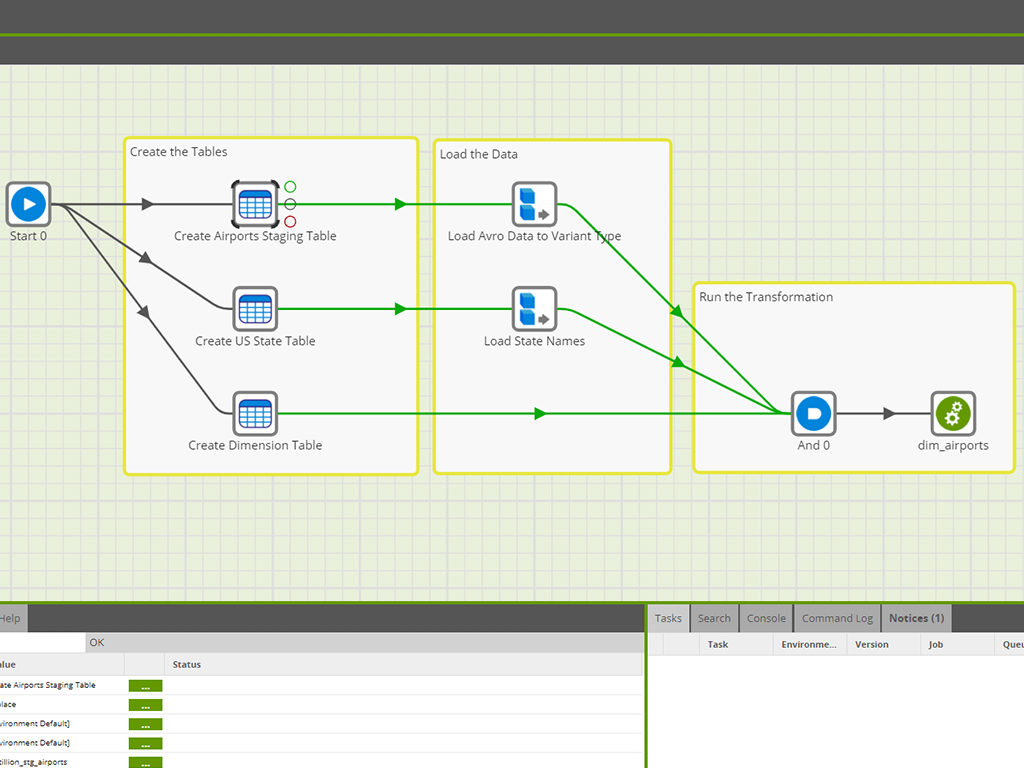
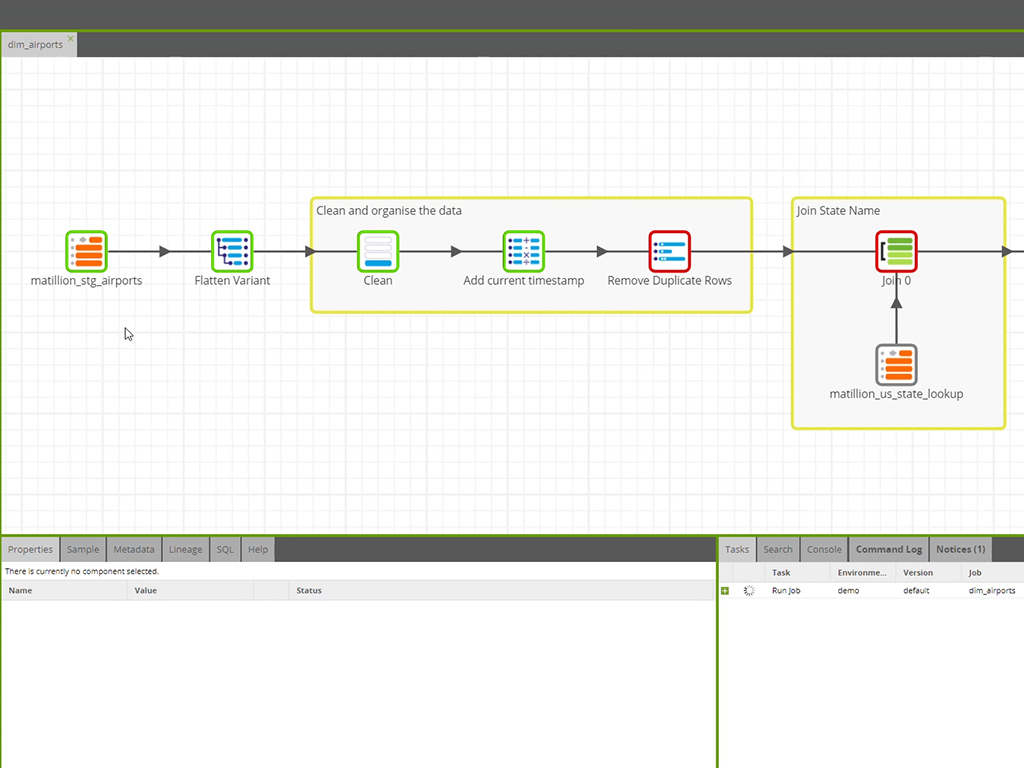
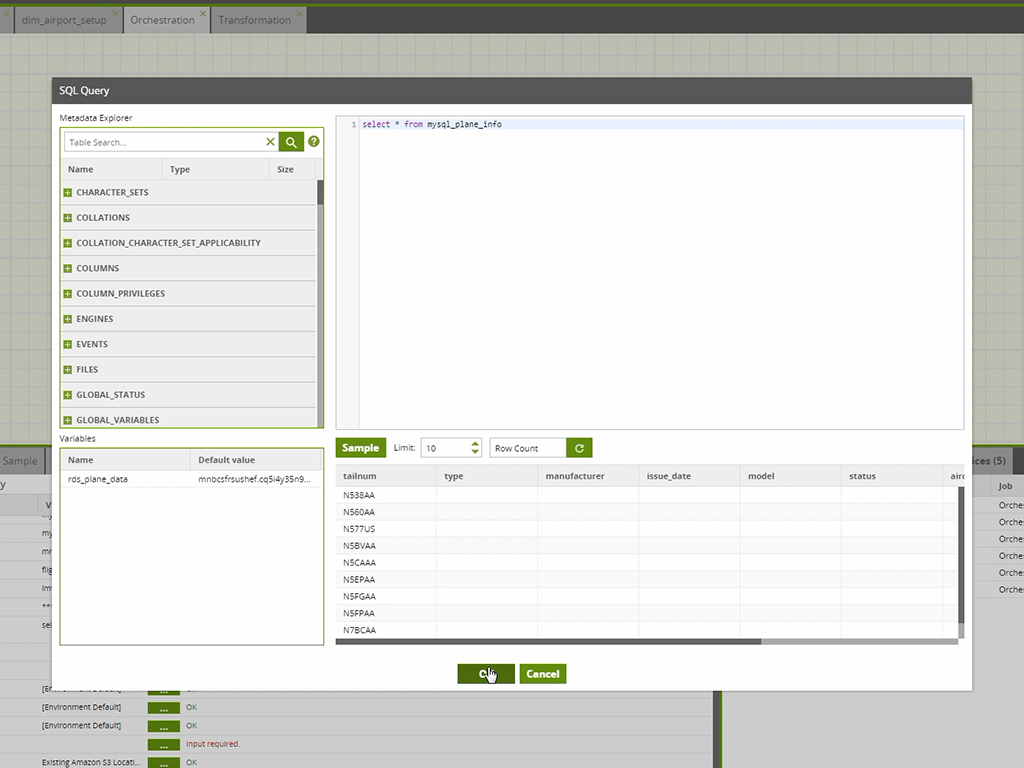
Screenshot of Matillion's GUI, used to orchestrate jobs with control data flow functionality, automating the ETL process.Screenshot of where structured and semi-structured data can be prepared to create clean data sets that can be used with any BI/reporting/visualization tool of choice. Matillion reads and combines data across a target warehouse external storage, such as S3 or Blob.Screenshot of Matillion's self-validating components, sample and row counts. If a job does fail, the warehouse queue services available with Matillion can be used get an alert to a connected email or Slack account.Screenshot of the SQL component used to run custom scripts from within Matillion. With hundreds of pre-built connectors out of the box, Matillion can handle complex transformation needs.