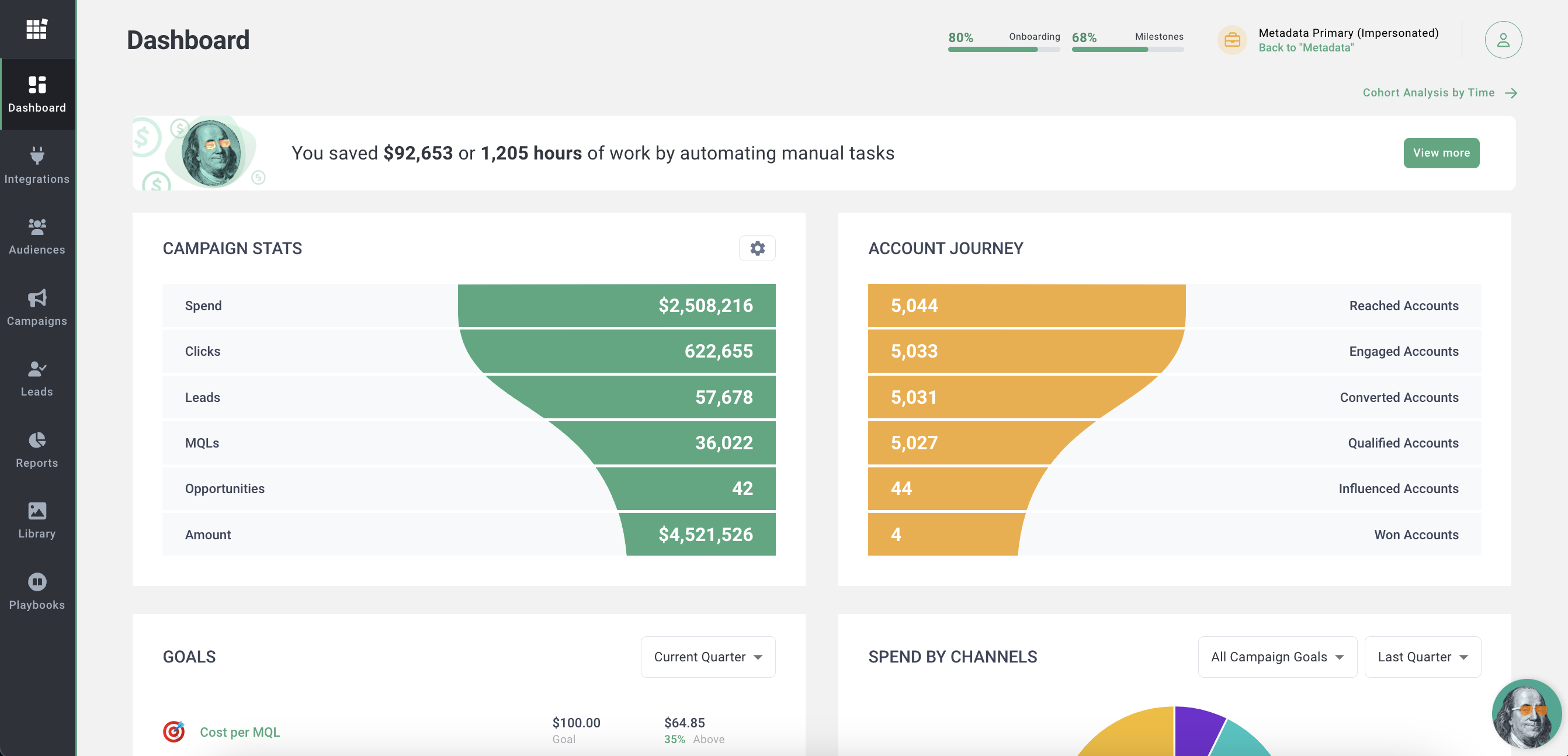
Based in San Francisco, Metadata.io is a Demand Generation and ABM platform designed to execute thousands of B2B campaigns in a matter of hours, automatically optimizing campaigns for pipeline impact at a high velocity.
$295
per month per installation
Terminus ABM Platform
Score 8.0 out of 10
Mid-Size Companies (51-1,000 employees)
Supporting B2B strategies, the Terminus platform offers tactical playbooks that help teams meet accounts throughout their entire lifecycle. It is a platform rooted in first-party data that surrounds buyers with engaging digital experiences from account acquisition to expansion and renewal. The Terminus engine is built to drive ROI, minimize fraud, prioritize brand safety, and turn intent into relevant, actionable insight for GTM teams. Key benefits of Terminus: - Relevant…
N/A
Pricing
Metadata.io
Terminus ABM Platform
Editions & Modules
MetaMatch
$295
per month per installation
Web Personalization
$24,000
per year
Audience Targeting
$24,000
per year
Metadata Base Platform
$60,000
per year
No answers on this topic
Offerings
Pricing Offerings
Metadata.io
Terminus ABM Platform
Free Trial
No
No
Free/Freemium Version
No
No
Premium Consulting/Integration Services
No
No
Entry-level Setup Fee
$2,500 one-time fee per installation
Required
Additional Details
—
—
More Pricing Information
Community Pulse
Metadata.io
Terminus ABM Platform
Considered Both Products
Metadata.io
Verified User
Anonymous
Chose Metadata.io
Metadata is way more cleaner in UI. Especially the UI of Facebook ad management is truly a horror show, glad to reduce my time spent in there.
Pricing. You can't beat metadata's metamatch audience package. Clearbit charges on a CPM basis on the amount of spend used on a certain audience while metadata is a flat fee
We choose Metadata.io because their solution would bring B2B targeting on all platforms. Other providers only offer this feature only on Facebook. Metadata.io also works as a campaign management platform, meanwhile, other providers only create audiences that are pushed to the …
These aren't apples-to-apples comparisons: I used Triblio at a previous company. Triblio is primarily for ABM display and you can have smaller audience pools (to the company level). Metadata has a display ad component that I am not currently licensed for. Triblio has added ABM …
We chose [Metadata.io] because it was a smaller company and could get more personalized attention. The price was better and they seemed more eager to support us. The feature set was what we were looking for and not more - it was exactly as robust as we needed it to be. Didn't …
Rollworks use case was more traditional ABM. Metadata is truly a paid social powerhouse for us. It's integral to our paid social program. It has more audience & ad capabilities as well.
I would say Terminus is easier to use and more cost effective. It is a better solution for beginners to get up and running with ABM marketing with enough runway to advance. Their customer service team is average, but there are learning tools to teach yourself. Lots of …
I was not involved in the evaluation process, however, I have heard that [the] Terminus ABM Platform is much more robust and the information [source] is much better.
It's a great all-around platform. With each of these ABM vendors, you have to pay for all the bells and whistles they offer. Terminus ABM Platform "base" packages include everything you need to get started and you can add on bits and pieces like chat, email or personalization …
Where Terminus ABM Platform was better than other options we evaluated: Much better quality and reach of [the] display network. More ability to tweak display network preferences and do things like contextual content targeting. Good control over ad budgets and pacing with …
Intent data & ad experiences were more robust & allowed for more customizations. Also - the interface was much more difficult to navigate to gain reporting insights that are valuable.
Terminus is competitive from not just a pricing perspective, but [its] ability to push more campaigns, through multiple channels, all through the Terminus platform.
I ran through a demo with the Triblio rep about a month ago. The platform seems to be very comparative to Terminus when it comes to the primary functionality. You can do display advertising to individuals based on company and other criteria. In talking with the Triblio rep, …
Sendoso and Terminus are alike in that they both work to add "personalization" into Marketing. However, they are not competitors per-say. Sendoso personalizes the physical interactions (direct mail) while Terminus works on the digital landscape. I would say Terminus more …
Terminus's professional services and support, along with its command-center approach, deliver a huge value to a ultra-lean fast moving business like Phononic. As a semiconductor startup that is rapidly growing, we need partners that can not only keep up with us, but also push …
Bizible is the only tool that I've done quite a bit of research on and it seems to be more advanced and further along than Terminus. They have an integration with SFDC as well as the ability to connect to a data warehouse.
We chose Terminus because of the campaign attribution models. Many companies do target account ad targeting, but none did that plus the revenue attribution from marketing.
Engagio: their analytics platform is slightly more refined, but Terminus is rapidly catching up. It is worth just using Terminus for the cost and would be another tool to complicate the Martech stack. Triblio: for a basic program, they have too many bells and whistles that are …
Sigstr is a solution for commercial teams. It allows the Customer Experience or Marketing team to manage the environment without getting IT involved. Other solutions we saw were basic IT managed solutions with no integrations or analytics.
Drift has banners available in their email tool, furthermore, we are able to mimic a Sigstr banner in Hubspot when we build emails by placing the banner image with a link in the bottom of an email, it's just a more manual process.
Terminus is a lot easier to use than other tools we have used or evaluated for our ABM campaigns. Updating what we want to see and working with their team has been a great experience. They listen and seem to understand our specific industry better. They aren't looking to …
Metadata is well suited when you have a really large ad budget (>50k per month at least). This is because the power of metadata lies in the ability to quickly set up and run a large number of experiments (combinations of channel, audience, creative, and conversion assets). To evaluate these variations, all of them need a large number of impressions, clicks, and conversions to be statistically relevant. If your budget is smaller, you will either have a very small number of experiments (not fully utilizing the power of metadata), or your experiments will not have enough clicks to make informed decisions. We had expected a better explanation of this from metadata before signing up.
I really love working with the team. If you are looking to get more targeted in your advertising approach, leverage intent data & have your sales team utilize this data for a more personalized experience - that is the best-case scenario. You do need to invest quite a bit into your advertising to be able to gather data & see [the] influence, so if your AOV would be impacted drastically by this cost, I would not recommend using the advertising experiences and chat experiences until you can invest more.
Event Announcements. We use Sigstr to promote hosted and co-hosted events. Email recipients can click on the Sigstr to register for the event itself. By promoting events through Sigstr we have been able to increase event registration and attendance.
Content Sharing. New blog post, webinar, presentation, infographic... you name it, you can use Sigstr to promote it. Furthermore, you can personalize the content to target different audiences based of the sender group. Example: customer content Sigstr belongs to support, while marketing new business content belongs to sales.
Announcements. Product enhancements, Company news etc. You can use Sigstr to promote general announcements relevant to the audience.
They recently purchased some new solutions that are being integrated into the platform so once that is completed it will be a much more robust solution.
I think updating what is considered high value vs brand awareness on the spike report could be a little more seamless.
For Salesforce integration, Terminus information unfortunately doesn't pull in historically, it just shows what has happened since the integration started. I think it's unfortunate because that historical data tells us a lot.
Terminus is a turn-key partner in the B2B Account-Based Marketing space. Their model is flexible and efficient which in turn provides effective results. Their sales staff is great and never tries to up-sell, but rather coach and educate our teams to be better at our jobs. It has been great to collaborate
These aren't apples-to-apples comparisons: I used Triblio at a previous company. Triblio is primarily for ABM display and you can have smaller audience pools (to the company level). Metadata has a display ad component that I am not currently licensed for. Triblio has added ABM features like personalized landing pages and resource hubs specific to target companies which have the potential to be really effective. I evaluated Influ2. They seem to be really great at targeting a person level across channels. So you can run a campaign to an audience as small as 1-5 people at a specific company using various targeting methods including email upload. Metadata can't get this granular.
It's a great all-around platform. With each of these ABM vendors, you have to pay for all the bells and whistles they offer. Terminus ABM Platform "base" packages include everything you need to get started and you can add on bits and pieces like chat, email or personalization as your organization continues to mature through their ABM journey.
Huge decrease in CPLs, CPMQL and Cost Per Opportunity
Big improvement in MQL to SQL rates
90%+ of our leads from paid social now have valid business emails, before it was like 30%
Saving us hundreds of hours over the course of the next year doing daily manual optimization and budget management tasks for us so we can focus on strategy and testing new things
It's EXTREMELY hard to assess total ROI with display advertising unless you're getting clicks on your ads. Even then you probably want additional tracking metrics such as Google Analytics, form fills, etc.
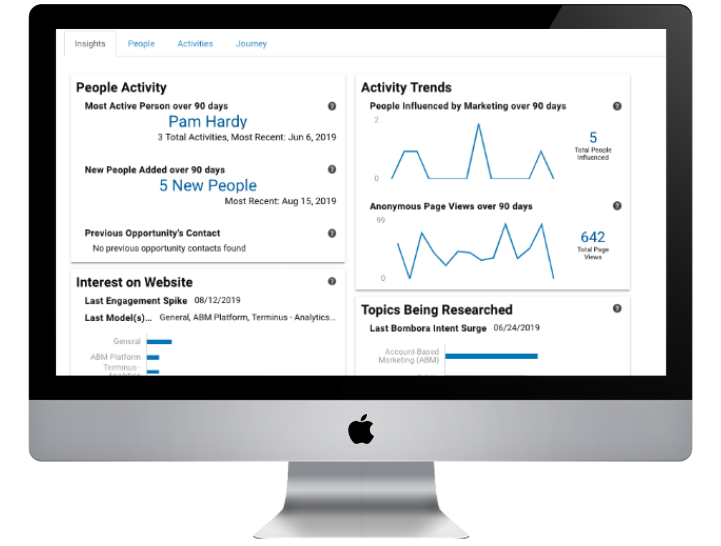
Our sales guys like the engagement spike reports, which can be useful for prompting them to reach out to their contacts.