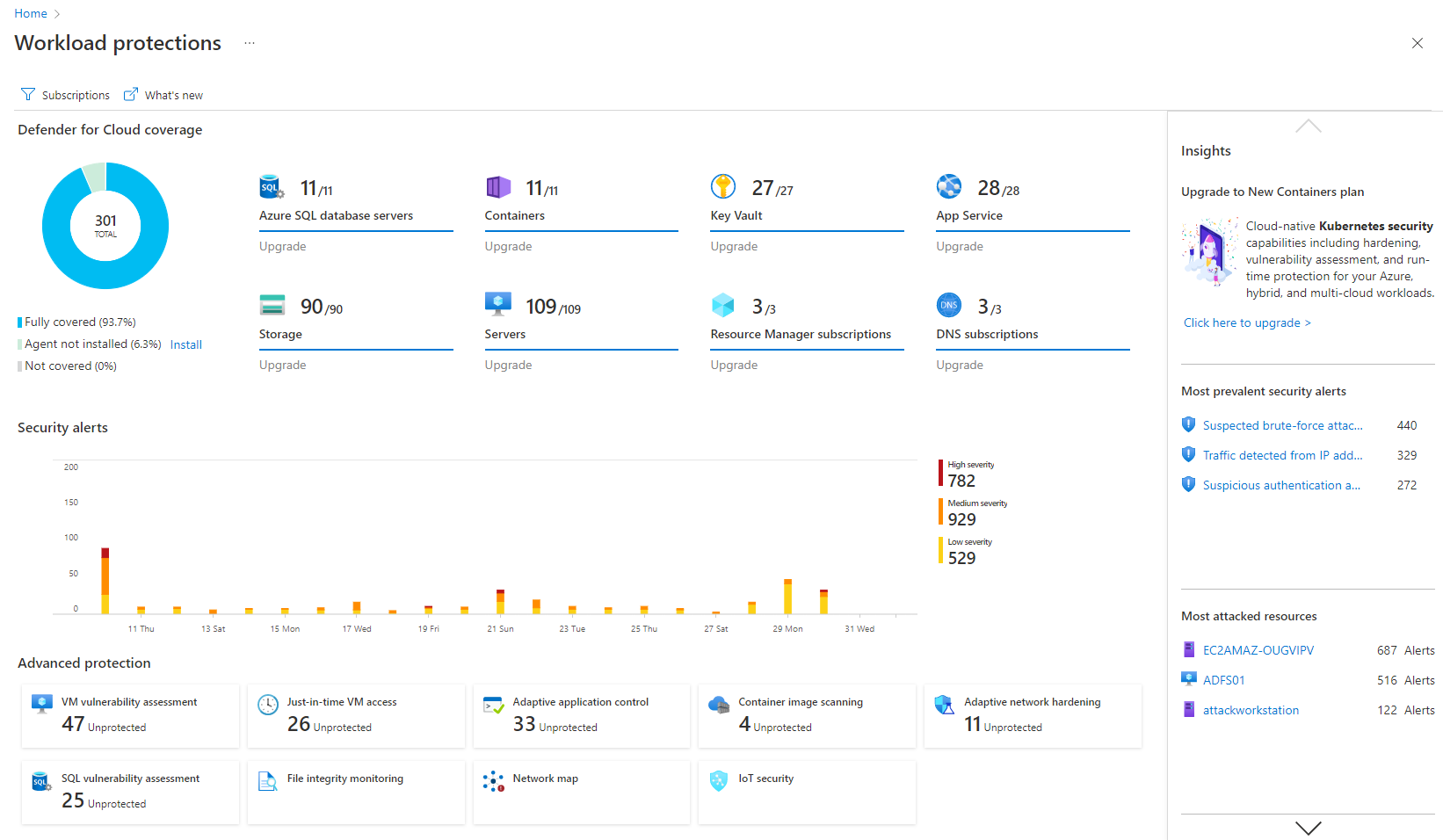
Microsoft Defender for Cloud is a Cloud Security Posture Management (CSPM) and Cloud Workload Protection Platform (CWPP) for Azure, on-premises, and multicloud (Amazon AWS and Google GCP) resources.
N/A
Qualys VMDR
Score 8.8 out of 10
N/A
Qualys VMDR 2.0 with TruRisk gives enterprises visibility and insight into cyber risk exposure with the goal of making it easy to prioritize vulnerabilities, assets, or groups of assets based on business risk. Security teams can take action to mitigate risk, helping the business measure its true risk, and track risk reduction over time.
N/A
Pricing
Microsoft Defender for Cloud
Qualys VMDR
Editions & Modules
No answers on this topic
No answers on this topic
Offerings
Pricing Offerings
Microsoft Defender for Cloud
Qualys VMDR
Free Trial
Yes
No
Free/Freemium Version
No
No
Premium Consulting/Integration Services
No
No
Entry-level Setup Fee
No setup fee
No setup fee
Additional Details
—
—
More Pricing Information
Features
Microsoft Defender for Cloud
Qualys VMDR
Threat Intelligence
Comparison of Threat Intelligence features of Product A and Product B
Microsoft Defender for Cloud
-
Ratings
Qualys VMDR
8.7
Ratings
9% above category average
Network Analytics
00 Ratings
8.60 Ratings
Threat Recognition
00 Ratings
8.50 Ratings
Vulnerability Classification
00 Ratings
9.30 Ratings
Automated Alerts and Reporting
00 Ratings
9.30 Ratings
Threat Analysis
00 Ratings
8.60 Ratings
Threat Intelligence Reporting
00 Ratings
8.50 Ratings
Automated Threat Identification
00 Ratings
8.50 Ratings
Vulnerability Management Tools
Comparison of Vulnerability Management Tools features of Product A and Product B
If you need to proceed with pay as you go service then go ahead with Microsoft Defender for Cloud. This could be expensive in the long run but if the organization usage is slightly less than then this would suite the purpose. Also, it has the latest threat updates, so you're future proof in terms of potential treats.
Qualys VMDR supports both remote scanning and as well as agent based scanning. With a complex infrastructure with over 2 million devices and 100s getting added and removed on daily basis makes the operations challenging. Qualys VMDR has a great feature to do discovery scan to detect active devices on the network and perform vulnerability scans on those assets. Authentication is also easy to setup and use.
Automation is crucial to managing sprawl and the additional complexity that comes with it. SOC management workbooks and process automation give significant flexibility.
The Security posture score and Security Alerts are neatly centralized and offer me crucial information quickly.
Defender for Cloud avoids the common compromise of simplicity for completeness (former Azure Security Center). The security warnings and advice go into great detail while remaining current and useful.
UI/UX. It can get a little messy when navigating around with all the flyouts in the Azure portal which can be frustrating, particularly when under time pressure.
The query languages for the queries and workbooks are another language that needs to be learned - it would be nice to have kept it closer to T-SQL or something like that to minimize the need to learn new syntax.
Adding cost estimations to the security recommendations would really improve the experience.
It is a great product that integrates nicely when running an Azure platform and even multi-cloud environment. Not looking for point-solutions but a suite that answers most requirements. It is very comfortable being able to use KQL, workbooks and automation that is native to the azure platform
Next to Veeam (which is a tremendous product for backup/DR) this is the best service/software I have used in the past three decades. Should be called the Swiss Army Knife of security.
This is iron but I am giving it 5 star and I can give more If I can do because they are best in support. So once you own this product they will assign a dedicated support for you and when you are under the weather with anything just connect them with anything call, ping or ticket they will come like Genie.
I believe Microsoft Defender for Cloud stacks up well against the other tools we looked at. It is native to the Azure platform and provides the same insights as the other tools. We selected Microsoft Defender for Cloud because it integrates well with the Azure resources and gives the needed insight, security alerts and recommendations.
Qualys VMDR was selected against competitors because of the depth of insight the platform provides. When stacked against other competitors, platforms like Syxsense couldn't produce the same level on insight and reporting like how Qualys VMDR does. Qualys VMDR also does a great job at gathering information about the latest security definitions and using those to analyze our environment to alert of any vulnerabilities. Something that Syxsense couldn't.