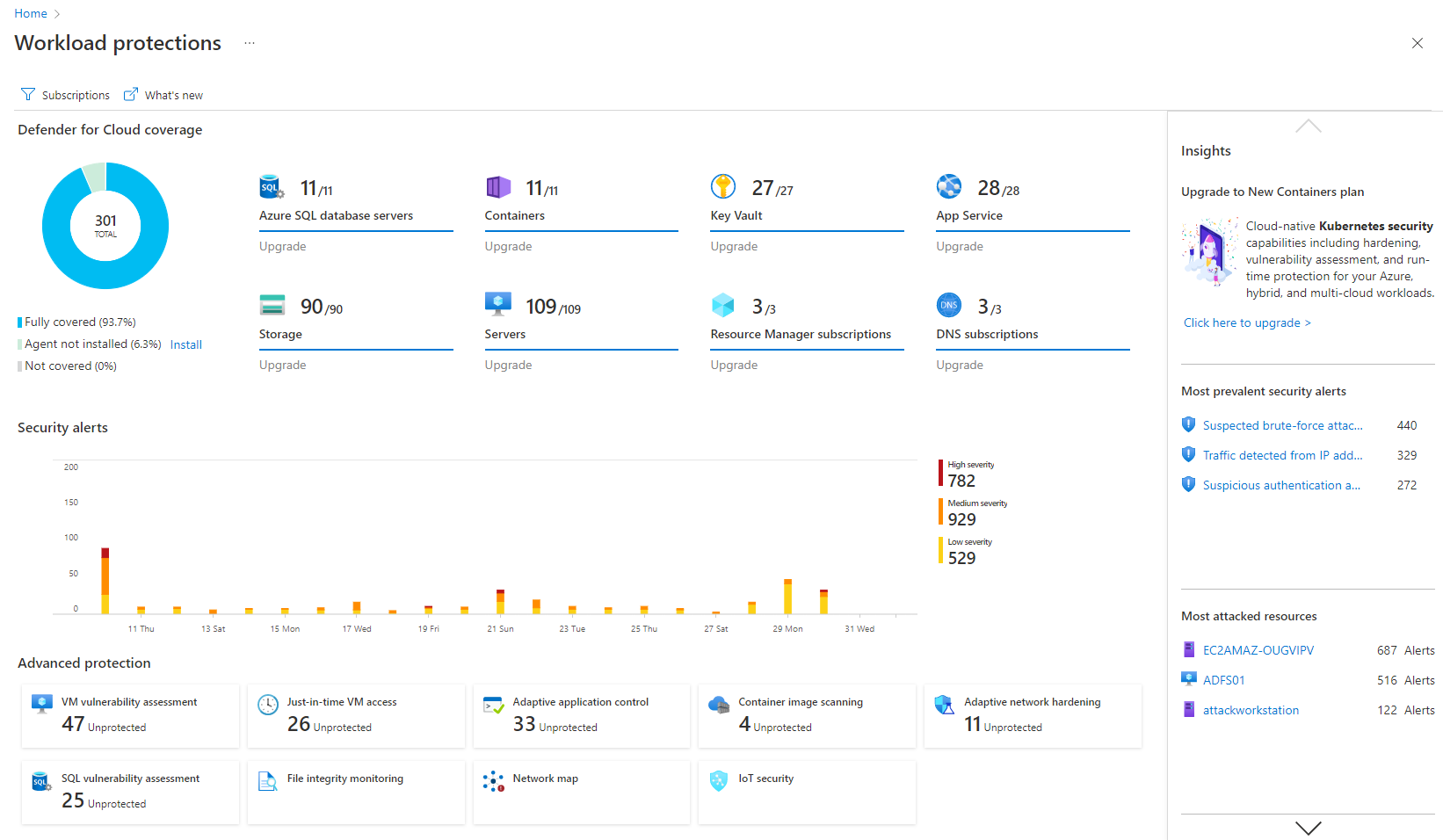
Microsoft Defender for Cloud is a Cloud Security Posture Management (CSPM) and Cloud Workload Protection Platform (CWPP) for Azure, on-premises, and multicloud (Amazon AWS and Google GCP) resources.
N/A
Tenable Nessus
Score 8.9 out of 10
N/A
Tenable headquartered in Columbia offers Nessus, a vulnerability scanning and security assessment solution used to analyze an entity's security posture, vulnerability testing, and provide configuration assessments.
We were one of the first ones to deploy when Microsoft released it, so it's hard to compare, but what we hear from competitors, the fact that Microsoft can see the full ecosystem using this product makes it a lot better as compared to using a third party tool. So it's the ease …
Evaluated between cost. I just think it integrates better with the Microsoft stack and I mean, I think just cost from just that perspective and being the one pane of glass, I think that's enough.
I believe Microsoft Defender for Cloud stacks up well against the other tools we looked at. It is native to the Azure platform and provides the same insights as the other tools. We selected Microsoft Defender for Cloud because it integrates well with the Azure resources and …
Microsoft Defender for Cloud offered a more integrated and comprehensive solution for our multi-cloud environment, integrating well with our security and compliance needs
Microsoft Defender for Cloud is definitely the choice with the latest market trend and attacks that are currently happening. Microsoft has been able to safe guard a lot after the recent serious attacks happening globally in the digital world. There is a trust in this software …
There is the several ways to protect the applications and lot more tools available in the market. Most commonly we used Crowd strike Falcon for endpoint detection and response capabilities. McAfee endpoint protection also provide broad range of security features. Best …
We used to use Symantec and McAfee. It's been mostly defenders since, gosh, the last eight to 10 years. So we're a small organization. We don't have a lot of folks, so single-painted glass is really important to be able to see the whole environment in a single place. And the …
When we purchase this data fund, we check with not competition and we decided to purchase these tools because it's strong and we have a good relationship with Microsoft.
It is very good in comparison to other products that we have used. Its price is very effective and attractive, and it also provides good security policies. threat intelligence is also good and user protection is also very much better, and it also serves new updates as and when …
Microsoft Defender for Cloud supports the hybrid resource assessment which includes Non-Azure Resources, Aws resources, gcp resources. So it is flexible to asses different cloud platforms. Also its pricing is comparatively affordable then Other cloud security tools available in …
Defender for Cloud (previously known as Azure Security Center) is a more comprehensive and extensive security solution. Currently, threat analytics make up only a small portion of the whole picture. It encourages a comprehensive picture of the cloud environment across all of …
Defender for Cloud is definitely less complex a solution and more turn-key. We found that it was easier to grab the information we needed, faster than the Palo solution. In addition, accounting loved the fact that it was less expensive. At the time of implementation, Palo's …
We looked at AlienVault since it can be a SIEM and scanner all in one. Ultimately, we decided AlienVault didn't stack up well against Nessus so we decided to purchase Nessus. Glad we did.
Sometimes when we identify a vulnerability with Nessus that has an exploit, we made a proof of concept with Metasploit in order to show to the IT managers the importance of the software/hardware hardening.
Nessus is standard vulnerabilities assessment tool, i would recommend for mid or higher level organization to have their personalised tool from Nessus for day to day managing of their network security with continuous improvements.
Nessus is the smallest product in the Tenable stable and is also the first vulnerability scanner to be created almost 20 years ago. Great tool for once off scans. But you need the other products if you want real time monitoring etc
Ease of deployment and use even for junior analysts, strong plugin support, and up-to-date CVE coverage, cost-effective licensing, especially for mid-size companies, and seamless integration with the SIEM tool. Overall, Nessus hit the right balance between functionality, …
If you need to proceed with pay as you go service then go ahead with Microsoft Defender for Cloud. This could be expensive in the long run but if the organization usage is slightly less than then this would suite the purpose. Also, it has the latest threat updates, so you're future proof in terms of potential treats.
Nessus is perfectly suitable for performing comprehensive vulnerability assessment scans being a vulnerability scanner. It is less appropriate for performing penetration testing since it is not a penetration testing tool, it does not have the ability and modules to exploit the vulnerabilities of the system.
Automation is crucial to managing sprawl and the additional complexity that comes with it. SOC management workbooks and process automation give significant flexibility.
The Security posture score and Security Alerts are neatly centralized and offer me crucial information quickly.
Defender for Cloud avoids the common compromise of simplicity for completeness (former Azure Security Center). The security warnings and advice go into great detail while remaining current and useful.
UI/UX. It can get a little messy when navigating around with all the flyouts in the Azure portal which can be frustrating, particularly when under time pressure.
The query languages for the queries and workbooks are another language that needs to be learned - it would be nice to have kept it closer to T-SQL or something like that to minimize the need to learn new syntax.
Adding cost estimations to the security recommendations would really improve the experience.
It is a great product that integrates nicely when running an Azure platform and even multi-cloud environment. Not looking for point-solutions but a suite that answers most requirements. It is very comfortable being able to use KQL, workbooks and automation that is native to the azure platform
Nessus is best and easy to use application for Vulnerabilities finding and reporting, it has multiple platforms and wide scope covering almost all devices for security improvement so far, thus we are very likely to continue its services.
Tenable Nessus is a great product and provides a lot of value, but it is difficult to set up and use and the amount of data it generates can be overwhelming. It does help us prioritize based on the severity of the detection, however there are sometimes mitigating factors that we have implemented that Nessus does not account for, which causes lots of noise in the reports.
I haven't needed to contact support yet. But issues are easily solved with a quick internet search which means support and by extension, the larger community are involved and knowledgeable.
I believe Microsoft Defender for Cloud stacks up well against the other tools we looked at. It is native to the Azure platform and provides the same insights as the other tools. We selected Microsoft Defender for Cloud because it integrates well with the Azure resources and gives the needed insight, security alerts and recommendations.
Ease of deployment and use even for junior analysts, strong plugin support, and up-to-date CVE coverage, cost-effective licensing, especially for mid-size companies, and seamless integration with the SIEM tool. Overall, Nessus hit the right balance between functionality, performance, and total cost of ownership for our needs and usability.
It has helped identify security flaws in our infrastructure that has helped better secure our client's data. It did so quickly and efficiently so I was able to move on to other tasks.