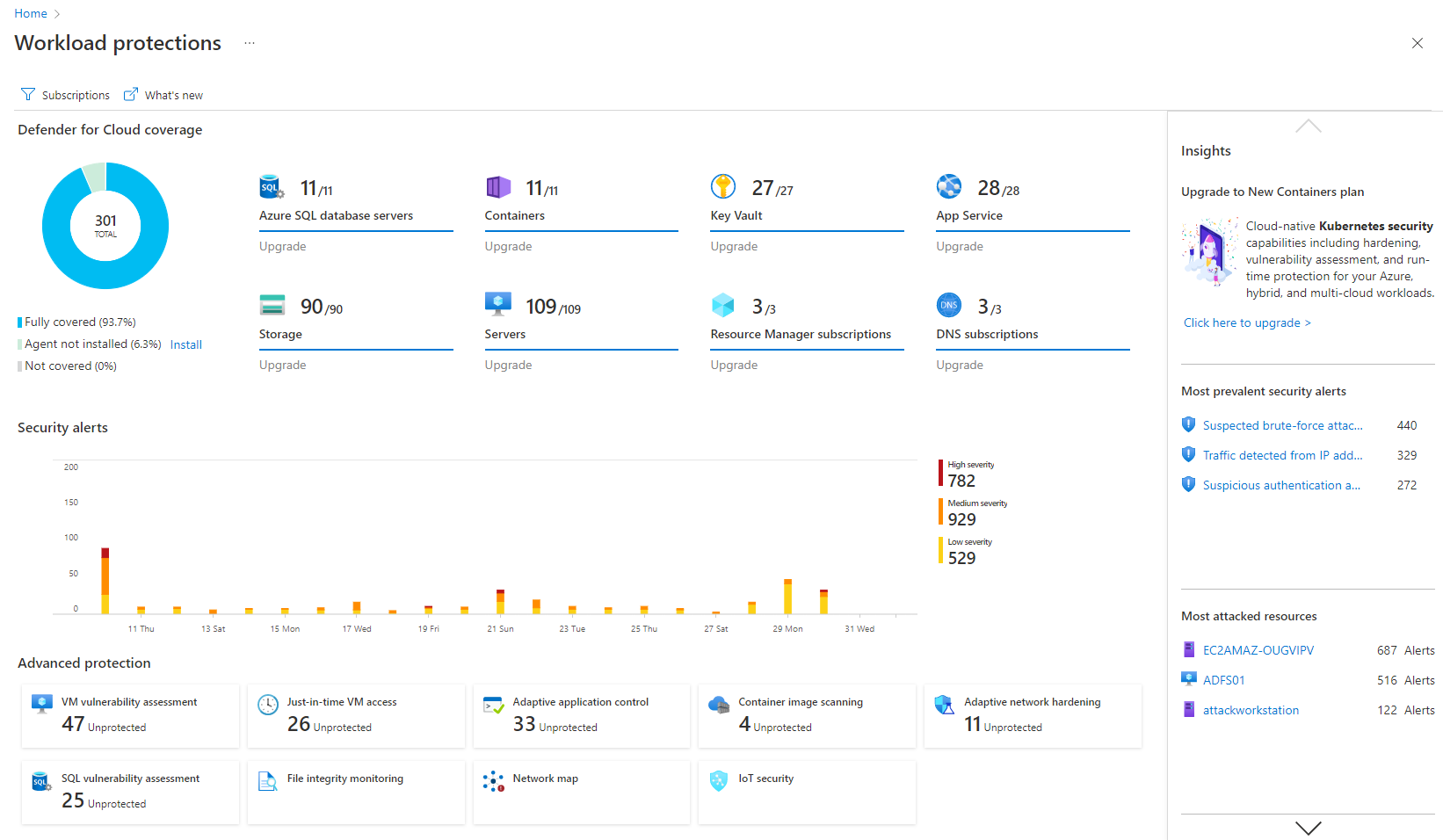
Microsoft Defender for Cloud is a Cloud Security Posture Management (CSPM) and Cloud Workload Protection Platform (CWPP) for Azure, on-premises, and multicloud (Amazon AWS and Google GCP) resources.
N/A
Tenable Vulnerability Management
Score 9.6 out of 10
N/A
Vulnerability management specialist Tenable offers their cloud application and container security platform Tenable Web App Scanning (formerly Tenable.io), a vulnerability management tool that emphasizes visibility of web applications, automatic scanning, and a unified view of cloud infrastructure and possible inconsistencies indicating a vulnerability.
N/A
Pricing
Microsoft Defender for Cloud
Tenable Vulnerability Management
Editions & Modules
No answers on this topic
No answers on this topic
Offerings
Pricing Offerings
Microsoft Defender for Cloud
Tenable Vulnerability Management
Free Trial
Yes
No
Free/Freemium Version
No
No
Premium Consulting/Integration Services
No
No
Entry-level Setup Fee
No setup fee
No setup fee
Additional Details
—
—
More Pricing Information
Community Pulse
Microsoft Defender for Cloud
Tenable Vulnerability Management
Features
Microsoft Defender for Cloud
Tenable Vulnerability Management
Threat Intelligence
Comparison of Threat Intelligence features of Product A and Product B
Microsoft Defender for Cloud
-
Ratings
Tenable Vulnerability Management
8.4
Ratings
6% above category average
Network Analytics
00 Ratings
10.00 Ratings
Threat Recognition
00 Ratings
10.00 Ratings
Vulnerability Classification
00 Ratings
10.00 Ratings
Automated Alerts and Reporting
00 Ratings
4.00 Ratings
Threat Analysis
00 Ratings
10.00 Ratings
Threat Intelligence Reporting
00 Ratings
5.00 Ratings
Automated Threat Identification
00 Ratings
10.00 Ratings
Vulnerability Management Tools
Comparison of Vulnerability Management Tools features of Product A and Product B
If you need to proceed with pay as you go service then go ahead with Microsoft Defender for Cloud. This could be expensive in the long run but if the organization usage is slightly less than then this would suite the purpose. Also, it has the latest threat updates, so you're future proof in terms of potential treats.
Tenable.io is a cost effective Internal and External scanner. The Internal scanner came with a .ova, so it was very simple and quick to deploy it into our ESXi environment. It has a cloud-based dashboard for management and the internal scanner is configured to auto-update from Tenable.io. The license came with 4 External PCI scans (with remediation) a year.
Automation is crucial to managing sprawl and the additional complexity that comes with it. SOC management workbooks and process automation give significant flexibility.
The Security posture score and Security Alerts are neatly centralized and offer me crucial information quickly.
Defender for Cloud avoids the common compromise of simplicity for completeness (former Azure Security Center). The security warnings and advice go into great detail while remaining current and useful.
UI/UX. It can get a little messy when navigating around with all the flyouts in the Azure portal which can be frustrating, particularly when under time pressure.
The query languages for the queries and workbooks are another language that needs to be learned - it would be nice to have kept it closer to T-SQL or something like that to minimize the need to learn new syntax.
Adding cost estimations to the security recommendations would really improve the experience.
It is a great product that integrates nicely when running an Azure platform and even multi-cloud environment. Not looking for point-solutions but a suite that answers most requirements. It is very comfortable being able to use KQL, workbooks and automation that is native to the azure platform
Support is usually really great at walking you through any steps you need to take when you get stuck on something. There are a few false positives and errors that have come up over the years that required their help to get through. Unfortunately, the steps required to diagnose some problems are more tedious than I think should be necessary. (IE: SQL instances can throw errors that clog up your logs because one plugin affects it in a certain way. The process to diagnose this is to watch timestamps of plugins in a log while monitoring the SQL logs at the same time and using your best guess as to what is causing it.)
I believe Microsoft Defender for Cloud stacks up well against the other tools we looked at. It is native to the Azure platform and provides the same insights as the other tools. We selected Microsoft Defender for Cloud because it integrates well with the Azure resources and gives the needed insight, security alerts and recommendations.
I think Tenable and Qualys have a lot of similarities, I continue to go back to Tenable because of my familiarity and comfort level with it. I've also used a company called SecurityMetrics which has vulnerability scanning included but it is not as comprehensive as Tenable.
We're able to mitigate over 90% of our vulnerability risk without too much effort. It helps find where automated patching fails and we can plan a fix from the findings.
A side effect of our scanning reveals new devices on our network that aren't cleared to be.