Microsoft Intune (formerly Microsoft Endpoint Manager), combining the capabilities of the former Microsoft System Center Configuration Manager, SCCM or ConfigMgr, is presented as a unified endpoint management option. Microsoft Intune is an endpoint management solution for mobile devices, an MDM solution that allows the user to securely manage iOS, Android, Windows, and macOS devices with a single endpoint management solution. The component Endpoint Configuration Manager (the…
$5
per user/per month
N-able N-central
Score 8.9 out of 10
N/A
MSPs
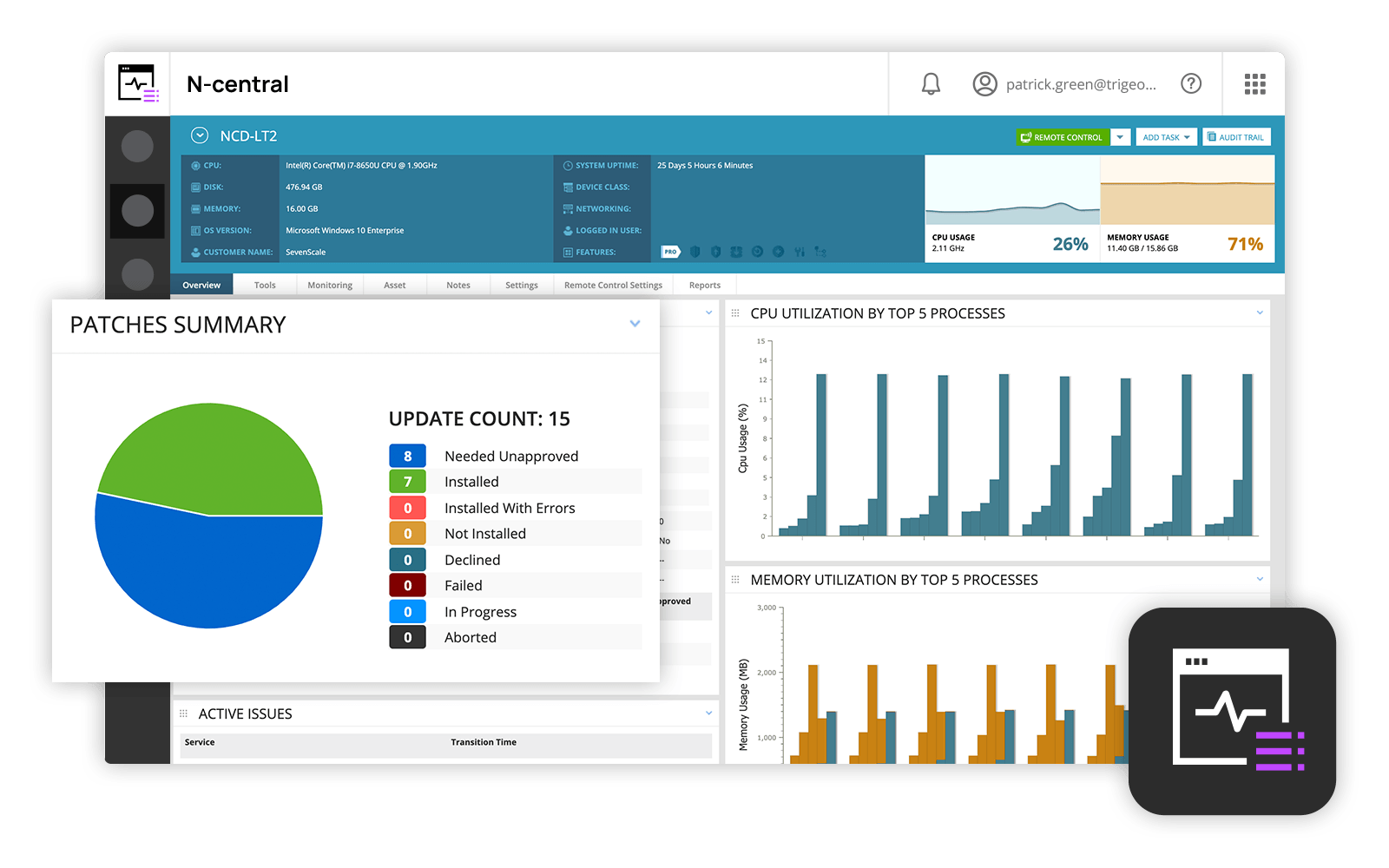
and IT professionals use N-able™ N-central® to monitor and manage devices and complex
networks remotely. N-central provides
visibility and efficiency as the user's needs scale. N-central can help users:
1. Proactively monitor everything on a customer network—not just servers
and workstations—and troubleshoot.
2. Stay on top of threats with features like MFA, antivirus, integrated endpoint
detection and response, data backup, disk encryption, email protection,…
N/A
Pricing
Microsoft Intune
N-able N-central
Editions & Modules
Microsoft 365 Business Basic
$5
per user/per month
Microsoft 365 For Individuals
$6.99
per month
Microsoft 365 Apps
$8.25
per user/per month
Microsoft 365 For Families
$9.99
per month
Microsoft 365 Business Standard
$12.50
per user/per month
Microsoft 365 Business Premium
$15
per user/per month
No answers on this topic
Offerings
Pricing Offerings
Microsoft Intune
N-able N-central
Free Trial
No
No
Free/Freemium Version
No
No
Premium Consulting/Integration Services
No
No
Entry-level Setup Fee
No setup fee
No setup fee
Additional Details
—
—
More Pricing Information
Community Pulse
Microsoft Intune
N-able N-central
Considered Both Products
Microsoft Intune
No answer on this topic
N-able N-central
Verified User
Anonymous
Chose N-able N-central
I selected N-able N-central as I liked the idea of easy-to-work with pricing that integrates with other PSAs (specifically ConnectWise PSA aka Connectwise Manage). I did not succeed with that. I'd use any of the other tools instead. The integration is problematic as the default …
Our version of SolarWinds was old and running on old hardware, but it was way easier to setup and do things with. It did not do everything N-able does such as patch management, or at least we didn't have a module to do so if one existed. However it definitely seemed easier to …
Windows Autopilot makes provisioning user Windows PC laptops a breeze. A user only needs to turn on the laptop, join it to their local WiFi, login with their O365 account then sit back and let Windows Autopilot handle the app installations required for work, configure the laptop settings to meet my organization requirements. I have seen this all completed in less than 30 minutes depending on how fast the internet connection is. Where Microsoft Intune needs to improve I think is the part where it can push out software updates to 3rd party apps. Right now I have to use Automox to fill in this gap.
In my opinion, N-able N-central is a good "learn your lesson and move onto something better" tool. I've used many RMM tools over the years and I feel that this one is slow, does a terrible job with reporting, alerting, monitoring, software deployments, etc. The ability to turn on services like AV, backup, etc easily is cute, but you're not going to be able to use your own tools with this easily. In my experience, if you do turn those tools on for testing during the trial, you'll be charged later (despite it being a trial). They also turn off your ability to monitor these increased costs or to turn them off yourself. As a company, I found that they were impossible to work with. The sales team is right there if you want to buy something - but if you need anything other than to buy something, in my experience, they take days or weeks to navigate. I found that they are not a terribly ethical company and are more concerned with making a few dollars than creating a partnerships with MSPs. I can see value is in the advertised price of $99 for a hundred endpoints. However, you need to remember to not trial any other tools (like AV, backup, etc).
[Microsoft Endpoint Manager (Microsoft Intune + SCCM)] helps to speed up the deployment of patches/software throughout our environment. I can easily build a package and then deploy across all endpoints.
The ability to supercede software is also quite handy. This automates the removal of old versions and replacing them with newer versions.
The Intune Autopilot option is very useful if you want to deploy software to devices straight out of the box. You can configure them to download software when a user opens a new PC and turns it on for the first time.
Robust patch management: it is easy to set up patching groups via tags, and configures patch management profiles and maintenance windows.
Remote Control: as long as the agent checks in, it is very quick and easy to take control of an endpoint, either in a separate session (RDP, kick the current user out), or to join the existing session of the current user, to provide desktop support or collaborate remotely.
Installation is very laborious and complicated. The number of things to manually configure during the installation is incredible.
OS deployment is hard to configure and troubleshoot. The Microsoft article on deploying Windows 10 via System Center Configuration Manager in a test environment takes 44 minutes to read (Microsoft's estimate, not mine -- check here: https://docs.microsoft.com/en-us/windows/deployment/windows-10-poc-sc-config-mgr). If something goes wrong, there are multiple log locations to check on both the server and client, making troubleshooting difficult.
The management console looks old, and its performance isn't great. It is often hard to find settings in the console, and it refreshes slowly. The old name for System Center Configuration Manager, SMS, comes to mind often. "Slowly Moving Software."
Mascom Wireless is a Microsoft shop and SCCM has proved to be helpful in keeping our Microsoft products up to date every month without fail. We also have a Microsoft Enterprise Agreement which we renewed for three years ending 2022. The remote access utility works wonders for the organisation and have saved travel bills including subsistance allowance. We have been able to fulfill security audits both internal and external. We have been able to keep a robust inventory of our computer assets and nothing falls of the cracks
Overall we have liked our solar winds experience, however, as our company has grown to support larger enterprises, this product does not have the functionality that our teams need in order to fully support them. The lack of granularity with backups and lack of ability to support nutanix environments is slowly drawing us into the use of other tools.
Overall, Microsoft Intune is very usable. While help documentation can be lacking, once setup and configured, Intune does all the work that used to be manual. There is a lot of automation and advanced features and manufacturer integrations you don't get anywhere else. These are absolutely game changers when managing IT workloads.
The user interface is fairly straight forward, with logic groupings for objects. I did not deploy this software, but am one of the daily administrators. Once you get the correct agent package (Which can be a challenge) the integration into AD is not bad. The UI could be more customized, but that may have been a design choice.
It's a 'heavy' system, which demands a lot of resources form the datacenter perspective. So, make sure you followed the requirements to avoid frustration in the future. From the 'client' perspective, it's fine. I've never had any issue with that.
Being a Microsoft product, support was good. Out interaction was limited to our in-house IT team which was installing the Intune app in our mobile device. The installation was smooth and we haven't faced any difficulties with the app while using it. Provides a smooth and secure access to all Office 365 apps in mobile while separating the personal and professional data.
Every time we have reached out to SolarWinds they are quick to respond, even offering support chat 24/7. Their support team is great and works with you to find solutions to issues. They have taken items we had issues with before and used those to create updates so that the issue is handled better in the future.
Work with a "test group" of users who you have a good relationship with so that when things don't work properly they understand! Work with your partner nicely without forcing things especially timelines as you are bound to make mistakes and create oversights in the project Management can also interfere with the implementation (which can cause delays) if you make too many mistakes which takes me back to having a "test group" where you have good relations
Microsoft Intune is more robust as far as fine-tuning security controls. It also allows for software installs, folder access controls, updating PCs, and other features simply not found in previous products we have used. Because it is rolled into MS 365 it's very cost effective. It's also a single pane of glass for managing user PCs and personal devices
Most advanced, and other technicians in the business already used it before. NinjaOne was a close competitor, but lacked some features that we ideally need. ITarian was too basic but was MUCH cheaper. For a startup MSP, it would be much more attractive. Splashtop was just for remote connections, which we used for some time before realizing full RMMs were a better fit for our requirements.
The positive impact it's had was it has been really beneficial in having an all-in-one Systems Management solution to be able to manage all endpoints across the organization. This has saved both time and costs from having to search/setup/manage other System Management applications and also have saved money from having to purchase a license for other commercial products.
Another positive impact it has had was in being able to easily remote into computers/endpoints, and also being able to provide remote assistance to end-users.
The negative impact has been it is not being fully utilized by most of the IT staff, as it is a more complicated platform to learn/master. This would require funding for IT staff to take training in learning the product, or require time to consult the documentation in the use of the product. As a result, this may hurt productivity in being able to have to work on other things.
The product definitely increases productivity. Technicians can spend a few seconds to take care of remote tasks with a few clicks as opposed to minutes to get a user to start a remote control session, or worse, going on site to work on a piece of equipment.
The packaging of the features makes selling and pricing the product fairly straight-forward and convenient. This saves our sales team time from trying to work with add-ons when pricing our services - the product makes it easy to just have an "all you can eat" package at a set price.
When something goes wrong with the product, our business and our customers suffer. If for example, a bug causes all managed computers to reboot, our customers call in, resulting in our technicians being booked solid doing damage control. This also causes loss of trust with our customers - we can't simply blame the product, the customer trusts us to provide them a service and if the product fails, we fail.