monday.com Work OS is an open platform designed so that anyone can create the tools they need to run all aspects of their work. It includes ready-made templates or the ability to customize any work solution ranging from sales pipelines to marketing campaigns, CRMs, and project tracking.
$12
per month per user
Planview AdaptiveWork
Score 7.4 out of 10
N/A
Planview AdaptiveWork is a web-based collaborative work management software. Planview AdaptiveWork enables users to connect employees and partners and create documents, reports and specialized workflow automation. Planview AdaptiveWork is designed to work across multiple teams to enable cross-company task, project, and resource management.
N/A
Pricing
monday.com
Planview AdaptiveWork
Editions & Modules
Basic
$12
per month per user
Standard
$14
per month per user
Pro
$24
per month per user
Enterprise
Contact Sales
Contact us
No answers on this topic
Offerings
Pricing Offerings
monday.com
Planview AdaptiveWork
Free Trial
Yes
Yes
Free/Freemium Version
Yes
No
Premium Consulting/Integration Services
No
No
Entry-level Setup Fee
No setup fee
Optional
Additional Details
Yearly plan: Save 18%
Monthly plan also available
—
More Pricing Information
Community Pulse
monday.com
Planview AdaptiveWork
Considered Both Products
monday.com
Verified User
Anonymous
Chose monday.com
It's been a while since trying Asana, so it's hard to say. I think they are very similar from what I remember, but maybe monday.com has more reporting and customization possibilities?

monday.com offer much of the standard tools and seems to be ever evolving. They seem to take feedback and constantly upgrade the tools. If all the tools are there, the differentiating factor might be the cost, any integrations you may need, and the visual "chemistry". To me, …
We chose to move from Zoho to monday.com when our company started growing exponentially. Overall, our team was thankful for the change because we were growing at far to fast of a speed for Zoho's tools to keep up with us. monday.com is a better, beefier platform with far better …
We decided to go with monday.com because they offered a free tier for nonprofits and because they are easier to use and offered additional features that we could not find on the other choices. Hands down, there was no better choice for us than monday.com.
When I arrived at my org, I was initially disappointed to hear that we used something other than Asana for project management. Fast forward just a few months, and I became a complete monday.com convert. While its organization is similar to Asana's, it's user interface, …
I would say this is one of my least favorite applications. I don't find it super user friendly due to the extreme amounts of customization. It feels like my information is in there somewhere, but I can never find it easily. I think that it looks a lot prettier than asana which …
monday.com seems to solve the issues and concerns for our marketing and graphics needs. I personally use Asana for my projects and tracking purposes and monday.com for my interations with Marketing and their needs.
monday.com is much easier to use and offers all the tools of google suite in one spot for task management. I use gsuite services still but in an entirely different way. If there is something that needs to be shared with the team or is important that I will need to refer back to …
Monday.com is the broadest scope work management software I have used. Its interface is basic and takes some getting used to, but the programming options are highly advanced and extremely effective.
I also use the other selected. But I prefer monday.com because it is more clear (visually and intuitively), and also because I have been using it for longer than the others. However, there is the price factor that must be taken into consideration
Monday.com is far more intuitive than Salesforce with it's automation features, lists are better and customizable and it makes things easier for everyone on the team.
Salesforces is a great CRM system but I feel as though it falls short as a collaborative project management …
As a developer, I have utilized the mentioned apps to integrate processes for clients, and I have found monday.com to be superior due to its abundance of features compared to others. Choosing monday.com provides enough capabilities for teams and managers to handle work in one …
monday.com is a much better tool for keeping track of tasks and assignments than MS Planner. In most situations where we used MS Planner we have switched to using monday.com instead.
monday.com is so much easier to use & project-tracking is not only easy to do, but the visuals are far from complicated & make it that much easier to keep track of everything.
I feel monday.com is easier to use than the others listed. Specifically, I used to use Trello in the past and I really liked it. I even recommended others to use it but since working in monday.com, I found it has so many more features that meet our teams needs and we have found …
monday.com has the only interface that is 100% customizable, can use public and private boards, can be shared with customers, produce Gantt charts, and has THE MOST integrations "in house". The professional relationships that monday.com has established to be "on board" with …
I searched for some other alternatives like monday.com, and I also tried them. For example, I have experience with Sloneek. But monday.com just feels different. I think it beats the competition in every way. You can also use monday's free version, and it is still a good task …
I chose monday.com because of its flexibility and ability to adapt to our needs. Throughout our work, I've seen how it helps us increase productivity and efficiency, which solidified my decision.
The easy of use and configuration is where monday.com has had an advantage. The ability for all our users to startup on the platform has helped to incorporate it into our enterprise environment quickly.
Actually, monday.com and Trello, although they are digital board systems, are both very different from each other. Trello is a simpler system that, although its function is also the organization of tasks, its visual system gradually overwhelms the user by "piling up" each post …
monday.com is simpler and easier to grasp, apply and navigate than Clickup, but the Clickup free version has so much more functionality available than the monday.com free / low-cost options (sorry, but it's true!). Google tasks is really simple and I shouldn't really compare …
It's about the same. It should be noted that Planview AdaptiveWork was not our first choice. We selected Planview PPM Pro & ProjectPlace based on capabilities and roadmap. There were roadmap items that were going to solve several business problems and allow us to leverage …
Planview AdaptiveWork is able to handle the volume of resourcing that we do as well as forecasting out multiple years where other systems were not able to do so.
I like that Planview AdaptiveWork is the full gamot for project, program and portfolio management. Building project plans, tracking tasks risks and issues, and being able to roll all of it up into comprehensive reports and dashboards is awesome. All of the new integrations …
We felt that Planview AdaptiveWork had the most potential to grow into the system and really liked that we could add on other Planview products if needed in the future. The system also felt more approachable for colleagues who might be less familiar with project, program, and …
We also evaluated Kantana. Ultimately decided on Planview AdaptiveWork because of cost, ease of GUI, ease of configuration, reporting capabilities and integration capabilities.
Planview AdaptiveWork was the right size, at the right price point that fit our customization and integration flexibility. It is intuitive to use but allowed us to add complexity as our needs grew
We moved from ConnectWise Manage to Planview AdaptiveWork. AdaptiveWork is so much more user friendly. Reporting is so much easier. Capacity planner is better.
As an IT professional in the field for over 15 years I have used multiple platforms to track projects and migrate resource data for analysis as well as creating dashboards for better leadership visualization. Planview is one of the best ones I have used as it has a lot of …
Planview Clarizen empowers us to spend less time aggregating on and more time acting on the data get a clear picture of the current and future requirements and visualize the portfolio and pivot quickly with changing business needs. Great product that empowers teams to reach …
Clarizen has a cleaner, easier-to-use UI than both Wrike and Microsoft Project in my opinion. Clarizen is overall pretty intuitive and you can use it on a daily basis to manage your projects without it taking up an exorbitant amount of time. Although I would say Wrike is …
It stacks up well to many other products. It is lightweight and intuitive to use. However, if you are a heavy Project user, or are considering a Project at the enterprise level, this might not be as sophisticated/ heavyweight as those kinds of products. However, for all but …
We are working on a Fixed work basis and have been using Clarizen for quite a long time. Clarizen helped us to track our project, requests, and billing in one shot, so we planned to stay with Clarizen.
Clarizen's ease of use, ease of setup, out-of-the-box delivery, project management, and time management were the factors for choosing Clarizen. All were good products but we are happy to have selected Clarizen.
As mentioned earlier in this review, in the end, Clarizen did not have the full functionality that our resource management team needed to do their jobs. Instead, we went with a more robust time tracking program that also included PTO accrual/tracking and expense reports …
We've looked at tools to replace Clarizen, but we have customized Clarizen so much it would be difficult to transition to a new platform. Some of the features we appreciated in other tools we have looked at are built-in BI tools, improved financial reporting for projects, and …
Here, I will suggest that it is best to create employees, clients, or project reports. Easy to track with the dashboards. I did many integrations and developments. I can not list each of them here. I will say the best tool for management. I couldn't see criteria of unsuitable. But yes It will depend on the client's requirements. I will suggest it as very user-friendly tool for CEOs, CTOs, Managers, and company owners also for team.
I've been an AdaptiveWork (Clarizen) admin for the past 14 years, so I've seen much improvement since I started working with the product. I'm very happy we can utilize the hybrid mode by using the cards, I think this was long overdue but it works very well.
Many ways to acclimate to the system; documentation, videos, community, and contacts.
Planview provides scalable customization options tailored to the unique needs of each business unit or department. Easily add or remove fields in the system. As the admin, it was easy to learn how to configure.
Offers flexibility to adapt to existing systems and align with organizational workflows and processes. There are multiple ways to customize each part of the system to meet our needs.
Ensuring I have set up a Private board vs public board is not clear - it would be useful to have an additional alert when creating a board as I work with sensitive information. It will eventually be used in a team based environment but while I test the boards, they needs to be private.
Time tracking is clumsy, could be easier to record
Planview AdaptiveWork's ability to create relations between work estimates, resources, and time is one of its strengths but also one of its drawbacks. The average user is a little less considerate of the way these things interact with each and the automatic way in which Planview AdaptiveWork will affect one or the other can occasionally create a confusing scenario if the user is unaware of how changing one will affect the other
Teams involved in content creation, such as marketing or editorial teams, could use monday.com to manage the entire content lifecycle. Boards might track content ideas, assignments, drafts, reviews, approvals, and publication schedules, helping teams collaborate and keep content production on track.
I give my renewal of this product a 9. It's only because we never know what product may come out next and how other factors in our office political environment may cause impact upon this. If I always had my way, this is what we'd settle on as our de facto project management system.
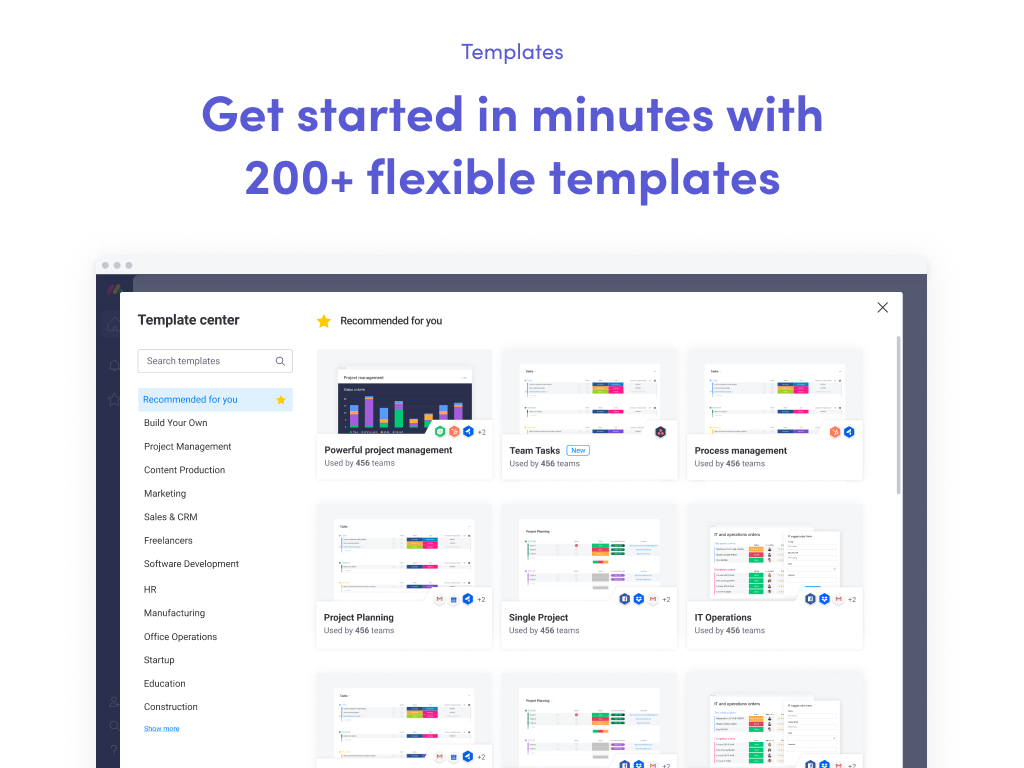
It's straightforward to use and simple to understand. They have tutorials on different elements of the system that you can learn. The workflow there is very intuitive, drag and drop, which doesn't require a learning curve for most people. Templates that also make things more accessible can be found.
It is easy to configure, intuitive. The customization process is in some ways better than Salesforce.com. It has a great UI. It does however depend on how it's implemented.
The design of it is generally fine, however the ability to data upload people from a spreadsheet is an obvious miss.
Sometimes it is slow when everyone is entering their time on Fridays or Mondays but other than that we rarely see downtime and maintenance notifications are well in advance.
Everything performs fairly well. Every now and then there are user errors where an employee will not click "ok" on a note they've created and simply exit out (I do wish that something was in place to prevent this, such as a pop "are you finished?")
Most Ancillary Pages: Quick to Reasonable (By "ancillary" I mean lesser used/master data maintenance pages - e.g. People, Customers, Individual Tasks, Milestones, etc.)
Work Plan (with 100 sub items): Reasonable to Slow
monday.com only really care about accounts that have 20 seats or more. While this is great for monday.com, it pushes smaller organisations to evaluate alternatives. We rate monday.com highly in our organisation because key staff have already got good experience with the application and we know we will get to 20+ seats one day. But, till then the billing model and lack of permanent enterprise features is a dread.
It's a good experience overall. Clarizen was useful when needed. It's mostly needed for advice on how to do more sophisticated actions or how to change something that was set up administratively. It's seldom used otherwise. The product consistently works, the documentation is acceptable, and the generally intuitive product is easy enough for most staff to pick up without much issue.
• We worked with a Project Manager on their side. He was very good about developing a project plan to hit our goal. I think we had weekly or twice weekly calls – very steady cadence over 3 month period. • Their PM skills were great – kept us on task. For the last week, they sent 2 people on site and they did training for power users. After that a couple of them revisited here
To have someone walk you thru the features and capabilities of Monday.com is priceless. Someone also coming along later in the contract to see if you are maximizing the program to suit your company needs is beyond helpful. The staff that have provided this training are fun, creative and very patient.
It's easy to access and frequently offered. Often I'm amongst only a few people on the call and get virtually individual attention. I also learn and share with the other attendees and we can see how we've each solved similar challenges.
We signed up for the accounts. Created the accounts. Ran the trial version and tested it live while we were running multiple projects and found that it was fitting our needs perfectly. When the trial ended and we were asked to purchase the full version, we did. We have found other ways to use it and it's a breeze.
We have been able to implement AdaptiveWork pretty easily but it requires updating of resource availability and continuous training as roles change and new people join the company. Other documentation is used such as spreadsheets for longer range planning and project approval
We decided to go with monday.com because they offered a free tier for nonprofits and because they are easier to use and offered additional features that we could not find on the other choices. Hands down, there was no better choice for us than monday.com.
Planview AdaptiveWork was the right size, at the right price point that fit our customization and integration flexibility. It is intuitive to use but allowed us to add complexity as our needs grew
For it to work across multiple departments and sites, I would like to see improvements made with integrations and automation. For this question, I am acknowledging not only the addition of internal triggers/automation, but also an expansion on external ones.
By using monday.com as an enablement tool for templated onboarding plans, we have been able to begin calculating the number of manager hours saved through our work (not defined yet).
monday.com's reporting tools also allow us to more easily report on the productivity and output of our team since we keep up with all projects and subitems in monday.com.
Planview AdaptiveWork allows us to report out on the status of our real estate projects on a regular basis. We have internal objectives that need to be met for on-time delivery and Planview AdaptiveWork provides us the data to be able to show how the teams are tracking on delivery.