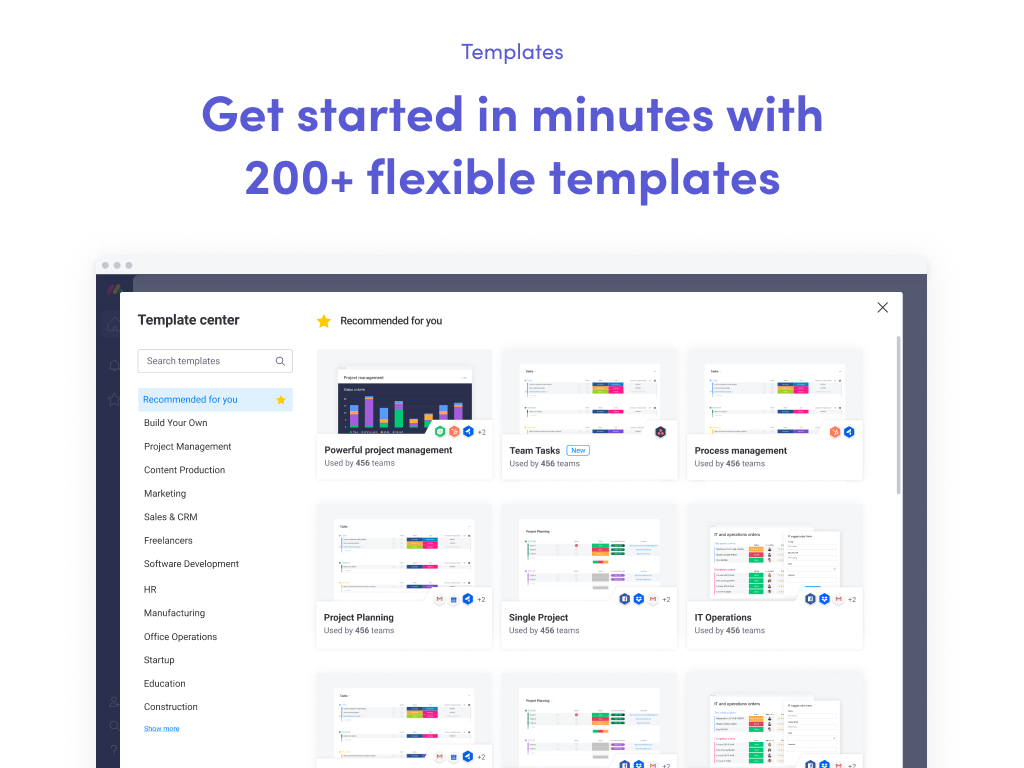
monday.com Work OS is an open platform designed so that anyone can create the tools they need to run all aspects of their work. It includes ready-made templates or the ability to customize any work solution ranging from sales pipelines to marketing campaigns, CRMs, and project tracking.
$12
per month per user
Todoist
Score 9.0 out of 10
N/A
Doist, a company boasting an entirely globally distributed workforce, offers Todoist, a project management platform emphasizing the needs of a distributed workforce. The application emphasizes tracking events over time with advanced closed task and progress reporting, with custom graphics for sharing or ease of review.
$8
per month per user
Pricing
monday.com
Todoist
Editions & Modules
Basic
$12
per month per user
Standard
$14
per month per user
Pro
$24
per month per user
Enterprise
Contact Sales
Contact us
Business
$8
per month per user
Offerings
Pricing Offerings
monday.com
Todoist
Free Trial
Yes
Yes
Free/Freemium Version
Yes
Yes
Premium Consulting/Integration Services
No
No
Entry-level Setup Fee
No setup fee
No setup fee
Additional Details
Yearly plan: Save 18%
Monthly plan also available
—
More Pricing Information
Community Pulse
monday.com
Todoist
Considered Both Products
monday.com
Verified User
Anonymous
Chose monday.com
It's been a while since trying Asana, so it's hard to say. I think they are very similar from what I remember, but maybe monday.com has more reporting and customization possibilities?

monday.com offer much of the standard tools and seems to be ever evolving. They seem to take feedback and constantly upgrade the tools. If all the tools are there, the differentiating factor might be the cost, any integrations you may need, and the visual "chemistry". To me, …
We chose to move from Zoho to monday.com when our company started growing exponentially. Overall, our team was thankful for the change because we were growing at far to fast of a speed for Zoho's tools to keep up with us. monday.com is a better, beefier platform with far better …
We decided to go with monday.com because they offered a free tier for nonprofits and because they are easier to use and offered additional features that we could not find on the other choices. Hands down, there was no better choice for us than monday.com.
When I arrived at my org, I was initially disappointed to hear that we used something other than Asana for project management. Fast forward just a few months, and I became a complete monday.com convert. While its organization is similar to Asana's, it's user interface, …
I would say this is one of my least favorite applications. I don't find it super user friendly due to the extreme amounts of customization. It feels like my information is in there somewhere, but I can never find it easily. I think that it looks a lot prettier than asana which …
monday.com seems to solve the issues and concerns for our marketing and graphics needs. I personally use Asana for my projects and tracking purposes and monday.com for my interations with Marketing and their needs.
monday.com is much easier to use and offers all the tools of google suite in one spot for task management. I use gsuite services still but in an entirely different way. If there is something that needs to be shared with the team or is important that I will need to refer back to …
Monday.com is the broadest scope work management software I have used. Its interface is basic and takes some getting used to, but the programming options are highly advanced and extremely effective.
I also use the other selected. But I prefer monday.com because it is more clear (visually and intuitively), and also because I have been using it for longer than the others. However, there is the price factor that must be taken into consideration
Monday.com is far more intuitive than Salesforce with it's automation features, lists are better and customizable and it makes things easier for everyone on the team.
Salesforces is a great CRM system but I feel as though it falls short as a collaborative project management …
As a developer, I have utilized the mentioned apps to integrate processes for clients, and I have found monday.com to be superior due to its abundance of features compared to others. Choosing monday.com provides enough capabilities for teams and managers to handle work in one …
monday.com is a much better tool for keeping track of tasks and assignments than MS Planner. In most situations where we used MS Planner we have switched to using monday.com instead.
monday.com is so much easier to use & project-tracking is not only easy to do, but the visuals are far from complicated & make it that much easier to keep track of everything.
I feel monday.com is easier to use than the others listed. Specifically, I used to use Trello in the past and I really liked it. I even recommended others to use it but since working in monday.com, I found it has so many more features that meet our teams needs and we have found …
monday.com has the only interface that is 100% customizable, can use public and private boards, can be shared with customers, produce Gantt charts, and has THE MOST integrations "in house". The professional relationships that monday.com has established to be "on board" with …
I searched for some other alternatives like monday.com, and I also tried them. For example, I have experience with Sloneek. But monday.com just feels different. I think it beats the competition in every way. You can also use monday's free version, and it is still a good task …
I chose monday.com because of its flexibility and ability to adapt to our needs. Throughout our work, I've seen how it helps us increase productivity and efficiency, which solidified my decision.
The easy of use and configuration is where monday.com has had an advantage. The ability for all our users to startup on the platform has helped to incorporate it into our enterprise environment quickly.
Actually, monday.com and Trello, although they are digital board systems, are both very different from each other. Trello is a simpler system that, although its function is also the organization of tasks, its visual system gradually overwhelms the user by "piling up" each post …
monday.com is simpler and easier to grasp, apply and navigate than Clickup, but the Clickup free version has so much more functionality available than the monday.com free / low-cost options (sorry, but it's true!). Google tasks is really simple and I shouldn't really compare …
Todoist: To-Do List & Task Manager is a more focused to-do app than monday.com or even Trello. It is simple yet flexible. However, Kanban power users will be underwhelmed by the limited functionality of the new board view. I hope that Doist will keep up the rapid pace of …
Notion and ClickUp are pretty similar. I find them useful for an entire team, and for creating docs and things like that. For a basic task management system though, it's overkill and I would lose tasks constantly (not be able to find them). Trello is better for a flow with …
Compared to other tools, Todoist offers a stronger focus on completing tasks compared to more complex project systems. We chose a combination of Asana (projects) and Todoist (more detailed task tracking), mutual integration and synchronization works flawlessly. We have …
Todoist is better than Asana for the reason being that it focuses on task management rather than projects. If a task that is in Todoist suddenly becomes a project or more of a long term thing, then I will duplicate the task in Asana as to track it's progress, stay on time, etc.
At one point, I used both Excel and Numbers to help keep track of my to do list… They were effective and so so far as it goes, but Todoist, in general prove to be the more superior program. The fact that I could easily color code and reassign tasks, and also the satisfaction of …
I've tried using project management software and other task management tools in the past but I have always come back to Todoist for its ease of use and simple yet effective functionality. It does a specific thing and does it really well without trying too hard or overextending …
Todoist is more focused on its goal than Google Keeps and is far more intuitive to use. For example, with just a click we see immediately that Todoist provides a way to distill tasks so that we only see what's immediately pertinent to us, via the Filters (which can be …
If I were to choose mutually exclusively, I would rather have Todoist: To-Do List & Task Manager than all those 3 Google apps combined; but if Todoist: To-Do List & Task Manager come out with an in-house calendar, then it would be super awesome.
[Todoist: To-Do List & Task Manager] is significantly simpler and cheaper than most of the alternatives and doesn't complicate the management of tasks with a plethora of unnecessary features. While all the alternatives have strong feature sets, what Todoist does better than any …
Todoist: [To-Do List & Task Manager] is easier to use and makes it easier to assign owners and determine a due date. I feel more confident that I know where and how a task will be tracked when I use [Todoist: To-Do List & Task Manager] versus any other similar software[.]
Todoist: To-Do List & Task Manager is much more simple with the ability to remove tasks from a single list rather than moving the item. The price point is very low and even the free features of often enough for my needs. The ability to quickly add items, have them synced to my …
Todoist: To-Do List & Task Manager is great for individual and personal use but isn't the best for team projects. It's too difficult to set up project tasking across multiple users with multiple tasks and multiple due dates.
Slack has a lot of options but was not what we needed. If we would go back to a more detailed tool we would use Ryver as that has more functions we would actually use. TickTick is great but somehow Todoist: To-Do List & Task Manager worked out better for us, but that is a very …
Todoist: To-Do List & Talk Manager is so much better than Google Tasks for one simple reason: nested project folders. There's also the smart text recognition when entering tasks in Todoist that makes it so much easier.
I prefer Todoist over Microsoft Notes. Todoist offers reminders and such to make sure we are not forgetting to do something that might've slipped off our plate. Microsoft Notes is simply just a great way to take notes. Using both is great, but we mainly stick to Todoist because …
I like Todoist better than Asana, Slack, and Boardable, but it may be simply because I don't use Todoist as a shared SaaS. Airtable serves a different main function (project management database), but inherent in it is the possibility of a large shared to-do list. Both Asana and …
There are so many task managers out there that it comes down to business needs and user preference. I selected Todoist because, for our particular business setup, it checked all the boxes. It's flexible, it's not limited to one ecosystem, and the price is exceptional. It can be …
I found that Todoist was the easiest way to organize all my tasks in multiple ways. I could be organized by date, priority, create sub-tasks, larger "areas" to keep things sorted. Others have a lot of the same options but not as good. I also really like how the app works on …
Asana is more project oriented and I really did not use it much, We used Trello with our team and while I liked it for projects, it really did not work for me with tasks. I have used many task managers over the years, and none can stack up to Todoist: To-Do List & Task …
Here, I will suggest that it is best to create employees, clients, or project reports. Easy to track with the dashboards. I did many integrations and developments. I can not list each of them here. I will say the best tool for management. I couldn't see criteria of unsuitable. But yes It will depend on the client's requirements. I will suggest it as very user-friendly tool for CEOs, CTOs, Managers, and company owners also for team.
[Todoist: To-Do List & Task Manager is] fantastic for small teams or for personal use. Really simple and easy to use so requires very little in the way of onboarding and gets people engaged quickly in the tasks they need to complete. May not be perfect where more complex usage is required but integrates with other tools so time tracking and other add ons are more than possible through other tools.
Being able to manage tasks across multiple devices and platforms is absolutely critical to me. If I am out of the office, the tasks will be on my phone. But they are also readily accessible on the web, on my desktop, and on my iPad.
There are several ways to organize your tasks... via Projects, Labels, Boards, Lists, etc. that allow users to use Todoist to fit their productivity workflow. I use them all and I have been delighted to see how Todoist has continued to improve and advance the Todoist application over the years.
I rely extensively on recurring tasks which allow me to never forget a birthday, monthly submission, chore at home, etc. Todoist offers many ways to manage recurring tasks, such as, "every week", "every April 8", "every fourth Thursday in November", etc.
Ensuring I have set up a Private board vs public board is not clear - it would be useful to have an additional alert when creating a board as I work with sensitive information. It will eventually be used in a team based environment but while I test the boards, they needs to be private.
Time tracking is clumsy, could be easier to record
Task Dependencies - Particularly for business projects, I'd love if we could make one team member's task dependent on another's where we could say "do this task 3 days after another one is complete"
No Two Factor Authentication - For me personally, I like to keep all my passwords secure and backed up by two-factor authentication. Just wish this was something Todoist offered!
Adding Start Date & End Date - Sometimes I set an end date farther in the future, but I'm not alerted that I need to be working on it before then to achieve that due date. If I look at the "Next 7 Days" section, I can see upcoming tasks, but ideally, I'd love to be able to set a start date and an end date so it could appear in today's tasks without needing to be completed today.
Teams involved in content creation, such as marketing or editorial teams, could use monday.com to manage the entire content lifecycle. Boards might track content ideas, assignments, drafts, reviews, approvals, and publication schedules, helping teams collaborate and keep content production on track.
It's straightforward to use and simple to understand. They have tutorials on different elements of the system that you can learn. The workflow there is very intuitive, drag and drop, which doesn't require a learning curve for most people. Templates that also make things more accessible can be found.
Excellent features and concept, simple implementation, but the software is not very clear in training new users and communicating features. The occasional unexplained crash or freeze is not handled gracefully by the desktop software, requiring either the user or tech support to manually restart.
Everything performs fairly well. Every now and then there are user errors where an employee will not click "ok" on a note they've created and simply exit out (I do wish that something was in place to prevent this, such as a pop "are you finished?")
monday.com only really care about accounts that have 20 seats or more. While this is great for monday.com, it pushes smaller organisations to evaluate alternatives. We rate monday.com highly in our organisation because key staff have already got good experience with the application and we know we will get to 20+ seats one day. But, till then the billing model and lack of permanent enterprise features is a dread.
I've been able to find answers to any questions I have in the support documents. You can explore key features and view ideas and best practices for getting organized with Todoist. You can also fill out a support form to submit a request for customized help if you run into anything not covered in the support documents.
To have someone walk you thru the features and capabilities of Monday.com is priceless. Someone also coming along later in the contract to see if you are maximizing the program to suit your company needs is beyond helpful. The staff that have provided this training are fun, creative and very patient.
We signed up for the accounts. Created the accounts. Ran the trial version and tested it live while we were running multiple projects and found that it was fitting our needs perfectly. When the trial ended and we were asked to purchase the full version, we did. We have found other ways to use it and it's a breeze.
We decided to go with monday.com because they offered a free tier for nonprofits and because they are easier to use and offered additional features that we could not find on the other choices. Hands down, there was no better choice for us than monday.com.
Todoist is more focused on its goal than Google Keeps and is far more intuitive to use. For example, with just a click we see immediately that Todoist provides a way to distill tasks so that we only see what's immediately pertinent to us, via the Filters (which can be customized and set to various priority levels). Also, Todoist's project board is something Google Keep doesn't even offer, it really can't even compete with Todoist simply because Todoist does so much more and was obviously designed with the business professional in mind.
For it to work across multiple departments and sites, I would like to see improvements made with integrations and automation. For this question, I am acknowledging not only the addition of internal triggers/automation, but also an expansion on external ones.
By using monday.com as an enablement tool for templated onboarding plans, we have been able to begin calculating the number of manager hours saved through our work (not defined yet).
monday.com's reporting tools also allow us to more easily report on the productivity and output of our team since we keep up with all projects and subitems in monday.com.