MongoDB Atlas is the company's automated managed cloud service, supplying automated deployment, provisioning and patching, and other features supporting database monitoring and optimization.
$57
per month
Oracle Autonomous Database
Score 9.1 out of 10
N/A
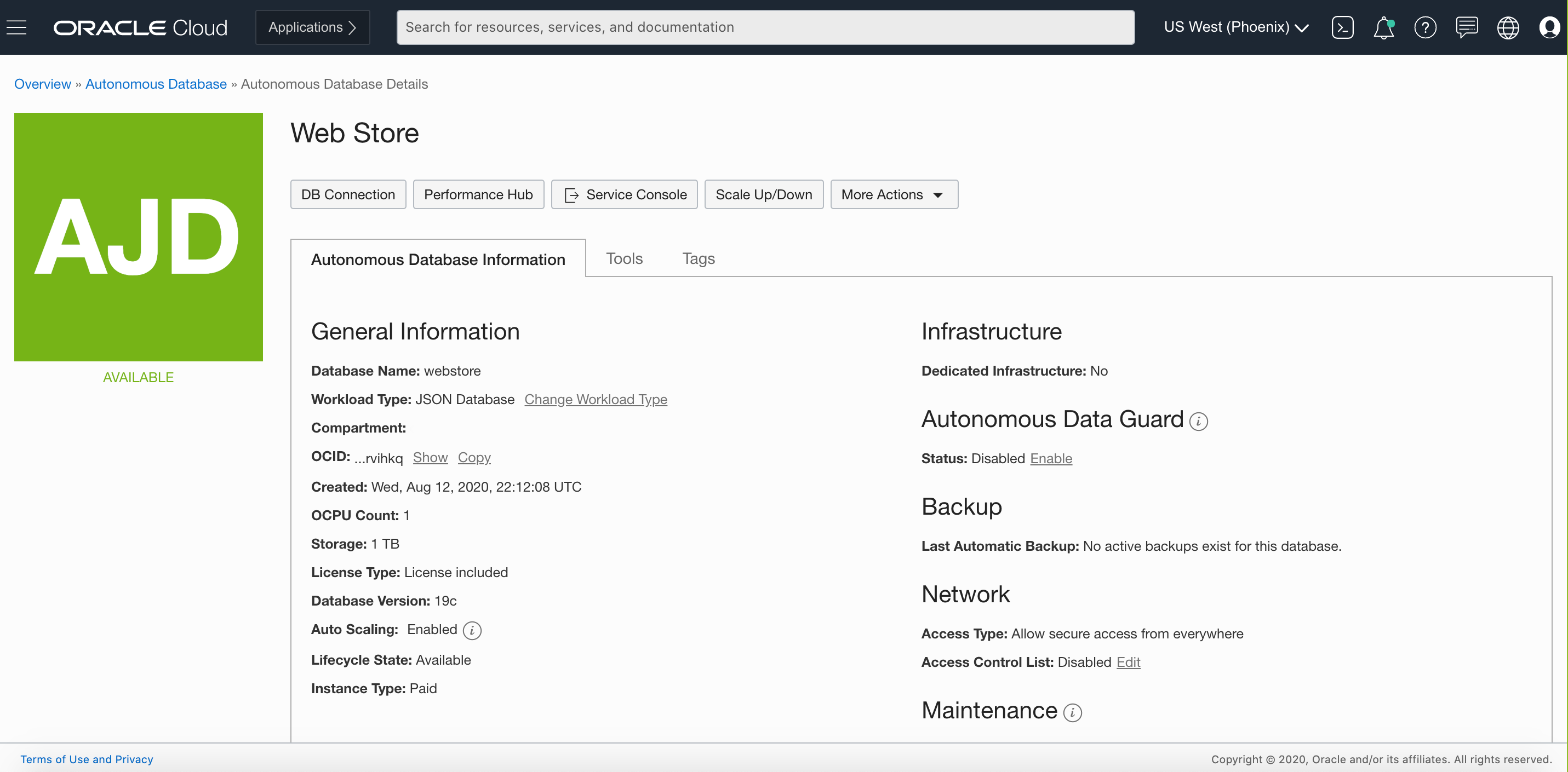
Oracle Autonomous Database provides a self-driving, self-securing, self-repairing cloud service that eliminate the overhead and human errors associated with traditional database administration. Oracle Autonomous Database takes care of configuration, tuning, backup, patching, encryption, scaling, and more.
N/A
Pricing
MongoDB Atlas
Oracle Autonomous Database
Editions & Modules
Dedicated Clusters
$57
per month
Dedicated Multi-Reigon Clusters
$95
per month
Shared Clusters
Free
No answers on this topic
Offerings
Pricing Offerings
MongoDB Atlas
Oracle Autonomous Database
Free Trial
No
Yes
Free/Freemium Version
Yes
Yes
Premium Consulting/Integration Services
No
No
Entry-level Setup Fee
No setup fee
Optional
Additional Details
—
—
More Pricing Information
Community Pulse
MongoDB Atlas
Oracle Autonomous Database
Considered Both Products
MongoDB Atlas
Verified User
Anonymous
Chose MongoDB Atlas
In general, they all compete against each other, and each solution has its own advantages and disadvantages. While MongoDB Atlas was the way to go for some cases, however, other databases were more fit for some services that MongoDB Atlas, especially if they were managed by us, …
MongoDB Atlas has been in the market for very long time and there are bunch of documentation, training and support for it. It also is specifically designed for the use case similar to our project and big companies in the market uses them for very high load which made us …
Both AWS RDS and MongoDB Atlas provide a state-of-the-art managed database hosting service, with the difference being the type of databases they support. AWS RDS does not support MongoDB engine and Atlas only supports MongoDB. So I consider them complimentary services and we …
MongoDB Atlas has an excellent rating out there in the market. They have a great supporting team as well. When we have questions about technical stuff, they respond fast. The performance of MongoDB Atlas is the key factor that we choose to use. Because it has such an easy way …
Vice President, Chief Architect, Development Manager and Software Engineer
Chose MongoDB Atlas
MongoDB is a great product but on premise deployments can be slow. So we turned to Atlas. We also looked at Redis Labs and we use Redis as our side cache for app servers. But we love using MongoDB Atlas for cloud deployments, especially for prototyping because we can get …
When choosing a NoSQL, open source database, MongoDB is the clear winner from an implementation standpoint. For databases that are better suited for highly-organized data, a traditional database engine like MySQL, PostgreSQL, or Oracle's RDBMS may be a better choice. When the …
Oracle DB is levels of magnitude more rich in its functionality, it is much stronger in security, DR, HA, etc. However, the main drawback is its cost compared to MySql.
Because I had a background with Oracle Database, and comparatively the autonomous database is very easy to scale up and to obtain performance information.
Hands down it's the best. It's secure and extremely fast. It also doesn't need a lot of babysitting. It's running itself. It does its job as advertised. This is why I feel everyone should if they haven't already taken a hard look OAD. I feel it's the future of technology at its …
I found Oracle Autonomous Database very secure to store data and private information.I always feel secure with Oracle Autonomous Databases disaster recovery features.It is very effective to build applications for mobile and desktop devices lesser code using a low code …
Oracle Autonomous Database has the warehouse extension, whose performance has no question, and it increases the relevancy of the company's operations and fosters performance. Further, Oracle Autonomous Database generates high-performance options, which navigates all the …
Oracle Autonomous Database is the right choice for multiple functionalities, for instance, the warehousing of databases, and transactional analytics. Besides, Oracle Autonomous Database generates a platform that makes the process of application development efficient and …
We had already experienced people in the team on Oracle as Oracle Database was already being used in the organization. Also, when we compared all other possibilities, it came out as a less costly solution.
Actually, we used both Oracle Autonomous Database for our Oracle-related environments and Azure SQL and Azure VMs hosting SQL Server for our SQL Server-related environments. We have different products, some of them are platform independent (can be deployed on Oracle, SQL …
Oracle Autonomous Database is easy to deploy and use. Provides various supports with security. So it is much better in terms of complexity and performance to manage our application in real time. Cost is also less as compare to other databases. Easy development and deployment is …
AWS and Digital Ocean are two of the major other systems we have and are still using. But we do use Oracle's systems far more than we use Digital Ocean and AWS. We selected Oracle Autonomous Database mainly because of the new cloud 2.0 benefits. They have convinced us to begin …
I would recommend MongoDB Atlas to every company who have a significant need in the NoSQL database and do not want to manage their infrastructure. Using MongoDB Atlas can significantly reduce your management time and cost, which saves valuable resources for other tasks. It also suits a smaller company as MongoDB Atlas scales up and down very quickly.
Scenarios where this is best suited are like where there are not large set of data which has to be analyzed and extracted.It helps in the efficiency of data .It is also well suited for medium size companies where you have to create a common data for everyone. As for large set of data, there can be network latency issues and thus there are some limitations of this software.
Generous free and trial plan for evaluation or test purposes.
New versions of MongoDB are able to be deployed with Atlas as soon as they're released—deploying recent versions to other services can be difficult or risky.
As the key supporters of the open source MongoDB project, the service runs in a highly optimized and performant manner, making it much easier than having to do the work internally.
For someone new, it could be challenging using MongoDB Atlas. Some official video tutorials could help a lot
Pricing calculation is sometimes misleading and unpredictable, maybe better variables could be used to provide better insights about the cost
Since it is a managed service, we have limited control over the instances and some issues we faced we couldn't;'t know about without reaching out to the support and got fixed from their end. So more control over the instance might help
The way of managing users and access is somehow confusing. Maybe it could be placed somewhere easy to access
There is no access to the physical host of the DB. This is expected from a managed DB. Everything must be done through the console or via API calls. This is a new learning curve for the DBAs.
Due to the lack of physical host access, certain features are not supported, such as Transportable tablespaces and Oracle LogMiner.
Certain special data types, (such as XMLType) are not allowed; be sure the app vendor certifies their product on this platform.
Autonomous is the way of the future and this is one system which is crucial to any system and is also autonomous. It is self-tuning and self-maintaining which are major advantages.
I would give it 8. Good stuff: 1. Easy to use in terms of creating cluster, integrating with Databases, setting up backups and high availability instance, using the monitors they provide to check cluster status, managing users at company level, configure multiple replicas and cross region databases. Things hard to use: 1. roles and permissions at DB level. 2. Calculate expected costs
The product is continuously evolving and new features are added frequently. Management options through the OCI (Oracle Cloud Infrastructure) console and through the command line and API are being enhanced frequently.
We love MongoDB support and have great relationship with them. When we decided to go with MongoDB Atlas, they sent a team of 5 to our company to discuss the process of setting up a Mongo cluster and walked us through. when we have questions, we create a ticket and they will respond very quickly
In general, they all compete against each other, and each solution has its own advantages and disadvantages. While MongoDB Atlas was the way to go for some cases, however, other databases were more fit for some services that MongoDB Atlas, especially if they were managed by us, which means less cost, like Redis for example
Hands down it's the best. It's secure and extremely fast. It also doesn't need a lot of babysitting. It's running itself. It does its job as advertised. This is why I feel everyone should if they haven't already taken a hard look OAD. I feel it's the future of technology at its best. Everyone should be taking notice of how far technology has come and where it's going.