MongoDB is an open source document-oriented database system. It is part of the NoSQL family of database systems. Instead of storing data in tables as is done in a "classical" relational database, MongoDB stores structured data as JSON-like documents with dynamic schemas (MongoDB calls the format BSON), making the integration of data in certain types of applications easier and faster.
$0
per month
OCI
Score 9.0 out of 10
N/A
Oracle Cloud Infrastructure (OCI) is Oracles's infrastructure-as-a-service (IaaS) platform which combines the utility of public cloud with the granular control, security, and predictability of on-premises infrastructure.
N/A
Pricing
MongoDB
Oracle Cloud Infrastructure
Editions & Modules
Shared
$0
per month
Serverless
$0.10million reads
million reads
Dedicated
$57
per month
No answers on this topic
Offerings
Pricing Offerings
MongoDB
OCI
Free Trial
Yes
Yes
Free/Freemium Version
Yes
Yes
Premium Consulting/Integration Services
No
No
Entry-level Setup Fee
No setup fee
Optional
Additional Details
Fully managed, global cloud database on AWS, Azure, and GCP
The environment I work in is somewhat unique in that we use both MySQL and MongoDB. However, each is used for specific purposes that the other is not well suited for. MongoDB is not a relational database like MySQL, so it serves as the perfect place to dump key bits of data for …
We have [measured] the speed in reading/write operations in high load and finally select the winner = MongoDBWe have [not] too much data but in case there will be 10 [times] more we need Cassandra. Cassandra's storage engine provides constant-time writes no matter how big your …
Both Couchbase and MongoDB are document-oriented NoSQL databases, so they have very similar features. While they do have some fundamental differences in terms of how they scale, shard, etc. the one key reason why we went with MongoDB is its availability and support from the …
The flexible structure underlying MongoDB's construction is not found in other competitors; the ability to easily change the structure without affecting other stored documents. It is very ideal for projects that you cannot predict that the structure will change this way. Of …
Implementing new features for application becomes simpler with MongoDB since you don't need to run database migration scripts just to for example add new fields to database only to store some extra data. This is especially good for the deployment phase. Only new version of …
MongoDB is a robust and scalable db which offers a lot of cool features out of the box. Being open sourced and backed by a great community with developer tools like mongo compass , it was a no-brainer to go for it. It has connectors in almost all programming languages and is a …
I would say Cassandra is better than MongoDB since it has the backing of Facebook to it. Its inherent properties like versioning put it into the other category of columnar databases, but it's one of the NoSQL databases which you should definitely consider for your organization …
This tool is only capable of reading real-time data very smoothly. The transition was also pretty easy and quick. Syntax is also very easy and comfortable to learn and use.
The main reason for selecting is that it works very fast under the Intellijet module environment and we …
In our early development days we weighed NoSQL databases like MongoDB with RDBMS solutions like MySQL. We were more familiar with MySQL from past experience but also were wary of painful data migrations that slowed down development iterations and increased the risk of outages …
Snowflake and Redshift are much more mature and have been around longer. MongoDB is definitely much less expensive and if you are in a startup, this is an almost for-sure option. Redshift can be slow and Mongo is much faster. However, losing the relational database aspect could …
It's very fast and easiest to use. Many companies are using this nowadays. It's helped to complete many software products very quickly so the year income has increased compared with last years. Many programmers are now leaning this tool as back end developers so that we changed …
MongoDB is our go-to database solution for any project, and the more we work with it the more we love it. Some say that NoSQL is pointless... Our developers wholeheartedly disagree, because they love working with it. Though both NoSQL and SQL have their purposes, in most …
Your default choice should not be MongoDB in my opinion. Most user-facing systems are relational by nature so a well known and reliable SQL database would be easier to maintain and simpler to develop long term. If you highly value speed of development go with firebase. If you …
It does not belong to certain cloud platforms. MongoDB is an independent program that works with any cloud platform including Amazon Web Services and the Google Cloud Platform. For companies who want to maintain a cloud agnostic structure, MongoDB is a great choice for NoSQL …
MongoDB and Cassandra are both database system from the NoSQL family. MongoDB can be used in lots of use cases while Cassandra has a specific usage. There are some features that MongoDB provides efficiently while Cassandra doesn't and vice-versa. Like, you can update the data …
We tend to choose MongoDB when we're faced with a particular situation: we know that we need a NoSQL database in general, and want an open-source implementation that allows us to prevent against platform lock-in. Amazon's new DocumentDB product even allows us to choose to use …
Main benefit was costing compared to other services and we use Oracle as a database so with Oracle Cloud Infrastructure we can fully utilize the Oracle Cloud Infrastructure database which helped a lot for our products to handle major load that is one big plus because we had pay …
Oracle Cloud Infrastructure typically offers lower pricing for compute and storage than AWS. There are no hidden charges, it is more transparent. It is built for running oracle databases which the application was using, and licensing is more cost effective as compared to AWS.
Right now we are evaluating the usage. Prima facie is that it will be game changer and we are supposed to start POC in next sprint. Can not put client details but on high level, clients are very excited to see if ML can predict areas of traction from where orders are created …
Selected ones are better than Oracle Cloud Infrastructure but it works well only for small scale applications. It leads to migration to other cloud platforms.
Used Google Cloud Platform to store data in data warehouse and the monitor it. Powerfull VM in GCP are very good and can process large databases too. We are using Oracle Cloud Infrastructure mostly because of client's request.
Performance and latency are excellent in Oracle Cloud Infrastructure. Except for AWS baremetal, I don't find anything like that. I found that, aside from conventional compute that works really good, they also offer HPC VDI. That's one of the strengths that should have more hype …
Oracle Cloud Infrastructure stacks up against EC2, in cases where out DB are Oracle, the transformation of the data take a lot of time and effort to warranty that the data have been migrated correctly, to offfcourse in case where Oracle are in our company will be always a …
Oracle Cloud Infrastructure is great because of the ample storage and quick loading times we receive compared to others. The cost is also very manageable. We like how Oracle is structured and we utilize the machine learning and AI built in tools quite often. We are very pleased …
- Performance was big reason for choosing Oracle Cloud infrastructure over AWS Ec2 and Azure VMware Solutions.- Oracle Database as application design was another reason for choosing Oracle Cloud infrastructure over AWS Ec2 and Azure VMware Solutions.
Oracle Cloud Infrastructure (OCI) competes with several major cloud providers, including Amazon Web Services (AWS), Microsoft Azure, Google Cloud Platform (GCP), and others.Here is why we consider selecting Oracle Cloud Infrastructure: Strong for Oracle Workloads, …
We used Microsoft Azure and Docker earlier and faced some difficulties like Microsoft Azure and Docker. Occasionally, the generation of large images can delay deployment. It is also necessary for me to admit that Microsoft Azure and Docker have a somewhat steep learning curve. …
Oracle Cloud Infrastructure provides strong and Innovative database services with its enterprise Autonomous Database and Exadata Features. Oracle database management can make huge workloads autonomously. OCI in addition is more cheaper compared to it's other competitors in the …
Services are almost the same, but OCI can provide more resources at the same price, our application can easily do the migration, and also, OCI also provides free VPC Site to Site VPN, which helps us create a security path from local to remote.
OCI does not stack up against these products due to their wide range of services, support, and ease of troubleshooting. There is an abundance of tutorials on the services provided by the competition, which makes them more easy to use. However, OCI is very competitive in pricing.
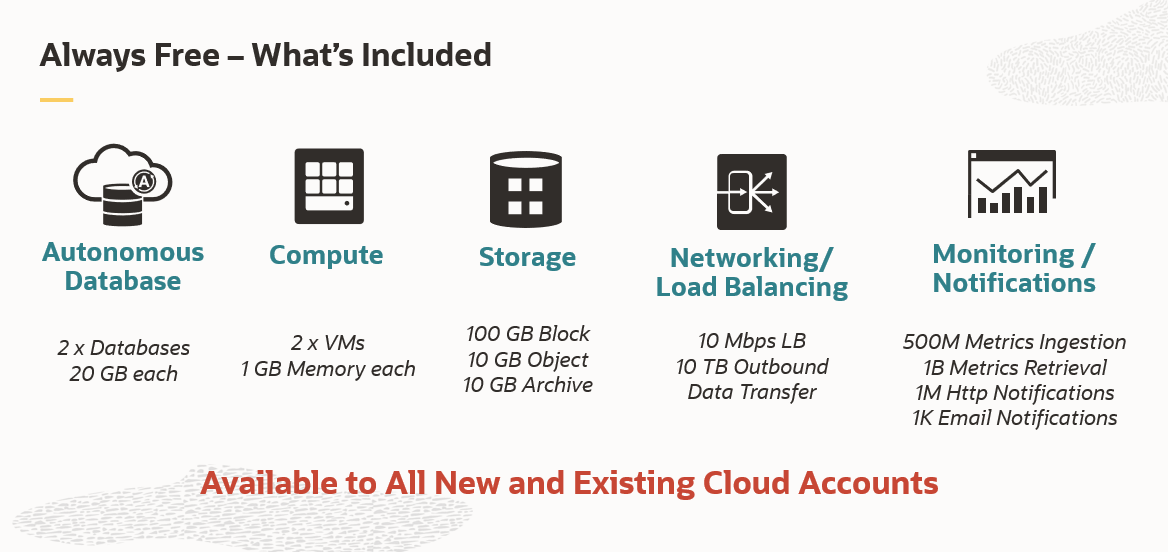
We use AWS and Google Cloud widely in our organization. However, we also use Oracle Databases for critical business, and OCI integrates well. We use OCI to test out our hypothesis for a rapid product. The Free tier is extremely useful to play around before committing.
There are numerous cloud providers in the market and I feel Oracle is very underrated for its capabilities and offerings . It has huge potential and it brings in very huge discounts for existing Oracle customers with unlimited licensing , if you are an existing ULA subscriber …
have used several other cloud functions provided by different companies but I found Oracle Cloud Infrastructure to be more user friendly and easy to understand and implement, also it has a global reach with different regions. OCI also has advantage of different database …
MongoDB [is] great at storing JSON data grouped into "collections". In this format, you can store any JSON documents and conveniently categorize them by collections. The JSON document contained in MongoDB is called binary JSON or BSON and, like any other document in this format, is unstructured. Therefore, unlike traditional DBMS, any kind of data can be stored in collections, and this flexibility is combined with the horizontal scalability of the database. It should be noted that MongoDB does not have links between documents and “collections” (this is partially compensated by the Database Reference - links in the DBMS, but this does not completely solve the problem). As a result, a situation arises in which there is a certain set of data that is not related to other information in the database, and there is no way to combine data from different documents. In SQL systems, this would be an elementary task.
Oracle Cloud Infrastructure (OCI) is a great fit when you need High-performance infrastructure for mission-critical apps that require low latency and high availability. Scalable compute services for big data analytics workloads that process massive datasets. Support for DevOps teams looking to streamline their development and deployment pipelines. But it might not be the best choice for Small-scale or low-traffic applications where you can find cheaper options elsewhere. Legacy workloads running on older tech like Oracle Solaris or Windows Server, where OCI's support may be limited.
Easy to learn. When I picked up MongoDB for the first time, I had little background in database management or modeling. If you have a background in javascript (and JSON)... then you can figure out how to use MongoDB pretty fast.
Fast performance.
It's relatively easy to set up in certain environments because there are lots of ready-made solutions out there.
There's a lot of support in the existing ecosystem for it —, especially in the node.js realm.
Query syntax is pretty simple to grasp and utilize.
Aggregate functions are powerful.
Scaling options.
Documentation is quite good and versioned for each release.
Block Volume provides durability and stability to data. IOPS can be changed on the fly. Always stay true to the promised performance.
Block Volume can be encrypted with ease to meet compliance. Can also be easily integrated with OCI vault service for extra security.
Object Storage and File Storage are other forms of storage that are secure and extremely easy to configure. FSS is one of the best in the industry when it comes to reliability and performance.
SSD block volumes are persistent in OCI unlike many other clouds.
Navigating the UI takes lots of getting used to. It reminds me of older GCP (just to get used to where everything is).
Permission for different things always seemed to be more difficult than it really needed to be. Once you got them set up you were good but updating anything or creating new permissions for just about anything took longer than I thought it should.
Based on how the buttons were laid out, it was pretty easy to delete all of your DNS records, and backing them up was not as intuitive as I'd like with the UI, but it was easy to do using a script.
MongoDB is one of the most famous non-relational databases in the world, there are famous active projects that use this database. I think that the same company that develops the database gives you the online induction totally free is something that really is very positive. Accounts with a first-class support to be able to relate the correct implementation of the database, in addition to teaching you the best practices to optimize your projects, I believe that with this decision it is more than obvious which is the best decision at the time of seeing with which database to work.
We have been using this product for the last 6 years, and we keep renewing it yearly as we have no issues with this cloud provider. Maybe till we have our products, we will use this cloud and will be renewing it.
It is one of the reasons why we prefer it to store documents in a JSON-style format, to access the desired document very quickly regardless of its size, to be readable by human eyes, and to be easily scalable and manageable.
The services & products in Oracle Cloud Infrastructure needs more improvement to beat other Cloud service providers. The price is good & Security processes are good. We are requiring to put more effort in supporting this Oracle Cloud Infrastructure than other Cloud service providers. Probably better ways are there but is not super easy to find or not super available
Yeah sometimes we had to face unplanned outages due to underlying infrastructure issues, so not every time,e but once in a while we face issues with availability. But the good thing is we have redundancy with DR setup and multi region so we can manage.
Oracle Cloud Infrastructure performance is good in terms of querying large datasets, and is also consistent. It integrates well with other third party applications, and doesn't noticeably seem to slow down. Complex analytical queries and reports are processed efficiently even with larger datasets. Auto-scaling has been useful for traffic handling as this is a major challenge for any application.
I have reached multiple times to the MongoDB community for the help and they have provided each and easy solution for every problem. Over the internet and on stack overflow many people responds over the challenges. Now this tool is very much used in every company and projects so internally many people are there to give a support.
Overall it is amazing, there is always room for improvement. We have weekly updates that tend to slow the program used more and more. We had to change some reports within Oracle because the others wouldn’t load. This is tied to our payroll and the delays are causing many time constraint issues and panic. We have to create a new report when one breaks. Otherwise awesome!
While the setup and configuration of MongoDB is pretty straight forward, having a vendor that performs automatic backups and scales the cluster automatically is very convenient. If you do not have a system administrator or DBA familiar with MongoDB on hand, it's a very good idea to use a 3rd party vendor that specializes in MongoDB hosting. The value is very well worth it over hosting it yourself since the cost is often reasonable among providers.
The environment I work in is somewhat unique in that we use both MySQL and MongoDB. However, each is used for specific purposes that the other is not well suited for. MongoDB is not a relational database like MySQL, so it serves as the perfect place to dump key bits of data for quick retrieval later. This is something we can't easily do with MySQL. On this smaller database, MongoDB also lets us retrieve data more quickly with its fast and efficient querying.
Performance and latency are excellent in Oracle Cloud Infrastructure. Except for AWS baremetal, I don't find anything like that. I found that, aside from conventional compute that works really good, they also offer HPC VDI. That's one of the strengths that should have more hype in OC advertising. After my tests, that were limited by the trial, I'm a net promoter of the service. I really miss the depth of my RDP connections and response times.
We have hosted around 500 + customers on this cloud so till day not faced any major issues, so we can use it for any kind of products and it can hold the load and easily scale based on need.
We can make more open and flexible systems due to its easy adaptation to new evolutions in web applications.
In the latest versions it offers support for different transactions and we could carry out real tests related to the concurrency of the application.
MongoDB allows you to have distributed clusters, which improves the speed of the queries by reducing the latency that exists between the database cluster and the service that executes the query.