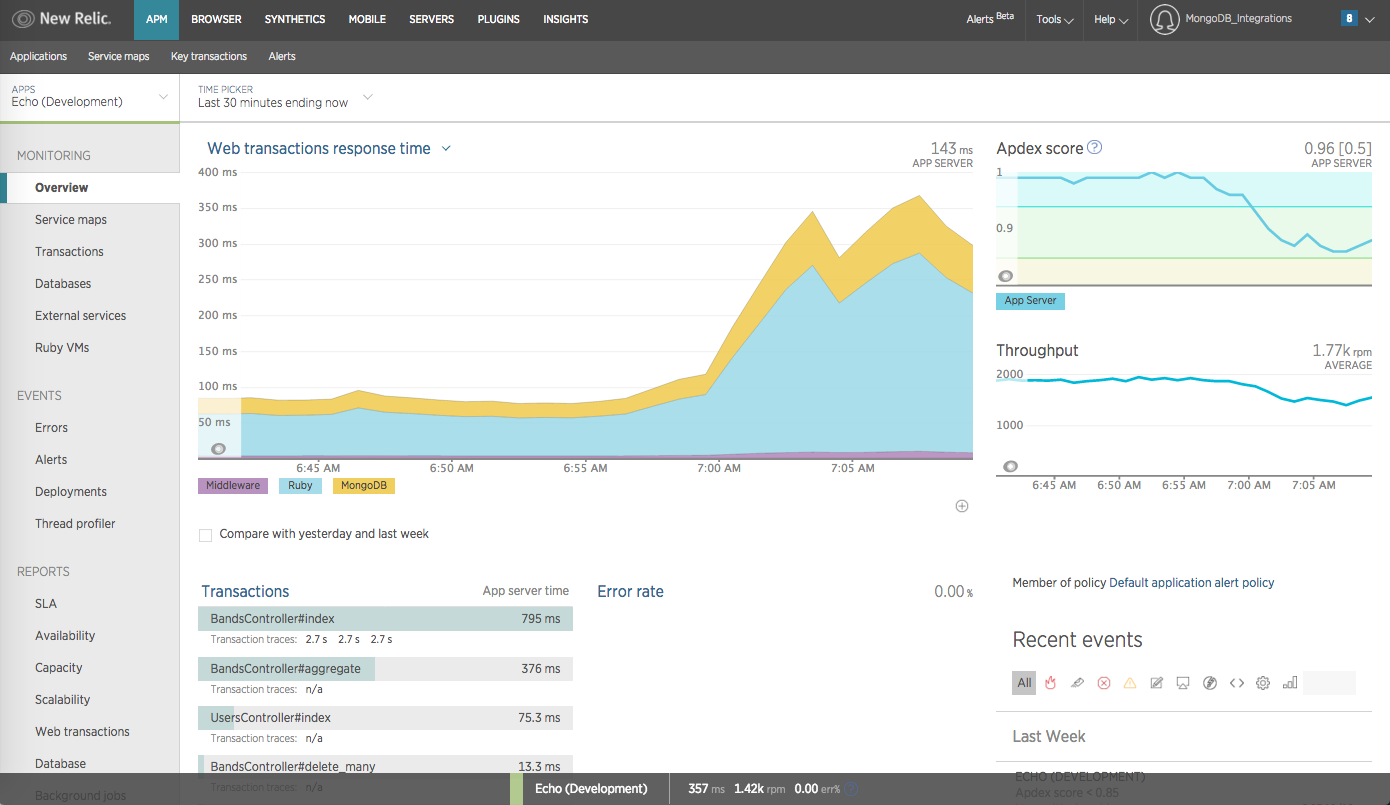
MongoDB is an open source document-oriented database system. It is part of the NoSQL family of database systems. Instead of storing data in tables as is done in a "classical" relational database, MongoDB stores structured data as JSON-like documents with dynamic schemas (MongoDB calls the format BSON), making the integration of data in certain types of applications easier and faster.
$0
per month
Snowflake
Score 8.9 out of 10
N/A
The Snowflake Cloud Data Platform is the eponymous data warehouse with, from the company in San Mateo, a cloud and SQL based DW that aims to allow users to unify, integrate, analyze, and share previously siloed data in secure, governed, and compliant ways. With it, users can securely access the Data Cloud to share live data with customers and business partners, and connect with other organizations doing business as data consumers, data providers, and data service providers.
N/A
Pricing
MongoDB
Snowflake
Editions & Modules
Shared
$0
per month
Serverless
$0.10million reads
million reads
Dedicated
$57
per month
No answers on this topic
Offerings
Pricing Offerings
MongoDB
Snowflake
Free Trial
Yes
Yes
Free/Freemium Version
Yes
No
Premium Consulting/Integration Services
No
No
Entry-level Setup Fee
No setup fee
No setup fee
Additional Details
Fully managed, global cloud database on AWS, Azure, and GCP
The environment I work in is somewhat unique in that we use both MySQL and MongoDB. However, each is used for specific purposes that the other is not well suited for. MongoDB is not a relational database like MySQL, so it serves as the perfect place to dump key bits of data for …
We have [measured] the speed in reading/write operations in high load and finally select the winner = MongoDBWe have [not] too much data but in case there will be 10 [times] more we need Cassandra. Cassandra's storage engine provides constant-time writes no matter how big your …
Both Couchbase and MongoDB are document-oriented NoSQL databases, so they have very similar features. While they do have some fundamental differences in terms of how they scale, shard, etc. the one key reason why we went with MongoDB is its availability and support from the …
The flexible structure underlying MongoDB's construction is not found in other competitors; the ability to easily change the structure without affecting other stored documents. It is very ideal for projects that you cannot predict that the structure will change this way. Of …
Implementing new features for application becomes simpler with MongoDB since you don't need to run database migration scripts just to for example add new fields to database only to store some extra data. This is especially good for the deployment phase. Only new version of …
MongoDB is a robust and scalable db which offers a lot of cool features out of the box. Being open sourced and backed by a great community with developer tools like mongo compass , it was a no-brainer to go for it. It has connectors in almost all programming languages and is a …
I would say Cassandra is better than MongoDB since it has the backing of Facebook to it. Its inherent properties like versioning put it into the other category of columnar databases, but it's one of the NoSQL databases which you should definitely consider for your organization …
This tool is only capable of reading real-time data very smoothly. The transition was also pretty easy and quick. Syntax is also very easy and comfortable to learn and use.
The main reason for selecting is that it works very fast under the Intellijet module environment and we …
In our early development days we weighed NoSQL databases like MongoDB with RDBMS solutions like MySQL. We were more familiar with MySQL from past experience but also were wary of painful data migrations that slowed down development iterations and increased the risk of outages …
Snowflake and Redshift are much more mature and have been around longer. MongoDB is definitely much less expensive and if you are in a startup, this is an almost for-sure option. Redshift can be slow and Mongo is much faster. However, losing the relational database aspect could …
It's very fast and easiest to use. Many companies are using this nowadays. It's helped to complete many software products very quickly so the year income has increased compared with last years. Many programmers are now leaning this tool as back end developers so that we changed …
MongoDB is our go-to database solution for any project, and the more we work with it the more we love it. Some say that NoSQL is pointless... Our developers wholeheartedly disagree, because they love working with it. Though both NoSQL and SQL have their purposes, in most …
Your default choice should not be MongoDB in my opinion. Most user-facing systems are relational by nature so a well known and reliable SQL database would be easier to maintain and simpler to develop long term. If you highly value speed of development go with firebase. If you …
It does not belong to certain cloud platforms. MongoDB is an independent program that works with any cloud platform including Amazon Web Services and the Google Cloud Platform. For companies who want to maintain a cloud agnostic structure, MongoDB is a great choice for NoSQL …
MongoDB and Cassandra are both database system from the NoSQL family. MongoDB can be used in lots of use cases while Cassandra has a specific usage. There are some features that MongoDB provides efficiently while Cassandra doesn't and vice-versa. Like, you can update the data …
We tend to choose MongoDB when we're faced with a particular situation: we know that we need a NoSQL database in general, and want an open-source implementation that allows us to prevent against platform lock-in. Amazon's new DocumentDB product even allows us to choose to use …
Snowflake provides various features, such as integration with Python using Snowpark. The reporting feature that caters to your small reporting needs is Snowsight. The Snowflake data marketplace is where you can get multiple data for free and even some of the data which you can …
These are comparable products that can make sense depending on the specific needs of your organization. All are certainly serviceable and have varying pros and cons. Snowflake seems to provide the greatest degree of flexibility and easy scalability as new data gets brought into …
We needed scalability and a new way of organizing our data; Snowflake allowed us to have a clearer view of our data warehouses and schemas. Snowflake is also way superior in terms of speed and quick insights from the raw data you query, which is very valuable to us.
Snowflake has an attractive pricing model with auto-suspend and auto-resume and pay per use. AWS Redshift requires higher administrative efforts to maintain and scale the platform whereas with Snowflake those admin tasks are not needed or automatically taken care of.
We had a MS SQL server with over 2 TB of ram & 51 processors that we were using, that could no longer handle our workload. Snowflake can handle 3 times that workload with ease and efficiency.
Snowflake is much faster and easier to write queries and pull data. But the visualization part of Snowflake is not as good as them. Also, Snowflake only supports SQL queries but not python or other languages. So basically Snowflake is the expert in its field but not suitable …
We particularly liked Snowflake's security model as well as its unique storage (whereby everything is essentially a pointer to immutable micro-partitions, which is the key behind its zero-copy cloning, its secure sharing, its time travel, etc.). and also how it separates …
While Snowflake is more open to cloud eco system, SAP integrated well with SAP eco system products like SAP ECC or SAP S/4. So for people who have invested heavily in SAP eco system including SAP ECC or S/4, it makes sense to go with SAP DWC which is also evolving very rapidly. …
In my opinion, the other tools have similar and some different features; however, when I ran proof of technologies between Synapse and Snowflake. Snowflake did things better or just had functionality that the other tools did not. One that stuck out at the time was scale up …
Each of the other solutions were cloud vendor specific, Snowflake can ride on either Amazon Web Services, Microsoft Azure, or Google Cloud. The fact that they are ANSI-sql compliant and have an effective means of offloading data makes them portable and easy to sell to teams …
Azure and Snowflake compared very similarly, but Snowflake provided more options to integrate and connect with tools/companies that were not partners. It seemed to be a more flexible environment. The barrier for entry on Oracle and Google we just too complicated. In particular, …
I have had the experience of using one more database management system at my previous workplace. What Snowflake provides is better user-friendly consoles, suggestions while writing a query, ease of access to connect to various BI platforms to analyze, [and a] more robust system …
Snowflake has won the match because it is giving an excellent performance with its efficient features and reliable results. This is a totally secure program for our precious and important data.
Our initial data warehousing solution was Treasure Data. We had issues with the costly pricing model, which would be exhorbitant if we want to hold our data in memory and query using Presto. As a result, some heavy lifting was done in Hive (managed by Treasure Data); …
In my experience running the data management practice at InterWorks, we believe that cloud data warehouse products will eventually serve the majority of data warehousing use cases and power data analytics at most companies. Of this cohort, we believe that Snowflake is the best …
Redshift compute and storage can be scaled up/down together (though they added some features recently, they don't quite add up). I haven't tried Avalanche or Firebolt but would love to in the near future, due to their pedigree or revolutionary billing methods.
- Cost was the main aspect on the decision. - Performance was in par or better compared to other tools in the market. - Snowflake in my opinion stacks better than other tools I have used in the past.
Accommodates future data types such as JSON and XML. Scalability is another advantage. Pay per use is beneficial for organizations like yours. Direct connectors with AWS help us to go with it. No limit on user creation and clone data not eating up extra disk space are a few …
Since we switch from amazon redshift to Snowflake, we found Snowflake is much better than redshift in many ways, including the data integrate and data pull. However, comparing directly pull data from amazon s3, Snowflake is quite slow in terms of data pull speed and the more …
Compared to Amazon Redshift, Snowflake is slightly easier and faster to achieve ROI but based on the user's perspective, the two tools have very little difference since both are leveraging SQL to pull data from AWS S3. Snowflake is also working with Microsoft Azure but it is …
Our issue with Redshift was that it was very expensive. On top of that, queries were still slow and if we used more of Redshift's memory, then it would have cost even more. Snowflake is not cheap, but less costly for us. Plus, the performance was much better. Also, we got to …
MongoDB [is] great at storing JSON data grouped into "collections". In this format, you can store any JSON documents and conveniently categorize them by collections. The JSON document contained in MongoDB is called binary JSON or BSON and, like any other document in this format, is unstructured. Therefore, unlike traditional DBMS, any kind of data can be stored in collections, and this flexibility is combined with the horizontal scalability of the database. It should be noted that MongoDB does not have links between documents and “collections” (this is partially compensated by the Database Reference - links in the DBMS, but this does not completely solve the problem). As a result, a situation arises in which there is a certain set of data that is not related to other information in the database, and there is no way to combine data from different documents. In SQL systems, this would be an elementary task.
If you need a quick query, snowflake is the way to go. It's super simple and scalable; we were struggling before with Azure, and with Snowflake, everything runs smoothly, and we have more control over our schemas and warehouses. Snowflake, in my opinion, is the next step when you want to scale your business and manage data. If your company is still small, there may be cheaper options.
Easy to learn. When I picked up MongoDB for the first time, I had little background in database management or modeling. If you have a background in javascript (and JSON)... then you can figure out how to use MongoDB pretty fast.
Fast performance.
It's relatively easy to set up in certain environments because there are lots of ready-made solutions out there.
There's a lot of support in the existing ecosystem for it —, especially in the node.js realm.
Query syntax is pretty simple to grasp and utilize.
Aggregate functions are powerful.
Scaling options.
Documentation is quite good and versioned for each release.
Snowflake scales appropriately allowing you to manage expense for peak and off peak times for pulling and data retrieval and data centric processing jobs
Snowflake offers a marketplace solution that allows you to sell and subscribe to different data sources
Snowflake manages concurrency better in our trials than other premium competitors
Snowflake has little to no setup and ramp up time
Snowflake offers online training for various employee types
Do not force customers to renew for same or higher amount to avoid loosing unused credits. Already paid credits should not expire (at least within a reasonable time frame), independent of renewal deal size.
MongoDB is one of the most famous non-relational databases in the world, there are famous active projects that use this database. I think that the same company that develops the database gives you the online induction totally free is something that really is very positive. Accounts with a first-class support to be able to relate the correct implementation of the database, in addition to teaching you the best practices to optimize your projects, I believe that with this decision it is more than obvious which is the best decision at the time of seeing with which database to work.
SnowFlake is very cost effective and we also like the fact we can stop, start and spin up additional processing engines as we need to. We also like the fact that it's easy to connect our SQL IDEs to Snowflake and write our queries in the environment that we are used to
It is one of the reasons why we prefer it to store documents in a JSON-style format, to access the desired document very quickly regardless of its size, to be readable by human eyes, and to be easily scalable and manageable.
The interface is similar to other SQL query systems I've used and is fairly easy to use. My only complaint is the syntax issues. Another thing is that the error messages are not always the easiest thing to understand, especially when you incorporate temp tables. Some of that is to be expected with any new database.
I have reached multiple times to the MongoDB community for the help and they have provided each and easy solution for every problem. Over the internet and on stack overflow many people responds over the challenges. Now this tool is very much used in every company and projects so internally many people are there to give a support.
We have had terrific experiences with Snowflake support. They have drilled into queries and given us tremendous detail and helpful answers. In one case they even figured out how a particular product was interacting with Snowflake, via its queries, and gave us detail to go back to that product's vendor because the Snowflake support team identified a fault in its operation. We got it solved without lots of back-and-forth or finger-pointing because the Snowflake team gave such detailed information.
While the setup and configuration of MongoDB is pretty straight forward, having a vendor that performs automatic backups and scales the cluster automatically is very convenient. If you do not have a system administrator or DBA familiar with MongoDB on hand, it's a very good idea to use a 3rd party vendor that specializes in MongoDB hosting. The value is very well worth it over hosting it yourself since the cost is often reasonable among providers.
The environment I work in is somewhat unique in that we use both MySQL and MongoDB. However, each is used for specific purposes that the other is not well suited for. MongoDB is not a relational database like MySQL, so it serves as the perfect place to dump key bits of data for quick retrieval later. This is something we can't easily do with MySQL. On this smaller database, MongoDB also lets us retrieve data more quickly with its fast and efficient querying.
Snowflake provides various features, such as integration with Python using Snowpark. The reporting feature that caters to your small reporting needs is Snowsight. The Snowflake data marketplace is where you can get multiple data for free and even some of the data which you can buy according to your needs. And the integration options with various tools like Sigma are add-ons.
We can make more open and flexible systems due to its easy adaptation to new evolutions in web applications.
In the latest versions it offers support for different transactions and we could carry out real tests related to the concurrency of the application.
MongoDB allows you to have distributed clusters, which improves the speed of the queries by reducing the latency that exists between the database cluster and the service that executes the query.