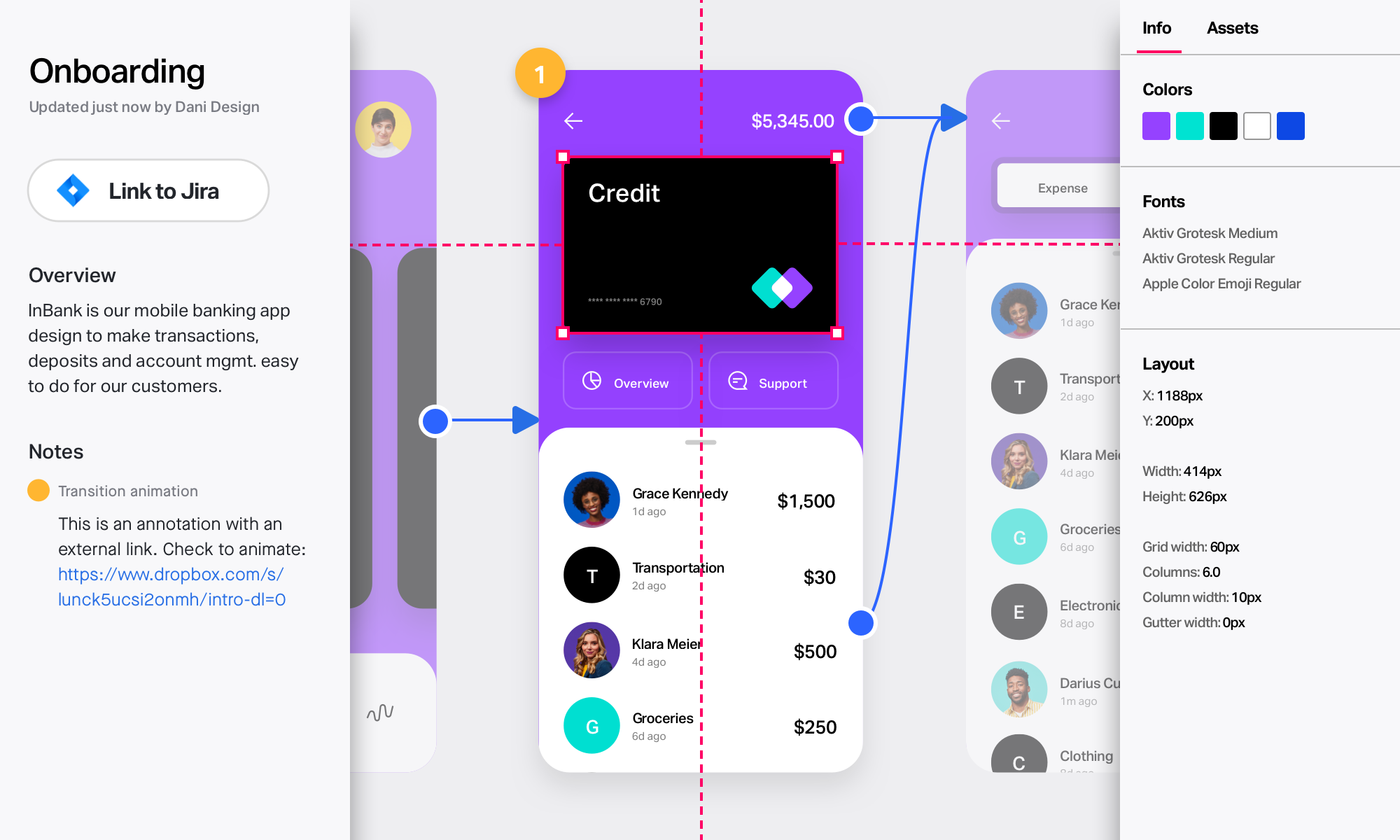
InVision is a collaborative design and prototyping platform with features such as freehand drafting mode and interactive mockups, collaboration, idea management, user testing, and integration with Slack and other collaboration tools. According to the vendor, 1 million designers are using the free version.
$0
Mural
Score 6.5 out of 10
N/A
MURAL (formerly Mural.ly) from Tactivos (DBA MURAL) in San Francisco is described by the vendor as a digital workspace and visual collaboration tool, designed for creative teams to make the process of design more efficient for distributed teams, working remotely.
$12
per month
Pricing
InVision
Mural
Editions & Modules
Free
$0
Pro
$7.75
per user/per month
Enterprise
Contact Sales
Starter
$12
per month
Plus
$20
per month
Enterprise
Contact sales team
Offerings
Pricing Offerings
InVision
Mural
Free Trial
No
Yes
Free/Freemium Version
No
No
Premium Consulting/Integration Services
No
No
Entry-level Setup Fee
No setup fee
No setup fee
Additional Details
—
Plans are billed annually.
More Pricing Information
Community Pulse
InVision
Mural
Considered Both Products
InVision
Verified User
Anonymous
Chose InVision
we use different 'similar' applications for different usecases.

I have only used InVision as a tool for designing mockups. I wouldn't be able to draw a fair comparison to other tools since I have more experience with InVision.
FigJam has more shapes, more importable reactions, and for me it's less likely to lag. It's also way easier to connect arrows to sticky notes in FigJam and overall rough designs look cleaner than in InVision.
[InVision] provides the ability to iterate really quickly, in fact, it is so intuitive that can be applied on live wireframe designing, while the ideas are being scratched and stormed from the team in a single discovery session, as well as allowing and giving access to the …
We went with InVision because we were already bought into that ecosystem. We have since decided to move to Figma, as we were not receiving the features we needed from InVision and the associated tools (Whimsical, Sketch, Abstract, and Zeplin). The ROI of Figma allows us to free …
InVision can be a powerful tool when paired with Sketch and other platforms like Freehand. However, Figma is currently the industry leader in terms of functionality and usability for collaborative UI design and prototyping. Invision's sharing and prototyping features are its …
Main difference is InVision's easy to use prototyping capability. When it is compared to Marvel and Axure RP, while it has less capabilities on tools it is more robust than both. I believe Figma is just a new and upgraded version of InVision where you could do everything online …
InVision is a bit limited overall compared to other programs like Figma, Photoshop, Illustrator and XD. At the time we selected InVision they were one of the leaders and introduced a lot of new features that were beneficial. However now we've moved back to many of the Adobe …
We only tested out using Adobe XD for similar uses and found it to be more challenging to fit within our processes. It didn't have as robust a set of capabilities as InVision and wasn't as easy to use enterprise wide. I recall also having issues with working with Sketch.
InVision was the best tool for our team. It has the features that best fit our process but is also flexible enough for make it work in various situations where visuals are a core component. We've been using InVision for over 5 years and we're not likely to move to another …
InVision's design is much more polished and seamless due to its apps on mobile and web. They are very easy to learn and gather feedback compared to Sketch or Principle. Although these features are quickly coming to the other apps, InVision has an upper hand at the moment with …
Zeplin also allows to share design spec and collect feedback, but the ability to have prototype changes the game.
Also, other products like Craft plugin is cherry on the cake.
Compared to other tools, InVision is a very solid tool with a great reputation and prototyping functionalities to back it up. InVision was the first prototyping tool we purchased, and it’s served us really well. However, more and more design tools are now also providing …
Balsamiq is a better tool for interactive prototyping and dynamic transition. InVision is definitely better for handling various designs, separated by projects and shared with different access levels across multiple organizations.
Other design tools have been creating their own prototyping functionality, which has made InVision less valuable over time. It is much more convenient to use the same tool for both design and prototyping, because it removes the unnecessary steps of exporting, importing, and …
InVision works seamlessly and easily when sharing and requesting comments from others. Other products I've used like Balsamiq and Dropbox (earlier versions) provided online displays of work, but no easy way to collect feedback or quickly update. InVision provides enterprise …
InVision is a great tool to use and well worth the price. However, if you're looking for some variety, UXPin and Figma are worth looking into too. While UXPin may be a tad simplistic in the design ability, Figma is a great competitor to InVision. Both tools are worth looking …
I actually haven't used anything that's similar to InVision, so can't compare. I'm not even sure there is anything out there that can actually compare to InVision. It's an ideal tool for any designer that wants to improve client/team feedback. I highly recommend it and look …
As the industry leader, XD and Figma have had some catching up to do. I think now InVision will have to innovate to hold these products off. Several are doing what made InVision famous, and in some instances do it even better. There is an insane amount of competition and …
Truthfully, while we have looked at others, InVision has the name recognition in the web design community and a tight integration with Sketch which is what was important to us. We have not seriously considered others, but may in the future as our needs change. This is our first …
Very similar to Miro I used Trello at the beginning of the pandemic but completely dropped it when I discover tools like Mural Survey Tools have more capabilities that are required sometimes but asking client to vote directly on the board in different ways serves me well most …
We used Miro as well and it was not as intuitive and easy to use as Mural is. Most take much longer to understand how to operate Miro , whereas this is not the case for Mural. It is very intuitive and offers a cleaner layout
I like it better than Miro because MURAL's more informal feel makes it encourage conversation and use. Miro also let's you bury too much information "inside" the notes making it really easy to lose sight of important data. I like MURAL better than LucidSpark because of how …
Mural has a User Interface that is easier to understand, which allows us to bring newcomers to brainstorm and design sessions without investing time in learning. Mural has more dinamic objects that impact on the presentation and visibility of the work, like having Post it notes …
MURAL has an extensive number of features and shapes and sticky notes to differentiate between the collaborators. The chat feature is amazing on MURAL itself for amazing discussions. Having a Scenario map, empathy map, Persona grid, Team, or opportunity canvas are some of the …
Mural has many more features PLUS it is so much easier to invite guests and get them engaged right away - 100% better experience overall. I felt like Mural had many more features and felt much more like the in-person experience vs. Jamboard. It is well worth the investment in …
I have tested a number of project management, workflow, and whiteboarding tools. All of them have their drawbacks. Some are too prescriptive and too process orientated, whilst others lack the simplicity of MURAL (formerly Mural.ly).
A couple of features I particularly appreciate are the content library (even though it should be improved) and the possibility to use multiple templates from different companies. Also the call feature looks interesting, even though I never used it so far. Overall, MURAL …
Mural was easier to use and share compared with Whiteboard. Whiteboard's functionality is limited. It is also integrated into Teams in an odd way that makes it difficult for team members to refer to old whiteboards. Mural as a stand alone web app is better.
I have had an experience of working with all the three above mentioned tools--Miro, InVision, and Lucidchart--and I can confidently say that MURAL (formerly Mural.ly) beats all these three tools when it comes to performing any kind of online collaboration activities, which …
InVision is well suited for design reviews and immersing yourself in the experience of an app-to-be. As a Product Manager, it's difficult to take abstract concepts, user pain points, and business needs, and produce a vision for an app without a visual aid to communicate a vision. InVIsion offers PMs, designers, and developers the opportunity to sketch a vision, communicate about it with inline commenting, and shareable with other stakeholders.
Remote Collaboration: In a remote or distributed work environment, Mural shines. It enables teams to collaborate effectively in real-time, bridging geographical gaps and facilitating virtual meetings, workshops, and brainstorming sessions. Workshop Facilitation: For facilitators leading workshops or team-building activities, Mural provides interactive templates and tools for engaging participants and achieving specific objectives.
Designs can be very slow to load on mobile devices, particularly when they include many screens.
There isn’t an offline version of the full app, which feels less-than-ideal for many of our teammates who live in areas with more spotty internet.
There are limited functionalities to portray animations and transitions. This hasn’t been a huge issue, but it makes the app feel a little out of date, considering the range of such functionalities in other apps.
Overall, MURAL is really easy to use, but there are a couple downsides. It's really easy to make areas of the board consistent because double clicking adds stickies that match those around the current one. It's really easy to connect the elements. And it's really easy to organize elements. Inconsistent controls, Panning, Line Connections, and latency are the only issues I had. My biggest issue is that the MURAL mouse buttons are very different from most similar software. This always causes me problems switching to a graphics software or 3D modelling software. Because MURAL uses the same button to pan and move elements, it's really easy to move things when panning around. The lines can also be a (sometimes huge) problem because thew will occasionally disappear or connect to things incorrectly. I think this is tied to latency issues which, in addition to causing phantom lines, can sometimes cause confusion to your team.
I didn't need to contact InVision support, as I've never needed it. They have an intuitive UI, and most of the questions are answered in their help portal or in tutorials online. Since many people use it, there a great resources available on for example YouTube. No problems so far with InVision.
[InVision] provides the ability to iterate really quickly, in fact, it is so intuitive that can be applied on live wireframe designing, while the ideas are being scratched and stormed from the team in a single discovery session, as well as allowing and giving access to the whole organization to the final outcome
I like it better than Miro because MURAL's more informal feel makes it encourage conversation and use. Miro also let's you bury too much information "inside" the notes making it really easy to lose sight of important data. I like MURAL better than Lucidspark because of how fast the pages load, especially links within the board. Any app is better than Microsoft whiteboard which is appalling unusable and feature incomplete.