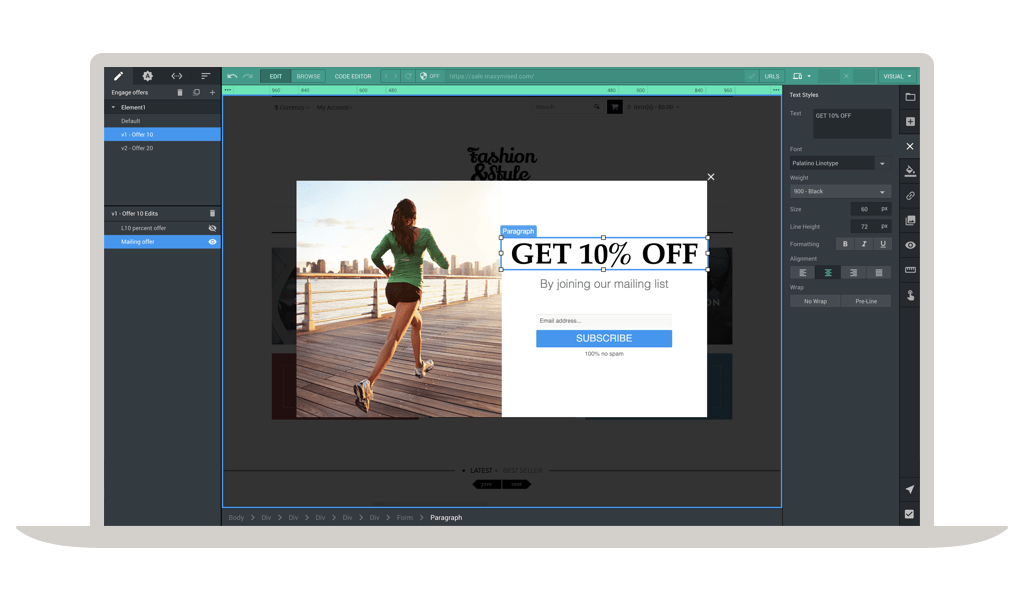
Mutiny is a no-code AI platform that helps marketers convert their top of funnel demand into revenue, without engineers. Mutiny gives marketers data and analytics, as well as AI-powered recommendations and content writing. Mutiny states they are backed by Sequoia Capital, YCombinator and CMOs from tech companies including AngelList, Carta, Gong, Hopin, Salesforce and Snowflake.
N/A
Oracle Marketing
Score 7.1 out of 10
N/A
Oracle CX Marketing (formerly Oracle Marketing Cloud) is a solution designed to enable marketers to plan and execute automated marketing campaigns via email, display search, video advertising, and mobile while delivering a personalized customer experience for their prospects.
N/A
Pricing
Mutiny
Oracle Marketing
Editions & Modules
No answers on this topic
No answers on this topic
Offerings
Pricing Offerings
Mutiny
Oracle Marketing
Free Trial
No
No
Free/Freemium Version
No
No
Premium Consulting/Integration Services
No
No
Entry-level Setup Fee
No setup fee
Optional
Additional Details
—
CX Marketing pricing is a function of usage.
More Pricing Information
Community Pulse
Mutiny
Oracle Marketing
Features
Mutiny
Oracle Marketing
Email & Online Marketing
Comparison of Email & Online Marketing features of Product A and Product B
Mutiny
-
Ratings
Oracle Marketing
9.3
Ratings
20% above category average
WYSIWYG email editor
00 Ratings
10.00 Ratings
Dynamic content
00 Ratings
9.00 Ratings
Ability to test dynamic content
00 Ratings
9.00 Ratings
Landing pages
00 Ratings
8.00 Ratings
A/B testing
00 Ratings
10.00 Ratings
Mobile optimization
00 Ratings
10.00 Ratings
Email deliverability reporting
00 Ratings
10.00 Ratings
List management
00 Ratings
9.00 Ratings
Triggered drip sequences
00 Ratings
9.00 Ratings
Lead Management
Comparison of Lead Management features of Product A and Product B
Mutiny
-
Ratings
Oracle Marketing
8.5
Ratings
9% above category average
Lead nurturing automation
00 Ratings
10.00 Ratings
Lead scoring and grading
00 Ratings
8.00 Ratings
Data quality management
00 Ratings
8.00 Ratings
Automated sales alerts and tasks
00 Ratings
8.00 Ratings
Campaign Management
Comparison of Campaign Management features of Product A and Product B
Mutiny
-
Ratings
Oracle Marketing
9.5
Ratings
25% above category average
Calendaring
00 Ratings
9.00 Ratings
Event/webinar marketing
00 Ratings
10.00 Ratings
Social Media Marketing
Comparison of Social Media Marketing features of Product A and Product B
Mutiny
-
Ratings
Oracle Marketing
9.5
Ratings
23% above category average
Social sharing and campaigns
00 Ratings
10.00 Ratings
Social profile integration
00 Ratings
9.00 Ratings
Reporting & Analytics
Comparison of Reporting & Analytics features of Product A and Product B
Mutiny
-
Ratings
Oracle Marketing
8.3
Ratings
13% above category average
Dashboards
00 Ratings
9.00 Ratings
Standard reports
00 Ratings
8.00 Ratings
Custom reports
00 Ratings
8.00 Ratings
Platform & Infrastructure
Comparison of Platform & Infrastructure features of Product A and Product B
Mutiny
-
Ratings
Oracle Marketing
9.5
Ratings
24% above category average
API
00 Ratings
9.00 Ratings
Role-based workflow & approvals
00 Ratings
10.00 Ratings
Customizability
00 Ratings
9.00 Ratings
Integration with Salesforce.com
00 Ratings
10.00 Ratings
Integration with Microsoft Dynamics CRM
00 Ratings
9.00 Ratings
Integration with SugarCRM
00 Ratings
10.00 Ratings
Best Alternatives
Mutiny
Oracle Marketing
Small Businesses
Bloomreach - The Agentic Platform for Personalization
B2B website optimization is where Mutiny shines. However, you would need a certain level of traffic to justify the investment. Mutiny currently does not support outside the web like in-app and it's also not made for B2C. There are other experimentation tools out there that are a better fit for those areas.
A duration of one and a half years is enough for us to recognize the capabilities of a tool and in my opinion, this one is just a great tool to manage marketing campaigns of even massive-sized firms. Its marketing automation tool and its way of managing campaign and the way it executes digital initiatives is enough to get an inkling of its abilities. Less favorable for the people who want to have something at a cheap price and are more dependent on the reports as its reports have nothing much in detail.
B2B Personalization. Many out-of-the-box audience segmentation options as well as integration options with tools like 6sense, Clearbit, Salesforce, Marketo, HubSpot, and Segment.
No need for engineering resources. Their simple, yet powerful visual experience editor as well as out-of-the-box functionalities like banners, side pops, survey modals and exit-intent modals let you create experiences without engineering.
Segment analyzer. They automatically suggest to you which segments have a high potential for improvement and recommend you a playbook from another Mutiny client to execute on successful use cases.
User Interface - The UI is a bit outdated and clunky, but gets the job done with some getting used to.
Training - There isn't much out there for training, unless you are willing to pay Oracle or a 3rd party.
Support - There is no dedicated support and you have to use their portal. It sometimes take awhile to get things looked at or fixed, but they eventually get to it.
We have been able to automate so many marketing processes with Eloqua over the past 5 years that the only direction would be to adopt the latest and greatest features Eloqua adds. The alternative would be to go back to the marketing stone-age and start over again. And we would rather move forward with increased automation and efficiency.
Personally, I find it quite easy to use. But for those members of our team who have little or no testing experience, it's been a bit more difficult. There's also training required for development teams in order to have your campaigns coded and set up in the most efficient way. Our developers have been able to do basic and intermediate tests with no difficulty, and they find the interface itself quite intuitive... it's just the extremely complex tests that require a bit more understanding.
There are occasional complaints about slowness to refresh a screen or build a report. However, this is as much a factor of network access speeds as the system itself, since often the complaints occur when someone is accessing on a wireless network.
I would actually rate day to day support a 1. We often knew more than the person on the phone.
I would however rate escalation support a 7. When we went to “red status”, support was very good. We were assigned a technical resource who performed a full audit. Unfortunately the integration to Salesforce.com still failed
They offer very basic classes which are required for master certification.
After having been through it, I would not consider anyone with a master certification any more qualified, unlike Salesforce.com certification which is a more difficult thing to acquire. For example, one of the classes towards certification was around social media. I would have expected examples of how to incorporate into campaigns in the product, with a demo and hands-on test. Instead, it was a powerpoint slideshow that went on way too long and covered really basic stuff like “what is Facebook, what is Twitter”
Ok, so, this sounds like it could be horrible because it was all remote, but we loved it... the Adobe training environment was easy to use, and the trainers were engaging. It was simple to switch back and forth between the meeting and the hands-on exercises in their training instances. We took the fundamentals training early in our implementation-- before the consultants came onsite-- and I know this made a big difference in our implementation, because we were able to ask informed questions throughout
I give it a 10 because the only issue we had was a result of not following the guidance we were given. Maxymiser provided a customized implementation guide for each site where we were adding the code. On our site implementations when we followed that guide to the letter, it was extremely fast and easy and has worked very well.
Mutiny makes it much simpler to execute personalization activities and A/B tests compared to big names out there like Optimizely and Adobe Target. The Mutiny team specifically tackled that hurdle that many marketers face when using these kinds of tools. They honed in on executing the "without the need for engineering" pieces. Note that Optimizely and Target both have WYSIWIG functionalities as well, it's just that Mutiny makes it easier to make changes, even with some AI-suggested copy recommendations. That being said, Optimizely and Adobe Target have more advanced features for A/B testing and AI/ML decision-making.
It was quite complex to generate segments with Adobe analytics and I wasn’t personally satisfied with the overall performance of Adobe Analytics and wasn’t enough flexible in any way. So we decided to switch to something else better than Adobe Analytics and is available in the market at a cheap rate and we ended up doing our research for the most suitable tool at Oracle Infinity and we don’t regret our decision.
Eloqua is definitely good for larger companies that have 100,000+ contacts and complex marketing workflows and data. Personalization is fairly robust with Eloqua for larger campaigns with smart content and features. Scaling across channels is also seamless - as the platform has great options for non-email channels like SMS, Direct Mail, Chat, etc.
Eloqua has had a very positive impact on our ROI and ability to build very complex programs. We have been nomitnated for the past 4 years as a Markie finalist and have won a Markie ourselves.
Eloqua has a great pulse on the marketing trends and future developments to help keep it's software competitive.