Neo4j is an open source embeddable graph database developed by Neo Technologies based in San Mateo, California with an office in Sweden.
$65
per month
Percona Server for MongoDB
Score 8.4 out of 10
N/A
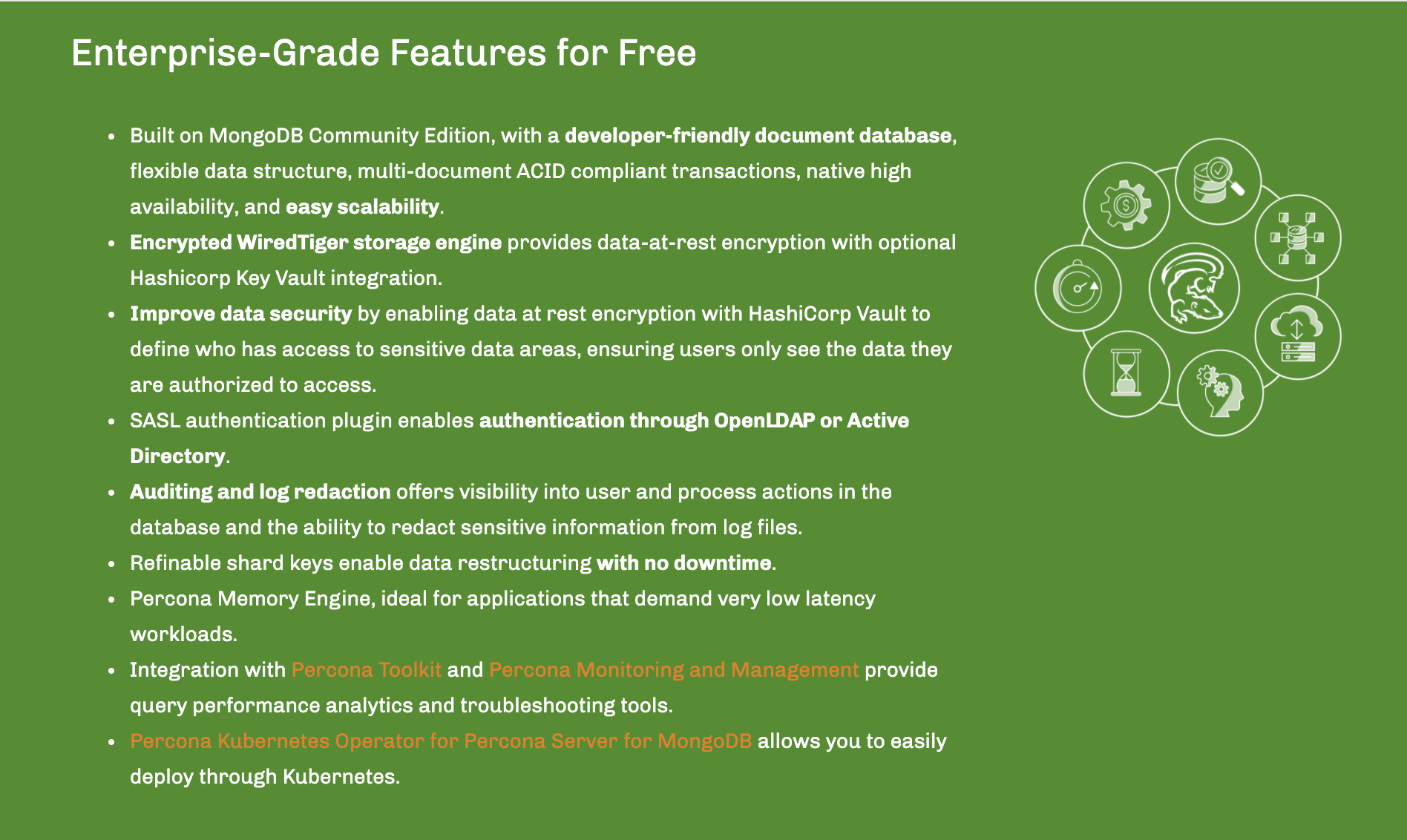
Percona Server for MongoDB is a free and open-source drop-in replacement for MongoDB Community Edition. It combines all the features and benefits of MongoDB Community Edition with enterprise-class features from Percona. Built on the MongoDB Community Edition, Percona Server for MongoDB provides flexible data structure, native high availability, easy scalability, and developer-friendly syntax. It also includes an in-memory engine, hot backups, LDAP authentication, database auditing, and log…
N/A
Pricing
Neo4j
Percona Server for MongoDB
Editions & Modules
Aura Professional
$65
per month
Community Edition
Free
Enterprise Edition
Contact Sales
Aura Free
Free
Aura Enterprise
Contact Sales
No answers on this topic
Offerings
Pricing Offerings
Neo4j
Percona Server for MongoDB
Free Trial
Yes
Yes
Free/Freemium Version
Yes
Yes
Premium Consulting/Integration Services
No
No
Entry-level Setup Fee
No setup fee
Optional
Additional Details
—
Free and open-source
More Pricing Information
Community Pulse
Neo4j
Percona Server for MongoDB
Considered Both Products
Neo4j
Verified User
Anonymous
Chose Neo4j
I have not used anything like Neo4J because of how unique it is in the work that it allows me to do. I am not aware of any other graph database platforms and it might be because it is a growing area (especially in the world of pharmaceuticals). I would be open to trying other …
Neo4j is a graph store and has different use cases compared to another NoSQL Document store like MongoDB. MongoDB is a bad choice when joins are common as existing operators for joining two documents (similar to tables in a relational store) as Mongo 3.5 use SQL like join …
Neo4j is ahead of any of the leading competitors I know. The only one which comes close, in my opinion, is the "Titan-Distributed Graph Database" which is completely open source and free to use. Titan works on top of Apache Cassandra so it has some huge learning curves to do, …
We've done some BOE comparisons between Neo4j, Titan, and OrientDB. The general consensus was that Titan is too unweildy and that Neo4j beat out OrientDB by being more active and having a large community.
At the performance level, it is similar to other solutions such as MongoDB and Percona Server for MySQL. and at the customization level, it offers better support for the development of specific solutions that seek good performance in transactions.
Its very well suited for storing graph types relationship information, such as a group of people and their relationships. Data modeling this sort of information in a traditional SQL database is a pain and inefficient. Using Neo4J allows for efficient modeling of data while providing rich querying capabilities using Cypher. Its also a great fit for any programming language because of its support for REST API. It's less appropriate for any other data structure other than Graph data. So as with any DB, evaluate the data structure and query and if the querying revolves around relationships, then Neo4J is a fit. If there is more need for looking up individual nodes and their associated information, Neo4J might not be the most efficient solution in the market.
It offers good support for the implementation of solutions in the public and on-premises cloud and integration with other services such as Hashicorp Vault for data encryption. One of the main advantages is the ease of configuration, in addition to offering transaction support for the different operations and scalability of the servers.
It would be nice to have some concept of namespaces, or some way of roughly making a single instance multi-tenant. It'd be nice to make sandboxing easier.
One aspect to improve is the user experience since sometimes the steps to take are not clear and the user may need to review some of the actions before continuing with the next ones. Another aspect to improve is the documentation and support for developers who want to know the tool.
It offers good support for the implementation of solutions in the public and on-premises cloud and integration with other services such as Hashicorp Vault for data encryption. Also, it offers support for different compatible programming languages such as C, C ++, Java, as well as offering good support for the persistence of schema-free data and the possibility of saving data in memory.
I have not used anything like Neo4J because of how unique it is in the work that it allows me to do. I am not aware of any other graph database platforms and it might be because it is a growing area (especially in the world of pharmaceuticals). I would be open to trying other softwares though.
At the performance level, it is similar to other solutions such as MongoDB and Percona Server for MySQL. and at the customization level, it offers better support for the development of specific solutions that seek good performance in transactions.
For experimentation purposes, it had a positive impact on my company. It was very natural to work with Neo4j and so intuitive to visualize the data.
Neo4j community edition is free, which is what we experimented on. So there was no investment up front apart from employee's time. But this quickly gave results and it was time well spent.
Neo4j is a cool but very new technology. It was hard to have people onboard, especially some of the leadership and relational folks.