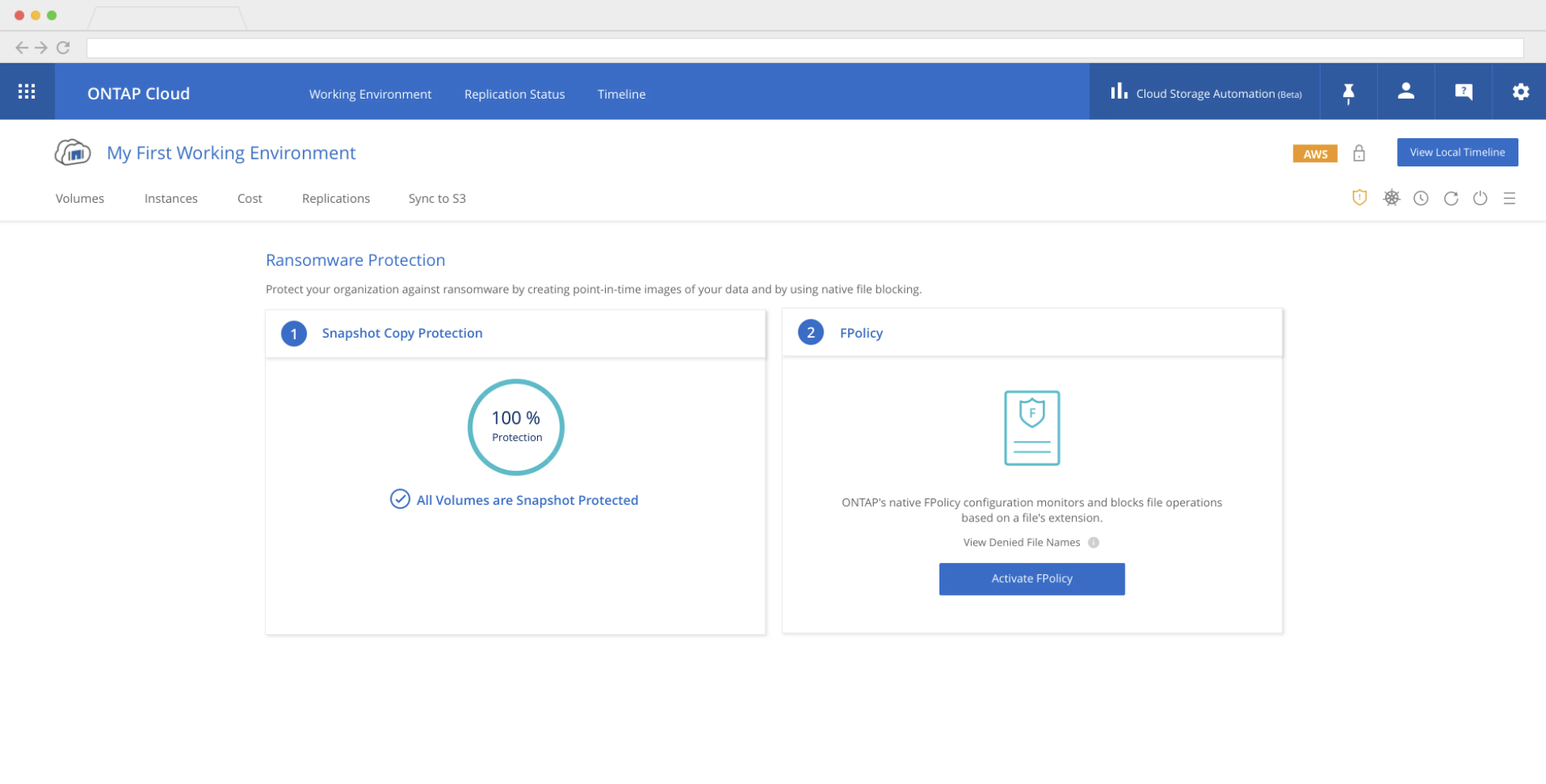
NetApp's Cloud Volumes ONTAP combines data control with enterprise-class storage features for various use cases, including file shares and block-level storage serving NAS and SAN protocols (NFS, SMB / CIFS, and iSCSI), Disaster Recovery (DR), Backup and Archive, DevOps, Databases (SQL, Oracle, NoSQL), or any other enterprise workload.
$0.64
Hourly
ownCloud
Score 9.2 out of 10
N/A
ownCloud is a self-hosted open source file syncing and sharing option, from the Boston-based company of the same name.
$5
per month
Pricing
NetApp Cloud Volumes ONTAP
ownCloud
Editions & Modules
Explore
$0.64
Hourly
Standard
$1.68
Hourly
Premium
$2.71
Hourly
Bring Your Own License (BYOL)
Purchased from NetApp
Standard
$5
per month
Enterprise
$12
per month
For Teams
$13
per month
For Single Users
$15
per month
Community
Free
Offerings
Pricing Offerings
NetApp Cloud Volumes ONTAP
ownCloud
Free Trial
Yes
No
Free/Freemium Version
No
No
Premium Consulting/Integration Services
No
No
Entry-level Setup Fee
No setup fee
No setup fee
Additional Details
Visit https://cloud.netapp.com/pricing for the pricing breakdown.
There really isn't any other option for a work-alike, particularly if using NetApp as primary storage. For us, the option was to just not have this extra tier, utilizing more storage space for snapshots and leaning more heavily on our separate backup servers. We still use the …
We evaluated AWS Storage Gateway against NetApp Cloud Volumes ONTAP and we found that NetApp Cloud Volumes ONTAP outperformed AWS in the following areas:
It is easier to set up, configure, and implement than AWS.
It has an easier to use and familiar storage volume management …
ScienceLogic SL1 and SolarWinds Storage Resource Monitor (SRM) were the closest competitors to meeting our business objectives. Tivoli Storage Manager was not able to meet the initial requirements. There was a significant overlap of capabilities between ScienceLogic SL1, …
Cost was a huge factor and ease of integration and deployment led us to ultimately choose NetApp Cloud Volumes ONTAP for our tertiary backup design. For our lightweight applications, we chose NetApp Cloud Volumes ONTAP because we were able to kill two birds with one product and …
The paid cloud services are expensive if you need a lot of data. You're giving your personal and business information to a data-hungry organization. Local NAS solutions are too slow. We run ownCloud on an older business PC and the performance is outstanding, even for remote …
ownCloud is better than Google Drive and Microsoft's OneDrive. I have not used Google Drive in some time now, so it may have improved. OneDrive has become better over time too, but my go-to is still ownCloud. Firstly, I prefer to have my data under my control. No other service …
I have a very similar experience between Google Drive and DropBox. Both offer real-time sharing and collaboration. Google Drive limits external access and requires the recipient of shared files to have a Google account. In the case of both DropBox and GoogleDrive, they limit …
Other tools with similar functionality have been much better for me to use. However, my company uses ownCloud as its software of choice, so I use it to remain consistent with them.
I have used several products based on public (DropBox, Google Drive, Microsoft Drive, etc) and private cloud (Citrix). Most of them work on public cloud space so they could present problems with compliance. Also, it is usually difficult to protect the information contained in …
Due to the need to support many external workers it was mainly cost effectivity of open source solution: ability to allow external workers to access company files without the need to pay a license for each of them every month. Unfortunately, ownCloud does not offer until now as …
ownCloud is one of the only self-hosted solutions worth it. It is open source and free, meaning that anyone with a Linux VM or an old laptop can host its own feature-rich cloud server. Many all-in-one firewalls will mix OwnCloud and Crashplan, joining document management and …
It is well suited to store lower-tier data in the cloud to free up space on primary storage. For our use, it is really only currently viable for things like snapshots and backups. Other organizations may find it useful for secondary-tier archival storage as well. At this point, I don't really trust any cloud solution as primary storage for anything. This may change in the future, but for backups and such, it is a nice option.
OwnCloud/Nextcloud is a great application for cloud storage of files, and makes sharing specific files or folders easy and fast. It also makes a great tool for real-time collaboration, including real-time chat and simultaneous editing of documents or spreadsheets. I have used ownCloud to assist clients in sending large files that could not be emailed -- for example, one of my clients is a Video Production agency. They produced a commercial to air, but could not email the file as it was 400MB. OwncCloud came to the rescue. I set up a temporary share and allowed him access to upload into that folder. Once the file was in the folder, I generated a share link that was then forwarded to TV stations for instant viewing in a browser. Each TV station then downloaded it and was able to add it to their scheduling system quickly. From the Photography side... I am able to deliver large amounts of files quickly and easily to my clients, and they can download or view on mobile devices easily. Since I use ownCloud on a daily basis, I cannot think of any reason why I would not use this software
OwnCloud is easy for me to use, and I believe it would be for others too. The barrier for most people will be the set up. For a technology professional like myself, ownCloud's setup is pretty straightforward, but it's not the sort of thing most casual users will be able to handle. Also, it's on the user to maintain the service. These can be taken care of by paying someone to do it for you.
Compared with other cloud services, ownCloud has been the most efficient. It doesn't create a noticeable drain on resources and very quickly syncs across all my devices. I'm usually able to save a file on my laptop and by the time I walk over and sit down at my desktop machine, it's already there. I don't need to wait as often as I have with services like OneDrive.
Regarding the community edition, there is a reasonably good support on the IRC, forums and in the issue section on Github. Perhaps a much more individual approach would be available if the premium support was chosen and the instance of the server was provided by the Owncloud company that also offers some premium extensions, not available generally. However, we did not need this level of support yet.
ScienceLogic SL1 and SolarWinds Storage Resource Monitor (SRM) were the closest competitors to meeting our business objectives. Tivoli Storage Manager was not able to meet the initial requirements. There was a significant overlap of capabilities between ScienceLogic SL1, SolarWinds SRM, and NetApp Cloud Volumes ONTAP. The latter provided a more positive and cohesive experience for our administrators and executives.
ownCloud is better than Google Drive and Microsoft's OneDrive. I have not used Google Drive in some time now, so it may have improved. OneDrive has become better over time too, but my go-to is still ownCloud. Firstly, I prefer to have my data under my control. No other service can offer the level of control that ownCloud does. Setting that aside, in my experience Google Drive never quite got syncing right. Unless you have a very small collection of files and you're not synced across many devices, Google Drive fails to achieve a complete sync. The icon is always showing that Drive is syncing (and not up to date). I've had similar issues with OneDrive, but these days on Windows 10 OneDrive usually can achieve a complete sync across multiple devices, but it often hogs CPU and Network resources to do so, and it's still slower than OneDrive.
The company grew from 4 employees in 2013 when ownCloud was initially deployed to about 40 in 2017 and still using it with a very similar setting without any major upgrade on the same Linux VPS. 95% of all company data are stored and shared via ownCloud successfully. No clear data about ROI but clearly the perfect adoption rate by all people and its ubiquitous use makes it an essential part of the company workflow.