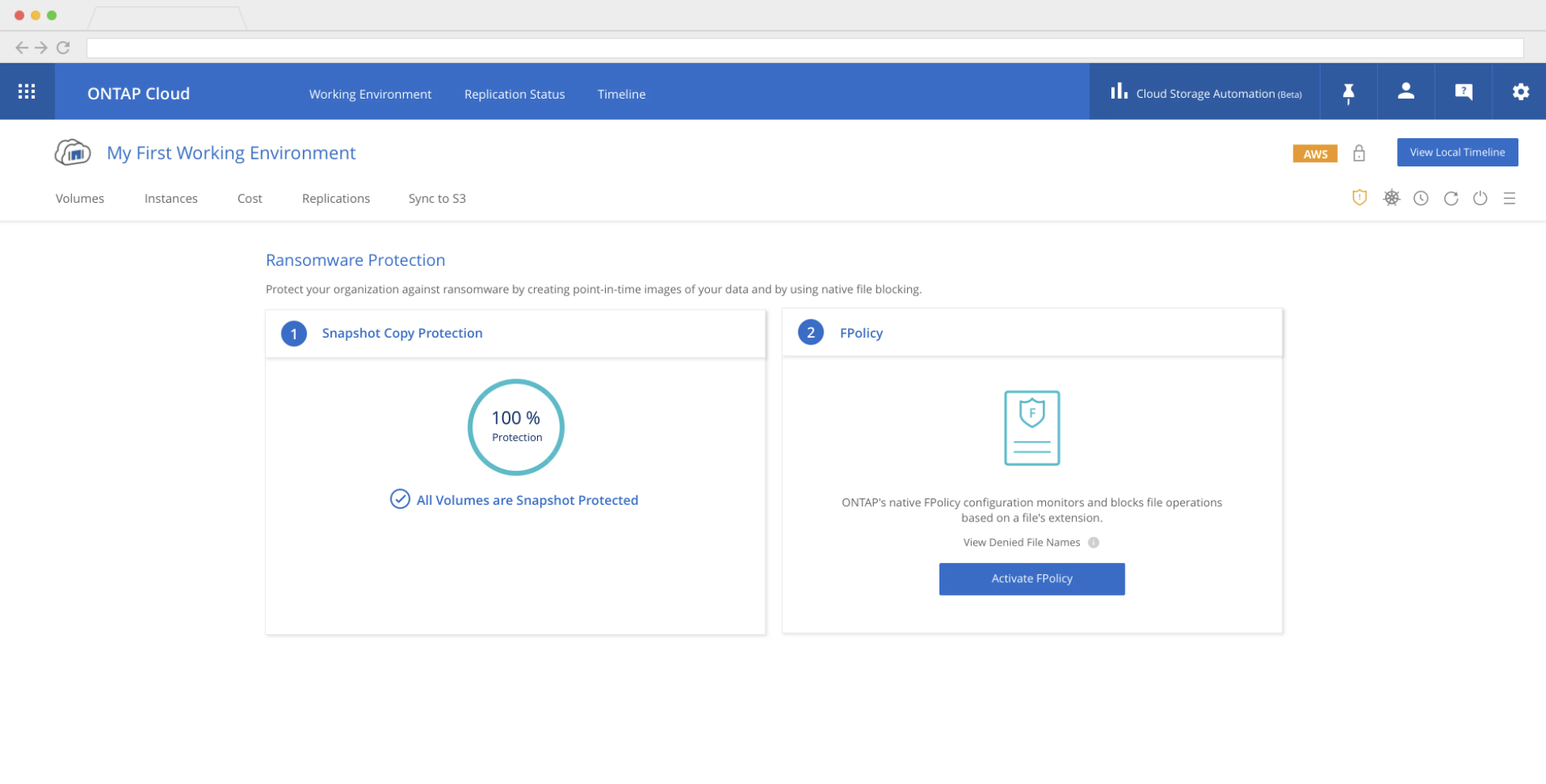
NetApp's Cloud Volumes ONTAP combines data control with enterprise-class storage features for various use cases, including file shares and block-level storage serving NAS and SAN protocols (NFS, SMB / CIFS, and iSCSI), Disaster Recovery (DR), Backup and Archive, DevOps, Databases (SQL, Oracle, NoSQL), or any other enterprise workload.
$0.64
Hourly
SugarSync
Score 5.8 out of 10
N/A
SugarSync is a cloud storage and backup solution designed for small businesses.
$7.49
per month
Pricing
NetApp Cloud Volumes ONTAP
SugarSync
Editions & Modules
Explore
$0.64
Hourly
Standard
$1.68
Hourly
Premium
$2.71
Hourly
Bring Your Own License (BYOL)
Purchased from NetApp
100 GB
$7.49
per month
250 GB
$9.99
per month
500 GB
$18.95
per month
Offerings
Pricing Offerings
NetApp Cloud Volumes ONTAP
SugarSync
Free Trial
Yes
Yes
Free/Freemium Version
No
No
Premium Consulting/Integration Services
No
No
Entry-level Setup Fee
No setup fee
No setup fee
Additional Details
Visit https://cloud.netapp.com/pricing for the pricing breakdown.
There really isn't any other option for a work-alike, particularly if using NetApp as primary storage. For us, the option was to just not have this extra tier, utilizing more storage space for snapshots and leaning more heavily on our separate backup servers. We still use the …
We evaluated AWS Storage Gateway against NetApp Cloud Volumes ONTAP and we found that NetApp Cloud Volumes ONTAP outperformed AWS in the following areas:
It is easier to set up, configure, and implement than AWS.
It has an easier to use and familiar storage volume management …
ScienceLogic SL1 and SolarWinds Storage Resource Monitor (SRM) were the closest competitors to meeting our business objectives. Tivoli Storage Manager was not able to meet the initial requirements. There was a significant overlap of capabilities between ScienceLogic SL1, …
Cost was a huge factor and ease of integration and deployment led us to ultimately choose NetApp Cloud Volumes ONTAP for our tertiary backup design. For our lightweight applications, we chose NetApp Cloud Volumes ONTAP because we were able to kill two birds with one product and …
SugarSync has solid security. It uses AES 256-cycle to scramble your records extremely still and the TLS show to get them coming. I can open the actual document and I can work on it, save it, and now it’s the same on my notebook as it is in the sync in the Cloud and here on my …
SugarSync, like all solutions, has its place in the data storage stack within a company. The main reason SugarSync is better than the other solutions is that it enables me to leave my hard drive organized and keep my existing file trees. I don't have to constantly move or copy …
SugarSync has the capability of synchronizing various directories, while some of their most popular competitors don't. However, this differentiator is not sufficient to retain the customers in a market of hyper-competition, as they are not adjusting to decreasing pricing market …
It is well suited to store lower-tier data in the cloud to free up space on primary storage. For our use, it is really only currently viable for things like snapshots and backups. Other organizations may find it useful for secondary-tier archival storage as well. At this point, I don't really trust any cloud solution as primary storage for anything. This may change in the future, but for backups and such, it is a nice option.
As with all file sharing, remote teams - the combination of being able to work alongside colleagues - or remotely (including "on a plane" / without Internet) - but always have your files saved locally makes it very easy to adopt.
It’s a subtle but important difference in how it works because we have to manage the process a little bit more but it also means also SugarSync can possibly fit better into
your productivity work style, especially if you’ve got a really good system of file
management, stuff that you already use whereas in Dropbox, if you have a file system, management system you already use and you want to share those files, you have to move them into Dropbox which might break your system
SugarSync requires just a little bit more forethought.
ScienceLogic SL1 and SolarWinds Storage Resource Monitor (SRM) were the closest competitors to meeting our business objectives. Tivoli Storage Manager was not able to meet the initial requirements. There was a significant overlap of capabilities between ScienceLogic SL1, SolarWinds SRM, and NetApp Cloud Volumes ONTAP. The latter provided a more positive and cohesive experience for our administrators and executives.
SugarSync has solid security. It uses AES 256-cycle to scramble your records extremely still and the TLS show to get them coming. I can open the actual document and I can work on it, save it, and now it’s the same on my notebook as it is in the sync in the Cloud and here on my desktop. So it works very simply and effectively from that perspective. Before I finish though, I do want to show you mobile access because mobile access is increasingly important for all of these different services that we’re talking about. For SugarSync, having access to our iPhone, iPad, or our Android device is also crucial. So here we see my iPhone is up and I’m going to go into my Productivity tab here