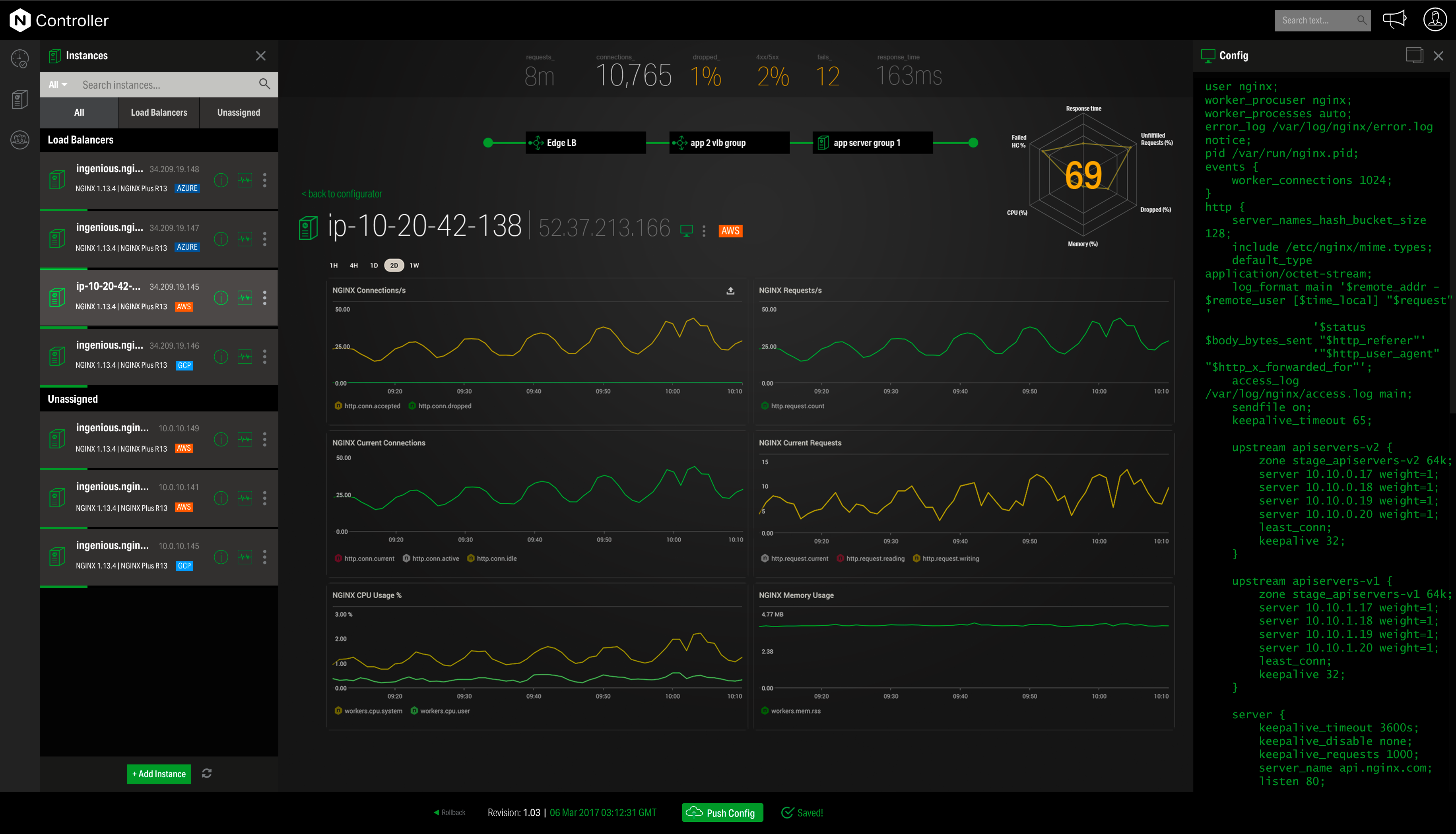
NGINX, a business unit of F5 Networks, powers over 65% of the world's busiest websites and web applications. NGINX started out as an open source web server and reverse proxy, built to be faster and more efficient than Apache. Over the years, NGINX has built a suite of infrastructure software products o tackle some of the biggest challenges in managing high-transaction applications. NGINX offers a suite of products to form the core of what organizations need to create…
N/A
TIBCO ActiveSpaces
Score 7.0 out of 10
N/A
ActiveSpaces from TIBCO supports an application infrastructure.
N/A
Pricing
NGINX
TIBCO ActiveSpaces
Editions & Modules
No answers on this topic
No answers on this topic
Offerings
Pricing Offerings
NGINX
TIBCO ActiveSpaces
Free Trial
Yes
No
Free/Freemium Version
Yes
No
Premium Consulting/Integration Services
No
No
Entry-level Setup Fee
Optional
No setup fee
Additional Details
—
—
More Pricing Information
Community Pulse
NGINX
TIBCO ActiveSpaces
Features
NGINX
TIBCO ActiveSpaces
Application Servers
Comparison of Application Servers features of Product A and Product B
Nginx is well suited for serving any static content - whether that be images, JS files, HTML files, CSS files, videos, etc. If you have a high-traffic website, Nginx will be a great fit because it handles large number of requests extremely efficiently. Nginx has full support on Unix systems, but only has limited support on Microsoft Windows machines.
TIBCO ActiveSpaces is only suited in the company where Tibco suites have been already used, the license cost is not a concern, it is only required for data caching purposes and only works in the client/server mode for middle-sizes of data. If the expectation is data cache + distributed computation or embedded IMDG is also one requirement or the data cluster needs span multiple data centers, other light-weight OpenSource IMDG solutions should be considered
Straight-forward configuration format that users of all skill levels can learn, and yet is powerful enough for the huge breadth of features that Nginx provides.
Massive scale right out the box. We've never had a Nginx instance overwhelmed by requests, and if we did it would be trivial to spin up more Nginx instances to handle the load.
SSL termination means that we can deliver content over HTTPS without needing our individual services to require TLS support. This saves us a lot of time and headache while keeping us secure.
Nginx is open-source and free, meaning that anyone can use it to power their services, from individual projects to billion-dollar websites.
Nginx often requires some initial configuration. It's worth doing, because you'll end up with great results, but it can be slightly daunting for someone to get started using it. Apache might have a leg up in that regard--When you install Apache, typically it's just about ready to do what you want already. But the issue with Apache is that most people skip the extensive tuning phase required after that, and with nginx it becomes more just a part of the configuration process.
Sometimes, the configuration syntax, even though it's powerful and terse, isn't the most intuitive. Luckily there's plenty of documentation about what things mean and how to accomplish certain things. There may not be much that can be done about this--to have a powerful web server, you need a powerful-enough configuration language.
The nginx brand is somewhat fragmented, and it can be confusing. There's the open source nginx web server, which I've primarily been referring to. But then there's NGINX Plus, a premium subscription-based service which works with a range of other NGINX products (NGINX WAF, NGINX Amplify, NGINX Controller). I've met a number of people who weren't very familiar with nginx, and instinctively went to nginx.com first, and from there it seems like everything costs money. It's only when they realize there's a different site, nginx.org, that they find what they went looking for.
TIBCO ActiveSpaces Tuple-based data structure is not flexible enough to support customized native data objects.
There is no secondary index option.
Doesn't provide "predicate based In-Grid distributed search and result aggregation."
only can be used as data cache, the node's only contribute memory but can not use the data partition owner node's computation power to apply the distributed computation customized by the user.
Cross data center replication (geographically) is a pain.
Encounter the performance issue when the data volume is huge, even according to the architecture design, linear scaling up should not have that issue.
Front end proxy and reverse proxy of Nginx is always useful. I always prefer to Nginx in overall usability when you have application server and database or multiple application servers and single database i.e. clustered application. Nginx provides really good features and flexibility which helps the system administrator in case of troubleshooting and also from the administration perspective. Also, Nginx doesn't delay any request because of internal performance issues.
TIBCO ActiveSpaces is easy to install and integrate with other product suites. It is easy to understand and implement as well. TIBCO ActiveSpaces supports multiple databases for storing the data(we are using Oracle Database). All the master data related to the users is being stored using TIBCO ActiveSpaces which keeps the data in memory and help to retrieve it quickly. It has helped to prevent concurrent login sessions by the same user as session details are stored in TIBCO ActiveSpaces and we override the existing user session with the new session details.
Community support is great, and they've also had a presence at conferences. Overall, there is no shortage of documentation and community support. We're currently using it to serve up some WordPress sites, and configuring NGINX for this purpose is well documented.
I have found that [NGINX] seems to perform better throughout the years with less issues although I've used Apache more. I would definitely recommend [NGINX] for any high volume site and I've seen this to usually be the case from most provided web hosts who will pick [NGINX] over alternatives
Before using TIBCO ActiveSpaces, we were storing all the data in Oracle Database and due to large volumes of data response time was more and overall performance had reduced. With the introduction of TIBCO ActiveSpaces, we moved the master data to TIBCO ActiveSpaces for storing data which needed frequent access in memory for faster retrieval. This improved the performance significantly and also made managing data easier.
When we first migrated our primary bidding environment architecture to Nginx, it was under duress due to Apache's inability to keep up when we consolidated away from an HAproxy model to a central HTTP proxy. So we even when we did not know what we were doing, we were able to make it work in a bad situation, and everyone was quite happy.
The biggest complaint I have is that I find the module compilation requirements for nginx+ rather burdensome. If we pay for Nginx+, I'd love to see then have pre-built modules for ready for each release of more modules. We are spending our own time engineering an in-house solution for module testing for nginx+ releases, which is disappointing.
I've also, as the primary Nginx person at my organization, inserted my expertise into other projects, and have saved our company lots of money getting rid of big $$$ appliances for general SSL proxying.
Speaking of Nginx replacing SSL appliances, we had an instance where we had to suddenly enable elliptic-curve SSL ciphers and our big $$$ appliances (you know who they are), were falling over. Even their SSL accelerator cards, after all, are just a few extra cores to process SSL. But in an environment of our size, we use DNS to spread the load to hundreds of frontend proxies with dozens of cores each to spread this load out, all at a lower price than ONE of the appliance pairs running Nginx. We couldn't even tell the change in load in our Nginx architecture when we enabled the ciphers.
Developers with basic knowledge of TIBCO and general data knowledge can easily design and develop an ActiveSpaces based cached solution. As the ActiveSpaces concepts are very simple and easy to understand.
Some business areas can predict the high influx of a service usage during a certain period. Business will be highly rewarded if they can identify these business areas and provide a cached solution using TIBCO AS.
Again, this is not a TIBCO ActiveSpaces only advantage and this is true for any/all caching products.
Some examples for the previous points are
a. telecom company pre-loading (eager load) customer's usage for the last month, right before releasing/issuing the bills to the customers.
b. Airline industry loading the customer's itinerary a week before his travel start date. Hence the last minute scrambling to fetch the customer's itinerary travel plans can be avoided.