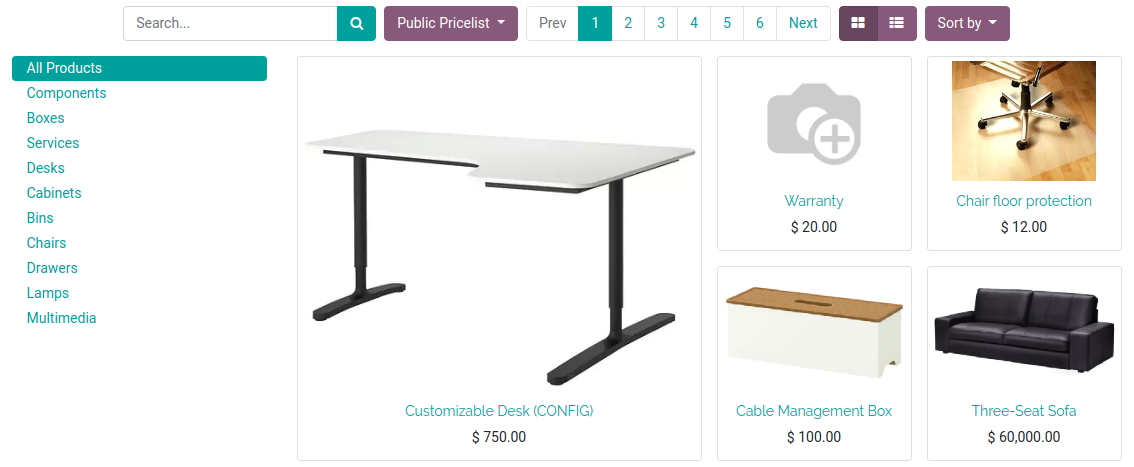
Odoo’s eCommerce application is designed to offer all the tools a business needs to create a stunning online store in no time at all. Users can customize designs for product pages, in order to showcase their business in a memorable and unique way. With Odoo’s fully integrated eCommerce app, inventory and sales can be managed and maintained with the help of automatic stock adjustments and reporting. Odoo is also integrated with a number of popular shipping carriers and online payment methods.
$0
Oracle Commerce
Score 8.6 out of 10
N/A
Oracle Commerce is an ecommerce platform that helps B2C and B2B businesses connect customer and sales data from their CRM to their financial and operational data so they can offer personalized experiences to buyers across sales channels.
N/A
Pricing
Odoo eCommerce
Oracle Commerce
Editions & Modules
One App Free
$0
Standard
$24.90
per month billed yearly per user
Standard
$31.10
per month per user
Custom
$37.40
per month billed yearly per user
Custom
$46.80
per month per user
No answers on this topic
Offerings
Pricing Offerings
Odoo eCommerce
Oracle Commerce
Free Trial
Yes
No
Free/Freemium Version
Yes
No
Premium Consulting/Integration Services
No
No
Entry-level Setup Fee
Optional
No setup fee
Additional Details
The Standard and Custom plans include the Odoo apps for a single fee.
It's cost-friendly and easy to set up, Odoo eCommerce is open so very easy to customize and learn at the same time, and doesn't require big hardware support because of cloud availability. Don't need a big IT team to manage the product. Very user-friendly and adaptable, the …
Oracle CX Commerce is more towards the higher price in terms of price as compared to the other products available in the market. But it is quite easy to implement, and the customization it offers makes it a powerful product in the market. Also, it is suitable for companies with …
Prior to taking on Oracle CX Commerce, we went ahead and evaluated Shopify. Shopify has an extremely similar concept overall. However, My organization ultimately went with Oracle [CX Commerce] because of how user friendly the solution is ,and how detailed its offerings are. …
Again - Oracle's seamless interconnectivity with Databases (Oracle DBs), its CRM services or other partner CRM services, micro/macro management which are necessary for businesses to have that information at each view. In addition to these crucial factors, the content management …
In many cases it depends on the needs of the client. In some cases they might already have experience with some part of one of these products. I have not seen a product with a better line of APIs that make it easy to get a site up and running.
I have only used Shopify Plus at another organization for a few months, but there are some key differences from Oracle Commerce Cloud. First of all, in terms of pricing, Shopify is much cheaper making it appealing to organizations of all sizes. In comparison to Oracle Commerce …
The business model of Oracle Commerce Cloud is much better than other products. Implementation is so fast. We decided to go for Commerce Cloud after analyzing two other products: VTex Commerce Cloud and Salesforce Commerce Cloud. The revenue share is a bad idea if you want to …
The upgrade cycle of OCC and the subscription model ensure we are always on the latest and greatest version of the platform. The responsive design makes it easier for small departments to provide an optimum mobile experience. The stability of the platform is far superior to our …
There is lots of more customization with Oracle Commerce Cloud, however the ease of installing plugins and utilizing them on your website is one thing I envy about WordPress
We weighed a few different options, including adjusting our own custom solution, but ultimately chose OCC due to Oracle's backing and integration with other Oracle items, which we also acquired (ERP, project management, etc.). Really, it's about a stable ecosystem with a …
OCC is PCI compliant which is very important for customers. Magento had problems regarding this in the past. Furthermore, Oracle Cloud Datacenter is PCI compliant, so there is no need to do an audit by the Oracle customer. Oracle's CX Suite offers more functionalities to …
We're married to Oracle ATG Web Commerce for the time being, and have been users for about six years now. We are slowly moving auxiliary features out of ATG and into custom in house solutions that give us purpose built, more responsive, and more appropriate functionality. …
Hibernate and JSF are both good, but for setting up and running an eCommerce system, you will need to start to build the site from scratch. ATG will allow a company to accomplish this task faster and it has a good and powerful framework to support the site.
Odoo eCommerce is best for a business that has to mark its presence at the very beginning, Odoo eCommerce helps a lot managing your revenues and costs at the same time as they have a full-fledged back end ERP product that serves the primary function of keeping a check on profitability and growth as a whole
As a techno functional person, one thing I can say is that their usage of APIs make the platform so innovative and solely based on some of the APIs it has evolved much faster than its competitors. It has suited most of its users who are buyers of client products and services just because of personalized experiences across all channels, thus amazing the buyers and bagging their mind shares. The Oracle CX Commerce platform has boosted subscription footfall and is a blessing with its flexibility and all roundedness.
It uses an effective algorithm to provide users with product recommendations based on other products they’ve previously viewed.
It comes with a decent support platform, where Oracle is attentive and provides help diagnosing issues that may arise within the environment.
Oracle CX Commerce comes with a developer tool known as the DCU Tool, which is very helpful when it comes to pushing changes from environment to environment. The DCU Tool is also a good resource to use for source control.
Integration with other Oracle web products, particularly Responsys. The more we can leverage our red apps together the better.
Development of new services, such as Experiments and AI Apps, requires extensive trouble shooting by the customer. We can spend months working with Oracle to get these services to work correctly. On the plus side, Oracle is clearly committed to solving the issues we find and works aggressively to resolve problems.
Upgrades to the application always seem to require a patch or two. This frequently extends the upgrade schedule, effecting our implementation plans and our own site enhancement schedule.
Oracle Commerce Cloud is definitely not my favorite platform to use, however our company has gotten very comfortable with the way our website operates using it so I do not see us switching to a different product any time soon. Over time, I’ve grown to have a love/hate relationship with this product, but as I learn more about what it offers I come to appreciate its functionality more
It's cost-friendly and easy to set up, Odoo eCommerce is open so very easy to customize and learn at the same time, and doesn't require big hardware support because of cloud availability. Don't need a big IT team to manage the product. Very user-friendly and adaptable, the aesthetics are very attractive and the data management aspect is also very great.
Prior to taking on Oracle CX Commerce, we went ahead and evaluated Shopify. Shopify has an extremely similar concept overall. However, My organization ultimately went with Oracle [CX Commerce] because of how user friendly the solution is ,and how detailed its offerings are. Oracle has so many extra features compared to Shopify that allows us to create a much more personalized experience for our clients.