NetSuite is a suite of ERP and accounting modules which is sold in various editions aimed at different size customers. The multi-country, multi-currency version is an additional module called OneWorld. Netsuite is a SaaS system and is not offered in an on-premise edition.
N/A
Odoo
Score 6.9 out of 10
Mid-Size Companies (51-1,000 employees)
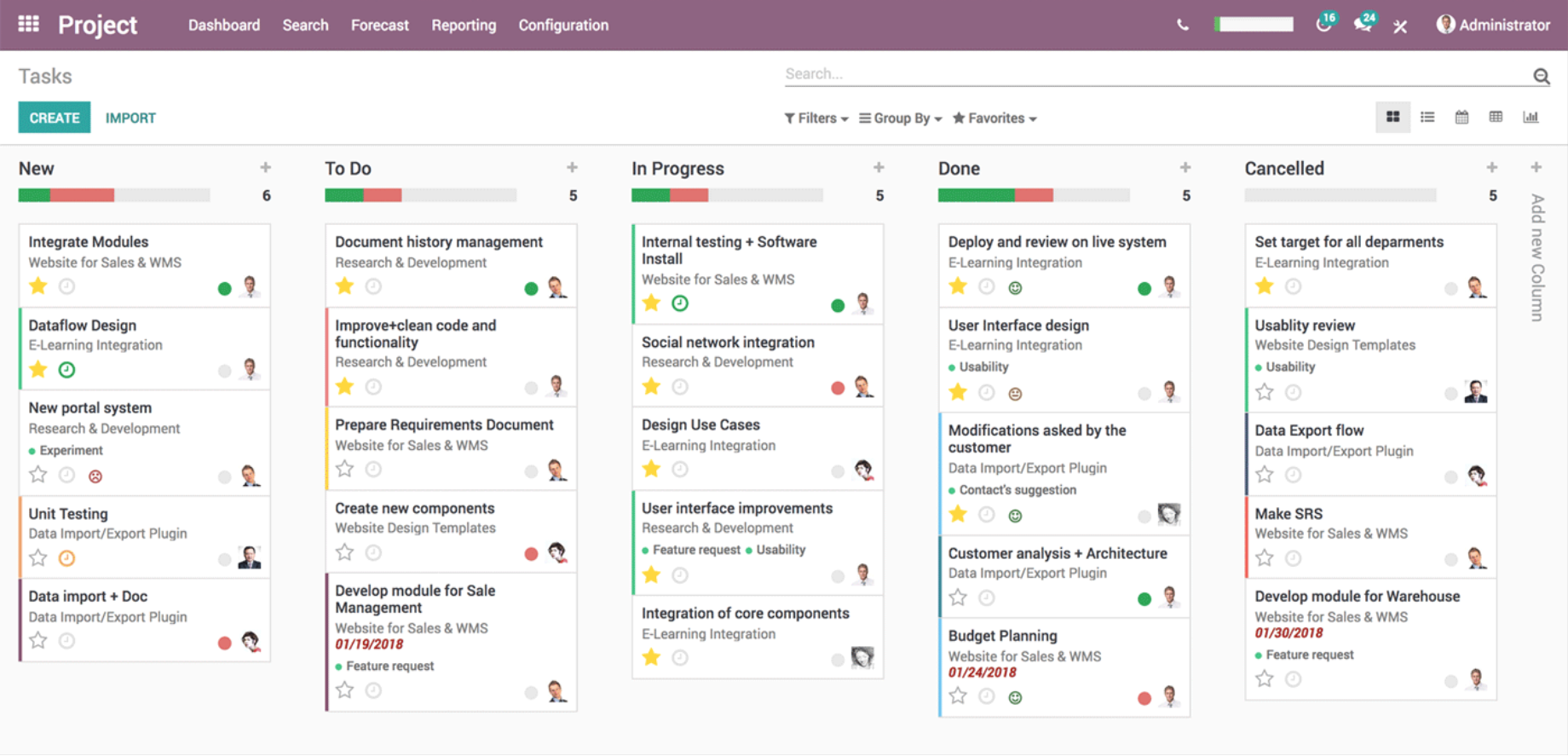
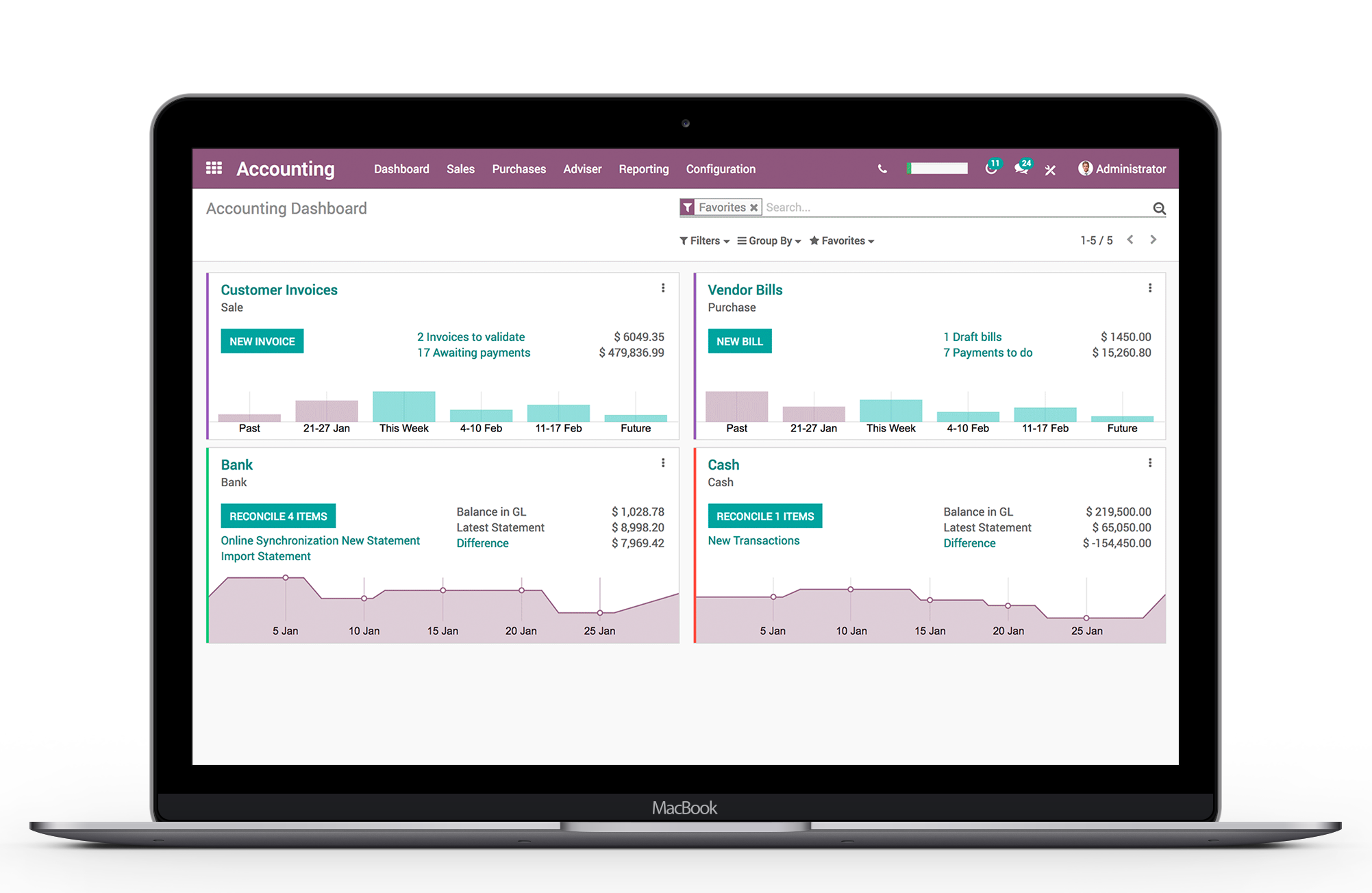
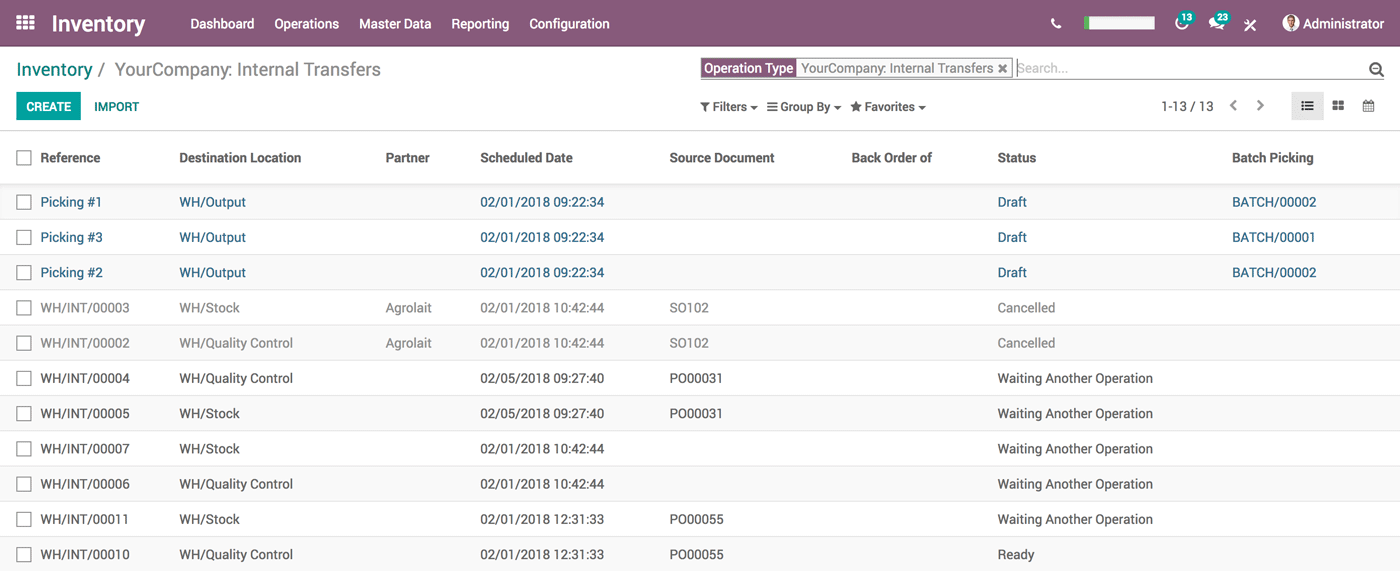
Odoo, from the Belgium-headquartered multinational company of the same name, is a suite of business applications for managing the sales pipeline. It also comprises a PoS and inventory management modules, scaling to a warehouse or retail management solution.
$31.10
per month per user
Pricing
NetSuite ERP
Odoo
Editions & Modules
No answers on this topic
Standard
$31.10
per month per user
Custom
$46.70
per month per user
Offerings
Pricing Offerings
NetSuite ERP
Odoo
Free Trial
No
Yes
Free/Freemium Version
No
Yes
Premium Consulting/Integration Services
No
No
Entry-level Setup Fee
No setup fee
-$49,321,250 per app/ per user/ per month
Additional Details
Users subscribe to NetSuite for an annual license fee. The license is made up of three main components: core platform, optional modules and the number of users. There is also a one-time implementation fee for initial setup. New modules and users and can be added as a business grows.
A discount is offered for new users for the first 12 months of use for the initial users purchased. ($24.90 instead of $31.10 for Standard)
More Pricing Information
Community Pulse
NetSuite ERP
Odoo
Considered Both Products
NetSuite ERP
Verified User
Anonymous
Chose NetSuite ERP
It was familiar to a few people in our organization who primarily use it.

In the past I always had a puzzle to assemble, with regards to data and management & ad-hoc reporting. With NetSuite ERP, as mentioned previously, everything is in one easy to retrieve place, and all the systems are there and cohesive. Although Workday Adaptive Planning and HFM …
For accounts payable , NetSuite far outweighs these other software and ERP platforms that I have used in the past. Speaking from someone with over 25 years accounts payable experience, you want an ERP system that is going to save time money and increase productivity. Exploring …
NetSuite is used for CRM, Inventory Management, Reports, and other business functions. NetSuite helps our company organize information and data. Inventory Management has been much easier to handle with this system, and it's easier to keep track of multiple products.
NetSuite is owned and run by Oracle which is the leader in the ERP market. NetSuite does a good job for middle market companies having much of the same functionality as Oracle for a much lower price. NetSuite compares favorably to other systems and financial software we …
Due to its comprehensive, cloud-based, and highly integrated suite of applications covering financials, CRM, supply chain, and more, providing a single source of truth for business data. Its scalability is a significant advantage, allowing businesses to easily add modules and …
NetSuite ERP is one of the big player in accounting software. I have good working experience with this software. it helps us to do more smart work instead of hard work. Provide more features and making business numbers easy and accurate. Along with that if helps us in many ways …
NetSuite offers a fully integrated solution that includes Finance, CRM, Inventory, Procurement, and Project Management—eliminating the need for multiple disconnected systems.
Other systems like Coupa offers business spend management.
I believe NetSuite ERP has more customizability than Salesforce so you can form it to exactly how you like although you may need more expertise with the platform to do so.
With its robust financial management, global capabilities, and industry-specific features, NetSuite ERP is a complete cloud-based solution that is perfect for expanding, multi-entity enterprises. Although it provides a single platform, it necessitates more training and …
NetSuite ERP is a much more comprehensive accounting ERP software than the other two mentioned. It is designed for bigger organizations who have more complex accounting things to account for. I believe NetSuite ERP is the best ERP system to use for our necessities. The other …
I was not the selector of the vendor for NetSuite ERP, and it is now the interface I am most used to. I would recommend SAP and their full suite of products, currently only using Concur, as I think it has a slightly cleaner and less cluttered interface, however I do not know if …
We don't have the need for an enterprise level solution like SAP, Oracle, or PeopleSoft so NetSuite ERP was a better fit. We had outgrown the functionality provided by our previous ERP system and of the three different solutions that we demo'd, NetSuite ERP checked the most …
Quickbooks is a great tool for startup companies. It provides all the basics; AR, AP, and Financials. However it does not provide anything with regards to advanced modules.
Sage Intacct is actually a very well made ERP system. Our company was considering both NetSuite ERP …
We came from an AS400 system. NetSuite is supremely advanced and more capable than our old system. We initially selected NetSuite for its reporting and analytics capabilities. From there, we looked at its automation and manufacturing capabilities. It has really outclassed our …
We scoped out so many ERP systems, and actually went very deep into launch and integrations with many, until we realized they were not a fit. This was due to currency capacities, global reach, manufacturing and process limitations, etc. We eventually finally bit the bullet and …
NetSuite ERP only offers a cloud model, vs. BC's on-prem and cloud models. However, this is not necessarily a bad thing. If you're deploying on-prem you may find yourself introducing all kinds of needless complexity you later regret. NetSuite ERP came fully-featured and remains …
Nestuite is more suitable for bigger organizations at growth and scale stages with at least two subsidiaries that want to integrate lots of software tools.
Netsuite is way more powerful, but also way more expensive. We chose Netsuite at a time when we thought we wanted our ERP to be the source for almost all data, and were willing to compromise on user friendliness to get there. Netsuite has great modules that are good when you …
Quickbooks is more user friendly and is designed better and really great for smaller businesses however, many companies will end up outgrowing it and need some of the NetSuite ERP functionality. We integrate Maxio with NetSuite ERP and we also integrated it with Quickbooks and …
It is simple to use and the features in Odoo are more advanced compared to zoho. The cost of Odoo is also very less comparatively with other competitors that are available in market. Accessing the in depth reports is very easy with Odoo and a person with low executive level can …
Odoo is much easier to use than SAP and is much more adaptable and cost effective. Odoo is much more of a complete system than Quickbooks and more thorough in its approach. If you have a very basic business to run, Quickbooks could work, but if you have any customizations that …
We decided to go with Odoo over Netsuite due to a few factors. Price was a big reason why, Netsuite is the most expensive ERP we vetted. I also did not have a great experience with Netsuite at my last job. I was on the roll out team and it did not work as promised for POS, …
Odoo talks with our other software (shipping, website, etc.) while our old software did not. It is also a web-based product so it is easily accessible from home, mobile, etc. Before, if I needed to work from home for some reason, I had to project my office computer screen to my …
we CAME from NetSuite (and should have stayed there!!) - but we thought Odoo would be better. Brightpearl was too expensive and too slow to implement - and we needed a system that could do the Spanish Legally mandatory Accounting reports...... and even here Odoo fails as no …
They don't even compare. Odoo is so bad with its UI it took me months to learn, and still be confused by it. Within less than a month using HubSpot I've surpassed my limitations and set up far more complex systems.
I selected Odoo because it is all in the cloud online and it is very easy to conect from everywhere, but then it did nos suit what we wanted in other fields and the service was poor,so we deceided to cancel the contract, but never get our money back since november 2020.
Odoo offers great ease of use and time to market. You can build on modules and integration, not an issue since the system will say "before" setup what modules relate to what you want. And in some instances will even install needed modules without your having to guess.
Odoo firmly holds a strong position among its competitors. It is extremely easy to use and getting started is a few clicks away provided that you are using their online services. The good thing about Odoo is they have a good support which gives them slight edges on their …
While comparing Direkto with the Odoo, I'd say, only consideration of the UI is enough to see the vital advantage of the latter. Moreover, the specific functions are way [more] easily searchable through the Odoo than in Direkto.
Well, since I started my current job we use Odoo as ERP for everything, in my previous jobs I used other systems but they have nothing to do with this system, but personally, it is a very friendly and easy to use system, they trained me for a couple of days and it was quite …
Compared to Zoho, I think Odoo lacks some clear ease of use that Zoho provides out of the box. Mainly the easy importation of leads and conversion / tracking. Additionally Zoho analytics is easier to customize the dashboard from the menus. After some tinkering I think you can …
NetSuite suits a mid-sized company best where the organization uses multiple currencies in its day-to-day transactions. NetSuite is ready-to-use for businesses that follow financial standards. The more custom business processes there are, the more implementation is required. I would not recommend NetSuite to a large organization due to its performance issues. Additionally, the in-house bank reconciliation tool is not user-friendly for business purposes.
Implementation was a terrible experience for us. Because it required a third party, we ended up way over budget and schedule. While Odoo advertises that it works with many systems, these third-party integrations often don't work out of the box and require extensive coding to set up. Furthermore, these "apps" can frequently break or lose integration.
Customizable Reports and Saved Searches allow much more maneuverability
Elimination Entries that are driven by advanced intercompany journal entries
Journal Entries can be entered in as basic or advanced intercompany to better represent the type of transaction occurred for reporting purposes
Training through the LCS module can help shed knowledge on a range of topics at a self paced learning basis
NetSuite ERP offers to all users a SuiteAnswers platform to pose frequently asked questions with answers generated from a combination of NetSuite ERP experts, users, and more recently AI based.
I am not the decision maker for this but I believe our company will be sticking with NetSuite for the long term. A CRM like this is a big investment and not something you move away from quickly and without a lot of planning. There is a lot of data involved and importing that into a new system is no easy task.
It's beneficial if you know what you're doing, but it can be very confusing to find what you're looking for, and many things seem overly complicated or require too many steps to accomplish a simple task - which can be overwhelming for someone accustomed to QuickBooks.
Once you complete the training with Odoo, you have a great grasp of how the system works, and most every feature is intuitive- There is rarely a task within Odoo that I get frustrated trying to figure out- I can typically look through the system and find what I need to do, and if I ever do need support, the Odoo Support team is excellent
It has been very reliable. I can only think of 1-2 times in 4.5 years that we have had issues getting in, and in each case were able to get back in within 1 hour. There has not been a major downtime
Most of the time the performance is very good. Pages load in a few seconds; financial reports take less than 5 seconds; basic searches take a few seconds. But performance can be sporadic throughout the day and cause the run time to triple.
I would like to give 8 rating for NetSuite support and reason for that is below: Whenever we faced any technical or functional issues we tried to reach out to NEtSuite support but response was not immediate. We told them about the urgency of the issue but still we were not getting response on time. Then, we have to reach out to AE to get things resolved.
Easy - there is NO SUPPORT (like in ABSOLUTELY NOTHING!!!!!!!). Even for legally mandatory requirements where the system MUST work, they will gladly take a month to get back to you with a NON-answer. We couldn't even get our bank statements correctly into Odoo for 2 months - leading to no reconciliation and the company accounts were a mess (still are!!) as a result - Completely irresponsible. Have not EVEN had an apology from Odoo - they couldn't care less !!
I had in person training for a day when first got the software. The training was good. The challenge was that there was a large gap between training and when we went live so we forgot quite a lot
Implementation was fine but could have gone quicker.
NetSuite provided me a implementation guide who I did not think was very knowledgeable.
I recommend that you make sure the organization knows how they are going to use the software and come up with an implementation plan before importing all of the data.
NetSuite by far is the most expensive; However, compared to the 3 systems notated, the overall functionality, capability and reporting advantages make it my top choice for companies experiencing exponential growth across all departments. Its a best in class solution for just about any user.
Compared to Zoho, I think Odoo lacks some clear ease of use that Zoho provides out of the box. Mainly the easy importation of leads and conversion / tracking. Additionally Zoho analytics is easier to customize the dashboard from the menus. After some tinkering I think you can get the same thing with Odoo, it's language and logic just take some geting used to. Airtable provides similarly easy to customize dashboards that are aesthetically appealing. but lacks the ability to track the customer journey as effectively as Odoo or Zoho systems.
We have been able to scale our business 25X without any major overhaul with Netsuite. Its dashboard setup makes onboarding new employees very easy and allows data to be shared across multiple offices. Its cloud setup does not put any pressure on IT to scale servers or other infrastructure. We have been able to become much more efficient in all aspects of the business.
NetSuite ERP data is used for material reporting. That is like balance sheet and profit and loss reporting. It plays a key role in financial data management.
Too many customisation become hard to manage in over a period of time.
It has helped us improve our purchasing and sales flow, now it is more organized, we can see which product was purchased from which supplier and which price is more convenient, very good
It helps to manage payments efficiently, and in less time than when it was managed manually, so it is a positive point that we can rescue in our organization.
In my case, managing inventory helps me more easily locate the most specific products that I require. Currently, we do not have details of mismatches with the products, so my inventory and my stock are kept perfectly updated.