Formerly from Micro Focus and earliler from Borland, unified test management with OpenText™ Silk Central drives reuse and efficiency. It gives users the visibility to control application readiness.
N/A
Ranorex Studio
Score 7.8 out of 10
N/A
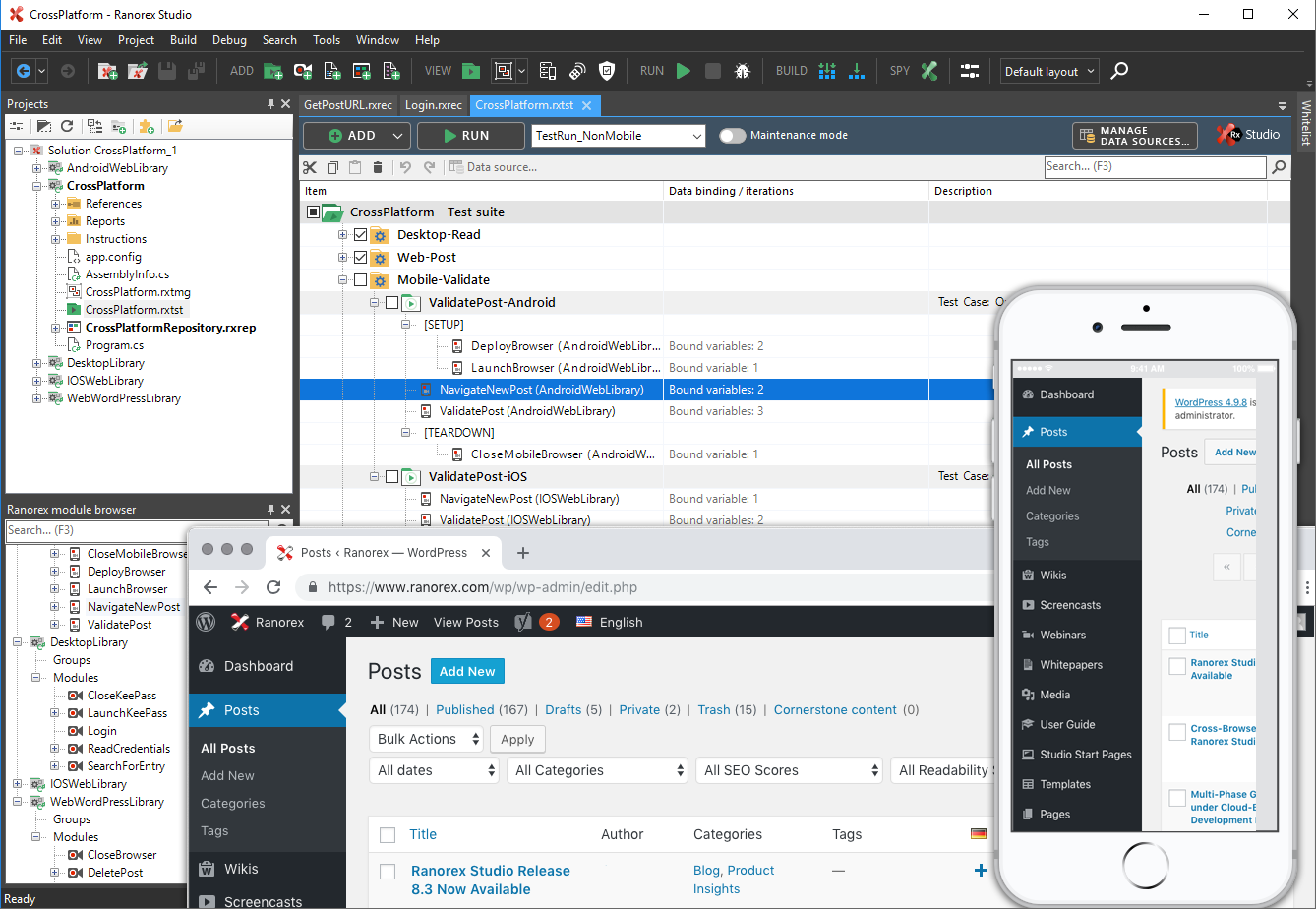
Over 14,000+ users worldwide automate tests with Ranorex Studio, which promises to enable rapid delivery of high-quality desktop, mobile, and web applications. The vendor says that with over 10 years in test automation, Ranorex Studio supports automating functional UI tests for even the most challenging technologies, from legacy applications to the latest web and mobile platforms. Ranorex Studio is an all-in-one tool that empowers everyone on the team. Key benefits and…
$890
per additional endpoint
Pricing
OpenText Silk Central
Ranorex Studio
Editions & Modules
No answers on this topic
Runtime Floating Licnse
$890
per additional endpoint
Premium Node-Locked License
$2,990
per installation
Premium Floating License
$4,990
per concurrent user
Offerings
Pricing Offerings
OpenText Silk Central
Ranorex Studio
Free Trial
No
Yes
Free/Freemium Version
No
No
Premium Consulting/Integration Services
No
No
Entry-level Setup Fee
No setup fee
Optional
Additional Details
—
All licenses are perpetual and include 12 months of maintenance and email support. A runtime floating license requires at least one premium license for test creation. Please contact our sales team for information about possible volume discounts and options for enterprise support. Consulting, integration and training services are available from our partners worldwide.
More Pricing Information
Community Pulse
OpenText Silk Central
Ranorex Studio
Features
OpenText Silk Central
Ranorex Studio
Test Management
Comparison of Test Management features of Product A and Product B
We didn't just select Borland Silk Central randomly. In the selection process, we actually evaluated in total 26 available test management tools in the market. We sent surveys to all potential users in the department to collect their wish list of our next management tool, converted them to a criteria list, and used that list to evaluate all 26 tools. We reduced the possible candidate tools to five and organized a small committee to pick the final three. Top management then checked their price tags and selected Borland Silk Central. Based on this evaluation process, I would say Borland Silk Central is suitable to an organization which has no more than 60 testers; needs both manual tests and automated tests; needs on-line support; needs a low learning curve and has a limited budget. My personal view is that this tool reaches the balance points among ease-of-use, budget and support.
Although the first year with Ranorex was fine and increased our productivity overall, the first problem that appeared after the standard support period expired gave the whole cooperation a bad taste. Apart from the fact that if you don't buy support continuously and the problem appears after a year and a half, for example, you have to buy support for the whole past period just to get someone to talk to you, after buying support and reporting the problem it took them half a year to even get to the problem analysis during which we were without a working application. Several times we had to tediously report the same problem over and over again as we were shuffled around by support teams who had no continuity for our support case. And when our support expired again for a period during which we could not use the program, Ranorex referred us to another support purchase, still without a working solution. This is totally unacceptable and definitely not a pro-customer approach.
Borland Silk Central is good for the users to associate test requirements, test cases, execution plans and test reports together. Each asset (test case, requirement, etc...) provides links for the users to jump to other assets in a click, and the users can jump back and forth between two assets.
Borland Silk Central is also good in test automation. Although Micro Focus does provide a client tool for test automation, the users don't really need it to automate the tests. In our case, we are using Python to automate the tests and use a batch file to launch tests, and in Borland Silk Central we just call that batch file from server side. The test result is automatically fed back to Silk server.
Micro Focus also publishes the schema of the database behind Borland Silk Central, so it is very easy to extend its function beyond its original design. Moreover, because its schema is published, we can easily retrieve and process its data for business intelligence purpose.
On the other hand, the plugins of Borland Silk Central with third-party tools are programmed poorly. In our case, the plugins for JIRA have a lot of limitations and were almost unusable in our test environment. (They did improve the plugins a little bit later, however.)
The tech support people are located in UK, so frequently it is difficult to get a hold of these guys due to different time zones. Also, most of them obviously don't have enough experience and sometimes drove us nuts in emergency situations.
The last thing I feel is that Micro Focus possibly doesn't provide enough manpower to maintain Borland Silk Central. There are tons of feature requests for Borland Silk Central pending there. Although they have frequent hot fixes every few months, they don't digest these requests quick enough.
Language support is limited, c# and Vb.net only if i remember correctly compared to other tools which allow many more. This addition would certainly be appreciated if added on in a company like mine with a variety of differently skilled individuals
Paid license. This is not always preferred. A free version without a limited trial but maybe limited features would be appreciated.
I suppose my experience is sort of mixed. Help documents are substantially helpful. I personally have not got the quickest responses from Ranorex support but at the same time, they are pretty good with updating their users frequently with info about their product/s and features. The community is really where I find support and I suppose that could look to be an extension of the product itself.
IBM Collaborate Suite - it is way too complicated and the learning curve is too high.
HP Quality Center - it is OK but a little bit expensive.
TestLink, Squash TM and other open source tools: The capabilities of open source tools just can't compare to commercial tools. Although we can modify the source code to improve the tool, we are just test engineers, not developers.
Zephyr: Our testers simply didn't like its UI - too weird.
Borland Silk Central provides a centralized test platform for multiple test departments in the company, so now all of the departments know what each of them is doing. In turn, all departments can coordinate with each other to reduce the duplicated test items and increase the overall test efficiency.
Also, Borland Silk Central enables the users to publish the test procedure (steps) of each test case so all the users can know how each test case is performed. It is not like what we had before, the test procedures resided in difference place from Excel to Google drive or some other weird locations.
Also, because all departments are using Borland Silk Central, all testers of the departments have better communication regarding testing methods. In the past, the department used different test management tools and it was hard for the testers to understand each other's testing methods.
Finally, because all departments share BorlandSilk Central, they also share the same set of reports published to Atlassian Confluence, so now they use the same set of reports to evaluate the test progress.
Reducing testing time is directly saving money if time is considered money.
Allowing less skilled users the ability to automate testing from the get-go because of Ranorex's ease of use and G.U.I. This of course positively affects a project and assists with user upskilling passively at least.