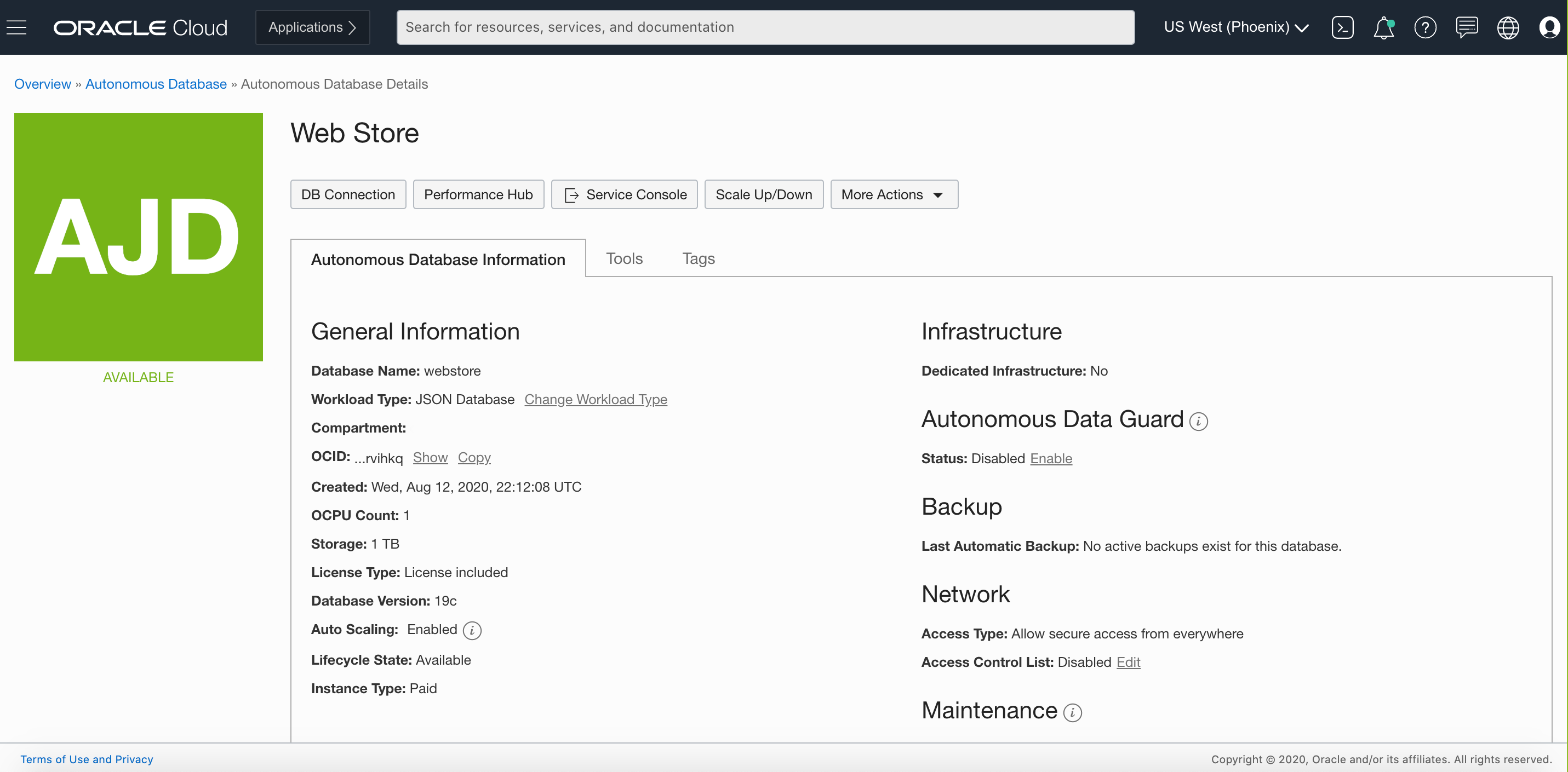
Oracle Autonomous Database provides a self-driving, self-securing, self-repairing cloud service that eliminate the overhead and human errors associated with traditional database administration. Oracle Autonomous Database takes care of configuration, tuning, backup, patching, encryption, scaling, and more.
N/A
Azure SQL Database
Score 8.9 out of 10
N/A
Azure SQL Database is Microsoft's relational database as a service (DBaaS).
$0.50
Per Hour
Pricing
Oracle Autonomous Database
Azure SQL Database
Editions & Modules
No answers on this topic
2 vCORE
$0.5044
Per Hour
6 vCORE
$1.5131
Per Hour
10 vCORE
$2.52
Per Hour
Offerings
Pricing Offerings
Oracle Autonomous Database
Azure SQL Database
Free Trial
Yes
No
Free/Freemium Version
Yes
No
Premium Consulting/Integration Services
No
No
Entry-level Setup Fee
Optional
No setup fee
Additional Details
—
—
More Pricing Information
Community Pulse
Oracle Autonomous Database
Azure SQL Database
Considered Both Products
Oracle Autonomous Database
Verified User
Anonymous
Chose Oracle Autonomous Database
Amazon did take the lead on this with multiple flavours of DB, but Oracle Engineering is unbeatable.
Oracle DB is levels of magnitude more rich in its functionality, it is much stronger in security, DR, HA, etc. However, the main drawback is its cost compared to MySql.
Because I had a background with Oracle Database, and comparatively the autonomous database is very easy to scale up and to obtain performance information.
Hands down it's the best. It's secure and extremely fast. It also doesn't need a lot of babysitting. It's running itself. It does its job as advertised. This is why I feel everyone should if they haven't already taken a hard look OAD. I feel it's the future of technology at its …
I found Oracle Autonomous Database very secure to store data and private information.I always feel secure with Oracle Autonomous Databases disaster recovery features.It is very effective to build applications for mobile and desktop devices lesser code using a low code …
Oracle Autonomous Database has the warehouse extension, whose performance has no question, and it increases the relevancy of the company's operations and fosters performance. Further, Oracle Autonomous Database generates high-performance options, which navigates all the …
Oracle Autonomous Database is the right choice for multiple functionalities, for instance, the warehousing of databases, and transactional analytics. Besides, Oracle Autonomous Database generates a platform that makes the process of application development efficient and …
We had already experienced people in the team on Oracle as Oracle Database was already being used in the organization. Also, when we compared all other possibilities, it came out as a less costly solution.
Actually, we used both Oracle Autonomous Database for our Oracle-related environments and Azure SQL and Azure VMs hosting SQL Server for our SQL Server-related environments. We have different products, some of them are platform independent (can be deployed on Oracle, SQL …
Oracle Autonomous Database is easy to deploy and use. Provides various supports with security. So it is much better in terms of complexity and performance to manage our application in real time. Cost is also less as compare to other databases. Easy development and deployment is …
AWS and Digital Ocean are two of the major other systems we have and are still using. But we do use Oracle's systems far more than we use Digital Ocean and AWS. We selected Oracle Autonomous Database mainly because of the new cloud 2.0 benefits. They have convinced us to begin …
The simplicity and great features and good support of Microsoft as well as the more reasonable flexible price than other competitors is one of the important reasons for choosing it.
Oracle database is "the" serious database. There really is no competition in that field. SQL Database would be a serious competitor through the ease of implementation and the "no maintenance," but since it's too expensive for "normal" use (medium to small applications), it just …
It is very easy to setup SQL database on Azure. one can always refer to their documentation for best practices. It is highly available and scalable. It is cheaper than its alternatives and provide better performance than others. As we are using many other services of Azure for …
Director, eCommerce Analytics and Digital Marketing
Chose Azure SQL Database
The Azure SQL Database, compared to our on premise SQL server installation, is much easier to use in terms of seeing database diagnostics. There is a whole visualization platform that comes with the tool that will allow your database administrator to see what jobs are tying up …
Amazon's RDS offering is actually very good and is used in other parts of the company, we just have a lot of Azure experience so wanted to leverage that.
Being able to manage our databases in the cloud, scale quickly, and only require access to VMs made choosing Azure a no-brainer over a traditional SQL Server installation/integration. We don't have the budget or resources to integrate and maintain servers on our own, so using …
I would say MySQL in either Aurora or MariaDB form come close however, Azure SQL Database has a more streamlined approach to delivering a consistent programmability model, supported drivers and feature set.
Azure SQL Database T-SQL is advantageous and more complete than SQL …
Azure owned by Microsoft who owned SQL Server, so provided a variety of tools for easy migration/transition and from on-premises to the cloud; and management. I recommend using Azure for any on-prem SQL server databases.
Azure SQL is a clear upgrade to SQL Server 2012 and pretty much has the advantage with all the extra features that it has. Security, queries, exporting tables, T-SQL has all improved. Transitioning 18+ years of an in-house database to the cloud was a struggle, but for the …
We moved away from Oracle and NoSQL because we had been so reliant on them for the last 25 years, the pricing was too much and we were looking for a way to cut the cord. Snowflake is just too up in the air, feels like it is soon to be just another line item to add to your Azure …
Amazon Relational Database Service is the other obvious competitor. We were already in Azure, so it's not a serious contender for our business due to that bias already, but I do personally find the marketing and documentation of RDS more intimidating to sort through.
Comparing with Amazon Aurora: Azure SQL DB is 100% compatible with SQL Server and Aurora is compatible with MySQL and PostGreSQL. Because of if, SQL DB suits large enterprises with hundreds of databases better. Comparing with Oracle: the main issue is that Oracle will try to …
It stacks up in different ways, for the most part, I think Microsoft is doing a really good job versus the competition. They basically started database type products from the beginning. I've always been excited about updates and can see their progress over time. Get's me really …
It's more easy to shift and get all the services up in no time, provide best up time and monitoring easily so you can get the best services which take care of themselves. It's a better fitting for a large company size.
As we were early adopters with Azure and landed on the Azure PaaS (Platform as a Service), it made sense to use databases that were on the same platform as the application to save on costs. Also, we were impressed with the simplicity of Azure SQL. From a management perspective …
Scenarios where this is best suited are like where there are not large set of data which has to be analyzed and extracted.It helps in the efficiency of data .It is also well suited for medium size companies where you have to create a common data for everyone. As for large set of data, there can be network latency issues and thus there are some limitations of this software.
Your upcoming app can be built faster on a fully managed SQL database and can be moved into Azure with a few to no application code changes. Flexible and responsive server less computing and Hyperscale storage can cope with your changing requirements and one of the main benefits is the reduction in costs, which is noticeable.
Scalability is #1: if it used to be an almost no-win endeavour to try to modernize your server or migrate to other hardware, with Azure SQL Database it becomes a press of a button.
All the tools simply work after you are on Azure SQL Database.
The applications do not need changes in order to start using Azure SQL Database.
Hybrid Cloud scenarios will work.
Clustering and failover - already there.
You can start monitoring the use and extract performance insights in a new way in Azure.
There is no access to the physical host of the DB. This is expected from a managed DB. Everything must be done through the console or via API calls. This is a new learning curve for the DBAs.
Due to the lack of physical host access, certain features are not supported, such as Transportable tablespaces and Oracle LogMiner.
Certain special data types, (such as XMLType) are not allowed; be sure the app vendor certifies their product on this platform.
A little slow on processing complex or large Views. We use a lot of Views to feed our BI system, and the processing time could see some improvement, IMHO.
Additional monitoring components would be nice too, automating some built in performance measurement tools would be a nice feature.
Price can always be improved as well. It’s not bad, but room for improvement.
Autonomous is the way of the future and this is one system which is crucial to any system and is also autonomous. It is self-tuning and self-maintaining which are major advantages.
The product is continuously evolving and new features are added frequently. Management options through the OCI (Oracle Cloud Infrastructure) console and through the command line and API are being enhanced frequently.
We give the support a high rating simply because every time we've had issues or questions, representatives were in contact with us quickly. Without fail, our issues/questions were handled in a timely matter. That kind of response is integral when client data integrity and availability is in question. There is also a wealth of documentation for resolving issues on your own.
Hands down it's the best. It's secure and extremely fast. It also doesn't need a lot of babysitting. It's running itself. It does its job as advertised. This is why I feel everyone should if they haven't already taken a hard look OAD. I feel it's the future of technology at its best. Everyone should be taking notice of how far technology has come and where it's going.
Oracle Database is "the" serious database. There really is no competition in that field. SQL Database would be a serious competitor through the ease of implementation and the "no maintenance," but since it's too expensive for "normal" use (medium to small applications), it just priced itself out of the market, so to speak. Nevertheless, we do have 2 or 3 large applications that are highly integrated in azure, and for those it's just too easy to use SQL Database instead of the on premise Oracle Database with VPN gateways etcetera.
We don't need a dedicated SQL dba because so many of the database maintenance operations are managed. A huge positive not only in budget but time constraints.
The ability to scale quickly is the biggest positive as our data needs change constantly.
Easy to migrate from legacy tools and systems, saving us on the need for redevelopment.