Oracle Cloud Infrastructure (OCI) is Oracles's infrastructure-as-a-service (IaaS) platform which combines the utility of public cloud with the granular control, security, and predictability of on-premises infrastructure.
N/A
Oracle Integration (OIC)
Score 5.0 out of 10
N/A
The Oracle Integration Cloud Service is an iPaaS providing prebuilt integration flows between applications, including other Oracle products. The Integration Cloud Service is scaled for enterprises, with prebuilt codeless adapters for on-premises and SaaS systems and low-code automation capabilities.
Main benefit was costing compared to other services and we use Oracle as a database so with Oracle Cloud Infrastructure we can fully utilize the Oracle Cloud Infrastructure database which helped a lot for our products to handle major load that is one big plus because we had pay …
Oracle Cloud Infrastructure typically offers lower pricing for compute and storage than AWS. There are no hidden charges, it is more transparent. It is built for running oracle databases which the application was using, and licensing is more cost effective as compared to AWS.
Right now we are evaluating the usage. Prima facie is that it will be game changer and we are supposed to start POC in next sprint. Can not put client details but on high level, clients are very excited to see if ML can predict areas of traction from where orders are created …
Selected ones are better than Oracle Cloud Infrastructure but it works well only for small scale applications. It leads to migration to other cloud platforms.
Used Google Cloud Platform to store data in data warehouse and the monitor it. Powerfull VM in GCP are very good and can process large databases too. We are using Oracle Cloud Infrastructure mostly because of client's request.
Performance and latency are excellent in Oracle Cloud Infrastructure. Except for AWS baremetal, I don't find anything like that. I found that, aside from conventional compute that works really good, they also offer HPC VDI. That's one of the strengths that should have more hype …
Oracle Cloud Infrastructure stacks up against EC2, in cases where out DB are Oracle, the transformation of the data take a lot of time and effort to warranty that the data have been migrated correctly, to offfcourse in case where Oracle are in our company will be always a …
Oracle Cloud Infrastructure is great because of the ample storage and quick loading times we receive compared to others. The cost is also very manageable. We like how Oracle is structured and we utilize the machine learning and AI built in tools quite often. We are very pleased …
- Performance was big reason for choosing Oracle Cloud infrastructure over AWS Ec2 and Azure VMware Solutions.- Oracle Database as application design was another reason for choosing Oracle Cloud infrastructure over AWS Ec2 and Azure VMware Solutions.
Oracle Cloud Infrastructure (OCI) competes with several major cloud providers, including Amazon Web Services (AWS), Microsoft Azure, Google Cloud Platform (GCP), and others.Here is why we consider selecting Oracle Cloud Infrastructure: Strong for Oracle Workloads, …
We used Microsoft Azure and Docker earlier and faced some difficulties like Microsoft Azure and Docker. Occasionally, the generation of large images can delay deployment. It is also necessary for me to admit that Microsoft Azure and Docker have a somewhat steep learning curve. …
Oracle Cloud Infrastructure provides strong and Innovative database services with its enterprise Autonomous Database and Exadata Features. Oracle database management can make huge workloads autonomously. OCI in addition is more cheaper compared to it's other competitors in the …
Services are almost the same, but OCI can provide more resources at the same price, our application can easily do the migration, and also, OCI also provides free VPC Site to Site VPN, which helps us create a security path from local to remote.
OCI does not stack up against these products due to their wide range of services, support, and ease of troubleshooting. There is an abundance of tutorials on the services provided by the competition, which makes them more easy to use. However, OCI is very competitive in pricing.
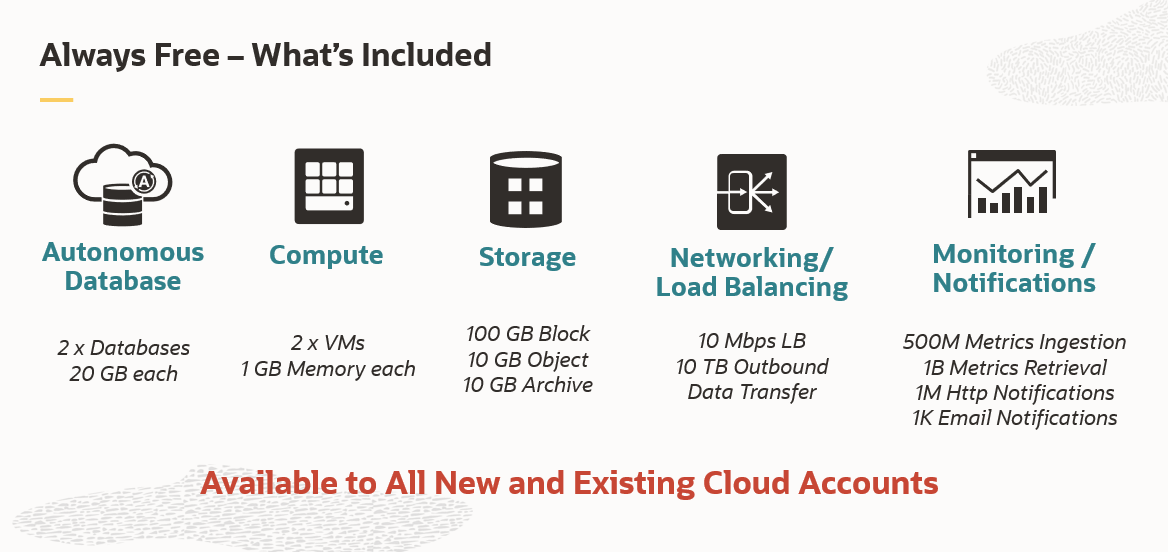
We use AWS and Google Cloud widely in our organization. However, we also use Oracle Databases for critical business, and OCI integrates well. We use OCI to test out our hypothesis for a rapid product. The Free tier is extremely useful to play around before committing.
There are numerous cloud providers in the market and I feel Oracle is very underrated for its capabilities and offerings . It has huge potential and it brings in very huge discounts for existing Oracle customers with unlimited licensing , if you are an existing ULA subscriber …
have used several other cloud functions provided by different companies but I found Oracle Cloud Infrastructure to be more user friendly and easy to understand and implement, also it has a global reach with different regions. OCI also has advantage of different database …
The nearest thing I have used to OIC is UiPath, as it is often used as a tool to integrate software together. However, it is much more suited to legacy software which have little to no API endpoints. If the infrastructure already exists I understand why people use RPA for …
Oracle Integration (OIC) Cloud is a new iPaaS that makes it very easy to connect ERP applications with Salesforce.com. They have pre-built connectors that eliminate errors by not having to worry about all the connection details needed to make sure the data mapping is accurate. …
Oracle has more SAS offerings than any other vendor and a higher number of clients are going towards Oracle SAS offering. In order to integrate SAS with other systems, OIC comes up with pre-built cloud adapters which make the turn around time faster than any other tool.
Oracle Mobile HUb is good to support the integration between Oracle ERP and Cloud systems. Integration Cloud is way broader in supporting the integration between both Oracle and non oracle third party systems. Wherever the transactions are real time and huge, Integration Cloud …
I haven't used any products like Oracle Process Cloud in the past, but our organization is planning to test out UIPath RPA and see how it compares with Oracle Process Cloud in the near future.
Oracle Integration Cloud product focuses more on integration compared to other Oracle products that we are using. We selected the OIC product to solve our integration needs, which are growing day by day, and the core applications are becoming more of the backbone of these …
This is my first PaaS product I've used, so I cannot compare it to others, but I can attest to the ease of development vs coding integrations from scratch. It is a huge time saver from a development standpoint.
Boomi has more stable integration and connectivity to SFDC, email and a few other adapters, but with OIC the user-friendly UI makes it simpler to build and support various integrations.
OIC has allowed us to decommission our Tibco environment and migrate from outsourced integration development to in house where costs are lower and time to development has increased in some cases from months to days or weeks.
It can integrate with any software or hardware and is easy to deploy between Enterprise Resource Planning, Supply Chain functions like procurement, inventory, ordering, on-premise applications, and human resources, marketing, sales and services. The connectors for databases …
Oracle's solutions play well with their own software and other systems. Their cloud products are familiar if you have used one and the UI is easy to use. Uptime and reliability are also always a factor.
SOA Suite Leverages JDeveloper and is much more robust than the standard tool. It incorporates so much more and has easy to use GUI features making it truely no comparison.
In my opinion there are other products that can implement SOA but the Oracle SOA Suite is the most comprehensive product available. I have not encountered many clients that disagree. While they may sometime moan and groan about the complexity they know that Oracle provides some …
Oracle Cloud Infrastructure (OCI) is a great fit when you need High-performance infrastructure for mission-critical apps that require low latency and high availability. Scalable compute services for big data analytics workloads that process massive datasets. Support for DevOps teams looking to streamline their development and deployment pipelines. But it might not be the best choice for Small-scale or low-traffic applications where you can find cheaper options elsewhere. Legacy workloads running on older tech like Oracle Solaris or Windows Server, where OCI's support may be limited.
Oracle Process Cloud is suited for medium-sized companies and up who want to create applications that can automate tasks without the need of recruiting more software developers. With a couple hours of training, any member of the organization's business team will be well-equipped with all of the knowledge that is needed to use Oracle Process Cloud effectively. If your IT team is large and able to take upon the task of making the given application, then something like Oracle BPM is a better solution.
Block Volume provides durability and stability to data. IOPS can be changed on the fly. Always stay true to the promised performance.
Block Volume can be encrypted with ease to meet compliance. Can also be easily integrated with OCI vault service for extra security.
Object Storage and File Storage are other forms of storage that are secure and extremely easy to configure. FSS is one of the best in the industry when it comes to reliability and performance.
SSD block volumes are persistent in OCI unlike many other clouds.
Auto-association of Oracle applications prepopulates the application connector select box and preconfigures Oracle Integration (OIC) using secure credential access for faster integration.
Various other system connectors are available to use readily.
User-intuitive experience--Connectors, integrators, and dashboard can be seen on one page.
Navigating the UI takes lots of getting used to. It reminds me of older GCP (just to get used to where everything is).
Permission for different things always seemed to be more difficult than it really needed to be. Once you got them set up you were good but updating anything or creating new permissions for just about anything took longer than I thought it should.
Based on how the buttons were laid out, it was pretty easy to delete all of your DNS records, and backing them up was not as intuitive as I'd like with the UI, but it was easy to do using a script.
Currently, it is not retaining the logs for more than 3 days, which it needs to address.
We also need some functionality inside the interface to re-push the same transaction again so that it will be helpful while testing and fixing the issue.
Also, some log errors are not giving the correct details. Oracle needs to rectify those.
We have been using this product for the last 6 years, and we keep renewing it yearly as we have no issues with this cloud provider. Maybe till we have our products, we will use this cloud and will be renewing it.
The services & products in Oracle Cloud Infrastructure needs more improvement to beat other Cloud service providers. The price is good & Security processes are good. We are requiring to put more effort in supporting this Oracle Cloud Infrastructure than other Cloud service providers. Probably better ways are there but is not super easy to find or not super available
Yeah sometimes we had to face unplanned outages due to underlying infrastructure issues, so not every time,e but once in a while we face issues with availability. But the good thing is we have redundancy with DR setup and multi region so we can manage.
Oracle Cloud Infrastructure performance is good in terms of querying large datasets, and is also consistent. It integrates well with other third party applications, and doesn't noticeably seem to slow down. Complex analytical queries and reports are processed efficiently even with larger datasets. Auto-scaling has been useful for traffic handling as this is a major challenge for any application.
Overall it is amazing, there is always room for improvement. We have weekly updates that tend to slow the program used more and more. We had to change some reports within Oracle because the others wouldn’t load. This is tied to our payroll and the delays are causing many time constraint issues and panic. We have to create a new report when one breaks. Otherwise awesome!
Performance and latency are excellent in Oracle Cloud Infrastructure. Except for AWS baremetal, I don't find anything like that. I found that, aside from conventional compute that works really good, they also offer HPC VDI. That's one of the strengths that should have more hype in OC advertising. After my tests, that were limited by the trial, I'm a net promoter of the service. I really miss the depth of my RDP connections and response times.
The nearest thing I have used to OIC is UiPath, as it is often used as a tool to integrate software together. However, it is much more suited to legacy software which have little to no API endpoints. If the infrastructure already exists I understand why people use RPA for integration, however for when API's are easily accessible and you're using Oracle tools, OIC is better.
We have hosted around 500 + customers on this cloud so till day not faced any major issues, so we can use it for any kind of products and it can hold the load and easily scale based on need.
We run big integration practices and that practice is pretty successful. We have seen the customer getting quick ROI as the initial investment is not much. The customer can also get a free 1-month trial instance of OICS to try out. All of our customers are happy with this investment so far.