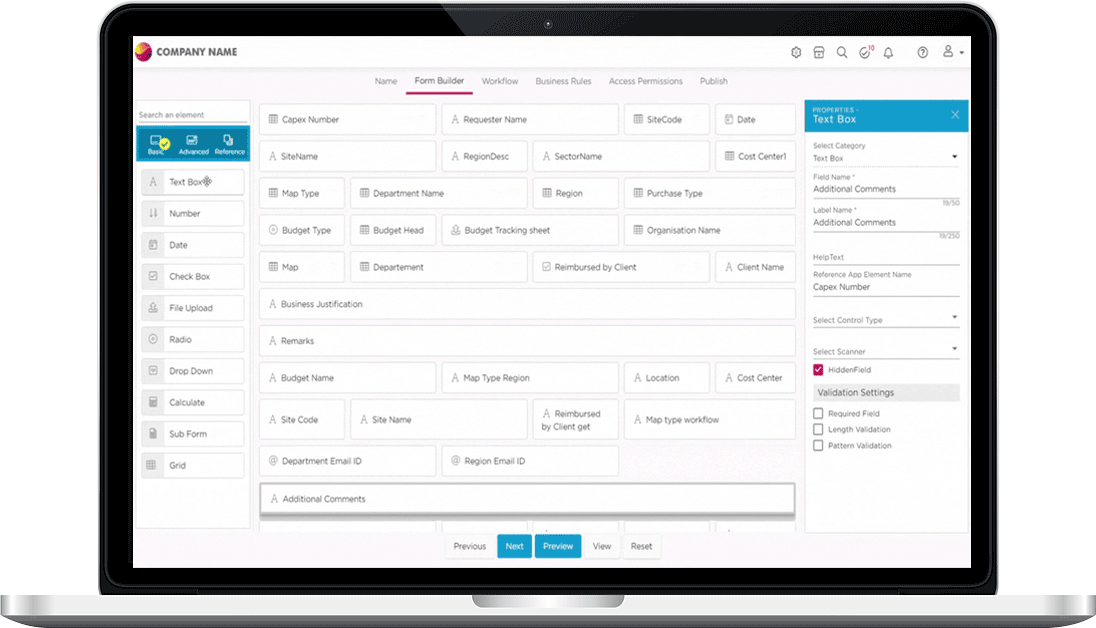
The OutSystems Platform is a Platform-as-a-Service solution for rapid delivery of responsive web and mobile applications. It includes functionalities required to develop, deploy, manage and change web and mobile applications. It is targeted at the delivery of enterprise applications that require integration with backend systems, complex business rules and logic, usable interfaces and flexibility to change. It can be deployed in the cloud, on-premises or in hybrid environments.
$4,000
per month
Quixy
Score 9.9 out of 10
Small Businesses (1-50 employees)
Enterprises can use Quixy's cloud-based no-code platform to enable their business users (citizen developers) to automate workflows and build simple to complex enterprise-grade applications for their custom needs. Quixy helps eliminate manual processes and turn ideas into applications making business more innovative, productive, and transparent. Users can start from scratch or customize pre-built apps from the Quixy app…
N/A
Pricing
OutSystems
Quixy
Editions & Modules
Basic
$4,000.00
per month
Pro
$10,000.00
per month
Enterprise
Contact Sales
Platform
Contact Sales
per month billed annually. This plan is suitable when the no. of users is high and the no. of apps/workflows is low.
Solution
Contact Sales
per month billed annually. This plan is suitable when the no. of users is high and the no. of apps/workflows is low.
Solution
Suitable when the no. of users is high and the no. of apps/workflows is low
Platform
Suitable when the no. of apps/workflows is high
Offerings
Pricing Offerings
OutSystems
Quixy
Free Trial
Yes
No
Free/Freemium Version
Yes
No
Premium Consulting/Integration Services
No
No
Entry-level Setup Fee
No setup fee
No setup fee
Additional Details
—
Solution
Suitable when the no. of users is high and the no. of apps/workflows is low
Platform
Suitable when the no. of apps/workflows is high
Enterprise
Suitable for bigger organizations looking for enterprise features
More Pricing Information
Community Pulse
OutSystems
Quixy
Features
OutSystems
Quixy
Low-Code Development
Comparison of Low-Code Development features of Product A and Product B
OutSystems excels with building web interfaces fast and lends itself to custom integrations written in .Net. Most anything can be brought in given this ability to be extended. One of the drawbacks to the speed of development is that most quality control teams become quickly overwhelmed and may be unable to keep up.
Quixy BPM for managing business processes distinguishes itself through its user-friendly interface and the absence of any coding requirements. This makes it an ideal solution for companies looking to streamline their operations. Quixy BPM is suitable for businesses of all sizes and represents a cost-effective way to save time and effort.
Deployment management – OutSystems has a built in robust, multi-environment deployment system that helps ensures the clean and error free deployment of applications through the development, testing and production product lifecycle
Rapid application development – Through the low code, graphical development environment you can develop applications far quicker than with more traditional development environments
Cross platform mobile development – OutSystems handle the development and building of mobile application for both iOS and Android in a simple streamlined way that removes 90% of the problems normally associated with multi platform development
The platform controls all the parts. While great for development and overall maintenance, it could lead to discussions with your DBA (who has to trust the platform). As a developer I love the platform, as a DBA I would like more control.
By making software development model driven using flows, you are forced to rethink the way of programming. It makes it easier, but sometimes the way of working leads to code which could be optimized (standard problem in model based software development).
Most of the code is generated, so the technical knowledge of the inner working of coding are not Essentials. This could lead to degration of this knowlegde. As part of this, most technologies will only be used when OutSystems supports it. They do a good job on implementing these things. But things like Node.js would be nice.
We are very happy with OutSystems and our developers deliver good work. OutSystems lets us build new software on a regulare (2 weekly) basis, which is highly flexible and adjustable. Even without very much experience, our developers manage to build usefull software, which is working a lot better than our previous (legacy) software.
OutSystems has a feature in which we can develop a functionality in a application and can use that functionality in another application without developing it again. That is main plus point for the development team so they can work with different functionalities rather focusing on the same thing again and again. if we want to make any change on the user side then we can make it live with just the deployment using the service center.
Quixy has allowed us to focus on more important tasks, as the platform takes care of labor-intensive administrative work. The automation of various processes has been invaluable, as it has saved us a considerable amount of time and resources. Overall, Quixy has transformed our administrative work and has enabled us to allocate more resources to critical tasks, leading to better outcomes for our organization.
The tech support is very reachable. Usually by [email] from but also by phone if needed. We had some difficulties at the start with understanding "what our machine was doing" under high performance load. After some good sessions understanding our needs they delivered good solutions for our problems we had in the beginning.
The online training material is well designed and explanations are step by step, helping trainees to understand and follow each exercise and new concept.
In a large company, patiently and consistently work the behind the scenes politics with business and IT partners across the firm. This is transformational - you will need a solid set of key business partners to lock arms together to move forward.
Totally different products of cource. Sitecore is best suited for full fledged websites with extensive support for analytics. OutSystems for modular business processes with a UI. Hence, there is no overlap. But even for small websites, or even landingpages, I would recommend OutSystems, with a custom made analytics part or a plugin.
While Excel is a powerful tool for organizing data and creating basic inventory spreadsheets, it lacks the automation and integration capabilities that Quixy provides. Also, we can integrate with other business systems, such as accounting and order fulfillment systems. So, we can actually have centralized system connected across several departments for automation.
The ease of use of the OutSystems development process has been the biggest ROI for us. We have developed our Framework product and maintained/enhanced it with only 4 workers.
OutSystems has enhanced their product very significantly over the last 4 years. They have gone from a simple to use tool to a very simple to use sophisticated tool that covers the standard mainframe-based computing apps and the apps used on handheld mobile devices all using the same basic set of development tools.