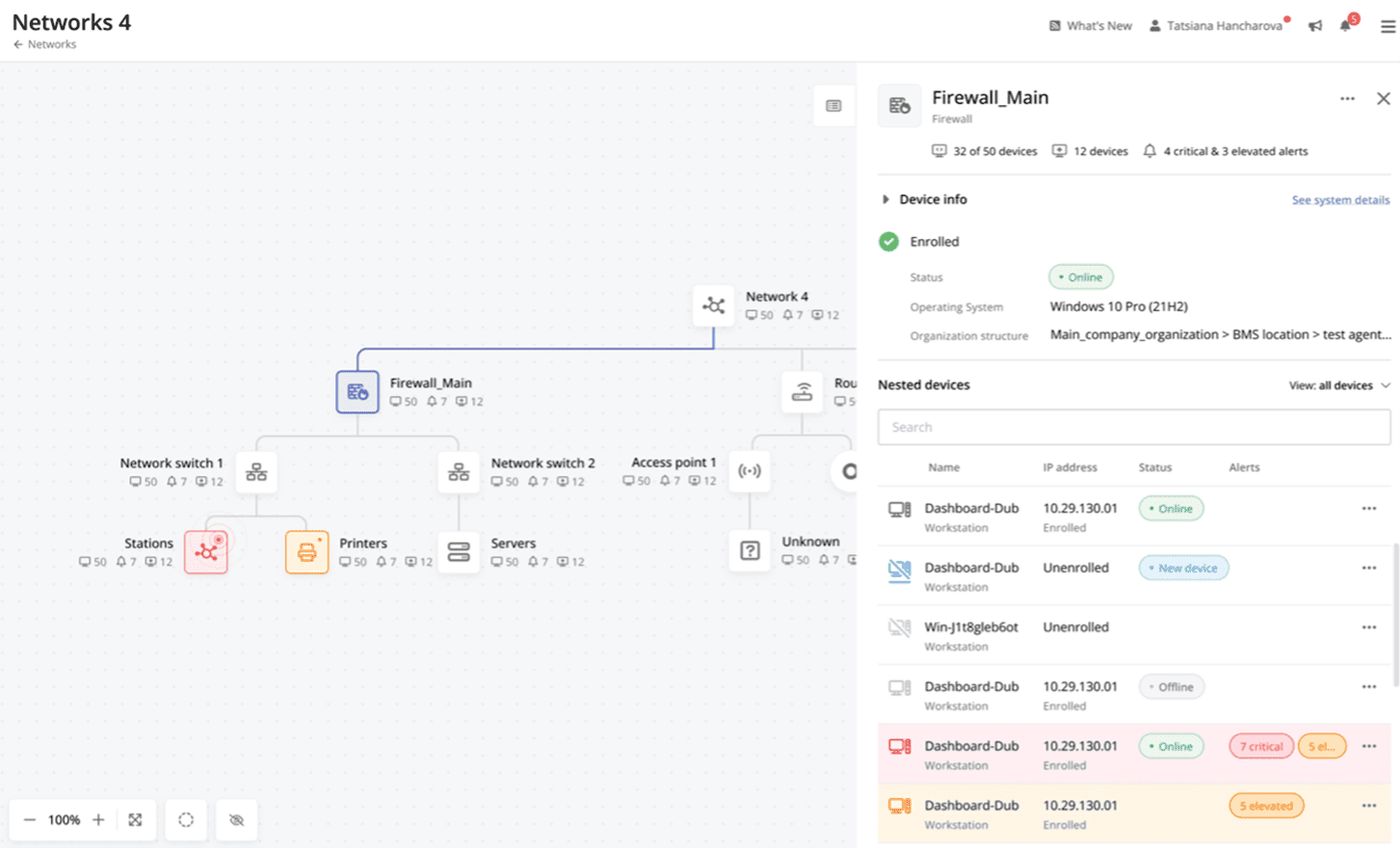
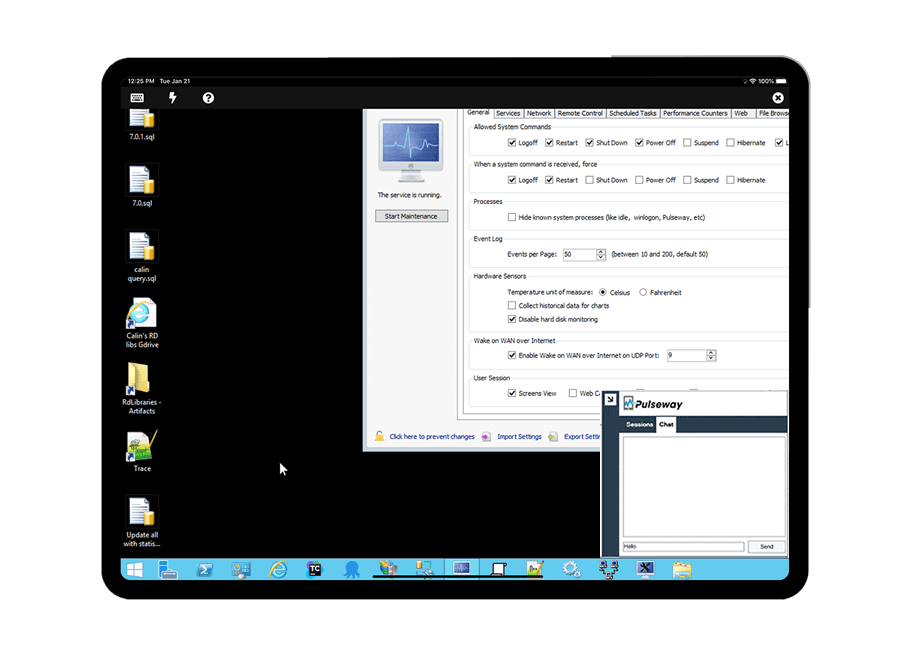
Pulseway is an IT monitoring and management solution that enables users to monitor, manage and control all systems and servers from a smartphone, tablet or browser. For system administrators, Pulseway sends a notification, so they can see an issue and sort it in seconds. Pulseway features: Automation: Auto-remediation workflows, so that IT issues are fixed before users even notice them. Mobile Access: Customers can monitor, manage, connect with…
$0.80
per month per installation
VMware vCenter
Score 8.7 out of 10
N/A
VMware vCenter is an advanced server management software that provides a centralized platform for controlling vSphere environments for visibility across hybrid clouds. VMware vCenter is no longer sold as a standalone product and is now available as a part of VMware Cloud Foundation.
$6,044
per year
Pricing
Pulseway
VMware vCenter
Editions & Modules
Enterprise
$0.80
per month per installation
Basic
6,044
per year
Production
6,244
per year
Offerings
Pricing Offerings
Pulseway
VMware vCenter
Free Trial
Yes
No
Free/Freemium Version
Yes
No
Premium Consulting/Integration Services
No
No
Entry-level Setup Fee
No setup fee
No setup fee
Additional Details
No hidden fees or contracts. Term-based discounts.
1. The fact there was no contract, we believe vendors should have to validate the usefulness of their product and their support to their customers every day, not just 1 or 2 months every few years. This is the same reason we allow our clients to leave …
I will admit, we started with Pulseway several years ago because we were able to start using it with a free account, which allowed us to install it on some in-house servers and gain experience with it. The other products we looked at all seem to require a considerable …
Pulseway has a more moderate learning curve compared to Nagios, which was overkill for our environment. Nagios also requires a server to run on, and we wanted to separate our monitoring from our hypervisor.
Pulseway has the most features, the best looking app with the best design and better usability than any others we evaluated. We liked the uniformity of the app design across all platforms (Windows, Android, Apple) and the notifications displayed on each platform. The price was …
Pulseway is by far the easiest to set up. The dashboard is very straight forward and has very little need for custom configuration. We use Pulseway to review basic server information and compare it to other similar servers to track outliers. It is very easy to see resources, …
Pulseway offers a reliable suite of tools at a reasonable cost. It has a lot of power in it if you are willing to put in the time to configure the automations and such in a way that works for you. They also integrate well with other tools offered by Kaseya.
In my experience, Red Hat Virtualization was cumbersome. I think VMware vCenter is definitely a better product. Red Hat discontinued their Virtualization product but still offers other virtualization platforms that I haven't tested.
We initially used Citrix XenServer and made the switch to VMware vCenter due to it being less expensive at the time. That was some 15yrs ago and is no longer the case as Broadcom has changed the licensing scheme for their products which greatly increased the costs.
Not really a competition. Proxmox and Hyper-V both lacks the manageability and easy to use access for multiple nodes and clusters. Also Hyper-V has the ability to use Multiple nodes but it does not compare to the level of VMware vCenter Server. All the integrations possible …
VMware as a product was most advanced hypervisor when we made the decision for our datacenter. Over the years VMware vCenter has kept it's edge and we have seen no reason to change to any other product as we have gained experience over the years. We do still continue to …
I was not involved in the evaluation, but my understanding from colleagues was that the years of experience in VMware vs. Hyper-V were very evident. VMware vCenter was simply a much more mature product.
vCenter is much more complete as a solution than other products that I have looked at and it works very well for our environment. vCenter is very easy to configure and does not have the unnecessary steps to set up and configure. Also, the different storage vendor support …
VMware vCenter Server's biggest competitor is Microsoft's Hyper-V Server. We prefer VMware vCenter Server because the hypervisor is much less resource intensive. It also gives us a different environment so that a specific Microsoft bug wouldn't take down all of our VMs if the …
[VMware vCenter Server] is the true leader in this space. The functionality and ability to offload tasks to other teams makes this a no brainer. The granularity in permission allows [VMware vCenter Server] to be secure and isolate teams to only the objects they are allowed to …
There was not much competition, VMware has been in the market the longest and other systems are still catching up. VMware is proven, trusted, and has a good support base, the other main differentiator is VSAN for storage, reducing the need for physical SAN(s) which can become a …
Hyper-V is not a bad product by any means, and it does have the benefit of not costing money for the software itself since it comes with the OS. That being said, it did start quite far behind VMware in features when it first came to market. Microsoft has been catching up, and …
vCenter beats the daylights out of Microsoft Hyper-V. Actions that take multiple clicks with Microsoft can be achieved in a single click with vCenter. It’s less expensive and easier to deploy and maintain.
VMware vCenter Server is a much more simplified, in my opinion, platform for managing a virtual infrastructure stack. There are a number of features that are available at the Enterprise and Enterprise+ tiers of service that other hypervisor environments do not excel at, or do …
Citrix XenCenter used an isolated client that directly connects to the hosts instead of using a management agent. This causes a number of issues if the host is not optimally configured. Microsoft Hyper-V has been behind VMware in feature set for many years, but is starting to …
We considered Microsoft Hyper-V very briefly. At the time we considered Hyper-V you still needed to purchase an extra management product to get features similar to vCenter; and even then, it didn't seem fully baked, yet. The situation may, and probably has changed, with later …
Based on the Gartner leader board, VMware is a pioneer in terms of virtualization, it is also API based which is easy to integrate on other systems via REST API's, the technology itself is powerful and it's corresponding other added value features that makes administering …
VMware is much easier to use, much easier to configure, and does not rely on having another OS layer like windows to run off of. This was they key for us because whenever we had to update windows we would have to migrate everything off just to apply some simple updates. VCenter …
Our desktop team uses Citrix XenApp for remote connectivity of our employees. However, this environment runs on our VMware vSphere hosts which are managed by VMware vCenter Server. :) XenApp was never considered to replace VMware vCenter Server or our vSphere hosts.
Proxmox VE is also a very powerful tool and is free, but vCenter has really hit the nail on the head as far as simplicity and ease of use, as well as, reliability.
When we were selecting a hypervisor a few years ago, VMware was the clear leader at the time. Now the gap has lessened but I still like the feature set and feel of VMware. VMware is also moving in a direction I generally like, so I don't have any reason to replace what we've …
There are similar products in the market, both commercial as well as open source. We only tried open source products such as Ovirt and ProxMox, however they did not possess the range of features of this product. In addition, the majority of such options do not provide an easy …
I've selected VMware vCenter Server among the other Virtual Server solutions because it reduces the amount of time and effort to run and set up maintenance tasks, create hosts and back them up. Replication is so easy when you have a second vCenter Server linked remotely that …
Pulseway is well suited for just about any situation where there is a need to remotely monitor and manage computers. The most basic features are available to anyone with a free account, so even a home user can set it up and use to keep an eye on computers. The more sophisticated features require a fairly inexpensive subscription, but are well worth the cost for a business wanting to monitor the health of their servers, etc. My experience with Pulseway is limited to using it in situations where there are fewer than a dozen or so computers/servers being monitored. I'm not really sure how well it scales up, so I can't say if it is a good solution for a large corporation with hundreds or thousands of machines that need to be monitored.
VMware vCenter Server is suited for pretty much any environment using virtual servers. It allows a centralized management view of the virtual servers and the physical servers that the virtual servers run on. There are so many things that VMware vCenter Server can do, including large Enterprise options that are cost-prohibitive for most organizations.
First and foremost, it provides a platform for us to virtualize our servers and it does it very well. Having the ability to spin up a new server from a template in a matter of seconds is amazing and saves precious time and resources.
VMware vCenter Server also provides the ability to view performance & statistical data that assists my team in balancing our host environment. Leveraging the vMotion functionality, we can quickly move VMs from one host to another for maintenance purposes, etc...
VMware vCenter Server also make it easy to add / modify hardware configurations within the VMs setup. Adding RAM, hard drive space, processor cores, etc...is as easy as it gets.
VMware vCenter Server makes it easy to backup and restore a VM from the console. You can quickly create a backup of any VM and store it during upgrades, etc...for easy roll backs.
There are a couple of computers that I keep ScreenConnect around for - as I lose connection with Pulseway and have to reestablish with ScreenConnect. I can't seem to get tech support interested in resolving this issue and it cost's me many $$ just to keep ScreenConnect running.
There is an issue with Webroot, their new endpoint solution. I can't get it to work - again, no help from Pulseway - they ignore my emails.
I still am not happy with the web interface. While convenient in that I can access vCenter from anywhere I have a browser connection, It feels slower than the thick client and if I'm doing anything that takes longer than a few minutes, I'll always opt for the thick client.
We are very dependent on this software, it has become a much needed tool to perform the daily tasks that are required to maintain the virtual server environment. VMware has become very pricey over the years, so we are looking for alternatives for cost savings strategy, but nothing has been found to be on par to what we are currently using
The tool is easy to use however it is can be daunting with the amount of features available in it. Last I checked, their knowledge base was not very expansive and they relied a lot on the changelog for how to do some stuff. This can make it hard to learn how to do some more advanced things like the automation.
I work with vCenter for 10+ years and i love it. I can find my way around and can help building and expanding the platform. It is easy to use and there are a lot good communities for the extra support when needed. Even the Homelab community is of great value.
I have never had to use the support for Pulseway. However, when initially starting out, we would receive emails every so often asking how we are doing and if there is any support that they can provide. I would imagine that any request would be supplied with the same great support!
VMware support has always been fantastic and they have been invaluable in solving tougher issues that have been run into. Most of the time, any oddities encountered are fixed by available updates. This can be deduced by support quickly with logs within vCenter. We have not run into something yet that support was unable to help with. They either have a solution already, or they are able to find one quickly.
Since moving away from the Windows Server hosting the vCenter application and instead using a virtual appliance, it has become much easier to implement and deploy the new versions. We can easily create a snapshot or clone of the vCenter vApp to ensure any problems encountered during the upgrade can be mitigated with a fall back to the old version to prevent unscheduled downtime.
The 2 major factors were: 1. The fact there was no contract, we believe vendors should have to validate the usefulness of their product and their support to their customers every day, not just 1 or 2 months every few years. This is the same reason we allow our clients to leave at any time if we fail to meet their standards. 2. The ease of managing the product, we demoed other products that would have almost required a full time employee just to manage the RMM tool itself. The ease of use of Pulseway meant a tech could manage it as part of their other duties much improving the ROI. Note: We also felt NinjaOne met these same conditions but we evaluated it after having used Pulseway for a few years and while we found it a great product, possibly even superior, we didn't find enough reason to go through all the work and retraining to change over.
vCenter is much more complete as a solution than other products that I have looked at and it works very well for our environment. vCenter is very easy to configure and does not have the unnecessary steps to set up and configure. Also, the different storage vendor support makes it easy to configure and maintain without having to use separate applications or consoles.
Problems can be dealt with more rapidly because I have access to systems from anywhere. I don't have to carry a computer with me nor do I have to find a location with potentially non-secure wifi to gain access to my systems.
I can handle 99% of my system admin tasks using Pulseway and never have to touch a system or connect to the console.
Pulseway gives so much control over a system that I don't need to spend extra money on other software to perform management tasks.