Quickbase helps users tackle any project, no matter how complex. Quickbase helps customers see, connect and control complex projects. Whether it’s raising a skyscraper or coordinating vaccine rollouts, the no-code software platform allows business users to custom fit solutions to the way they work – using information from across the systems they already have.
$700
per month
Zenkit
Score 8.0 out of 10
N/A
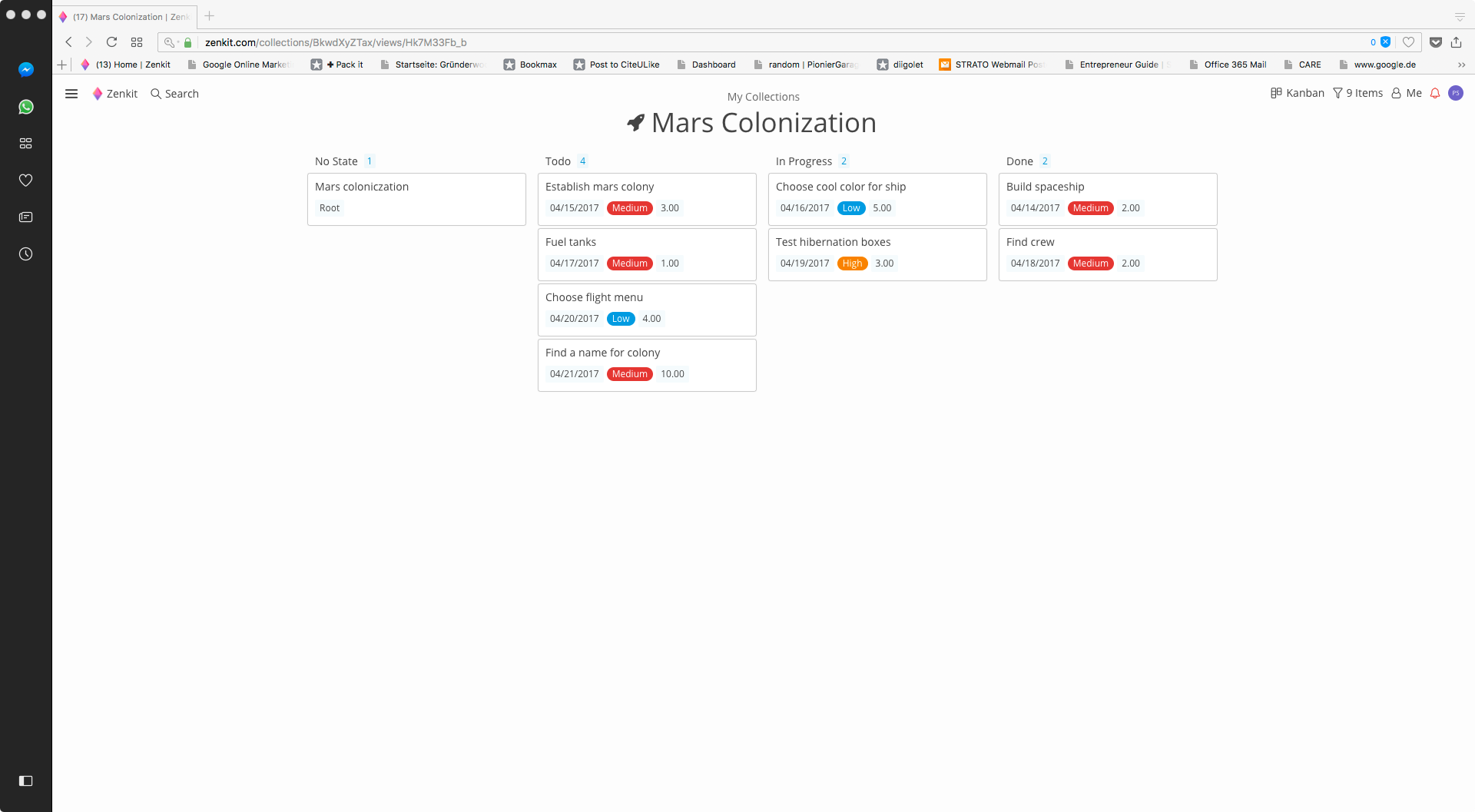
Zenkit is a collaborative SaaS platform for project management, database building and more. This solution enables users to follow their data through its entire lifecycle. Zenkit allows users to manage their data in any way they need to – build their own CRM, reporting system, or financial planner. Users can share their data and assign tasks to colleagues.
$9
per user
Pricing
Quickbase
Zenkit
Editions & Modules
Enterprise
Full Customizable
per month/billed annually
Business
Starting at $2,200
per month
Team
Started at $700
per month
Plus
$9.00
per user
Business
$29.00
per user
Offerings
Pricing Offerings
Quickbase
Zenkit
Free Trial
Yes
No
Free/Freemium Version
No
Yes
Premium Consulting/Integration Services
No
No
Entry-level Setup Fee
Optional
$9 per user
Additional Details
Quickbase offers three key plans, with feature distinction, simple and consistent entitlements, and a flexible licensing model, giving users the option of either user based or usage based licensing across all 3 plans.
Quickbase is pretty easy to use, user friendly and simple dashboard. Anyone can easily use Quickbase without any prior knowledge. This is efficient and fast performer. You can prioritize task easily . You can manage lifecycle of prospects effectively . Good reporting features …
Microsoft tools are functional but they are not necessarily created for scalability. As our contract scaled, we needed something that had the capability to consolidate data as well as handle more and more amounts of data and analysis. Quickbsae has also helped us stop working …
I picked Quickbase before investigating the low-code no-code market because I was so impressed. I did a pricing exercise a couple years ago because Quickbase was drastically increasing the cost and decreasing our allotments/features. We could have saved a lot of money by going …
Some will tell me they don't use Quickbase because they already have Excel. I always take that opportunity to explain how they're missing out by not converting that Excel sheet (which takes less than 1 minute to convert) into a Quickbase tool. The functionality that Quickbase …
Compare to excel Quickbase is having so many advanced features which help users to solve different scenarios of real time problem. excel can only store and sort the data according to our request. Pipelines, notifications, reports, charts, formulas, forms these are the advanced …
Quickbase stacks up against them because it's speed of delivery is not only important for development but also for true change and lifetime, which are remarkable tools.
Out of the box softwares come with out of the box assumptions that are difficult to mold your workflow to so companies generally adapt part of their workflow to how the software works and then when that fails revert to doing it outside of any system. Quickbase does the opposite …
Quickbase is highly flexible for application development. Other vendors also provide customization options, but Quickbase is preferred because it is more flexible and provides more custom options. Also, Quickbase is preferred because it is easier for data handling. Other …
We've looked at Microsoft Power Applications and use them where appropriate but its limited and they are not as agile or as clean looking as Quickbase and requires more build time to deliver similar outcomes.
Well, there's a plethora of low-code tools out on the marketplace and, you know, there's a reason that we've decided to partner with QuickBase because it has all the right balance of the ability to integrate with the ability for a citizen developer to create apps successfully. …
QuickBase is really the first product like itself that I've used. I mean, granted I lived and breathed in Excel in my past career, and being able to see what you do in Excel and bring it to life in a totally different aspect to an application in QuickBase is just taking it to a …
Depending on your use case, Todoist can be enough if you are just looking for a simple to-do-list. But if you are looking to manage larger-scale projects, with multiple departments scattered over different offices - then you need Zenkit. The flexibility allows you to tailor …
Zenkit is more flexible in managing your tasks in different views. Sometimes you just need a to-do list so Todoist would be fine, but with managing whole projects with design, content and other stuff, Zenkit gives us more options and flexibility.
As described before, Zenkit adds a lot more flexibility to the things the other applications can do. But this also means that there is no predefined structure which might be helpful for some people. Zenkit is working on that and is releasing some apps building on the core, so …
More team members were already using Asana, so I migrated over to that. It also has robust reminders setup on their software. Many of the capabilities are similar to Zenkit, but the preference (as a company) is for Asana, so I switched over to it. Zenkit has a nice GUI and Is …
I really like that it's simple, user-friendly, and flexible, because it helps me view my data. You can visualize and customize your tasks. It also has a mind-map view which can be very helpful for planning your project. With the integration with other services like Slack and …
In a previous review for Trello I said it was great, which it is. Zenkit, however, is Trello on steroids and previously only thing holding me back from moving totally to Zenkit was the fact they didn't have mobile apps. They now have a both Android & Iphone apps. So I will be …
Quickbase has proven that if it's in a spreadsheet, it really should be in Quickbase. One of my more recent achievements with the program was redesigning our current process for notifying management of something irregular. The old process had all the notification infrastructure built behind the scenes with only a handful of people knowing and understanding the process. The new process was able to clean up the behind-the-scenes and also provide an increased level of intuitiveness by allowing complete visibility and customization of notification recipients. This allows the initial notification to reach a select number of management individuals who can then decide whether or not it needs to be escalated, all while allowing the operations personnel to get back to work immediately. The biggest issue I've found with the program is the limitation of the user - I find that the biggest roadblock in my way is myself, as I am confident the program has the ability to accomplish what I need, but am I skilled enough to create it? This has helped me become very proficient in only one year of use and become more active in community engagement surrounding the program.
I like to manage tasks and projects with Zenkit. I can use the comment section to discuss specific tasks with my colleagues and can see the progress. If the project is large, it's sometimes hard to keep the overview in focus
Pipelines - being able to share them or have permissions based viewing capabilities
Table size limits are small for really large apps. While I agree that there needs to be a cap on the size, it would be nice to adjust it up when needed.
We are growing our user base and getting more out of this system. Quick Base will continue to grow with our company as more of our users become super users and are capable of developing new features and solutions. We're getting more and more interested from departments that are hearing of our successes.
Quick Base has done everything we have asked it to do and then some. Our original goal was to have one system for CRM that encompassed both the sales process and the customer management. We have gone w-a-y beyond that with analytics, project management, system bug logging, and historical effort reporting.
I gave it a 10, but it should be a 9.99. They do a nice job of keeping the application running. The application can drag a bit when you have thousands of users accessing the application concurrently. We experienced this with large scale implementations.
Some of our tables that hold over a million records are starting to perform poorly, with some summaries taking over 20 seconds to load. This may be an indication that it is best to archive old data when reaching large volumes like this.
If you utilize the community, the support is amazing. Unfortunately, I find their actual support system a bit underwhelming. They don't seem to have a great process for interacting directly with an issue and often sweep significant issues under the rug by categorizing them as "Enhancement" ideas or legacy items.
I am really satisfied with the support. You normally get a response in less than a day. Also there are a lot of video-tutorials for different features.
Quick Base already is having a separate portal of providing training to customers and it is very easy to use and updates as per the new features added in to the application
I was not directly involved with the initial account implementation, only a bystander. For the app I directly implemented for my department only, I wish I had know to create an app diagram first. I don't remember if that was suggested. I think that would be a great help tip tool when a new app is created, to have a page with a check list of what is needed or how to get started. If you are a regular app builder, then you can bypass it or have the ability to turn it off in the app settings.
I picked Quickbase before investigating the low-code no-code market because I was so impressed. I did a pricing exercise a couple years ago because Quickbase was drastically increasing the cost and decreasing our allotments/features. We could have saved a lot of money by going with another comparable solution. However, those companies didn't have the longevity and all of the features and functions that Quickbase had.
Depending on your use case, Todoist can be enough if you are just looking for a simple to-do-list. But if you are looking to manage larger-scale projects, with multiple departments scattered over different offices - then you need Zenkit. The flexibility allows you to tailor your workspace to your needs for every project, and the simple usability makes it possible to use by people from every department.
While the purpose of this product is to provide flexibility and scalability to and organization, it is not as easy to roll out on the enterprise level. The support from Quick Base is not on a level that it makes the process easy and fluid. Be prepared to spend more time on this product than you might want to.
Quickbase has saved us so much time by reducing the clicks you need to get from one place to another. It takes the average colleague 5 or 6 clicks to get to another tool they need to do their job whereas it takes me 1 or 2 clicks to get to that same tool by using a personal Quickbase dashboard that has all the tools I need all on one page. This is a huge timesaver, especially when desk sharing where you have to get quickly to the info you want to share.
Quickbase has helped us streamline workflows and close gaps by having to ask for info only 1 time. Since users can't save a form until they've provided all the info you need on your end to complete a task, it saves a tremendous amount of time for everyone. No more replying to emails 2 or 3 times until you get the info you need.