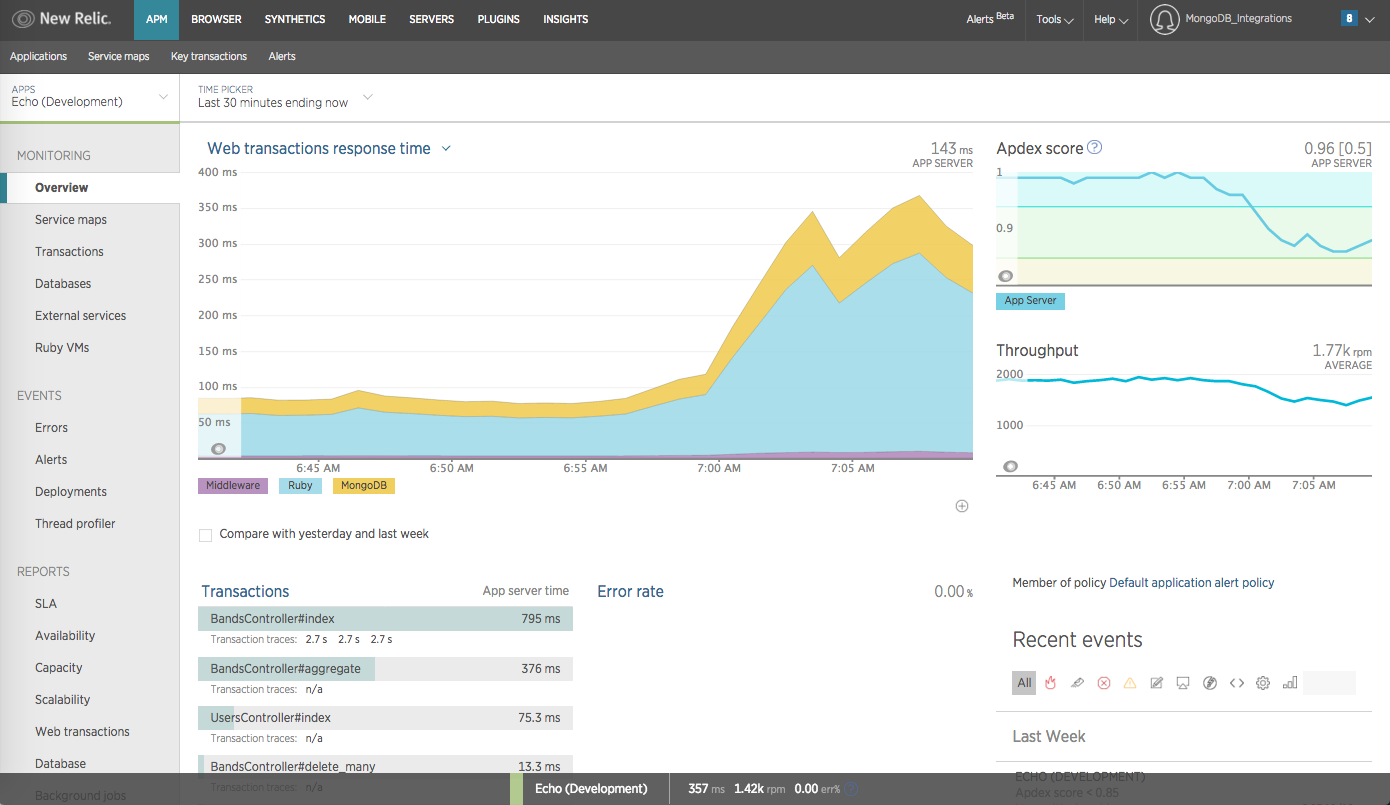
MongoDB is an open source document-oriented database system. It is part of the NoSQL family of database systems. Instead of storing data in tables as is done in a "classical" relational database, MongoDB stores structured data as JSON-like documents with dynamic schemas (MongoDB calls the format BSON), making the integration of data in certain types of applications easier and faster.
$0
per month
RavenDB
Score 8.1 out of 10
N/A
RavenDB is a NoSQL Document Database that is fully transactional (ACID) across the database and throughout clusters. The database minimizes the need for third party addons, tools, or support to boost developer productivity and get projects into production fast. Users can setup and secure a data cluster deploy in the cloud, on-premise or in a hybrid environment. RavenDB offers a Database as a Service solution, allowing users to pass on all…
N/A
Pricing
MongoDB
RavenDB
Editions & Modules
Shared
$0
per month
Serverless
$0.10million reads
million reads
Dedicated
$57
per month
No answers on this topic
Offerings
Pricing Offerings
MongoDB
RavenDB
Free Trial
Yes
Yes
Free/Freemium Version
Yes
Yes
Premium Consulting/Integration Services
No
No
Entry-level Setup Fee
No setup fee
No setup fee
Additional Details
Fully managed, global cloud database on AWS, Azure, and GCP
The environment I work in is somewhat unique in that we use both MySQL and MongoDB. However, each is used for specific purposes that the other is not well suited for. MongoDB is not a relational database like MySQL, so it serves as the perfect place to dump key bits of data for …
We have [measured] the speed in reading/write operations in high load and finally select the winner = MongoDBWe have [not] too much data but in case there will be 10 [times] more we need Cassandra. Cassandra's storage engine provides constant-time writes no matter how big your …
Both Couchbase and MongoDB are document-oriented NoSQL databases, so they have very similar features. While they do have some fundamental differences in terms of how they scale, shard, etc. the one key reason why we went with MongoDB is its availability and support from the …
The flexible structure underlying MongoDB's construction is not found in other competitors; the ability to easily change the structure without affecting other stored documents. It is very ideal for projects that you cannot predict that the structure will change this way. Of …
Implementing new features for application becomes simpler with MongoDB since you don't need to run database migration scripts just to for example add new fields to database only to store some extra data. This is especially good for the deployment phase. Only new version of …
MongoDB is a robust and scalable db which offers a lot of cool features out of the box. Being open sourced and backed by a great community with developer tools like mongo compass , it was a no-brainer to go for it. It has connectors in almost all programming languages and is a …
I would say Cassandra is better than MongoDB since it has the backing of Facebook to it. Its inherent properties like versioning put it into the other category of columnar databases, but it's one of the NoSQL databases which you should definitely consider for your organization …
This tool is only capable of reading real-time data very smoothly. The transition was also pretty easy and quick. Syntax is also very easy and comfortable to learn and use.
The main reason for selecting is that it works very fast under the Intellijet module environment and we …
In our early development days we weighed NoSQL databases like MongoDB with RDBMS solutions like MySQL. We were more familiar with MySQL from past experience but also were wary of painful data migrations that slowed down development iterations and increased the risk of outages …
Snowflake and Redshift are much more mature and have been around longer. MongoDB is definitely much less expensive and if you are in a startup, this is an almost for-sure option. Redshift can be slow and Mongo is much faster. However, losing the relational database aspect could …
It's very fast and easiest to use. Many companies are using this nowadays. It's helped to complete many software products very quickly so the year income has increased compared with last years. Many programmers are now leaning this tool as back end developers so that we changed …
MongoDB is our go-to database solution for any project, and the more we work with it the more we love it. Some say that NoSQL is pointless... Our developers wholeheartedly disagree, because they love working with it. Though both NoSQL and SQL have their purposes, in most …
Your default choice should not be MongoDB in my opinion. Most user-facing systems are relational by nature so a well known and reliable SQL database would be easier to maintain and simpler to develop long term. If you highly value speed of development go with firebase. If you …
It does not belong to certain cloud platforms. MongoDB is an independent program that works with any cloud platform including Amazon Web Services and the Google Cloud Platform. For companies who want to maintain a cloud agnostic structure, MongoDB is a great choice for NoSQL …
MongoDB and Cassandra are both database system from the NoSQL family. MongoDB can be used in lots of use cases while Cassandra has a specific usage. There are some features that MongoDB provides efficiently while Cassandra doesn't and vice-versa. Like, you can update the data …
We tend to choose MongoDB when we're faced with a particular situation: we know that we need a NoSQL database in general, and want an open-source implementation that allows us to prevent against platform lock-in. Amazon's new DocumentDB product even allows us to choose to use …
First of all, Microsoft Access is also a powerful, efficient, and free database. But the feel of it, I mean the GUI is not all great for me. It is very eye-stressing. MongoDB is also a good database, it too is efficient, productive, and powerful. But, upon this, RavenDB is a …
The team is very nice, very helpful, and answer very fast to any answer you may have. Thanks to their help, we were able to use and understand all the RavenDB features in no time! Documentation for server and client is very clear, with a lot of use cases. Maintenance is easy, …
RavenDB is just smarter than the competitors. The mapping reduction sorting is head and shoulders above everything else I've used. Nothing really approaches comparable in terms of complexity. Because of the searching of predetermined categories, read efficiency is terrible. …
The company needed a cache server that was closest and the most accessible, which is why we are currently experimenting with RavenDB which gives us the option to set up our hub in a local setting.
Much better support, more transparent pricing, much more easy setup process, native integration into c# / net core. We also tried to set up a Mongo Atlas cluster by self-study but weren't able to get this running. There is a much better response when searching in google, but a …
While MongoDB is in general more popular, I cannot fathom why that is. If you want ACID support (and as a developer, you'll always want that), MongoDB is way slower when compared to RavenDB. Furthermore, RavenStudio is just integrated, while
[RavenDB is] just simply much cleverer than the competition. The map reduce indexing is a league above anything else I have used. Nothing else comes close on abstraction as well. Read performance is terrifying due to querying pre calculated indexes. It is just a pity it is not …
Having ACID compliance is a big enough reason to choose RavenDB over the other products. You don't have to worry about losing your data if the plug is pulled. You're able to perform many actions within a transaction and not worry about your data being in a bad state if the …
Installing and configuring. We had some big issues with indexing the data after the documents were created and wanted to expand the index, with millions of records this task mostly did not complete despite a dedicated server.
Out of the many variants of document and SQL databases out there that we have used, RavenDB is our no 1 choice for anything but the smallest projects which can be served with a very small SQL instance. Other than that, RavenDB packs more features and is easier to work with than …
The given alternatives are also powerful and really good noSQL databases but the highest availability of RavenDB allows me/us to know it a lot better. RavenDB is encrypted by default wherever we use it in production and it has a high level of documents compression.
As I have said before in the previous questions ... RavenDB has a very simple clean UI, but stacks up in its power. Though new to me, I have found it to be much easier to learn and use than my previous database - Microsoft SQL Server. RavenDB's simple design and meaningful …
Being that ACID and cluster transaction support is a big plus against all of them. Cool prices on Azure and AWS is another plus. The ability to search between millions of documents.
When I first started using RavenDB, I did evaluate Mongo DB but found it to be lacking. The primary issue was that Mongo DB did not support atomic consistency for the persistence of multiple documents at the same time, although I think this may not be an issue with subsequent …
Once I had got my head around the concept of a document database it was a happy bye-bye to SQL Server. Firebird - far too fiddly - I found myself writing a silly API to sit on top of Firebird just to do the most basic things. MongoDb - in the very short time I spent with it, it …
We chose Raven over Mongo because it has robust support for multi-document transactions, first-class .NET and LINQ support, a well-designed API that has inspired imitation and has better tooling out of the box. We chose Raven over Redis because Raven is a full persistent …
MongoDB [is] great at storing JSON data grouped into "collections". In this format, you can store any JSON documents and conveniently categorize them by collections. The JSON document contained in MongoDB is called binary JSON or BSON and, like any other document in this format, is unstructured. Therefore, unlike traditional DBMS, any kind of data can be stored in collections, and this flexibility is combined with the horizontal scalability of the database. It should be noted that MongoDB does not have links between documents and “collections” (this is partially compensated by the Database Reference - links in the DBMS, but this does not completely solve the problem). As a result, a situation arises in which there is a certain set of data that is not related to other information in the database, and there is no way to combine data from different documents. In SQL systems, this would be an elementary task.
RavenDB is very well suited for NoSQL beginners to start easily setting up and using a NoSQL database. Also to set up a high performance and high availability cluster is possible without reading tons of documentation. Very straightforward assistant! The performance is really high.
Easy to learn. When I picked up MongoDB for the first time, I had little background in database management or modeling. If you have a background in javascript (and JSON)... then you can figure out how to use MongoDB pretty fast.
Fast performance.
It's relatively easy to set up in certain environments because there are lots of ready-made solutions out there.
There's a lot of support in the existing ecosystem for it —, especially in the node.js realm.
Query syntax is pretty simple to grasp and utilize.
Aggregate functions are powerful.
Scaling options.
Documentation is quite good and versioned for each release.
MongoDB is one of the most famous non-relational databases in the world, there are famous active projects that use this database. I think that the same company that develops the database gives you the online induction totally free is something that really is very positive. Accounts with a first-class support to be able to relate the correct implementation of the database, in addition to teaching you the best practices to optimize your projects, I believe that with this decision it is more than obvious which is the best decision at the time of seeing with which database to work.
We've had an excellent experience using RavenDB. Internally we are testing the newer features in 5.0 such as time series, which will effect the con specified previously dependent on the real world performance. We foresee that BattleCrate will continue to use RavenDB as we grow.
It is one of the reasons why we prefer it to store documents in a JSON-style format, to access the desired document very quickly regardless of its size, to be readable by human eyes, and to be easily scalable and manageable.
Really good .NET client that is very easy to use. The management studio is excellent and puts anything that Microsoft or Oracle have to shame. Very quick to develop with once the complexity hurdle has been overcome. Initially using it can be a bit painful until you fully grasp the event sourced nature of the indexing.
I have reached multiple times to the MongoDB community for the help and they have provided each and easy solution for every problem. Over the internet and on stack overflow many people responds over the challenges. Now this tool is very much used in every company and projects so internally many people are there to give a support.
Had a question that was answered in minutes. Never used a NoSQL approach before, but was able to be proficient in a matter of hours. Easy to read API Documentation. 5 out 5 support in book, I have never once ran into an issue that wasn't quickly solved by either their support team or myself doing a quick search online.
While the setup and configuration of MongoDB is pretty straight forward, having a vendor that performs automatic backups and scales the cluster automatically is very convenient. If you do not have a system administrator or DBA familiar with MongoDB on hand, it's a very good idea to use a 3rd party vendor that specializes in MongoDB hosting. The value is very well worth it over hosting it yourself since the cost is often reasonable among providers.
The environment I work in is somewhat unique in that we use both MySQL and MongoDB. However, each is used for specific purposes that the other is not well suited for. MongoDB is not a relational database like MySQL, so it serves as the perfect place to dump key bits of data for quick retrieval later. This is something we can't easily do with MySQL. On this smaller database, MongoDB also lets us retrieve data more quickly with its fast and efficient querying.
RavenDB is just smarter than the competitors. The mapping reduction sorting is head and shoulders above everything else I've used. Nothing really approaches comparable in terms of complexity. Because of the searching of predetermined categories, read efficiency is terrible. RavenDB is a storage system designed for the current websites and functional prototypes. It has an easy-to-use interface and enables quick replication and backup installation. Furthermore, technical assistance responds quickly and walks you through the implementation and deployment procedures.
We can make more open and flexible systems due to its easy adaptation to new evolutions in web applications.
In the latest versions it offers support for different transactions and we could carry out real tests related to the concurrency of the application.
MongoDB allows you to have distributed clusters, which improves the speed of the queries by reducing the latency that exists between the database cluster and the service that executes the query.
RavenDB has saved my customers a lot of money with their cloud services' tiered model. The database is able to grow with the project/company and can start out small at a low cost.
RavenDB is free for three nodes and three CPUs, which makes it great for development scenarios. You're able to start rapidly building applications without having to worry about licensing.
Scaling out has allowed us to use three small cloud servers when starting out and get the performance and throughput of a single larger server.