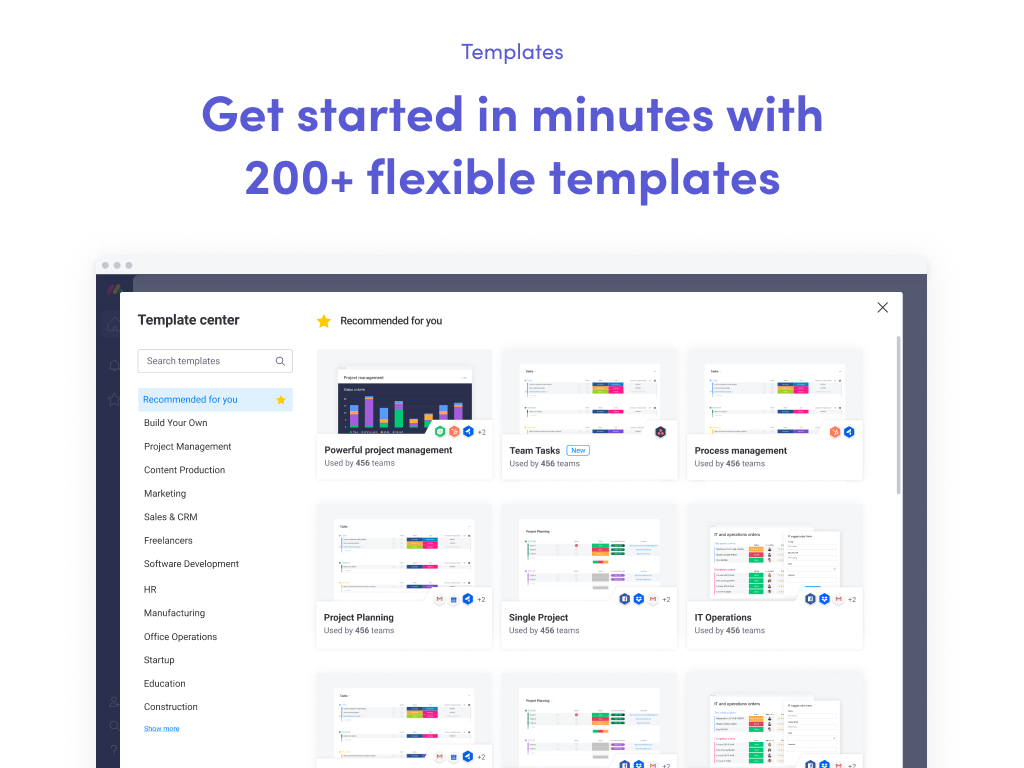
monday.com Work OS is an open platform designed so that anyone can create the tools they need to run all aspects of their work. It includes ready-made templates or the ability to customize any work solution ranging from sales pipelines to marketing campaigns, CRMs, and project tracking.
$12
per month per user
Rocketlane
Score 9.7 out of 10
N/A
As per the information provided by the vendor, Rocketlane is
a platform specifically designed to cater to onboarding, implementation, and
professional services teams. The primary objective of this platform is to
enhance collaboration with customers, optimize project delivery efficiency, and
augment customer experience and accountability. Its target audience primarily
includes industries such as CS (Customer Success) and Professional Services. It
emphasizes its capability to expedite time-to…
N/A
Pricing
monday.com
Rocketlane
Editions & Modules
Basic
$12
per month per user
Standard
$14
per month per user
Pro
$24
per month per user
Enterprise
Contact Sales
Contact us
No answers on this topic
Offerings
Pricing Offerings
monday.com
Rocketlane
Free Trial
Yes
Yes
Free/Freemium Version
Yes
No
Premium Consulting/Integration Services
No
No
Entry-level Setup Fee
No setup fee
No setup fee
Additional Details
Yearly plan: Save 18%
Monthly plan also available
—
More Pricing Information
Community Pulse
monday.com
Rocketlane
Considered Both Products
monday.com
Verified User
Anonymous
Chose monday.com
It's been a while since trying Asana, so it's hard to say. I think they are very similar from what I remember, but maybe monday.com has more reporting and customization possibilities?

monday.com offer much of the standard tools and seems to be ever evolving. They seem to take feedback and constantly upgrade the tools. If all the tools are there, the differentiating factor might be the cost, any integrations you may need, and the visual "chemistry". To me, …
We chose to move from Zoho to monday.com when our company started growing exponentially. Overall, our team was thankful for the change because we were growing at far to fast of a speed for Zoho's tools to keep up with us. monday.com is a better, beefier platform with far better …
We decided to go with monday.com because they offered a free tier for nonprofits and because they are easier to use and offered additional features that we could not find on the other choices. Hands down, there was no better choice for us than monday.com.
When I arrived at my org, I was initially disappointed to hear that we used something other than Asana for project management. Fast forward just a few months, and I became a complete monday.com convert. While its organization is similar to Asana's, it's user interface, …
I would say this is one of my least favorite applications. I don't find it super user friendly due to the extreme amounts of customization. It feels like my information is in there somewhere, but I can never find it easily. I think that it looks a lot prettier than asana which …
monday.com seems to solve the issues and concerns for our marketing and graphics needs. I personally use Asana for my projects and tracking purposes and monday.com for my interations with Marketing and their needs.
monday.com is much easier to use and offers all the tools of google suite in one spot for task management. I use gsuite services still but in an entirely different way. If there is something that needs to be shared with the team or is important that I will need to refer back to …
Monday.com is the broadest scope work management software I have used. Its interface is basic and takes some getting used to, but the programming options are highly advanced and extremely effective.
I also use the other selected. But I prefer monday.com because it is more clear (visually and intuitively), and also because I have been using it for longer than the others. However, there is the price factor that must be taken into consideration
Monday.com is far more intuitive than Salesforce with it's automation features, lists are better and customizable and it makes things easier for everyone on the team.
Salesforces is a great CRM system but I feel as though it falls short as a collaborative project management …
As a developer, I have utilized the mentioned apps to integrate processes for clients, and I have found monday.com to be superior due to its abundance of features compared to others. Choosing monday.com provides enough capabilities for teams and managers to handle work in one …
monday.com is a much better tool for keeping track of tasks and assignments than MS Planner. In most situations where we used MS Planner we have switched to using monday.com instead.
monday.com is so much easier to use & project-tracking is not only easy to do, but the visuals are far from complicated & make it that much easier to keep track of everything.
I feel monday.com is easier to use than the others listed. Specifically, I used to use Trello in the past and I really liked it. I even recommended others to use it but since working in monday.com, I found it has so many more features that meet our teams needs and we have found …
monday.com has the only interface that is 100% customizable, can use public and private boards, can be shared with customers, produce Gantt charts, and has THE MOST integrations "in house". The professional relationships that monday.com has established to be "on board" with …
I searched for some other alternatives like monday.com, and I also tried them. For example, I have experience with Sloneek. But monday.com just feels different. I think it beats the competition in every way. You can also use monday's free version, and it is still a good task …
I chose monday.com because of its flexibility and ability to adapt to our needs. Throughout our work, I've seen how it helps us increase productivity and efficiency, which solidified my decision.
The easy of use and configuration is where monday.com has had an advantage. The ability for all our users to startup on the platform has helped to incorporate it into our enterprise environment quickly.
Actually, monday.com and Trello, although they are digital board systems, are both very different from each other. Trello is a simpler system that, although its function is also the organization of tasks, its visual system gradually overwhelms the user by "piling up" each post …
monday.com is simpler and easier to grasp, apply and navigate than Clickup, but the Clickup free version has so much more functionality available than the monday.com free / low-cost options (sorry, but it's true!). Google tasks is really simple and I shouldn't really compare …
Rocketlane is more robust for onboarding than monday.com with better customer interface. However, Rocketlane does not have some of the advanced features of ChurnZero or GUIDEcx. However, Rocketlane's pricing is aligned well with the features they offer.
The older one was no as good as Rocketlane because the User interface and UI are most important to use any software for the end user. Because more easy to understand, and easier to adapt the software. Thanks, Rocketplane I really like rocketplane because of its features and …
Rocketlane was extremely easy to stand up and get running. Both our internal teams and customers have been fans of the process so far. We had our first projects set up, with our Salesforce sync and white-labeled branding all live within the first week.
For our specific needs, Rocketlane fits the bill perfectly. It had just the right amount of features without it being overly complicated to teach the client. The pricing also worked out well: just pay monthly licenses per user.
Here, I will suggest that it is best to create employees, clients, or project reports. Easy to track with the dashboards. I did many integrations and developments. I can not list each of them here. I will say the best tool for management. I couldn't see criteria of unsuitable. But yes It will depend on the client's requirements. I will suggest it as very user-friendly tool for CEOs, CTOs, Managers, and company owners also for team.
There is project management tracking from the start till the end (onboarding till hypercare). The bifurcation of project stages and pre-built templates is good; you can assign client tasks. Less appropriate: Raising tickets for developers because there is no escalation management option. Let’s say the developer didn’t reply in 24 hours for a high-priority task; this should be automatically escalated to their senior.
Status updates can be published, which can be seen by external stakeholders/clients even though they are not on Rocketlane or they have not taken Rocketlane subscriptions.
Timesheets can be easily tracked through which resource utilization can be planned.
Ensuring I have set up a Private board vs public board is not clear - it would be useful to have an additional alert when creating a board as I work with sensitive information. It will eventually be used in a team based environment but while I test the boards, they needs to be private.
Time tracking is clumsy, could be easier to record
Teams involved in content creation, such as marketing or editorial teams, could use monday.com to manage the entire content lifecycle. Boards might track content ideas, assignments, drafts, reviews, approvals, and publication schedules, helping teams collaborate and keep content production on track.
It's straightforward to use and simple to understand. They have tutorials on different elements of the system that you can learn. The workflow there is very intuitive, drag and drop, which doesn't require a learning curve for most people. Templates that also make things more accessible can be found.
Everything performs fairly well. Every now and then there are user errors where an employee will not click "ok" on a note they've created and simply exit out (I do wish that something was in place to prevent this, such as a pop "are you finished?")
monday.com only really care about accounts that have 20 seats or more. While this is great for monday.com, it pushes smaller organisations to evaluate alternatives. We rate monday.com highly in our organisation because key staff have already got good experience with the application and we know we will get to 20+ seats one day. But, till then the billing model and lack of permanent enterprise features is a dread.
To have someone walk you thru the features and capabilities of Monday.com is priceless. Someone also coming along later in the contract to see if you are maximizing the program to suit your company needs is beyond helpful. The staff that have provided this training are fun, creative and very patient.
We signed up for the accounts. Created the accounts. Ran the trial version and tested it live while we were running multiple projects and found that it was fitting our needs perfectly. When the trial ended and we were asked to purchase the full version, we did. We have found other ways to use it and it's a breeze.
We decided to go with monday.com because they offered a free tier for nonprofits and because they are easier to use and offered additional features that we could not find on the other choices. Hands down, there was no better choice for us than monday.com.
For it to work across multiple departments and sites, I would like to see improvements made with integrations and automation. For this question, I am acknowledging not only the addition of internal triggers/automation, but also an expansion on external ones.
By using monday.com as an enablement tool for templated onboarding plans, we have been able to begin calculating the number of manager hours saved through our work (not defined yet).
monday.com's reporting tools also allow us to more easily report on the productivity and output of our team since we keep up with all projects and subitems in monday.com.
As an admin and end-user, Rocketlane has saved me at least four hours of work every week. Multiply that across the entire team, and we're saving two full days of work by removing all the manual tasks.