
Oscar Fernandez
ABM Specialist
Chose Salesforce CRM Analytics
It is better to the integration with all our existing systems, despite of the higher cost if you compare it with the others

| Product | Rating | Most Used By | Product Summary | Starting Price |
|---|---|---|---|---|
 Salesforce CRM Analytics | N/A | Salesforce CRM Analytics (formerly Tableau CRM) is a cloud-based business intelligence solutions and analytics software. It provides users with automated data discovery, CRM-connected analytics, top-down views of data, augmented analytics, predictive insights, and customizable data visualization tools. | N/A | |
 SAS Visual Analytics | Enterprise companies (1,001+ employees) | SAS Visual Analytics provides a complete platform for analytics visualization, enabling users to identify patterns and relationships in data that weren't initially evident. Interactive, self-service BI and reporting capabilities are combined with out-of-the-box advanced analytics so everyone can discover insights from any size and type of data, including text. | N/A |
| Salesforce CRM Analytics | SAS Visual Analytics | |||||||||||||||
|---|---|---|---|---|---|---|---|---|---|---|---|---|---|---|---|---|
| Editions & Modules | No answers on this topic |
| ||||||||||||||
| Offerings |
| |||||||||||||||
| Entry-level Setup Fee | No setup fee | No setup fee | ||||||||||||||
| Additional Details | — | SAS Visual Statistics and SAS Office Analytics are also available as add-ons. | ||||||||||||||
| More Pricing Information | ||||||||||||||||
| Salesforce CRM Analytics | SAS Visual Analytics | |
|---|---|---|
| Considered Both Products | Salesforce CRM Analytics Oscar Fernandez ABM Specialist Chose Salesforce CRM Analytics It is better to the integration with all our existing systems, despite of the higher cost if you compare it with the others  Punnareddy Pallerla Sr Software Engineer Chose Salesforce CRM Analytics Salesforce is having the positive as it has inbuilt other modules where they have their own data but other tools have to get the data from other systems  Shreya Sharma Advertising - Data Analyst Chose Salesforce CRM Analytics Compare to other solutions Tableau CRM provides more attractive GUI and interactive dashboards. Cost and integration are still a challenge as It cost around $150 per user license cost.  Shiv Shrotriya datawarehousing/BI developer Chose Salesforce CRM Analytics Tableau CRM no doubt has best GUI compare to any other existing BI tools we are currently working on. We are already using Salesforce as a CRM tool for sales/services/marketing and Tableau CRM has easy connectivity and development with Salesforce data. After demo the sample …  Tony Phan Tactical Procurement Specialist (Vietnam & APAC Support) - Source To Procure Team Chose Salesforce CRM Analytics Before this our company have been using lots of other tracking tools but mostly it is very manual when it comes to generating reporting view which is resolved when using Salesforce Einstein Analytics since reporting feature is automated. Tons of time have been saved from …  Shefali Sethia Consultant Chose Salesforce CRM Analytics [Salesforce Einstein Analytics (formerly Wave Analytics)] is far far better than these alternatives as everything can be done on single platform from data extraction to data transformation. Sharing of data is very easy and secure. One dashboard is suitable for different users …  Chike Igwegbe Founder Chose Salesforce CRM Analytics The collaboration feature is second to none, and the way we can assess our business in real-time is really nifty!  Duncan Hernandez Product Owner, Business Intelligence Chose Salesforce CRM Analytics Tableau is more of a developer tool and for non-technical workers, it is hard to learn. The product is superior to Einstein Analytics, but if the first goal is to get this out to an entire company, then Salesforce is the way to go. For the technical workers, the limitations of …  David McCoy Provisioning Engineer Chose Salesforce CRM Analytics Our company chose it while trying to use other analytics software. The team all agree that this is a very good product and that it deserves to be put up against all others. Managers were very happy with the way it helped promote the sales team to better themselves. Highly …  MEGAN BOATWRIGHT Customer Care Representative II Chose Salesforce CRM Analytics I have not used any other products.  Viswam Srinivasan Salesforce Application Development Assoc Manager Chose Salesforce CRM Analytics The reason is that this requires less development and is more of a point and click system that every user will enjoy more.  Pedram Mizani, MD, MHSA Chief Clinical Officer Chose Salesforce CRM Analytics Very strong, but again once you’re tied into Salesforce, you’re quite stuck so begin learning how to optimize its use personally very quickly. Otherwise, you’ll be depending on very expensive consultants who don’t always have your best interest in mind. | SAS Visual Analytics  Raman Ahuja Associate Consultant Chose SAS Visual Analytics Visual Studio IDE  Tapan Jain Data Analyst Chose SAS Visual Analytics Tableau Desktop  Mike Narumiya Director, Data and Information Systems Chose SAS Visual Analytics Price and features we looked at seemed consistent. We chose this product because our staff already knew the product, plus users at the state had recommended it as it is what they use.  suva sahu Project Lead Chose SAS Visual Analytics SAS visual analytics has high sped LASR servers mounted on Hadoop filesystems which makes it more powrful for analytics.  Alex Rubin Sr. SAS Programmer (consultant) Chose SAS Visual Analytics Never used or evaluated other similar products  Erik Larsen Consultant SAS Business Intelligence Architect and Analyst Chose SAS Visual Analytics There is no contest. SAS is easier maintain and has much more in the way of analytics than MicroStrategy has. It can pull from more than one data source and when the underlying architecture changes, it is much easier to maintain. More savvy analysts can perform more with SAS … |
| Salesforce CRM Analytics | SAS Visual Analytics | |||||||||||||||||||||
|---|---|---|---|---|---|---|---|---|---|---|---|---|---|---|---|---|---|---|---|---|---|---|
| BI Standard Reporting |
| |||||||||||||||||||||
| Ad-hoc Reporting |
| |||||||||||||||||||||
| Report Output and Scheduling |
| |||||||||||||||||||||
| Data Discovery and Visualization |
| |||||||||||||||||||||
| Access Control and Security |
| |||||||||||||||||||||
| Mobile Capabilities |
| |||||||||||||||||||||
| Application Program Interfaces (APIs) / Embedding |
|
| Salesforce CRM Analytics | SAS Visual Analytics | |
|---|---|---|
| Small Businesses |  BrightGauge Score 9.1 out of 10 | BrightGauge Score 9.1 out of 10 |
| Medium-sized Companies |  Reveal Score 10.0 out of 10 | Reveal Score 10.0 out of 10 |
| Enterprises |  Kyvos Semantic Intelligence Layer Score 9.9 out of 10 | Kyvos Semantic Intelligence Layer Score 9.9 out of 10 |
| All Alternatives | View all alternatives | View all alternatives |
| Salesforce CRM Analytics | SAS Visual Analytics | |
|---|---|---|
| Likelihood to Recommend | 7.0 (0 ratings) | 9.0 (0 ratings) |
| Likelihood to Renew | - (0 ratings) | 9.3 (0 ratings) |
| Usability | 7.7 (0 ratings) | 6.0 (0 ratings) |
| Support Rating | 7.7 (0 ratings) | 8.0 (0 ratings) |
| Implementation Rating | 6.0 (0 ratings) | - (0 ratings) |
| Salesforce CRM Analytics | SAS Visual Analytics | |
|---|---|---|
| Likelihood to Recommend |
|
Raman Ahuja Associate Consultant |
| Pros |
Shefali Sethia Consultant |
Tapan Jain Data Analyst |
| Cons |
|
|
| Likelihood to Renew | No answers on this topic |
Erik Larsen Consultant SAS Business Intelligence Architect and Analyst |
| Usability |
Tony Phan Tactical Procurement Specialist (Vietnam & APAC Support) - Source To Procure Team |
Raman Ahuja Associate Consultant |
| Support Rating |
|
 Nicole Jagusztyn Institutional Research Officer |
| Implementation Rating |
| No answers on this topic |
| Alternatives Considered |
|
|
| Return on Investment |
|
suva sahu Project Lead |
| ScreenShots | SAS Visual Analytics Screenshots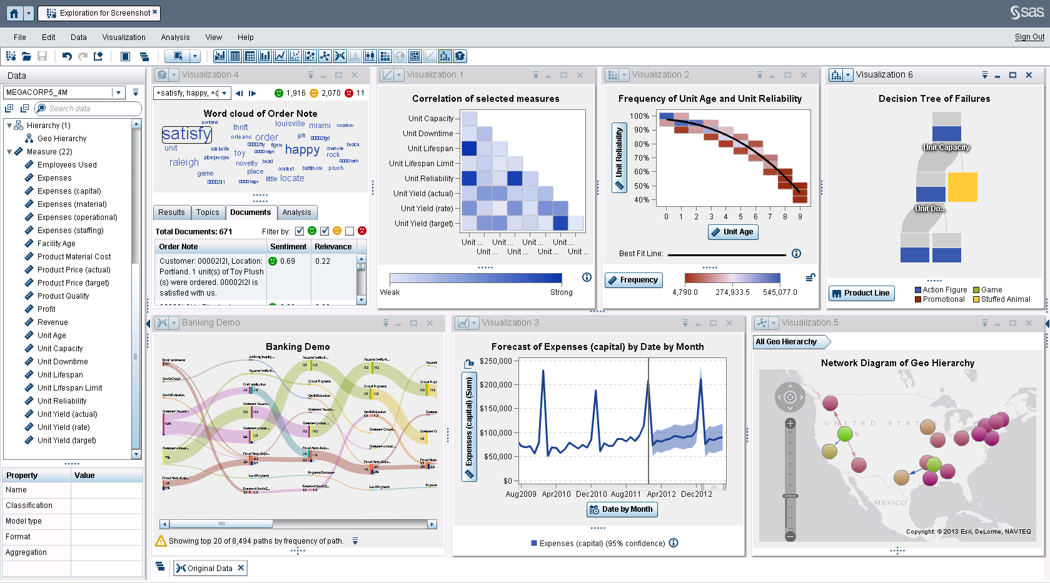 |