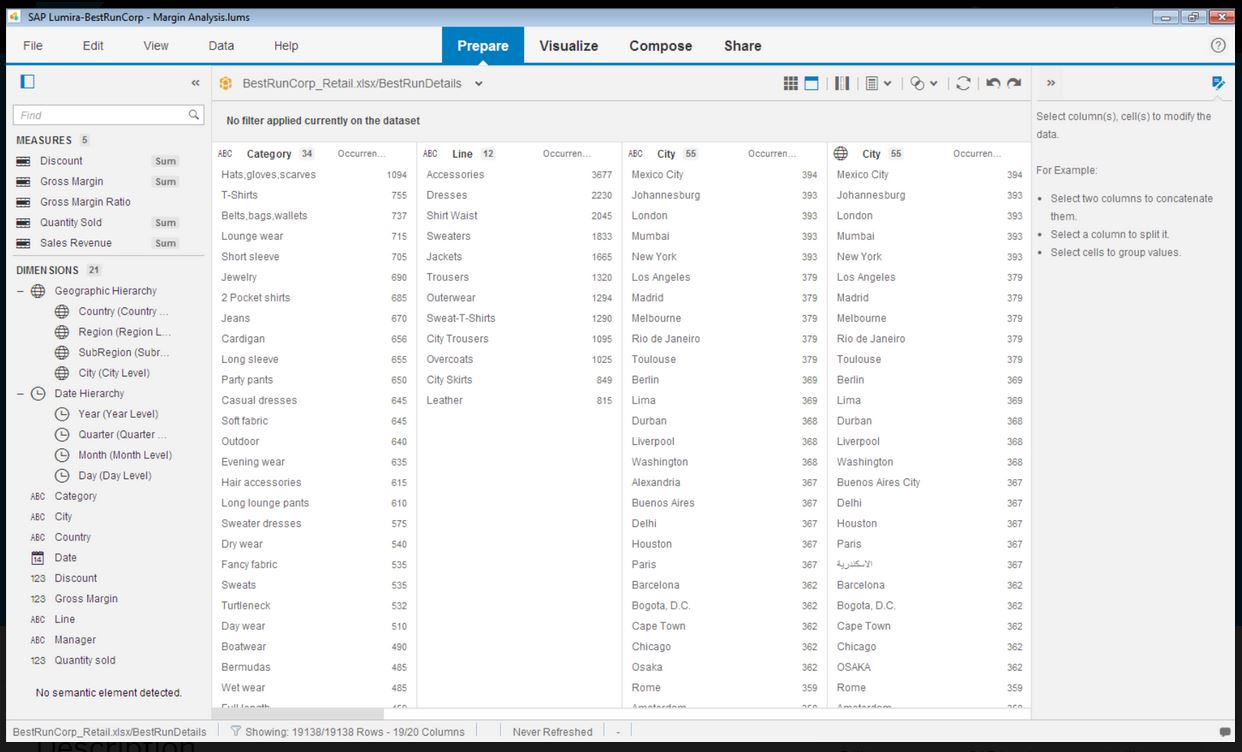
SAP Lumira Discovery is SAP’s data visualization and discovery application. It facilitates data discovery, visualization, and analysis by assisting users with creation of dashboards, infographics, presentations, data facets, tag clouds, and more.
$185
per user
Sigma
Score 9.1 out of 10
N/A
Sigma Computing headquartered in San Francisco provides a suite of data services such as code free data modeling, data search and explorating, and related BI and data visualization services.
I have evaluated products such a Tableau Desktop and Splunk and the biggest difference I realized was the ability to include interactive controls in the output. For instance if I wanted to include the ability to filter by a category or filter by a date range, the controls can …
SAP Analytical Cloud is more advanced and go to product from SAP side and thus the use case identification and the need of the organization need to be looked into, before deciding the product. The performance of SAP SAC is also better than SAP Lumira, and SAP SAC is used for …
Even though SAP Analytics Cloud is considered to be better in aspects such as data connectivity or analytics, we decided to choose Lumira as it was easier to understand, learn and use. As our business is not really that big and does not require the inclusion of large amounts of …
Much better. Quicker and easier to update. Better connectivity and able to share and collaborate. The ability to connect data puts it a step above the others.
SAP Analytics Cloud is better than SAP Lumira Discovery in so many ways starting from data connectivity, modelling, self- service analytics, complex applications, planning to Augmented Analytics. When there are policy restrictions, then without much choice, users can go for …
I stack up against 360 dialog Whatsapp Business API tools as it has very weak internet connection and it cannot store data and sometimes in WhattsApp BI tools the searching, connecting, acquiring, and merging data is becoming difficult. I choose SAP Lumiera Discovery as the …
The way it works with other SAP apps is a great factor which tilts the pointer in favor of SAP LD. By that I mean ability to import data from places like SAP HANA, BW, BO Universe, etc. provides a flexible way to cleanup and prepare data for analysis easily and quickly. The …
Lumira offered more in depth visualization for reporting and presentation, this tool took some time to learn the ins and outs to but after training this was a pretty straightforward data display software tool that was very helpful showing data searched and narrowed down to …
Normally uses around the world have suggested using SAP Lumia rather using others. It gives life to your data presenting in a beautiful way. This tool enables companies to benefit from their data using advanced visualization and unique analytic functionalities. SAP Lumia can be …
1. SAP Lumira doesn't need an expert on data analytics. It does all the hard work for you. 2. Cost effective and can be implemented with little technical effort. 3. Training costs are very minimum and the possibilities of returns are huge.
Lumira is the worst. If you are a total SAP shop you might prefer to use WebI, BeX, or even Crystal Reports/Dashboards before making the leap into Lumira. If you have the option and are already a MS 365 user, download PowerBI, it is cheaper, easier and more powerful.
None of the above mentioned tools have good SAP products connectivity. Most of the medium and Large organizations usually run large-scale SAP deployments.
SAP Lumira is mainly for non technical persons. When one is not into much data and doesn't want to dig dip into data models and algorithms, it is very handy. But, if you are dealing with lots of data with huge variety and volume you should consider the alternatives, as the …
Compared with the built-in Cloud for Customer reporting suite, Lumira was quicker at processing figures and provides a greater range of reporting visualisations, as well as being much more user friendly for non-technical end users to pick up and use with minimal direction. …
we choose SAP Lumira because comes from SAP and we trust in the quality of their products, also we saw a very potetial tool for out clients to explore their data and add value to their erp implementation
For a full featured SAP environment, Lumira is the suitable platform for a BW, Hana, ECC universe or third party DB universe sourced reporting compared to all of the other analytical platforms.
It has better visualization than the above-mentioned software. It is much easier to use SAP Lumira for quick data visualization without any hitches. We are confident in the product and it has never failed to deliver what we looked for. Our efficiency has increased 3 fold since …
In India, users are already using this product and have got adapted to it. It's tough because it is not as beneficial as Lumira, but to bring a change in an Indian company is hard to implement.
I am not an expert in any of these, though from my brief exposure to Looker it felt like a steeper learning curve, more appropriate to companies with dedicated and skilled BI engineers, whereas Sigma (and Tableau, and Looker Studio) offer a quicker and more intuitive interface …
Sigma Computing exclusively uses Snowflake as its data source, which enhances data security by not caching or extracting data locally. Tableau, on the other hand, allows a broader range of internal databases and files like SQL Server, Postgres, etc., and supports extracted …
maintianed is very user friendly. Its various ways of embedding helped us in various aspects. The usage of control ids of the filters as parameters helped us in optimizing very longSQL queries. The live Support team every weekday is a very great intiative that helped in quick …
I'd rate Sigma to be extremely similar to Sisense except it looks not as nice. I would say that as a tool, Sigma is more user-friendly than Tableau, Power BI, Trevor, and Metabase.
I do feel that Looker is far more powerful and looks great, but I also recognize that Looker does …
Sigma computing has better pricing than the competitors. We're always looking for what is good for the price but also gives us all we need to complete our reporting. It also brings about a lot of updates that are nice to see. The embedding helps other BI tools sometimes.
Sigma has a better view of tables and it is much easier to create new data sets/aggregations. Tableau is better in some visual aspects because there is more customization available, albeit more confusing than Sigma to do. Sigma is very intuitive and did not take long to learn …
Sigma Computing had better functionality and is beginner friendly. While Tableau is a more well known product, Sigma Computing has a better user interface that is easier to comprehend for those without a non-technical background. This makes it easier to showcase dashboards to …
Sigma is the easiest to use from a workbook developer perspective, and from a non-technical end user perspective. Everything from administration, semantic layer setup, to creating dashboards is easier in Sigma than these other tools. Developing content in Sigma is enjoyable, …
Sigma has the capabilities of the other BI tools. I think it's pretty user friendly and easy to learn. Many of our stakeholders are used to using Excel so it's nice that it is a smooth onboarding process for them. We haven't looked into much of the visualization capabilities so …
I have found that Tableau can be used to create a greater variety of custom and complex visuals, though these visuals are far more difficult to create in a quick turnaround. While Sigma may be more limited in terms of what types of visuals can be create or how customized they …
With Looker, to be effective, a substantial amount of coding & modeling needs to happen in LookML. Being another language to learn, users have to context switch again from at a minimum either SQL or Python into LookML. The concept of being able to source control, code review, …
Less visually appealing. Feels like fewer pixels. Harder to make graphs and visuals. Really good integration with snowflake and intuitive usage for custom equations and filters.
sorta in the middle. One thing that differs than domo or power bi, is that those softwares bring in the data into the platform, instead of how sigma runs a query against our data warehouse each time a user interacts with the dashboard (there is some small caching, so not always)
Sigma is by far the best. It is easiest to learn and easiest to use on a day to day basis. I never have to wait for dashboards to load and it's very easy to understand the variables that are going into my visualizations. Best of all I can manipulate the data within Sigma …
flexibility, works really well with snowflake, export capability, level of support, the fact that Sigma Computing is a start up and improving so quickly. Web based software
SAP Lumira helped to create intuitive and real-time dashboards in a story format to the organization. However with new capabilities of SAP, like SAP Analytics Cloud (SAC) providing more planning and analytical capabilities. Thus the identification of the use cases with the available products should be done. SAC is more integrated and the go to product in SAP roadmap.
Scenarios where Sigma Computing is well suited: - Data Reporting and Visualisation : It is suitable for dashboards that integrate data from multiple back-office systems - Search and Filtering Capabilities: It provides a robust platform for searching through datasets and visualisations. Scenarios where Sigma Computing is less appropriate: Handling of null values and dynamic table adjustments
Control over data import formatting - for example where amount and currency values are imported there is not enough control over the transformation and formatting and this has caused us data import difficulties where values read have been truncated due to punctuation in the amount fields.
The user interface is simplified, but the terminology and screen layout do not always make it obvious how to start the process for a new user - for example to add a new data source or create a new report.
Viewer level license is quite limited. These users can't download data or even add filters on datasets. Something to keep in mind.
Directly querying the underlying data warehouse will lead to increased usage. Not a big deal on something like Redshift, but your Snowflake consumption will increase, potentially by a lot.
Because we are very satisfied with the product and would most likely renew because of the services it provides. It is a tool that you bring into your organization and let it change the way you analyze your data, present your data and share you date within the Respective teams
It has good features, the data connectivity and merging is really good, and it has helped our IT team. Nevertheless, it can sometimes be hard to use and some of the features can be found outdated. As we don't have a lot of data, it is a decent tool for our data analytics, but I wouldn't recommend for bigger or more complex businesses with large amounts of data.
It has a clean and modern interface. However, it is not completely intuitive. I think it would be better and easier to navigate with more Windows style drop down menus and/or tabls. There is a significant learning curve, but that may be due in part to the technical nature of this type of software tool.
Lumira is a desktop application runs in its own JVM. It installs its own java runtime libraries to avoid any core java version conflicts. The availability of the application is completely relies on individual machine hardware configuration. On a decent desktop, it performs well and always launches in either 32 or 64 bit environment based on the hosts system's OS
The performance is linear with amount of data that is being explored. We have done some benchmarks acquiring 10million data cells without having any performance problems. We need to make proper adjustments to jvm run time properties to start with higher heap size and other parameters that optimizes the run time performance
It does not have many bugs or issues since not a lot of new features are being added. The customer support for SAP Lumira Discovery is good and anyone considering this as a self-service tool would be happy. It integrates well in the SAP BI suite of products and the overall experience is positive.
They are very friendly and informative. They are quick in resolving our queries and help us understand very minute things as well. They are quick in creating feature tickets based on our custom requirements, and they would also create a bug ticket if there is any discrepancy and get that checked on time.
Most of the user guides are pretty comprehensive and very easy to understand. The product itself is designed to be self-serve tool, did not need much of the end-user training. Most of the training we had is to how to read the data, how to explore the data, how to acquire the data etc.
Installing the desktop software on end-user machines is always challenging. The machine specifications are the biggest factor when running Lumira and be able to handle large datasets during data exploration. This often demands beefy machines at least for power-users. Although Lumira software licensing is not a big problem but managing partner's extensions and keeping track of their individual licenses may be an issue. If there is a way to bundle the more popular extensions such as vSQL or vOLAP should be bundled in core product and offer them as part of Lumira license instead of a separate license which causer operational burden.
I have evaluated products such a Tableau Desktop and Splunk and the biggest difference I realized was the ability to include interactive controls in the output. For instance if I wanted to include the ability to filter by a category or filter by a date range, the controls can easily be embedded in other products.
I am not an expert in any of these, though from my brief exposure to Looker it felt like a steeper learning curve, more appropriate to companies with dedicated and skilled BI engineers, whereas Sigma (and Tableau, and Looker Studio) offer a quicker and more intuitive interface for smaller companies like ours without dedicated BI resources on staff.
Enterprise wide implementation is a challenge with data security and trustedness. No easy installation can be done across the enterprise. no upgrade paths also available from SAP. They have so much of experience with desktop implementation, there it could be a controlled environment with a capital budget. These may be resolved in the upcoming releases
Monitoring health of cloud platform has allowed the company to anticipate issues before they affect customers – Sigma prompted us building a canary monitoring process that provides customer container health.
Customer success has used an activity report to discover customers running runaway processes that they were unaware of, creating an alert to contact the customer and prevent an embarrassing situation.
Customer success uses the activity report to prompt conversations regarding increases or declines in behavior that led to increasing contract limits or addressing churn concerns.