Shopify is a commerce platform designed for both online stores and retail locations. Shopify offers a professional online storefront, a payment solution to accept credit cards, and the Shopify POS application to power retail sales.
$39
per month
Springbot
Score 6.0 out of 10
N/A
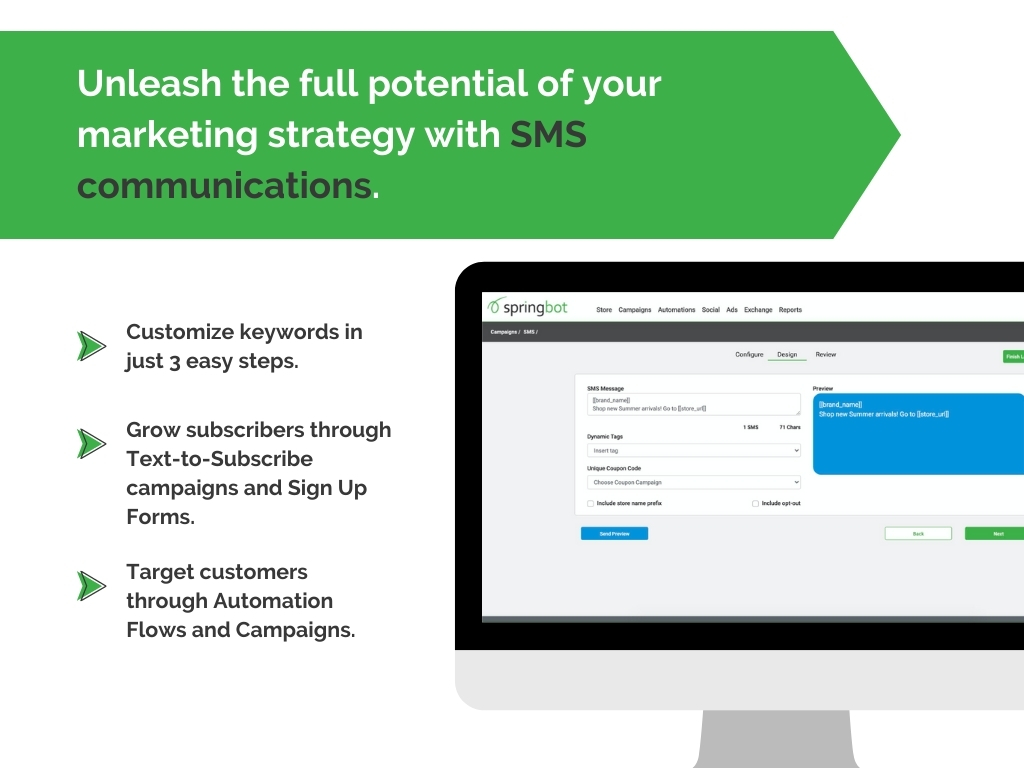
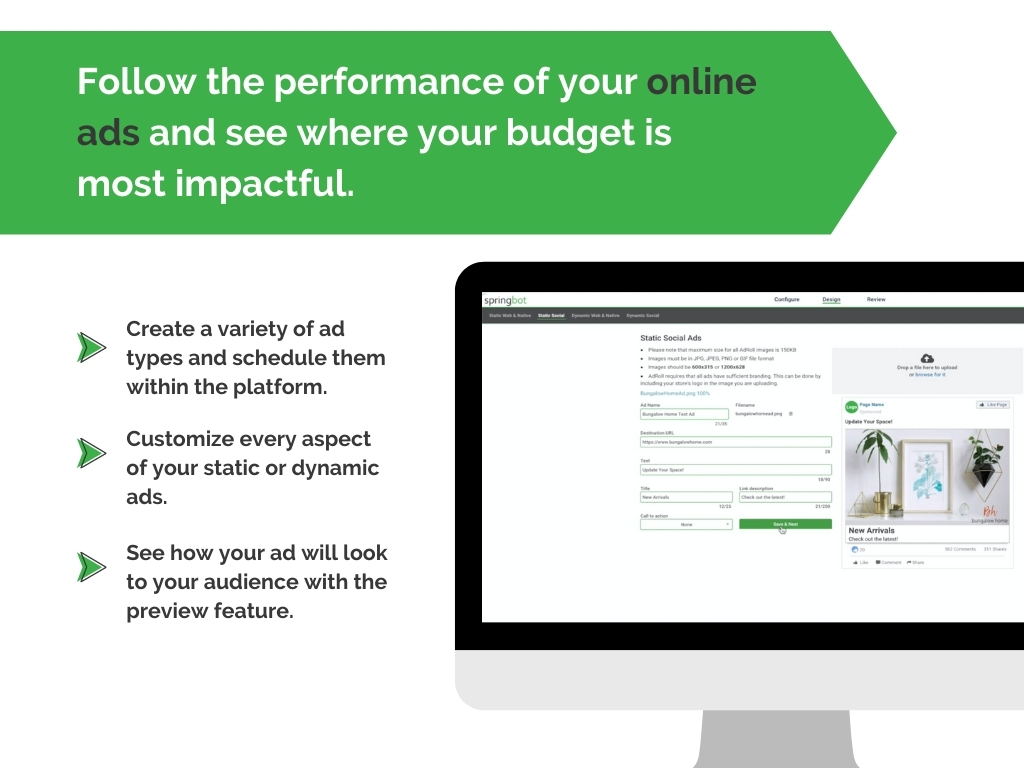
Springbot aims to bring all the marketing capabilities large retailers have to small businesses at a fraction of the cost. Through Springbot, online stores will be able to leverage automated marketing on channels such as email, SMS, social and online ads. Business owners and marketers who find themselves wearing many hats can still send the right message at the right time with confidence. With an all-in-one marketing automation platform designed with ease of use in mind, business…
$199
for up to 5,000 subscribers (includes email marketing, social hub, reporting and dashboards, signup forms, automations, account management, support and onboarding. See website for additional package options.
Pricing
Shopify
Springbot
Editions & Modules
Basic Shopify
$39
per month
Grow
$105
per month
Advanced
$399
per month
Shopify Plus
2,000
per month
Shopify Plus
2,300
per month
Platform Base Package
$199/month
for up to 5,000 subscribers (includes email marketing, social hub, reporting and dashboards, signup forms, automations, account management, support and onboarding. See website for additional package options.
Offerings
Pricing Offerings
Shopify
Springbot
Free Trial
Yes
Yes
Free/Freemium Version
No
No
Premium Consulting/Integration Services
No
No
Entry-level Setup Fee
No setup fee
No setup fee
Additional Details
A 25% discount is offered for annual billing.
See website for pricing calculator for additional pricing options.
Shopify out of the box had more features and did what we were looking to do that BigCommerce could not do without extensive customizations using a third-party vendor. That made it a very easy choice to switch to Shopify. Most of the customizations needed in Shopify we were able …
I havent had a very detailed look at the others. But for us, to migrate the whole infrastructure to something else doesnt make sense. We are happy with Shopify.
Shopify is the best tool in the ecosystem because with all the apps in its sphere, you can do almost anything. It also has the best checkout experience one can ask for in the Ecommerce / website space. I think when it comes to shipping inventory and theme management it’s the …
Shopify allows for companies to quickly and easily get online and selling. However, the more you want to customize the platform, the more you'll realize that other platforms (such as Wordpress + WooCommerce) end up being better because you have access to all of the core code …
Initially we built our website on Godaddy. There was not much SEO functionality and website user experience wasn`t great either. Hence, we migrated to Shopify and everything changed for the better.
WooCommerce may be a good option for a developer or simple websites for service based businesses (e.g., electrician/cafe/etc). If you are selling a physical or digital product and require the ability to customize your store with any frequency or to track performance etc then I …
Shopify is not as user-friendly or attractive as Squarespace. Also, the interface is much more challenging due to the way the digital download variants system has been designed (requiring third party app). I find Shopify to be slightly superior to Wix for product selling - …
I have been in e-commerce for over 15 years now, and Shopify is overall the best website platform that I have used. I have used AmeriCommerce, StoresOnline/Crexendo, BigCommerce, Weebly/Square, Wix, Wordpress, GoDaddy and others - Shopify is the best in most …
Big Commerce and SAP Hybris are two other platforms we've investigated and Shopify is by far easiest to use and customize. While it doesn't do everything out of the box, the apps do fill in many gaps. The cost however, is probably the biggest selling point against these other …
I am semi familiar with Wix. I prefer the Shopify interface for its ease of functionality and I think the platform is just more realistic in terms of what a business wants to see on the back end.
Shopify is so much easier to use, and much more user-friendly than both BigCommerce and Magento. The reporting, product management, and app marketplace are much better as well. Shopify also integrates with other systems very easily with apps and sales channels, so it saves a …
For e-commerce, Shopify provides a greater range of capabilities and integrations, including inventory management, shipping, and payment choices, and marketing tools. It offers more apps and customization possibilities accessible to businesses. Shopify helps you better organize …
We did not evaluate other products because of Shopifys name recognition and overall great reviews. I had heard of Wix as another option for website creation and building, but Shopify is a lot more complex for our business needs and fulfills our need for a platform where we can …
The old platform that I used could not help us to meet our requirements. It was not helping us properly, then I got to know about Shopify and started using it. After 1 month [of] usage of Shopify we could understand that this is the best platform [for E-commerce] to make …
Shopify is easy to use. You do not need to install many plugins for it, and if you are using Woocommerce, you will have to install some plugins. With Shopify, you get a high speed hosting and CDN (content delivery network) which will make your website fast. The checkout is also …
Shopify is easy to navigate and export shipping data to other shipping management tools. We have multiple clients (70+) using Shopify and rarely have issues. With others, we seem to have trouble daily with export to our shipping management tools. In addition to export issues, …
Shopify is the full-fledged complete package. It is equipped with all the superb features. Shopify is one of the most used cloud-based e-commerce store creation platforms available in the market for medium and small businesses. Shopify is the best store creation tool with …
Adobe Business Catalyst was used before Shopify but we ended moving away from the platform and we constantly ran into issues. The support wasn't like Shopify, nor was the platform as reliable. Shopify handles alot more, alot better but we found the constant need to add add-ons …
Disaster save your money there are other options out there. We were never able to get off the ground. Due to them being so unflexible, we did not implement anything.
Springbot's account management team is excellent to work with - they understand my business and my goals, and partner with me to achieve on those growth goals - from traffic, to subscribers and revenue.
We were choosing between a few different options when considering a new email marketing program. Previously we were using Constant Contact, but wanted a program that offered more. We looked into Klaviyo as well, but after comparing the two we decided to go with Springbot as …
We are looking at using Tealium to segment our customers now, something we had hoped Springbot would allow us to do. Tealium allows us to segment and send to any channel and any ESP. Springbot would allow us to create segments based on a few demographic, product and purchase …
Shopify is perfect for companies who are looking to run a simple-to-medium base e-commerce system and aren't looking to get too fancy with integrations. Those companies, though, that have more complex integrations (especially with checkout) might be better off using another e-com system out there where you have access to the full core code.
If you have a small marketing team with a small budget and you use Mailchimp & Adroll, Springbot might work for you. Otherwise, there are other more robust tools out there to accomplish the same goals. They need to work on more integrations with other ESPs and retargeting providers. And they need to work on making sure the data being sent to their customers is accurate.
One of the things that impressed me the most early on was their dedication to email deliverability and growing my "engaged" list of customers. Through this, they taught me the value of quality subscribers vs. quantity of subscribers, while still sharing new ways to grow my email list in a healthy and sustainable manner. For so long, my main focus was always having the biggest email list - and while that's good to have a lot of subscribers, the most important thing is to make sure they are ENGAGED with your brand. So together we've come up with fun ways to do that, and we've seen that reflected in our list growth and open rate.
One of the other things I was looking to do when I partnered with Springbot was to increase my site traffic. The original sales rep had a few recommendations on how we could do this, and our team was most excited about their Facebook Services offering. We were paired with a Facebook expert who did a discovery call with us, and then presented a strategic plan for us to follow for the first 90 days, until we could fully optimize. Their Facebook team narrowed down my target audience and has helped strategically grow my site traffic.
Finally, and maybe the part that I value the most, is the partnership that I've developed with Springbot. Out of the gate, there is absolutely work to do to get things set up and they don't sugar coat that. While much of the onboarding was smooth - we had a few obstacles to work through, and I'm thankful my Success Manager kept me up to date as we resolved anything that came up, and was proactive with her outreach and recommendations to get the most out of the platform. I find myself learning something new each time I chat with her, whether it be optimizations to my automations, new marketing ideas, or ways to increase engagement as I go into the holidays.
After being with them for a year, I feel this is more than a vendor + customer relationship, and think of it as a strategic and valuable partnership.
Basic requests for store management are not out of the box. Shopify puts a lot of stock in their apps and app partners to bring some of the features that I expected to be out of the box. I've used Shopify for multiple clients and ran into roadblocks for each when we were unable to do basic things. Sometimes the apps are free and it's no big deal. Other times you have to pay for another service to do something as basic as set up stock out reports and notifications.
Their support/team communication is poor. Again, working on multiple stores with license on all their levels and the support was consistently unresponsive or unhelpful.
If you're a partner managing multiple stores, the log-in between the partner dashboard and your individual stores is confusing. I'm often found in a loop searching for the right place to log in because you can't access the stores you are a partner on in the same way as the other Shopify stores. Seems minor, but it's a frustrating thing I encounter often.
Nothing we have used in the past or have seen thus far even comes close to offering what we get with Shopify Plus, especially for the price. You cannot even come close to getting what we are getting at the price we pay. We are beyond thrilled and Shopify Plus meets and exceeds all of our needs and expectations. We love it!
It is fairly easy to use Shopify regardless of what task you are attempting to perform. Most things are customizable to a degree without requiring coding ability. I have very limited coding experience and have still been able to navigate my way around changing features of the website that require edits to the code with the use of AI and trial-and-error. This previously wasn't possible with the WooCommerce platform.
I think Springbot is pretty user-friendly overall. The only down-side is that the website is often updated, leaving the customer to hunt certain features down that are now in a different spot. So I think it would be helpful if every so often they sent an email that let customers know what changes were made and where to access everything
In terms of support I give Shopify a 9 out of 10 because they're always very friendly and thorough, and they personally can't solve my problem for me they always point me in the proper direction with the proper information I need to move forward
They only cared about referencing the user agreement to get out of any common sense discussion I tried to have. They have one goal take your money and don't care if the system is working for you or not.
Shopify offered us several trainings to setup a Shopify store, how to build a brand, SEO, product photography etc. All this content have been super helpful in our journey.
Shopify out of the box had more features and did what we were looking to do that BigCommerce could not do without extensive customizations using a third-party vendor. That made it a very easy choice to switch to Shopify. Most of the customizations needed in Shopify we were able to do ourselves.
We were choosing between a few different options when considering a new email marketing program. Previously we were using Constant Contact, but wanted a program that offered more. We looked into Klaviyo as well, but after comparing the two we decided to go with Springbot as they offered a wide variety of insights and had wonderful customer service.
It got the store up quickly so the client could start selling. She was previously selling products on Etsy and Facebook and wanted to consolidate everything onto one website, so the main thing Shopify solved was to reduce the store owner's time in managing all her products on multiple sites. Also, we had previously built a website on Wix with all the custom functionality and branding she needed - a truly great, high-end website - but it performed so slowly that it was unusable. So the speed at which Shopify can be set up and then works on the page is appreciable.
The website was manageable by the client - she could figure the system out herself after a while so she saved money on costs for hiring developers. She did have to hire developers to customize some of the plug-ins but costs are all relative; it wasn't a high investment compared to building a full e-commerce website. With the complexity and size of her product base and the functionality and branding she wanted to have in a website, and the potential of her business, she would have needed to invest well over $10,000 to get to where she really needs to be. In the end she kept the budget under $5000.00.
Costs kept climbing with plug-ins having to be added with everything. My client became more involved in building the website and began to try multiple plugins, and she did not have the skill base to evaluate the plugins functionalities so she chose plugins that did not do everything she needed, and then ended up paying the plugin developers to customize the plugins. So on one hand, it's pretty amazing to be able to bring up an e-commerce website as quickly as a week or so, but on the other hand if you need anything customized or deeper functionality in regards to product searching and filtering on the web page, and management on the backend, it quickly goes beyond the skills of the average person to manage, and above their expected budget as well. In the end my client really did not get anything close to the functionality for the website we had originally envisioned.
Shopify was the easiest way we could find to bring the client's products to a global market. We evaluated several other platforms and the functionality simple did not seem to be adequate, so Shopify seemed like the only solution that could do enough of what we needed and still stay within this client's budget. Really the problem in this project was not platform per se but that the budget wasn't large enough. Shopify managed to provide a solution for an ecommerce store with thousands of products on a tiny budget, so in the sense of pure functionality it provided the best value of all the platforms we evaluated. The solution still isn't big enough for this client's business though so, without having insights into this client's post-build sales results, my guess is that because her new website did not make her products easier to sort through, and she likely didn't have much more budget left to invest in SEO and other marketing of the website, her sales probably didn't increase substantially as a result of having built the website. So I think this project all in all did not likely have a high ROI.