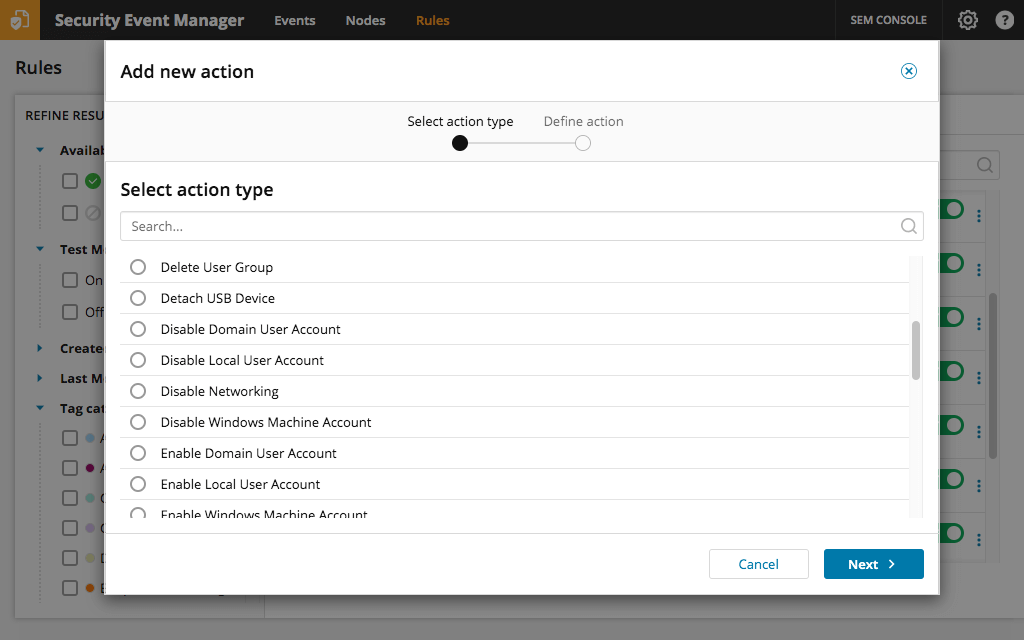
SolarWinds LEM is security information and event management (SIEM) software.
N/A
Splunk Enterprise Security
Score 9.6 out of 10
N/A
Splunk Enterprise Security is an analytics-driven SIEM that helps to combat threats with actionable intelligence and advanced analytics at scale.
N/A
Pricing
SolarWinds Security Event Manager (SEM)
Splunk Enterprise Security
Editions & Modules
No answers on this topic
No answers on this topic
Offerings
Pricing Offerings
SolarWinds Security Event Manager (SEM)
Splunk Enterprise Security
Free Trial
Yes
No
Free/Freemium Version
No
No
Premium Consulting/Integration Services
No
No
Entry-level Setup Fee
No setup fee
No setup fee
Additional Details
—
—
More Pricing Information
Community Pulse
SolarWinds Security Event Manager (SEM)
Splunk Enterprise Security
Considered Both Products
SolarWinds Security Event Manager (SEM)
Verified User
Anonymous
Chose SolarWinds Security Event Manager (SEM)
The compare well against the others - the pricing models for all but Splunk (free version) are based on EPS/TB consumed... the problem they pose is guesstimating the price tag per month. SolarWinds Security Event Manager gets around that.
It came down to price on this one. SolarWinds gave us a great break on
it. For the features that we were looking for, SolarWinds is a great
value for our dollar. As far as features go, we were looking for some
Solarwinds Security Event Manager (SEM) is the best solution for price/performance. The solution has an easily understandable architecture and also the solution can be installed easily. The solution is a very stable and fast solution for our company size.
Fortianalzyer can only do logs from FortiGate so usefulness is limited. Elasticsearch was a lot slower than Solarwinds and the filters were a lot harder to set up and use. The connectors for SEM were far more stable.
Splunk was a pretty good product but the licensing structure needed a lot of work. They changed the structure three times that I am aware and I still had problems understanding LogRhythm had a lot of issues correlating users to IP addresses, the mappings were frequently wrong …
We found that SolarWinds performed poorly when the Architecture included many large data centers spread across the globe. When evaluating the SolarWinds Security Event Manager (SEM) solution we quickly realized that we needed a distributed architecture with log aggregation to …
We chose this product because of its integration to SolarWinds Orion. We were Threat Monitor users previously. This product has been a great substitute. Dollars to dollars this product performs fairly well.
SEM is much better value proposition due to being priced by node and not by size of the event database. It's also much easier to configure that splunk and needs much less infrastructure to run. Out of the box SEM beats splunk on functionality. We looked at many products and …
I find Tripwire Log Center to be adequate and stable but it lacks the graphics and the unified UI that you can have with SolarWinds products. It is also not as simple to set up and operate. One more advantage that SolarWinds products have is the THWACK forum, a big user base …
It is a bit hard to compare, since Cortex XDR is kind of a different starship, with endpoint protection and such, and not really great for auditing Windows Event Logs. ELK stack on the other hand is free in some of it's editions but seems much similar then Cortex. SolarWinds SEM …
We picked SolarWinds because of the better price point, integration with other SolarWinds products, and the ease of training. Because we were already familiar with the SolarWinds way of doing alerts and reports, it made this product a nice fit for our company and it has great …
The first reason is the ease of installation. Unlike competitor, SEM was running and partially deployed within a day. With the defaults already in the SEM, it's super easy to get result quickly, without a consultant. Also, it's not too resource-intensive, and does not …
SolarWinds SEM was selected because it integrates with VMAN on the Orion platform and allows all monitoring information and alerts to be aggregated in one place.
Several clients have moved away from LogRhythm because of cost. SEM offers the best ROI for the function. Its interface is much cleaner then LogRhythm. However, there is a steeper learning curve with SEM. The ease of search and data integrity offered by SEM is definitely a …
I know the Qradar is not the right SIEM tool to compete with Solarwinds SEM but when we looked from a cost, audit & compliance perspective (which are major for many customers), we knew the log management and compliance with regulation would be achieved with SEM. But no machine …
SolarWinds provides support so when you have problems you don't need to turn to information bases as you can just get a hold of SolarWinds support. I would say another reason for getting SEM is that it is generally easier to configure and easier to learn than the other …
I have additionally used Netwrix Auditor, which has some similarity with SolarWinds SEM. I use both hand in hand, but typically use the SEM first since it is easier to manage. With Netwrix custom searches are more complex than customer searches in the SEM. The SEM makes it easy …
We implemented SolarWinds Security Event Manager to replace our Cisco MARS appliance. We found the Cisco MARS appliance cumbersome and difficult to connect to and use, as well as very costly from a support and maintenance perspective. SolarWinds Security Event Manager has more …
LogRhythm is good for a team comprising mostly non-technical IT users. Unlike Splunk, it has a GUI log search and a good ticketing system. Splunk is better than Logrhythm for me as it provides me with the ultimate flexibility to write custom queries. Scalyr is a good tool and …
I did not choose this product. Overall although I like ES, I think Sentinel in certain ways is the superior product. The Kusto Query language is a lot easier to use. For instance anything that requires manual parsing in query can be more difficult with this product. Also some …
AlienVault is much more user and beginner friendly, however Splunk ES very much so provides more capability for mass data manipulation, report and dashboard customization, and trend analytics.
These two really helps in better way and low cost and high productivity. Automatic detection ML help you to detect many ways and create cases based on risk score GRS UBA helps to protect organization from data ,via sharing through emails and USB s . Gurucu product license once …
Splunk enterprise is the only solution that we’ve been able to identify that provides risk based alerting, which allows our SOC to reduce analyst fatigue which would be a huge problem without it. Before RBA, there were thousands of alerts a day and it was impossible to review …
I consider Splunk Enterprise Security to have the strongest deployment methodology and troubleshoot features. Other products also provide good solutions such as Riverbed, Broadcom and Solarwinds but I think Splunk Enterprise Security is a great and trustable option to use for …
Even though Splunk ES is not the cheapest solution on the markt, we found it was still cheaper compared to Secureworks we had before. Also the level of flexibility and "thinking with the customer" is much better now.
Traditional hardware logging mechanisms do not provide in-depth research data on the threats and signatures, while Splunk Enterprise Security could easily achieve this feat.
FortiAnalzer is a hardware solution, but with Splunk, we could identify as well get the correct solution for the active threats and too with accurate and precise detailing.
- Schema on the fly indexing --> Gives you faster index searches. Even if you use Datamodes, it's 100x time faster as well. - Correlation with other domains easily gives you total visibility and reduces the time to investigate and understand the problem. - With lookups and trust, …
Securonix does not nearly meet the scale, extensibility, and maturity that Splunk ES offers. However, when looking at the MSP architecture options, Securonix is a much more flexible platform for multi-tenanting. So, Splunk ES for captive SOC platforms and Securonix for …
Splunk ES is by far the best solution in the market as per flexibility, features and support. Cost-wise, it is the most expensive option to go with, but that has its own advantages as the product that we get is premium and superior to other SIEM. The best thing about Spunk ES …
Splunk Enterprise Security allows for data normalization that does not compare to other SIEMs such as QRadar or Trustwave. QRadar requires custom dsm parsers before the data can be onboarded. I appreciate that Splunk Enterprise Security can ingest any source of data and …
LogRhythm is a superior SIEM from a purely security/SOC perspective in my opinion. However, Splunk shines if you have an expert behind the wheel or if the organization is quite large - as my experience with LogRhythm indicated it couldn't handle large-size organizations.
Splunk does not hide its correlation and analytics logic from users as much as other solutions in the same space. While some features are harder to access the underlying information is all accessible and tunable. This gives Splunk an edge over other solutions that lock the …
Splunk Enterprise Security is superior in the logging aspect and searching. That’s why it was easier to pick switch to Splunk Enterprise Security. Arcsight is however superior in the correlation and stability aspect. It’s very reliable and stable that we sometimes forget that …
Solarwinds SEM is great for generating reports for investigation purposes. Once you set up the connectors you can walk away and the product runs without needing maintenance. It was however pretty difficult to create the reports and alerts when now starting out and it can be very intimidating for new users.
SolarWinds easily provides the much needed visibily into changes in an Active Directory (AD) environment. Email alerting can be configured to alert a team if an account is locked out, disabled by another users, or if users and/or computers accounts are created.
SolarWinds allowed a searchable audit feature. Microsoft Windows can be configured to log many different parts of a system, but search those logs can be difficult. SEM allows you to search for specific users or events.
Its best feature is its user interface, which is easy to navigate and understand. All you need is a little tutorial on how to use the Splunk query language and you're done.
Logs can be easily uploaded or shared across multiple platforms and display a highly insightful graphical representations of data using graphs, tables, and many other formats.
Compared to other SIEMs, there are features that are missing. Machine learning, automatic event correlation, ability to correlate multiple sources together.
The UI is clunky, and the *New* event log analyzer page felt really disjointed from the rest of the product.
In my experience, the dashboards were almost unusable. They persisted across login per device, and even then they sometimes would reset and go back to the ''Getting Started'' look.
It is pretty likely that we will renew SEM when the time comes up. It is easy to use and maintain so there isn't much of a need to replace this product. It is also a pretty fair price for the capabilities provided by the SEM
It is very good - but you get what you pay for. The intent is not for a Fortune 500 that needs more "heavy lifting" with SolarWinds Security Event Manager & for whom the price tag is not (much of) a consideration.
You definitely need to learn how to use Splunk to get the most of the tool. There are many courses available for free to get up to speed on the usability of the tool but it's not that simple. It will take time to digest all the data and to understand how to query for what you are looking for.
ES requires a very performant infrastructure: if it has it's performant, otherwise not. I had situation with a very performant infrastructure and I didn't notized that it was a distributed architecture, it seemed that there ware few data on my PC, othewise I experienced less performant infrastructures with less performaces.
The quality of support can vary depending on whom you end up speaking with. I was fortunate enough to work with a support representative who was very familiar with the product. He had even authored some of the support documentation on the website. On the flip side, I had two other experiences where I was simply directed to online training material.
It's good when it's responsive, but I've had times where I had to wait quite a while for a response. But these are typically the exceptions rather than the rule. When you do get a response it is always well-informed and appropriate. I would say they've been trending better over time with this.
I experienced only on-line training, but the trainers were very professional and competent. Maybe it could be more useful if they also have an experience in projects because sometimes they didn't have a real project experience to communicate to the students. Anyway, it was very interesting and I learned many thing that's very difficoult (or maybe impossible!) to have by myself, aven if I have more than 10 years of Splunk activity experience.
It was very interesting and I learned many thing that's very difficoult (or maybe impossible!) to have by myself. The only problem was that, when I worked with the Splunk Professional Services, I found some difference between the training contents and the information from PS. In addition is required a long experience on Splunk Enterprise for the data ingestion part, in other words I'm able to work with ES because I'm worling on Splunk since 11 years, otherwise I'd some problem.
The compare well against the others - the pricing models for all but Splunk (free version) are based on EPS/TB consumed... the problem they pose is guesstimating the price tag per month. SolarWinds Security Event Manager gets around that.
LogRhythm is good for a team comprising mostly non-technical IT users. Unlike Splunk, it has a GUI log search and a good ticketing system. Splunk is better than Logrhythm for me as it provides me with the ultimate flexibility to write custom queries. Scalyr is a good tool and quite frankly lot faster than Splunk. However, I prefer Splunk because of its better Dashboards and panel customization abilities. Elastic is another amazing tool. It is hard to choose between the two especially because both have different sets of logs on them. I use both. Elastic for internal server logs, Splunk for everything else.
We have on prem splunk and it’s mostly east to setup, but we have issues keeping data separated between customer splunk deployments while at the same time only having to look at one SIEM to address events in every environment
It saves a lot of time when we had issues trying to figure out where the user account lockout was coming from.
With it being an affordable SIEM, we are able to have the ability to do the actions associated with a SIEM and the advantages of not “breaking the bank account”.
We have a 100% success rate on all our ES implementations due to the amazing documentation and Splunk enablement on the subject.
Our Splunk ES business has grown 100% YoY for the last 3 years.
In terms of long term management and maintenance, ES has been highly stable and predictable, reducing our overhead on costly services team for ad hoc maintenance work.