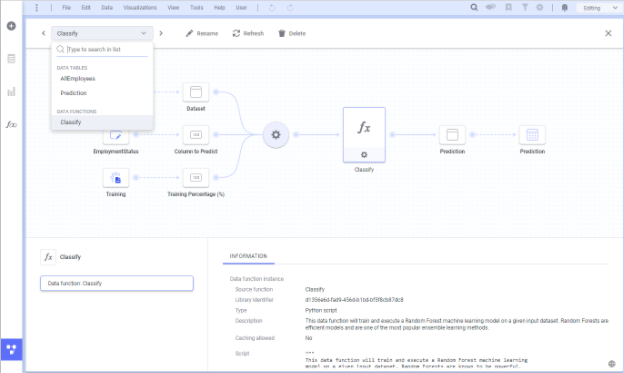
Spotfire, formerly known as TIBCO Spotfire, is a visual data science platform that combines visual analytics, data science, and data wrangling, so users can analyze data at-rest and at-scale to solve complex industry-specific problems.
N/A
TARGIT
Score 7.6 out of 10
N/A
TARGIT Decision Suite is a business intelligence (BI) and analytics platform used to automate reporting, boost operational visibility, and give teams insights that support data-driven decisions. The solution combines data from multiple source systems, including enterprise resource planning (ERP) software, customer relationship management (CRM) platforms, and all other data sources to give organizations a complete picture of their operations. …
N/A
Pricing
Spotfire
TARGIT
Editions & Modules
No answers on this topic
No answers on this topic
Offerings
Pricing Offerings
Spotfire
TARGIT
Free Trial
Yes
No
Free/Freemium Version
No
No
Premium Consulting/Integration Services
No
No
Entry-level Setup Fee
No setup fee
No setup fee
Additional Details
For Enterprise engagements, contact Spotfire directly for a custom price quote.
—
More Pricing Information
Community Pulse
Spotfire
TARGIT
Considered Both Products
Spotfire
Verified User
Anonymous
Chose Spotfire
No experience with the tools in the list above other than Spotfire.
Spotfire has an extremely large and dynamic range of visual analysis tools that can be catered for most issues or projects to create a custom analytics dashboard when compared to other tools I've used. It's multitude of available database connections allow for most …
Spotfire is stronger than other tools to built complex metrics within the tool, without needs of etl updates and query changing. It has lots of useful visualizations to deep dive data and give interesting analysis to business users. Moreover, with some studies and tests, you …
Although Spotfire has a longer learning curve, it has proven to be more practical and impactful than Tableau. We had only evaluated other tools at a high level initially, and were surprised to hear the success stories of companies moving from Tableau to Spotfire. We have found …
Because of Spotfire's robust features and capabilities, I chose it as my
preferred software. Spotfire's greater overall performance and
scalability set it apart from other software solutions. It can handle
Spotfire is appropriate for every organization of any size because it can be a recipient of data for better decision-making. Being a robust development platform for creating reports and dashboards, creating a new Spotfire dashboard is relatively simple. Developers can create …
Spotfire is more suited for manufacturing industries with regards the huge data to process to make relevant decision that use big data for making decisions, besides this Spotfire supports more and excels at Availability & Scalability, Data Sources Connectivity and Deployment …
I choose Spotfire because of the following - custom visual using JavaScript - on the fly chart property update using iron python - easy report Deployment and update -easy to manage user access via so or ldap - best report data Extraction -mix data sources -custom data load …
Spotfire is significantly ahead of both products from an ETL and data ingestion capability. Spotfire also has substantially better visualizations than Power BI, and although the native visualizations aren't as flexible in Tableau, Spotfire enables users to create completely …
Spotfire's key strength les in extent of customization possible and it's inherent Data Analytics capabilities. With in-memory and in-database analysis capabilities, it comes out as a high performance and high efficiency BI solution. Adding to it, Spotfire integrates the …
Easy to use and is a very flexible tool. Great to have multiple services. Find it to be a trusted platform. The ability to add Iron Python scripts and include code snippets is very useful. Like the style of the created views.
I find both Microsoft Power BI and Spotfire very easy to use. I would rate them on par with each other. There isn’t much to differentiate them. Maybe the learning curve on Spotfire is a bit steeper than Microsoft Power BI.
Augmented AI with Spotfire is very useful for data virtualization. Since data visualization is a quick and very easy way to convey our information. This software makes it easier with its interactive way of presenting data in charts, graphs, and 3D forms.
It provides all tools along with in-built apps for analysis and generating reports, metrics, charts, and graphs. Comes with appropriate costing model at least for an average size organization
Spotfire is the best application for power users by virtue of its wide variety of visualizations, incorporated analytics, superior data canvas, and ability to integrate code such as R or Python. The learning curve is steeper and the menus are Windows 7 once you are past some …
The only other tool we use in my course is Tableau. Tableau is very popular regionally (Omaha, NE), runs locally on Mac and PC, is free for students and faculty, and has a web outlet for sharing. It also plays well with AWS. For these reasons, we use it as the primary …
Targit's in-memory suite of tools can process data very fast. We selected it for the speed of data processing, and availability of all ETL, cube, and reporting capabilities in the same product.
While their product is top of the line and works very well for us, we ultimately selected Targit because of their team. We love working with them and they are always super helpful. Whenever we have a request or issue, they are there ready to happily help us resolve it and move …
Targit was more expensive, but it was going to be easier for us to add more data sources (Google Analytics in particular) than Jet Reports would have been. I also liked the reporting interface in Targit much better; the ability to click on elements in an object to dynamically …
It really met our business requirements when we were searching for a reporting/Bi tool and the flexible business model of being able to introduce additional functionally as your organization grows and requires it made the investment decision the right one for us. The …
TARGIT is as user friendly as SAP BW, and more user friendly than Crystal Reports. The downside of both TARGIT and BW is that you're limited to the data points provided by IT.
Spotfire was used to look at a large data set of an in process manufacturing step. The data visualization was set up to look at yield as a function of several inputs (chemical / equipment / operator). After only a short analysis it was immediately obvious that there was a 5% yield discrepancy based on the operator using the equipment. The operators were retrained and the yield gap was eliminated.
Overall, TARGIT is a valuable tool, and more and more associates are realizing this every day. It's become our standard for sales reporting. I would recommend the software for use at other companies, and I often encourage fellow associates to gain access and basic training.
The in-memory cube in the Targit suite is an excellent tool that can replace SSAS in theMicrosoft BI suite of tools. InMemory aggregations are lightning-fast compared to Microsoft SSAS.
Targit also has a cool HTML5 reporting tool.
It is a complete suite of BI tools including ETL, cube and reports.
They should have a lower price point for users to access the analyst version who don't require advanced capabilities. For example, a lower price if users just need to do some basic slicing and dicing with their data and not have to the data science functionality (ie. K-means clustering, regression modeling, classification modeling, etc.).
Currently, you can't change the font type/color on the axis, which I'm sure will eventually be available in the future as they have a Spotfire Ideas portal that they're fairly responsive to and act on. I guess at the end of the day, it's about the data and what insights you get from it.
I think including the Data Discovery module in the base package instead of charging extra for it would go a long way to making the software better. If you don't have much background with SSIS or SSAS and you do not buy the module, it will be difficult for you to add or modify data sources.
There are a couple small tweaks to the interface that would be helpful but are far from necessary. For example, unlike an Excel pivot table, you cannot move the measures above the dimensions in a table interface. There are workarounds for this, however.
I understand the need to make their calculation language as complex as it is, but it still seems like it could be made simpler. It's helpful that it comes with several standard calculations that you can easily add to an object, but if you want to modify a calculation or create your own, it can be more complicated than I would like.
It's a very powerful tool that allows for a myriad of customizations within the analysis files themselves, particularly with the custom expression functionality. There have been some great strides with the quality of the visualization options (which were not great to begin with) and I hope to see more improvements made as the product gets updated.
The use of Targit is widespread throughout our organization. Our users are becoming comfortable with the tool and Targit has allowed our company to truly grasp the concept of Business Intelligence and making better business decisions through the analysis of our data. Our users are not waiting for IT to create reports for them, they have full rich self-service BI with Targit and are able to turn a great analytical idea or ad-hoc query hypothesis into concrete answers with actionable responses within minutes.
Basic tasks like generating meaningful information from large sets of raw data are very easy. The next step of linking to multiple live data sources and linking those tables and performing on the fly analysis of the imported data is understandably more difficult.
Everything on the back end needs to be correct, which sometimes it may not be set up or missing some variables. Some of the more difficult parts of Targit require a lot more attention and object creation to work properly
Even though, it's a rather stable and predictable tool that's also fast, it does have some bugs and inconsistencies that shut down the system. Depending on the details, it could happen as often as 2-3 times a week, especially during the development period.
Generally, the Spotfire client runs with very good performance. There are factors that could affect performance, but normally has to do with loading large analysis files from the library if the database is located some distance away and your global network is not optimal. Once you have your data table(s) loaded in the client application, usually the application is quite good performance-wise.
Support has been helpful with issues. Support seems to know their product and its capabilities. It would also seem that they have a good sense of the context of the problem; where we are going with this issue and what we want the end outcome to be.
Everyone I've dealt with at Targit genuinely cares about me and my success, and they respond to questions quickly and accurately. There is literally nothing more I could ask for from their support.
The instructor was very in depth and provided relevant training to business users on how to create visualizations. They showed us how to alter settings and filter views, and provided resources for future questions. However, the instructor failed to cover data sources, connecting to data, etc. While it was helpful to see how users can use the data to create reports, they failed to properly instruct us on how to get the dataset in to begin with. We are still trying to figure out connections to certain databases (we have multiple different types).
The online training is good, provides a good base of knowledge. The video demonstrations were well-done and easy to follow along. Provided exercises are good as well, but I think there could be more challenging exercises. The training has also gone up in price significantly in the last 3 years (in USD, which hurts us even more in Canada), and I'm not sure it is worth the money it now costs (it is worth how much it cost 3 years ago, but not double that.)
The original architecture I created for our implementation had only a particular set of internal business units in mind. Over the years, Spotfire gained in popularity in our company and was being utilized across many more business units. Soon, its usage went beyond what the original architectural implementation could provide. We've since learned about how the product is used by the different teams and are currently in the middle of rolling out a new architecture. I suggest:
Have clearly defined service level agreements with all the teams that will use Spotfire. Your business intelligence group might only need availability during normal working hours, but your production support group might need 24/7 availability. If these groups share one Spotfire server, maintenance of that server might be a problem.
Know the different types of data you will be working with. One group might be working with "public" data while another group might work with sensitive data. Design your Library accordingly and with the proper permissions.
Know the roles of the users of Spotfire. Will there only be a small set of report writers or does everyone have write access to the Library?
ALWAYS add a timestamp prompt to your reports. You don't want multiple users opening a report that will try and pull down millions of rows of data to their local workstations. Another option, of course, is to just hard code a time range in the backing database view (i.e. where activity_date >= sysdate - 90, etc.), but I'd rather educate/train the user base if possible.
This probably goes without saying, but if possible, point to a separate reporting database or a logical standby database. You don't want the company pounding on your primaries and take down your order system.
Make sure all of the back end work is done prior to getting Targit set up. Every variable you may need for calculations needs to be correct and every item needs to be uniform so it is read properly.
Spotfire is appropriate for every organization of any size because it can be a recipient of data for better decision-making. Being a robust development platform for creating reports and dashboards, creating a new Spotfire dashboard is relatively simple. Developers can create highly customized dashboards using the tools it provides. I will recommend this software to others
While their product is top of the line and works very well for us, we ultimately selected Targit because of their team. We love working with them and they are always super helpful. Whenever we have a request or issue, they are there ready to happily help us resolve it and move forward.
In an enterprise architecture, if Spotfire Advanced Data services(Composite Studio),data marts can be managed optimally and scalability in a data perspective is great. As the web player/consumer is directly proportional to RAM, if the enterprise can handle RAM requirement accomodating fail over mechanisms appropraitely, it is definitely scalable,
Spotfire really helped a lot of people in terms of analysis. It eliminates data analysis in excel. Because even underlying data you can explore it in Spotfire.
Spotfire helps data analysts to investigate data and also help analysts solve inconsistency of data.
Spotfire helps data analysts in building great dashboard that provide insights to users to make decisions to drive revenue and manage the churn.
It really has answered questions during decision-making conversations where a task item would have been created with days of turnaround time instead of getting the necessary information within minutes during that same conversation.
Unified Reporting that maintains in alignment with business needs.