Tableau Desktop is a data visualization product from Tableau. It connects to a variety of data sources for combining disparate data sources without coding. It provides tools for discovering patterns and insights, data calculations, forecasts, and statistical summaries and visual storytelling.
$75
per month per user
Visier People
Score 8.7 out of 10
Enterprise companies (1,001+ employees)
Visier aims to give organizations a "Workforce AI Edge:" A set of AI-powered capabilities that help leaders understand the relationship between people and work, elevate employee productivity, and win by adapting to change faster. The company offers people analytics, workforce planning, and compensation allocation. All Visier technology is underpinned by its Real-time People Data Platform, which uses AI to unlock the business-transforming potential of people data, work data, and the fusion…
N/A
Pricing
Tableau Desktop
Visier People
Editions & Modules
Tableau
$75
per month per user
Tableau Enterprise
$115
per month per user
No answers on this topic
Offerings
Pricing Offerings
Tableau Desktop
Visier People
Free Trial
No
No
Free/Freemium Version
No
No
Premium Consulting/Integration Services
No
No
Entry-level Setup Fee
No setup fee
No setup fee
Additional Details
All pricing plans are billed annually.
—
More Pricing Information
Community Pulse
Tableau Desktop
Visier People
Considered Both Products
Tableau Desktop
No answer on this topic
Visier People
Verified User
Anonymous
Chose Visier People
Tableau was much slower than Visier People when trying to add or change filters, especially for the amount of data we were visualizing. It was good for housing data/creating different tables, but not good for visualization. we could create very basic charts in our dashboards, …
I definitely would place Visier above these. Tableau is awesome, do not get me wrong; however, Visier is good for what it does and Tableau is good for its purposes. It would not be fair to compare the two though honestly since I am currently living in Visier, daily.
We have considered other software that can analyze the performance of each employee but they have never been as accurate as Visier has been, this platform is very detailed and there is no problem in understanding the data since all the information is clear and precise. Visier …
The best scenario is definitely to collect data from several sources and create dedicated dashboards for specific recipients. However, I miss the possibility of explaining these reports in more detail. Sometimes, we order a report, and after half a year, we don't remember the meaning of some data (I know it's our fault as an organization, but the tool could force better practices).
This solution, prepared mail for the HR departments, is definitely well suited for decision making. This means that Visier enhances data analysis and drives planning, metrics, and business results to the next level. The ability to transform databases of employees' data (for example) into interactive, clear, and detailed reports supports and upgrades the current decision-making process.
The Visualizations graphics are really good and the color options help in designing attractive charts. They help to convey more information and can be made interactive.
You can add filters with offer you to plug and play with values and understand different outcomes.
You can drag and drop options while creating charts and dashboards. also it is a very fluid layout.
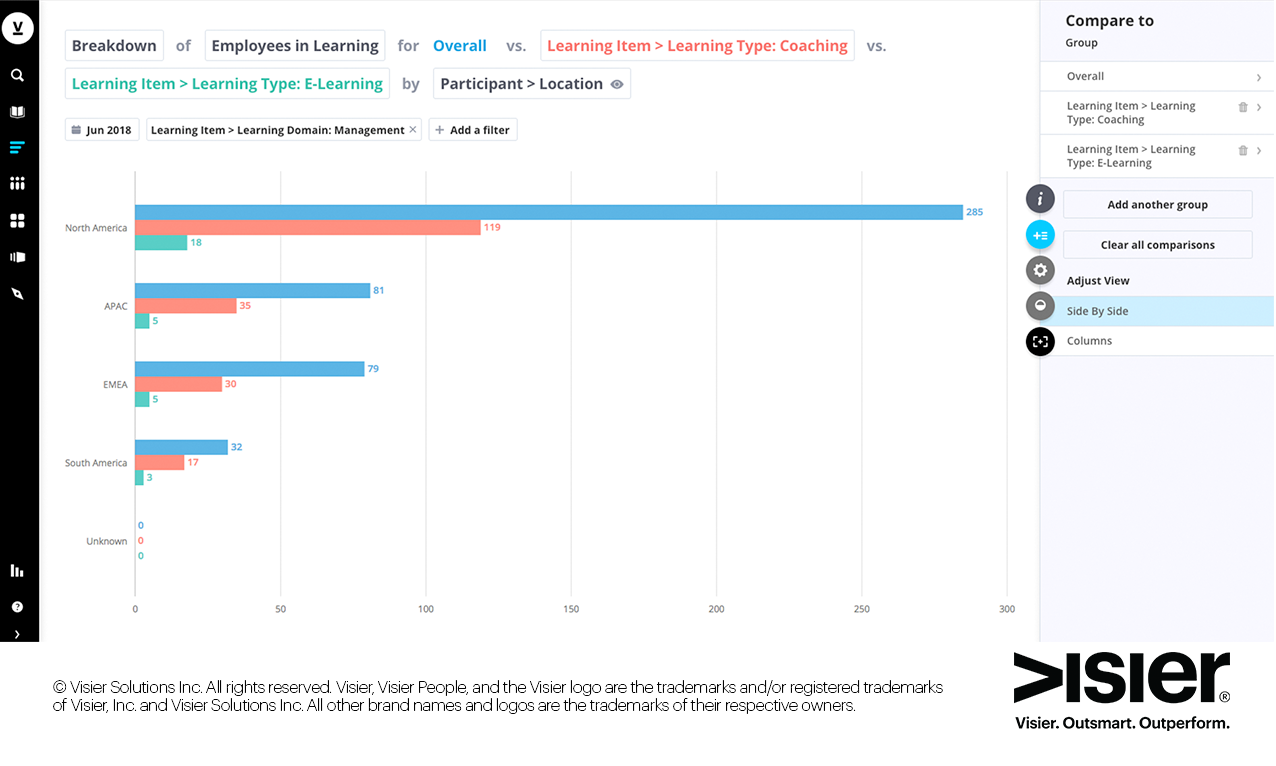
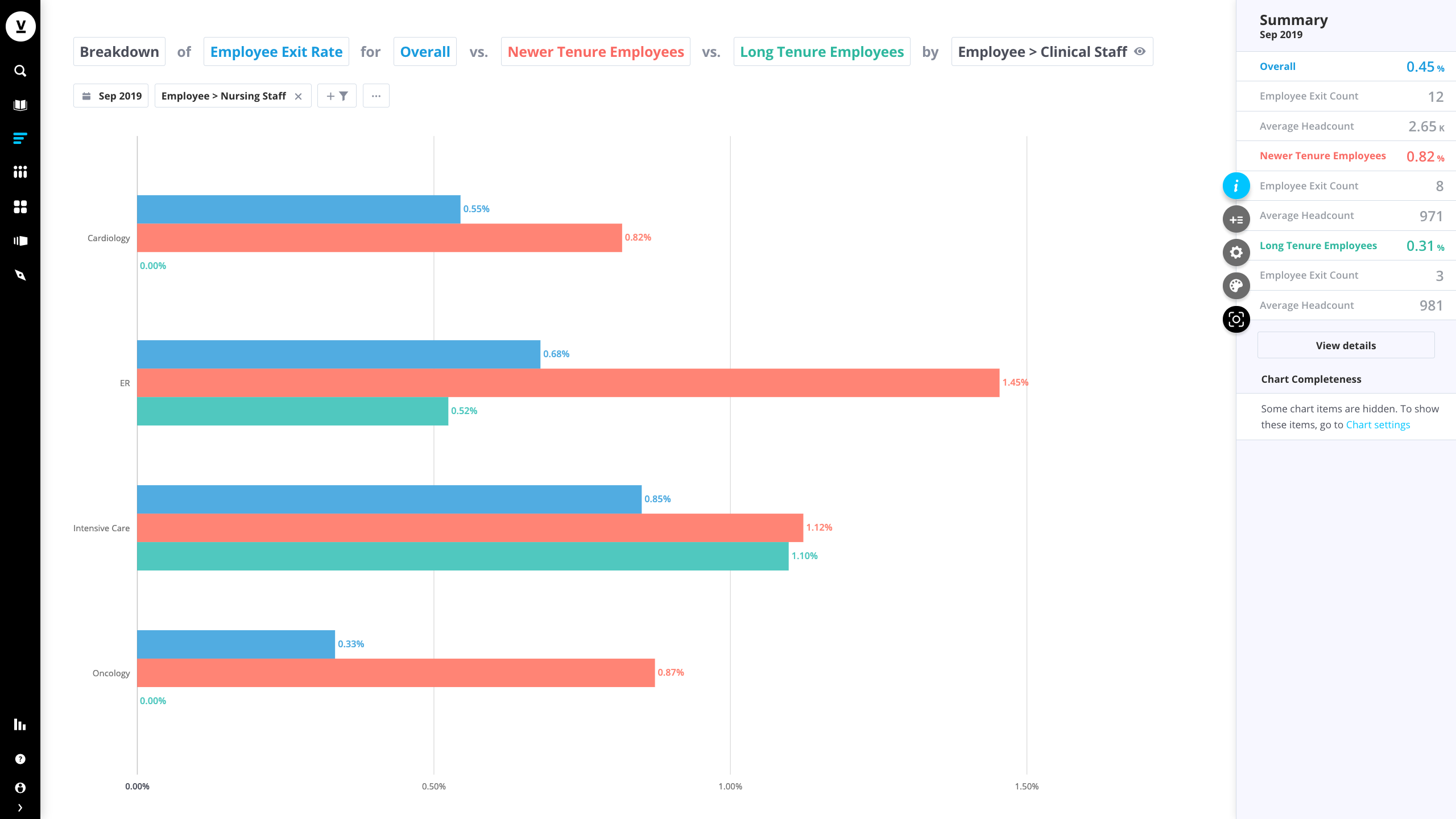
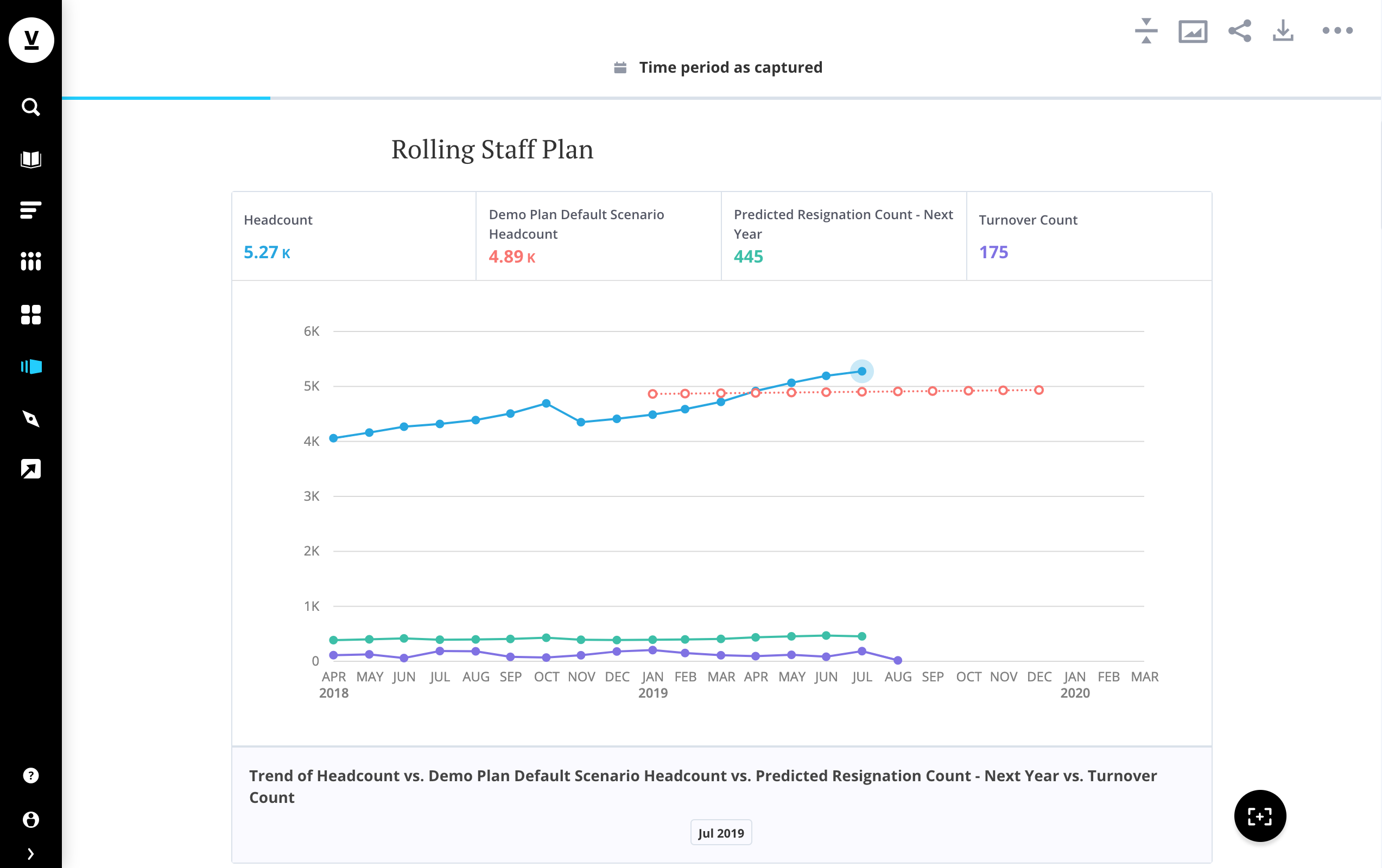
Visier does an excellent job providing summary charts and graphs of people data, including turnover, job information, and diversity and inclusion statistics.
Visier is flexible in setting up data feeds between various systems to ensure all of our data is accessible in one system. For example, we have a data connector between our market pricing, HCM, and recruiting systems.
Visier has an intuitive and user-friendly interface that empowers line managers and HR partners to use the system. Managers and HR partners can easily share data with other users.
Technical Deadlines Often Missed: On several occasions during data onboarding, or applying fixes to data, communicated deadlines were missed by 24-48 hours.
Security can be convoluted, but is effective.
Built on Flash and the only native mobile apps are for iPad (iPhone forthcoming).
Because right now its the best option out there (disclosure: I haven't used Qlikview or some of the other direct competitors of Tableau). The big investment is in Tableau Server not desktop. For the cost of the license of Tableau desktop, its a pretty good deal. You can hook it up to pretty much any data source easily. You can easily share the visualizations with your team/colleagues easily. Tableau Desktop is generally easy to use for business users. But the more advanced stuff is better suited for a analyst or someone with a IT/CS background.
It is a software with great resources, it increases the possibility that the entire workforce is productive, it gives us quick answers, it is the most powerful workforce analysis software that exists so far.
Tableau Desktop has proven to be a lifesaver in many situations. Once we've completed the initial setup, it's simple to use. It has all of the features we need to quickly and efficiently synthesize our data. Tableau Desktop has advanced capabilities to improve our company's data structure and enable self-service for our employees.
Visier People makes it very easy for all end users to go in and see, pull, or dig in to their data where previously my team would have to pull or schedule a report of the data to each user. It is also very fast in updating charts/analyses when changing or adding filters, which makes the ease of use better. Last, the charts and analyses are very visually appeasing, making users want to use the platform more.
When used as a stand-alone tool, Tableau Desktop has unlimited uptime, which is always nice. When used in conjunction with Tableau Server, this tool has as much uptime as your server admins are willing to give it. All in all, I've never had an issue with Tableau's availability.
Tableau Desktop's performance is solid. You can really dig into a large dataset in the form of a spreadsheet, and it exhibits similarly good performance when accessing a moderately sized Oracle database. I noticed that with Tableau Desktop 9.3, the performance using a spreadsheet started to slow around 75K rows by about 60 columns. This was easily remedied by creating an extract and pushing it to Tableau Server, where performance went to lightning fast
The Tableau Desktop's support team has been very helpful and tend to response very quickly. After all you have paid very premium price for the product and it goes to the services. This makes using the tool much easier for these who doesn't have such experience to get help quickly.
It is admittedly hard to train a group of people with disparate levels of ability coming in, but the software is so easy to use that this is not a huge problem; anyone who can follow simple instructions can catch up pretty quickly.
I think the training was good overall, but it was maybe stating the obvious things that a tech savvy young engineer would be able to pick up themselves too. However, the example work books were good and Tableau web community has helped me with many problems
Time needs to be spent ahead of implementation to make sure data sources are set up and ready. Consultants need to understand the data sources and the goals before setting foot on-site. Installation is easy, learning to use it takes time. The training resources available are great.
Visier can move as quickly or as slowly as the client needs. The topic-by-topic approach separates the project in clear phases and allows for focus on specific data. Depending on the size of the implementation team, implementation could move more rapidly if the subject matter experts are responsible for the individual topic data sets.
Tableau Desktop is clearly one of the best in the business. It has incredible capabilities, and many features are extremely useful. The intuitiveness of the dashboards and the graphical nature of the visualizations are widely used features and super helpful. One of the other benefits is that both programmers and non-programmers can equally explore and create their own opportunities, and seamless integration is possible.
Our business has experimented with the use of Skedulo, but it has not stacked up against Visier People, as we don't get the luxury of the nicely recorded data that Visier People gives us. We have been able to record important information day-to-day due to the use of Visier People - Skedulo just didn't compete.
Tableau Desktop's scaleability is really limited to the scale of your back-end data systems. If you want to pull down an extract and work quickly in-memory, in my application it scaled to a few tens of millions of rows using the in-memory engine. But it's really only limited by your back-end data store if you have or are willing to invest in an optimized SQL store or purpose-built query engine like Veritca or Netezza or something similar.
A quick analysis of the company's trends has been obtained, measuring the possible failures that may be found in the company.
Errors have been quickly performed efficiently, helping to have a better job optimization.
Thanks to the fact that many negative aspects of the company have been improved, better sales results have been obtained since the analyzes that have been made of the workforce with this platform have optimized the performance of the employees.