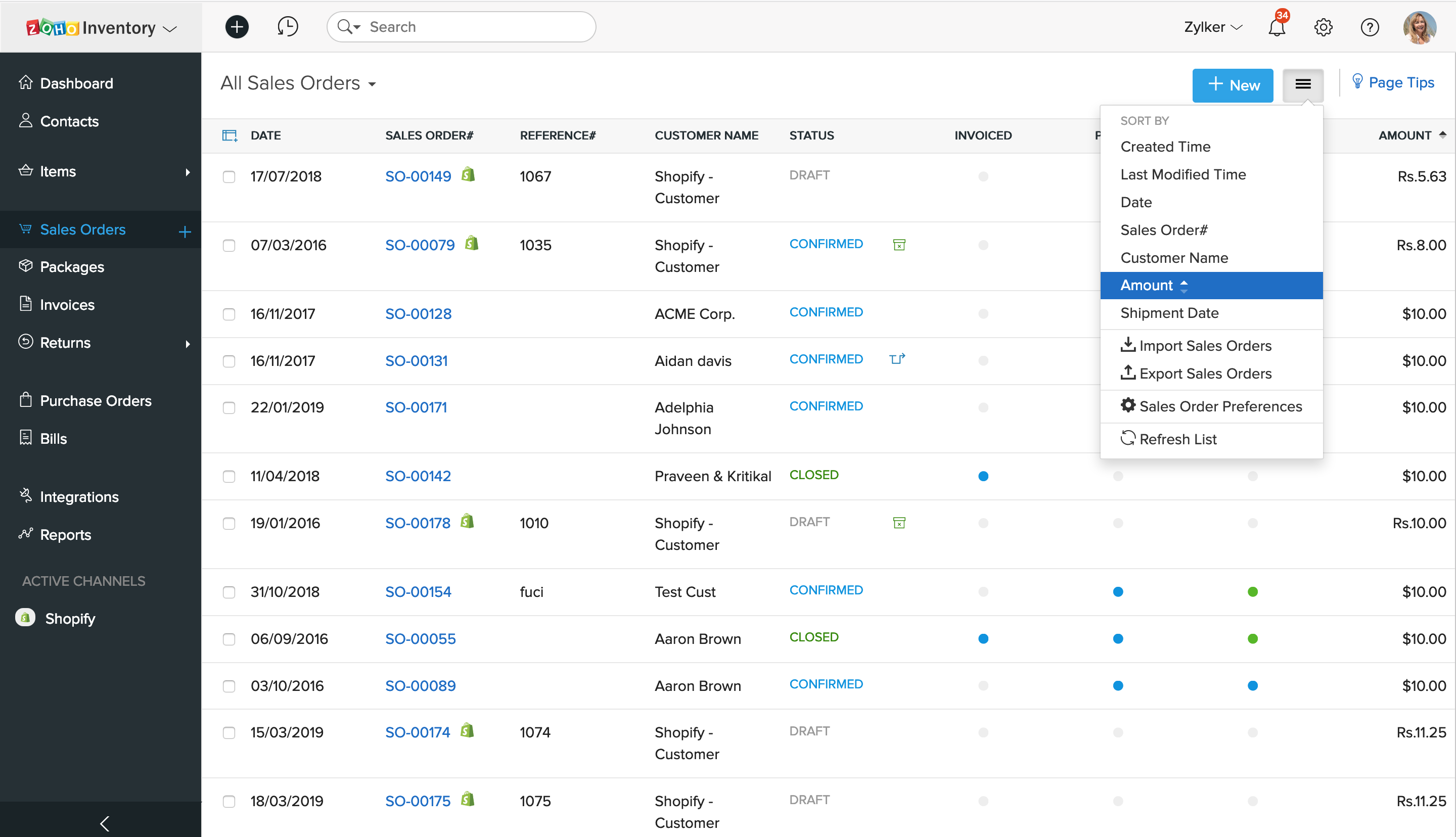
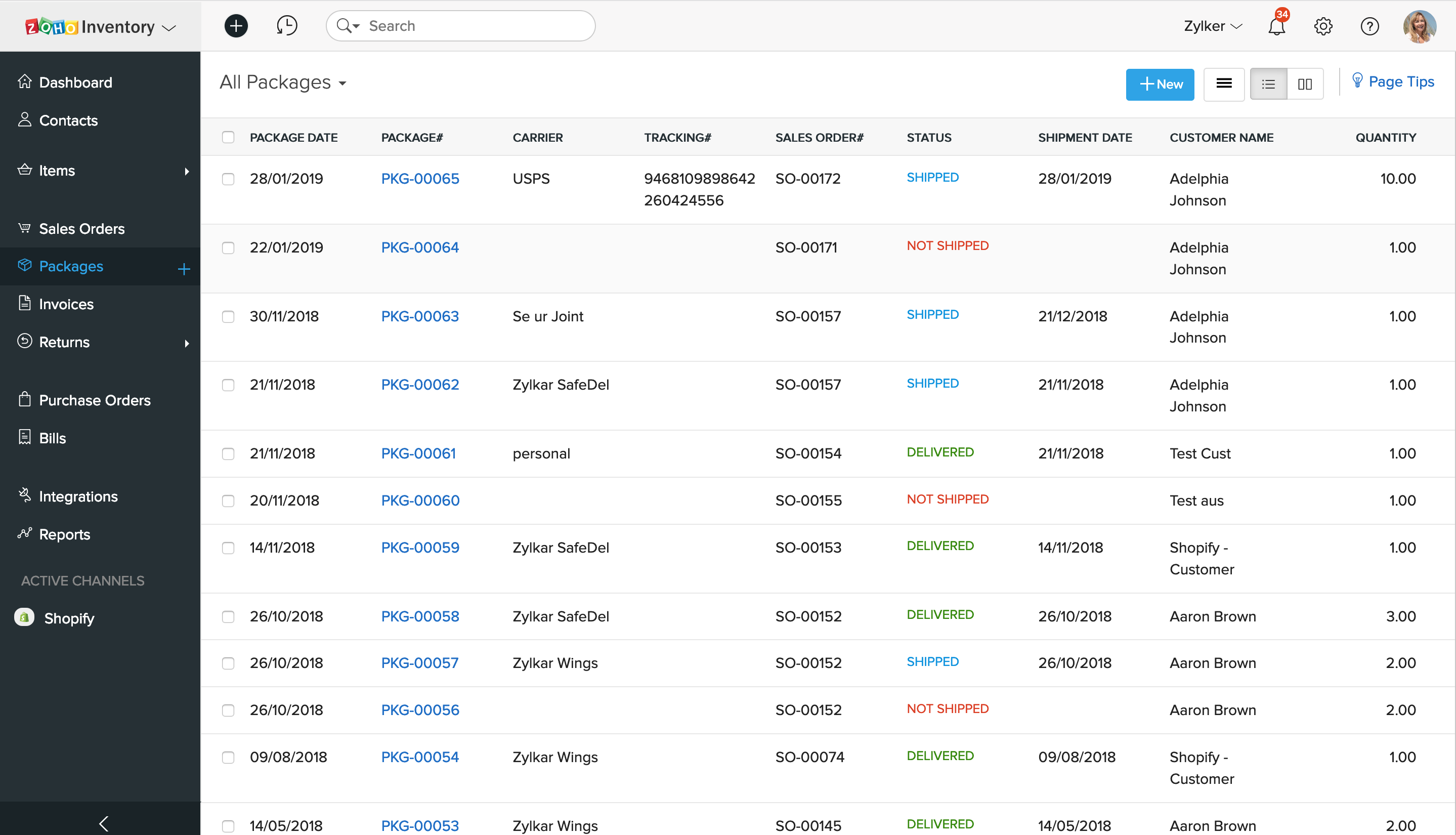
Zoho Inventory is a cloud-based inventory management solution designed for small to midsize businesses. It features inventory management modules including reporting and analysis, and lot traceability. It features mobile compatible apps for Android and iOS devices. Zoho Inventory offers additional capabilities such as built-in shipment estimating, and tracking and delivery confirmation features that allow users to invoice, ship and track products. The solution allows users to create…
$39
per organization / month billed annually ($49.00 billed monthly)
Zoho One
Score 8.9 out of 10
N/A
Zoho One is a suite product from Zoho Corporation, that combines their sales and marketing application, and also gives organizations a comprehensive set of tools to organize finances, track payables, and manage bills and expenses.
$444
per year per employee (Must purchase license for ALL employees)
Pricing
Zoho Inventory
Zoho One
Editions & Modules
BASIC
$39.00
per organization / month billed annually ($49.00 billed monthly)
STANDARD
$79.00
per organization / month billed annually ($99.00 billed monthly)
STANDARD
$199.00
per organization / month billed annually ($249.00 billed monthly)
All Employee Pricing
$444
per year per employee (Must purchase license for ALL employees)
Flexible User Pricing
$1080
per year Licenses for any no. of users
Offerings
Pricing Offerings
Zoho Inventory
Zoho One
Free Trial
Yes
Yes
Free/Freemium Version
Yes
No
Premium Consulting/Integration Services
No
No
Entry-level Setup Fee
Optional
No setup fee
Additional Details
—
Month-to-month plans available.
More Pricing Information
Community Pulse
Zoho Inventory
Zoho One
Features
Zoho Inventory
Zoho One
Customization
Comparison of Customization features of Product A and Product B
Zoho Inventory
-
Ratings
Zoho One
9.7
Ratings
24% above category average
API for custom integration
00 Ratings
10.00 Ratings
Plug-ins
00 Ratings
9.50 Ratings
Security
Comparison of Security features of Product A and Product B
Zoho Inventory
-
Ratings
Zoho One
9.0
Ratings
10% above category average
Single sign-on capability
00 Ratings
9.00 Ratings
Role-based user permissions
00 Ratings
9.00 Ratings
Reporting & Analytics
Comparison of Reporting & Analytics features of Product A and Product B
Zoho Inventory
-
Ratings
Zoho One
9.0
Ratings
22% above category average
Dashboards
00 Ratings
9.00 Ratings
Standard reports
00 Ratings
9.00 Ratings
Custom reports
00 Ratings
9.00 Ratings
General Ledger and Configurable Accounting
Comparison of General Ledger and Configurable Accounting features of Product A and Product B
Zoho Inventory
-
Ratings
Zoho One
8.0
Ratings
4% above category average
Accounts payable
00 Ratings
8.00 Ratings
Accounts receivable
00 Ratings
8.00 Ratings
Global Financial Support
00 Ratings
7.00 Ratings
Standardized Processes
00 Ratings
9.00 Ratings
Inventory Management
Comparison of Inventory Management features of Product A and Product B
Zoho Inventory
-
Ratings
Zoho One
10.0
Ratings
23% above category average
Inventory tracking
00 Ratings
10.00 Ratings
Location management
00 Ratings
10.00 Ratings
Order Management
Comparison of Order Management features of Product A and Product B
Zoho Inventory
-
Ratings
Zoho One
9.1
Ratings
15% above category average
Pricing
00 Ratings
9.50 Ratings
Order entry
00 Ratings
9.00 Ratings
Credit card processing
00 Ratings
8.00 Ratings
Cost of goods sold
00 Ratings
10.00 Ratings
Subledger and Financial Process
Comparison of Subledger and Financial Process features of Product A and Product B
Zoho Inventory
-
Ratings
Zoho One
9.3
Ratings
21% above category average
Billing Management
00 Ratings
8.00 Ratings
Cash and Asset Management
00 Ratings
10.00 Ratings
Travel & Expense Management
00 Ratings
10.00 Ratings
Project Execution Management
Comparison of Project Execution Management features of Product A and Product B
Zoho Inventory
-
Ratings
Zoho One
10.0
Ratings
37% above category average
Project Planning and Scheduling
00 Ratings
10.00 Ratings
Task Insight for Project Managers
00 Ratings
10.00 Ratings
Procurement
Comparison of Procurement features of Product A and Product B
Zoho Inventory
-
Ratings
Zoho One
10.0
Ratings
36% above category average
Bids Analyzed and Compared
00 Ratings
10.00 Ratings
Supplier Management
00 Ratings
10.00 Ratings
Risk Management
Comparison of Risk Management features of Product A and Product B
Zoho Inventory
-
Ratings
Zoho One
10.0
Ratings
42% above category average
Control Management
00 Ratings
10.00 Ratings
Logistics
Comparison of Logistics features of Product A and Product B
Zoho Inventory
-
Ratings
Zoho One
10.0
Ratings
40% above category average
Fulfillment Management
00 Ratings
10.00 Ratings
Supply Chain
Comparison of Supply Chain features of Product A and Product B
Requires a lot of customisation to get started. Very limited customer support, support appeared to not be that knowledgable with issues that aren't the usual issues most users get. Forms aren't optimised for conversions. Zoho offers a lot of features but the depth of its functionality proves limited as our demands increase.
Zoho One helps me to create and document each of my closures by creating deals. Zoho One helps me to generate reports, which helps me to track my contact. Zoho One helps me on creating tasks and reminds me to get it done on time. Zoho One keeps each steps and actions I took from lead to a deal.
Easy to see the kpis for different aspects of my business
And offers a consolidation of CRM campaign and other applications without having to use other technologies from other companies so it's great to consulate consolidated
Templates within Zoho Inventory are very weak. You can't customize many including package slips, shipment docs, etc...
When an order has multiple packages, it's next to impossible to find the item you are looking for. Scenario, a large order has many packages and a customer has cancelled one of the items. You must click through every package to find the item, edit the package and remove it before you can cancel the item.
The reports within Inventory are extremely basic and many of them are useless
The packing slip module is useless as it does not print out bin locations
It's an inventory management system but it does not have bin locations
The backorder system is useless. If you "backorder" something then the whole order is locked until the backorder arrives in. Scenario.... a client orders 20 items, 1 is on backorder. You "backorder" that one item but want to ship the other 19... not possible. The order gets completely locked.
You can't print out RMA requests. There is just no option to do it, you have to do a screen shot
Integration with Amazon or other 3rd party e-commerce providers is troublesome.
It is relatively easy to customise but the problem is sometimes it is not easy to see where this customisation is available. Also the integrations with external systems can prove problematic both during installation and ongoing development and maintenance. It's great for small companies with a simple inventory or even larger organisations with smaller product lines. And it is reasonably priced if you ar eprepared to put the time in.
ZOHO is very easy to use. All you need to do is follow the steps and features aligned in it. ZOHO doesn't need complex coding or training; anyone can easily access and use it. You may feel a bit of difficulty initially, but show me an easy tool when you are using it for the first time.
Support is great as a customer, as a partner I get moved to that team more often and find issues in the support being provided. It also appears that the support agents do not take into account all the information provided and default back to the "step 1 of the playbook" instead of taking into account the business reason the support is being requested and understanding the steps already taken.
The inventory management is better than QuickBooks however you give up an awful lot to get that benefit. The reporting in QuickBooks is far superior. The reporting in Inventory is terrible with every few options to customize the reports. For example, pulling in a salesperson report that factors in returns is not possible. You can't pull a report to see what items need to be picked for all open orders.
The primary reason we switched from Daylite is when we started using Virtual Assistants and wanted a cloud based alternative which Daylite didn't provide. We left MYOB when I think it stopped supporting Apple computers. We left AccountEdge when it stopped supporting payroll tax tables for Apple computers. Thankfully, each time we left one software company we were led to Zoho and have remained ever since.