TrustRadius: an HG Insights company

TIBCO Data Virtualization

Score8.6 out of 10

99 Reviews and Ratings

What is TIBCO Data Virtualization?

TIBCO Data Virtualization is an enterprise data virtualization solution that orchestrates access to multiple and varied data sources and delivers the datasets and IT-curated data services foundation for nearly any solution.

Read more details.

Media

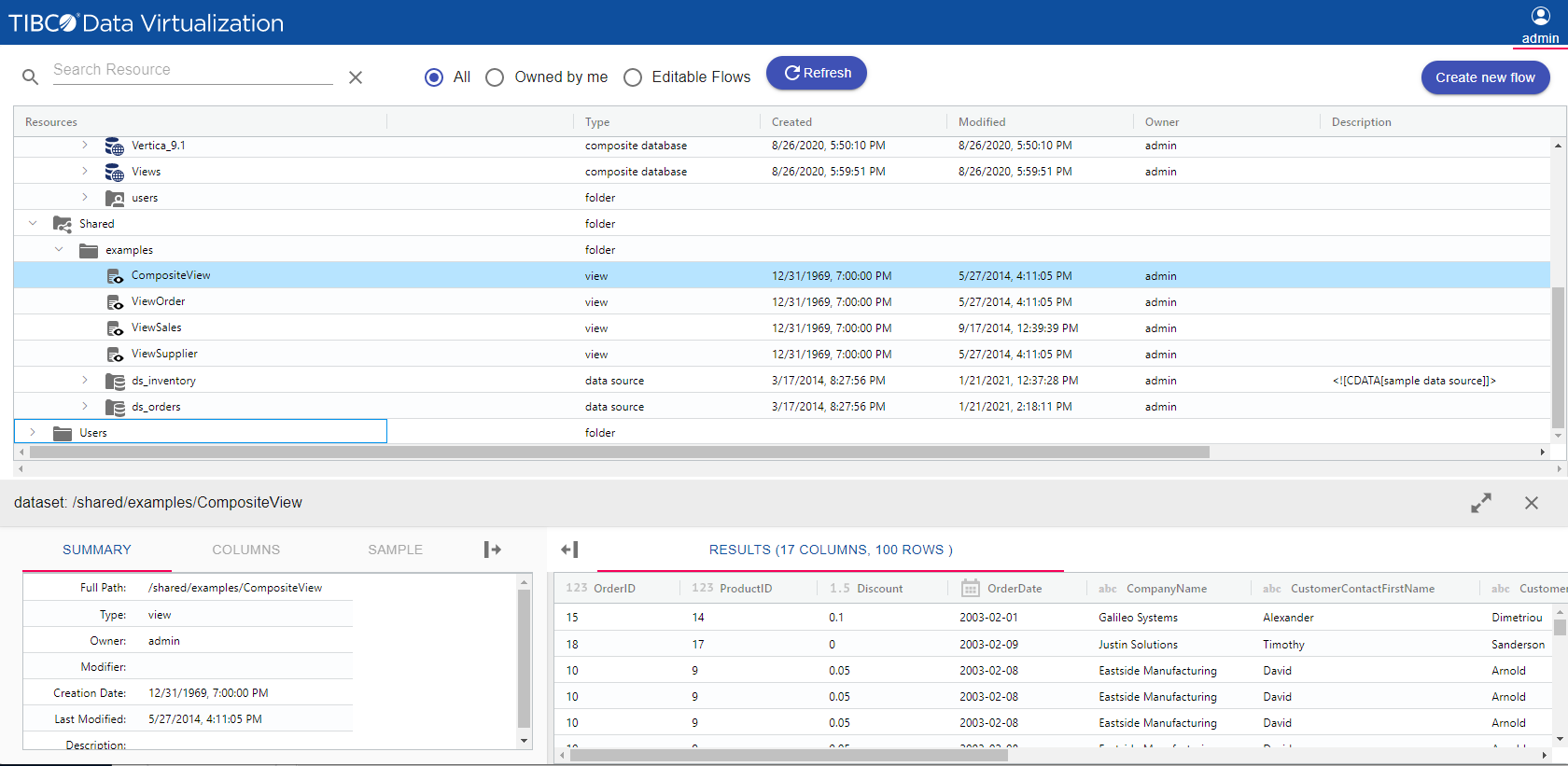
Screenshot of Data Flow Editor
Screenshot of Data Catalog
Screenshot of Transform Editor

1 / 3

Screenshot of Data Flow Editor

Who Buys & Uses TIBCO Data Virtualization

A robust data virtualization

Use Cases and Deployment Scope

Processing data from other sources is ideal for data consumption within the company and is what generates easy-to-read data reports. Many departments use TIBCO Data Virtualization thanks to the fact that it has very simple tools that are perfectly integrated, we always manage to solve the difficulties in data governance and data virtualization is a source of success in data management.

Pros

  • Fast and effective data processing.
  • Robust connection to multiple data sources.
  • It has a user interface that guarantees compliance with business goals due to how easy it is to execute all functions.

Cons

  • The price can be very expensive in the initial stage of implementation and can be very high risk, but everything is positive after implementation.

Return on Investment

  • The growth of the use of TIBCO Data Virtualization in the company is widely satisfactory for different departments that depend on its use to complete the safe work with the optimal data virtualization and with TIBCO integrations and also third-party tools, all this is a factor determining factor in the company's own growth.

Other Software Used

TIBCO BusinessConnect, TIBCO Cloud Nimbus, Google Cloud Datastore

TDV as a semantic and security layer

Use Cases and Deployment Scope

really great for abstraction of the queries to objects and column and row level security of elements. TDV is the layer between the application and the data storage layer that ensures proper authorization of what a user or role can read, write, or alter and handles the translation between these components into SQL statements

Pros

  • abstraction
  • row level security
  • column level security

Cons

  • user interface
  • training
  • documentation

Return on Investment

  • increased security
  • reduction of work duplication
  • increased logical transparency

Alternatives Considered

Dremio

Other Software Used

Snowflake, Azure Databricks, Microsoft Power BI

Usability

Data Virtualization ... Evolution or Revolution

Use Cases and Deployment Scope

Identified as one important enabler for the new digital ecosystem, is helping NOS build a Digital Stack and deliver new capabilities much faster and enforce security, resilience, performance, and scalability. We start by implementing Data Virtualization to support our Interactive Voice Response used by our Call Center 24x7 and expanding this capability to our digital channels providing the best experience to NOS customers.

Pros

  • Performance (Data Cache keeps a live "copy" of our data)
  • Common data model design for Business and IT(improve data governance)
  • Faster Implementation(time-to-market)
  • Secure (systems not exposed)
  • Resilience (support several scenarios simultaneous - online data vs cache data)

Cons

  • Studio User interface more modern
  • Messaging (Kafka, Pulsar,...) adapter out-of-the-box without the need to buy additional software

Return on Investment

  • FASTER time-to-market, from several months to weeks
  • INCREASED information quality from batch to online event processing
  • LOWERED costs due to multi functional agile team delivery(every week)

Alternatives Considered

K2View Data Fabric, Oracle GoldenGate, Oracle Data Integrator and Oracle Database

Usability

Powerful data visualization tool for more insights, collaboration

Use Cases and Deployment Scope

I use TIBCO Spotfire to analyze and visualize tabular data in biomedical research, which including preclinical experiment, screening, text mining, genomics, data from clinical trials.

Pros

  • process, reshape data, allows many operations like pivot, unpivot, change column names etc.
  • interactive interface
  • variety of visualization provided
  • option of sharing on web or download as file
  • data canvas to understand relationship among data tables and edit processes

Cons

  • interface: the filters - can be a hassle when many tables in the
  • color scheme: not be able to save or customize
  • export image can't define the size of output
  • can't define the base scheme color e.g. axis, ticks, current default is too light, difficult to see in Powerpoint.

Return on Investment

  • increase insights - especially relationships among different variables.
  • increase reproducibility, reduction of error
  • facilitate commnication with data sharing
  • increase productivity, e.g. can be built to look up data point in a large dataset

Alternatives Considered

Tabula.io

Other Software Used

Microsoft Excel

Rich feature with limited scalability

Use Cases and Deployment Scope

Bringing disparate data sources together to allow for a homogeneous denormalized view for data distribution and consumption across multiple business units. Scope is primarily across the Finance, Risk space.
TIBCO DV allows us to bring the Balance sheet data, and merge that with the counterparty data, market data, exchange rates and risk attributes.

Pros

  • Bringing disparate data sources together
  • Intuitive setup wrt the physical, logical and business layer definitions.

Cons

  • Memory management and query optimization
  • Transparency and control over execution plan

Return on Investment

  • Reduced data management cost, albeit requiring increased oversight

Other Software Used

Starburst Enterprise, IBM Cognos Controller, Databricks Lakehouse Platform